
For me, choosing a web host used to be simple. I looked at price, speed, uptime, storage, and support. That was it. But in 2026, the conversation is different. Hosting is no longer just a technical decision. It is also a business, branding, and sustainability decision. That is why eco-friendly web hosting USA has become a practical search topic for business owners, bloggers, agencies, ecommerce brands, and publishers who want their websites to run well without ignoring the environmental cost behind the screen.
I have worked with content-heavy websites, SEO projects, publishing workflows, and online business decisions long enough to know one thing: hosting is never “just hosting.” A slow host can hurt conversions. Poor uptime can damage trust. Weak backups can ruin months of work. And now, unclear sustainability claims can make a brand look careless or, worse, performative.
So I did not look at these providers as a green badge collector. I looked at them as a business decision. Does the host explain its sustainability approach? Does it use renewable energy certificates, renewable-powered infrastructure, carbon offsets, or efficiency improvements? Does it still offer the basics a real business needs: speed, support, backups, security, scalability, and transparent pricing?
The honest answer is that not every green host is green in the same way. Some directly buy Renewable Energy Certificates. Some rely on renewable-powered cloud infrastructure. Some focus on efficient data centers. Some offset part of their emissions. That difference matters.
Why Server Emissions Matter More in 2026
When I look at web hosting as a business decision, I no longer see it as just storage, speed, and uptime. Every website runs on servers, and those servers need electricity, cooling, hardware, and constant maintenance.
That matters more in 2026 because data centers are using more power as AI, cloud services, ecommerce, streaming, and digital publishing keep growing. For U.S. businesses, hosting is now part of a bigger sustainability conversation.
This does not mean a small business website is the main problem. But it does mean business owners should be more thoughtful. A faster, cleaner, better-optimized hosting setup can reduce waste, improve user experience, and support a stronger brand image.
So when I review eco-friendly web hosts, I do not only ask, “Is this host green?” I ask, “Can this host prove its green claim while still keeping a business website fast, secure, and reliable?”
What Counts as Eco-Friendly Web Hosting?
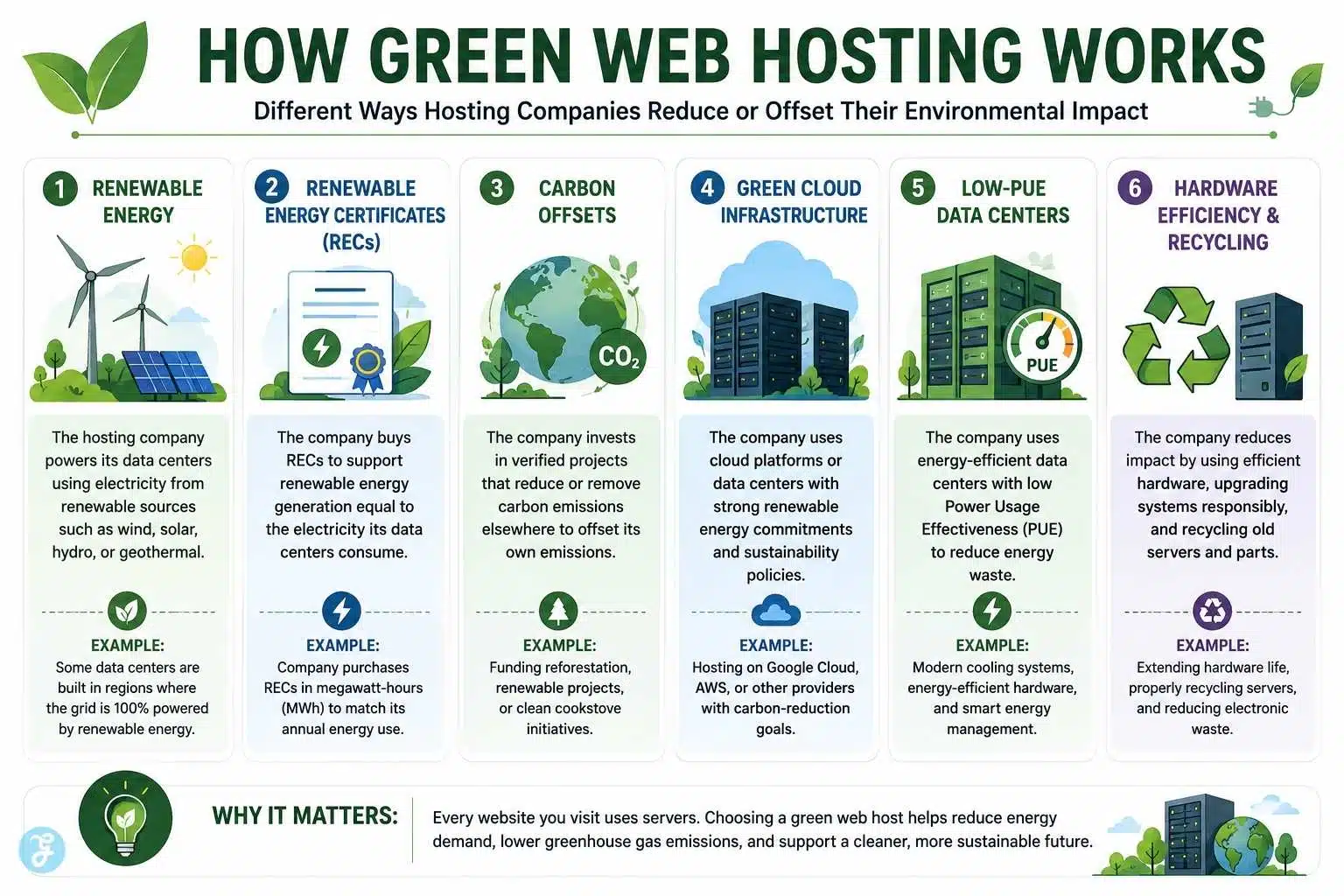
Eco-friendly web hosting usually means the provider is trying to reduce or compensate for the environmental impact of hosting websites. But the method can vary.
A provider may use renewable electricity in its data centers. Another may buy Renewable Energy Certificates, also called RECs. Another may use a cloud platform with renewable-energy commitments. Another may offset emissions through carbon projects or reduce waste by recycling old hardware.
A REC does not mean the exact server holding your website is physically powered by wind or solar every second. In my research, I found that according to the U.S. EPA, a Renewable Energy Certificate represents the environmental and other non-power attributes of one megawatt-hour of renewable electricity generated and delivered to the grid.
That distinction matters because green marketing can get slippery. The FTC’s Green Guides are designed to help marketers avoid environmental claims that mislead consumers. So for this article, I avoided calling any provider “perfectly green,” “zero impact,” or “planet-saving.” Those phrases sound nice, but they are usually where accuracy goes to die, wearing a recycled cotton T-shirt.

How I Selected These Eco-Friendly Web Hosts
I used a business-first selection method. A host had to make sense for U.S. businesses, not just win a sustainability slogan contest.
I looked at:
- Clear public sustainability claims
- Renewable energy, RECs, carbon offsets, or green cloud infrastructure
- Business usability for blogs, agencies, ecommerce, and small business sites
- Hosting features like SSL, backups, CDN, support, storage, and uptime claims
- Pricing transparency, especially renewal pricing
- Whether the green claim was direct, partner-based, or partly limited
- Whether I could explain the recommendation without pretending all hosts are equal
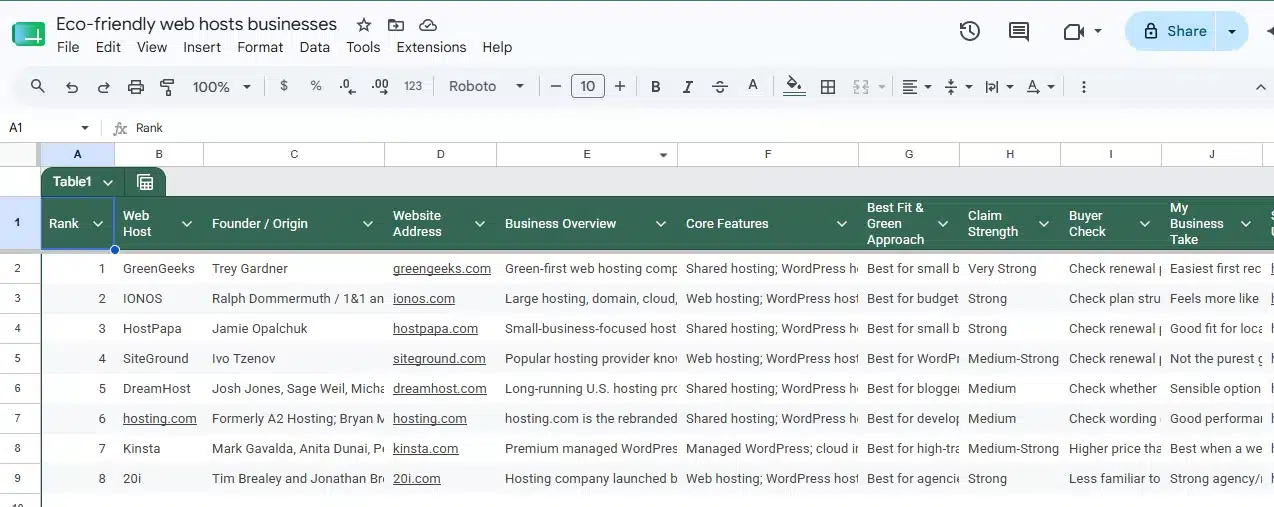
Here is the quick comparison before we go deeper.
| Web Host | Best For | Green Method | Business Caution |
| GreenGeeks | Best overall green hosting | 300% REC match through BEF, tree planting | Renewal pricing rises after promo |
| IONOS | Budget-conscious U.S. businesses | 100% renewable electricity in proprietary North America and Europe data centers, offsets for backup fuel | Interface may feel less familiar than cPanel |
| HostPapa | Small businesses | Green-e Certified RECs through BEF | Check renewal pricing carefully |
| SiteGround | WordPress and performance-focused sites | Google Cloud-based green infrastructure | Green claim is partner-infrastructure-based |
| DreamHost | Bloggers and simple business sites | Green operations and efficient infrastructure policies | The sustainability claim is less quantified |
| hosting.com | Speed-focused users | Carbonfund.org partnership, hardware efficiency, partial server CO2 offsets | “Some” server emissions are offset, not necessarily all |
| Kinsta | Agencies and premium WordPress | Cloud infrastructure, Cloudflare integration, performance efficiency | Premium pricing |
| 20i | Agencies and reseller hosting | 100% renewable energy and low-PUE data centers | Less mainstream for U.S. beginners |
1. GreenGeeks: Best Overall Green Hosting for Small Businesses
Founder: Trey Gardner || Website Address: greengeeks.com
Business Overview
GreenGeeks is one of the clearest green-focused hosting companies in this list. The company was founded in 2008, and Trey Gardner is listed as CEO and founder on GreenGeeks’ official green hosting page. GreenGeeks says it has been recognized by the U.S. EPA as a Green Power Partner since 2009.
The business focuses on web hosting for small businesses, bloggers, WordPress users, WooCommerce stores, resellers, and VPS customers. Its sustainability message is not hidden in a footer. It is central to the brand.
Core Features
- Shared hosting
- WordPress hosting
- WooCommerce hosting
- VPS hosting
- Reseller hosting
- Free SSL
- CDN support
- Daily backups on selected plans
- 99.9% uptime guarantee
- Green hosting badge for websites
Best Fit & Green Approach
GreenGeeks is best for small businesses, blogs, service websites, niche publishers, and personal brands that want sustainability to be part of their public brand story.
Its green approach is based on a 300% renewable energy match. GreenGeeks says it works with the Bonneville Environmental Foundation, calculates yearly energy consumption and carbon footprint, and purchases RECs at three times the amount it consumes. It also says it plants one tree for every hosting account provisioned.
My Business Take
GreenGeeks is the easiest first recommendation if a business wants green hosting without overcomplicating the decision. Its sustainability message is clear, measurable, and simple to explain to customers.
I would use GreenGeeks for a blog, service business, local business website, affiliate site, or content-heavy project where sustainability supports the brand image. The only thing I would watch carefully is renewal pricing and plan limits, because cheap first-term hosting prices have a funny habit of growing up too fast.
2. IONOS: Best for Budget-Conscious U.S. Businesses
Founder/Origin: IONOS comes from the 1&1/United Internet business history, strongly associated with Ralph Dommermuth and the wider United Internet group.
Website Address: ionos.com
Business Overview
IONOS is a large hosting, domain, cloud, server, and business infrastructure provider. It is not a small eco-hosting startup. It is better understood as a major digital infrastructure company that also has strong sustainability policies.
For U.S. businesses, IONOS is useful because it offers more than basic shared hosting. A company can use it for domains, websites, email, VPS, cloud servers, dedicated servers, and business infrastructure.
Core Features
- Web hosting
- WordPress hosting
- Domains
- Professional email
- VPS hosting
- Dedicated servers
- Cloud hosting
- SSL certificates
- Backup and security tools
- Business infrastructure services
Best Fit & Green Approach
IONOS is best for budget-conscious U.S. businesses, startups, local companies, and growing teams that want multiple digital services under one provider.
Its green approach is infrastructure-based. IONOS says its proprietary data centers in North America and Europe run on 100% renewable electricity. It also says that when non-renewable energy sources are used, such as diesel backup generators, the carbon is offset.
My Business Take
IONOS is not the most emotionally “green-branded” company here, but it may be one of the more practical choices for businesses. It gives you scale, affordability, hosting products, and a renewable-energy policy in one package.
I would consider IONOS for a small business that wants hosting, a domain, email, and infrastructure without jumping across five different platforms. It feels less like an eco-marketing choice and more like a serious business operations choice.
3. HostPapa: Best Small-Business Green Hosting Platform
Founder: Jamie Opalchuk || Website Address: hostpapa.com
Business Overview
HostPapa was founded by Jamie Opalchuk in 2006 in Burlington, Canada. The company says its executives have more than 70 years of combined experience in web hosting services.
HostPapa is built strongly around small-business hosting. It offers web hosting, WordPress hosting, VPS hosting, reseller hosting, domain registration, email, website tools, security, and support.
Core Features
- Shared web hosting
- WordPress hosting
- VPS hosting
- Reseller hosting
- Domain registration
- Business email
- SSL certificates
- Website migration
- CDN on selected plans
- Backup and security tools
- 24/7 support
Best Fit & Green Approach
HostPapa is best for small business owners who want hosting, a domain, email, and support in one place. It works well for local businesses, beginner e-commerce websites, service providers, consultants, and small teams.
Its green approach is based on Renewable Energy Certificates. HostPapa says it purchases Green-e Certified RECs from the Bonneville Environmental Foundation in an equivalent amount of MWhs to cover its electricity usage with renewable energy annually.
My Business Take
HostPapa is a practical small-business choice. It is not the host I would pick for a complex enterprise setup, but for a business owner who wants a website, domain, email, security, and support without technical drama, it makes sense.
I would frame HostPapa as a green hosting option for business owners who want simplicity. Not every founder wants to become a server admin after dinner, and honestly, fair enough.
4. SiteGround: Best for WordPress Performance With Greener Infrastructure
Founder: Ivo Tzenov || Website Address: siteground.com
Business Overview
SiteGround is a well-known web hosting company with a strong reputation among WordPress users, agencies, e-commerce owners, and small businesses. SiteGround identifies Ivo Tzenov as a founding member, and the company has described its growth from a small startup into a global web hosting technology business.
Its main strength is not just green messaging. It is performance, support, WordPress tools, backups, caching, staging, and managed hosting features.
Core Features
- Web hosting
- Managed WordPress hosting
- WooCommerce hosting
- Cloud hosting
- Free SSL
- Daily backups
- Built-in caching
- CDN support
- Security tools
- Staging on selected plans
- Agency tools
Best Fit & Green Approach
SiteGround is best for WordPress websites, agencies, business blogs, ecommerce stores, and companies that care about speed, backups, and support.
Its green approach is mainly partner-infrastructure-based. SiteGround says it is not a data center provider and relies on the green policies of its main data center partners. It moved infrastructure to Google Cloud partly because of Google’s sustainability commitments. SiteGround also highlights optimization, caching, and efficient technology as part of reducing resource use.
My Business Take
SiteGround is not the purest green-hosting brand on this list, but it is one of the strongest business hosting choices. I would use it when website performance matters more than having the boldest green claim.
For a WordPress business website, speed and uptime are not optional. If a site loads slowly, visitors leave, conversions drop, and the owner starts blaming “the algorithm” for what is really a hosting problem.
5. DreamHost: Best for Bloggers and Simple Business Websites
Founders: Josh Jones, Sage Weil, Michael Rodriguez, and Dallas Kashuba || Website Address: dreamhost.com
Business Overview
DreamHost was originally founded in 1997 as New Dream Network while its founders were undergraduates at Harvey Mudd College. DreamHost’s own overview names Josh, Sage, Michael, and Dallas as the founders, and a DreamHost press release identifies them as Josh Jones, Sage Weil, Michael Rodriguez, and Dallas Kashuba.
Today, DreamHost provides website hosting, WordPress hosting, email hosting, domain registration, and cloud services. It is one of the more established hosting names in the market.
Core Features
- Shared hosting
- WordPress hosting
- Managed WordPress hosting through DreamPress
- VPS hosting
- Dedicated servers
- Email hosting
- Domain registration
- Cloud services
- SSL support
- Backup options
Best Fit & Green Approach
DreamHost is best for bloggers, personal brands, portfolio sites, small business websites, and simple WordPress projects.
Its green approach focuses on optimized facilities and company policies. DreamHost says its data centers use high-efficiency cooling infrastructure, power-efficient processors whenever possible, state-level clean wind programs, and grids that obtain electricity from many renewable sources.
My Business Take
DreamHost is a sensible choice for simple websites and content projects. Its sustainability claims are not as sharply quantified as GreenGeeks, IONOS, or HostPapa, but it still has a clear green hosting page and practical hosting products.
I would use DreamHost for a blog, portfolio, personal brand, or small business site where simplicity matters more than advanced hosting controls.
6. hosting.com: Best for Speed-Focused Users
Founder/Co-Founder: Bryan Muthig, technical founder of A2 Hosting || Website Address: hosting.com
Business Overview
hosting.com is the current brand name for A2 Hosting. The company officially announced in 2025 that “A2 hosting is now hosting.com.” That point matters for 2026 accuracy. Many older articles still list A2 Hosting without mentioning the rebrand. For a fresh business listicle, that looks outdated.
A2 Hosting built its reputation around speed-focused hosting, developer-friendly features, and performance tools. hosting.com continues that positioning with shared hosting, WordPress hosting, VPS hosting, dedicated servers, migration support, and 24/7/365 support.
Core Features
- Shared hosting
- WordPress hosting
- VPS hosting
- Dedicated servers
- NVMe SSD storage
- LiteSpeed Web Server on selected plans
- Free account migration
- Security tools
- 99.9% uptime commitment
- 24/7/365 support
Best Fit & Green Approach
hosting.com is best for developers, agencies, speed-focused website owners, and users who previously knew A2 Hosting.
Its green approach includes a long-running partnership with Carbonfund.org. hosting.com says that since 2007, it has worked with Carbonfund.org and offsets some of its servers’ CO2 emissions every year. The word “some” matters here. This should not be rewritten as “offsets all emissions” unless the company states that clearly.
My Business Take
hosting.com is a performance-first host with a visible environmental history. I would not rank it above GreenGeeks or IONOS for sustainability proof, but I would include it for readers who care about speed and want a provider with long-running green initiatives.
The rebrand also gives the article a useful update angle. It shows you are not recycling a 2022 hosting roundup with a new year taped on top.
7. Kinsta: Best Premium Managed WordPress Hosting
Founders: Mark Gavalda, Anita Dunai, Peter Sziraki, and Tom Zsomborgi || Website Address: kinsta.com
Business Overview
Kinsta was founded in 2013 by Mark Gavalda, Anita Dunai, Peter Sziraki, and Tom Zsomborgi. Kinsta confirms this on its official company information page.
Kinsta is not a budget shared host. It is a premium managed hosting platform built for WordPress, agencies, ecommerce brands, publishers, SaaS blogs, and high-traffic business websites.
Core Features
- Managed WordPress hosting
- Cloud-based infrastructure
- Global data center options
- Cloudflare integration
- CDN
- Web application firewall
- DDoS protection
- Daily backups
- Staging environments
- Free migrations
- Developer tools such as SSH, Git, and WP-CLI
Best Fit & Green Approach
Kinsta is best for agencies, high-traffic WordPress sites, serious business blogs, SaaS companies, publishers, and ecommerce sites where performance affects revenue.
Its green approach is based on cloud infrastructure, performance optimization, CDN delivery, caching, efficient website delivery, and reducing unnecessary data transfer. Kinsta presents itself as a green hosting company and says it works to reduce carbon emissions as much as possible.
My Business Take
Kinsta is not the right choice if someone only wants the cheapest possible hosting plan. It becomes attractive when the website is part of the business engine.
If a slow website costs sales, leads, signups, or ad revenue, premium managed hosting can be worth it. Kinsta’s green angle is not as simple as a 300% REC match, but its performance-first infrastructure can help run a cleaner, faster, more efficient website.
8. 20i: Best for Agencies and Reseller Hosting
Founders: Tim Brealey and Jonathan Brealey || Website Address: 20i.com
Business Overview
20i was launched by Tim and Jonathan Brealey in 2016. The company says the founders created 20i with 20 years of hosting experience behind them.
20i focuses on high-performance hosting for agencies, e-commerce sites, businesses, side projects, resellers, and users managing multiple websites. It is especially interesting for agencies because it offers reseller hosting, multi-site tools, CDN features, and cloud-based infrastructure.
Core Features
- Web hosting
- WordPress hosting
- Reseller hosting
- VPS hosting
- Managed cloud servers
- Autoscaling hosting
- Free CDN tools
- Website migration tools
- Security features
- Global CDN locations
- Multi-site management tools
Best Fit & Green Approach
20i is best for agencies, freelancers, developers, and reseller hosting businesses that manage several client websites.
Its green approach is one of the strongest ones on this list. 20i says all its web hosting became powered by 100% renewable energy in 2023. It also says all hosting is powered by 100% renewable energy and that its data centers are built to reduce environmental impact with low PUE.
My Business Take
20i is a smart inclusion because it serves a different reader than a beginner shared host. I would frame it for agencies and resellers, not first-time website owners.
If someone manages multiple client sites, renewable-powered hosting can become part of the agency’s pitch. It is not just “we build websites.” It becomes “we build and host websites with a cleaner infrastructure choice.” That is a better business story.
How to Choose the Right Eco-Friendly Web Host
The best green host is not always the same for every business. A local bakery, a law firm, a content publisher, an e-commerce shop, and a WordPress agency do not need the same hosting setup.
Here is the selection framework I used:
Check the Green Method First
Do not stop at the word “eco-friendly.” Look for the actual method.
A provider may use:
- Renewable electricity
- RECs
- Carbon offsets
- Green cloud infrastructure
- Low-PUE data centers
- Efficient hardware
- Remote-work policies
- Server recycling
- CDN and caching to reduce unnecessary load
The more specific the claim, the easier it is to trust.
Match Hosting Type to Business Type
A simple blog can run on shared hosting. A serious WooCommerce store may need stronger WordPress hosting. An agency may need reseller or multi-site tools. A high-traffic publisher may need premium managed WordPress hosting.
Buying too little hosting creates performance problems. Buying too much hosting wastes money. Both are annoying, just in different fonts.
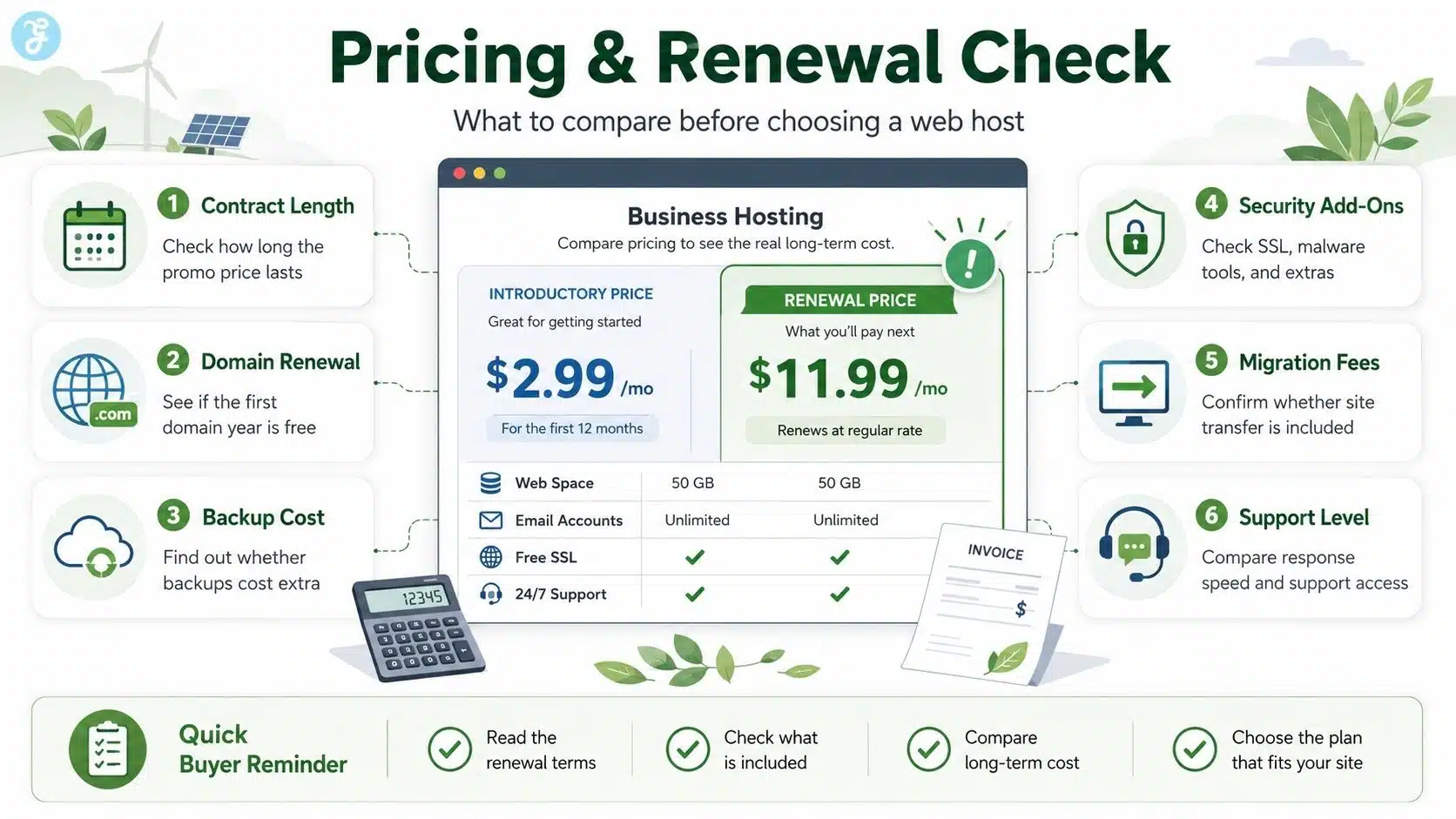
Check Renewal Pricing
Introductory hosting prices are often low. Renewal prices can be much higher. This is normal in the hosting industry, but it should never be ignored.
Before buying, check:
- First-term price
- Renewal price
- Backup costs
- Migration costs
- Domain renewal price
- Security add-ons
- Storage and traffic limits
The cheapest first-year deal is not always the cheapest business decision.
Look at Backups and Security
A green host without backups is not a business solution. It is a future headache wearing a leaf badge.
For business websites, check whether the plan includes:
- SSL
- Daily or automatic backups
- Malware scanning
- Web application firewall
- DDoS protection
- Secure login tools
- Easy restore options
Do Not Ignore Speed
Efficient hosting should still be fast. Page speed affects user experience, conversions, and SEO. A cleaner hosting choice should support performance, not punish it.
That is why providers like SiteGround, Kinsta, hosting.com, and 20i still deserve attention even when their sustainability approach is not identical to GreenGeeks or HostPapa.
Final Business Takeaway: Green Hosting Is Useful, But Proof Matters
After reviewing these hosts, I would not choose one just because it says “green.” I would first check whether the company clearly explains its sustainability method, then compare speed, support, backups, and renewal pricing.
For a small U.S. business where sustainability is part of the brand story, I would start with GreenGeeks. For affordable business infrastructure, I would look at IONOS, while clearly noting that it is German-based with North American infrastructure. For simple small-business hosting, HostPapa is practical.
If WordPress performance matters more, I would compare SiteGround and Kinsta. For speed-focused users, hosting.com is worth considering, but I would be careful not to overstate its green claim. For agencies and resellers, 20i stands out because renewable-powered hosting can support a stronger client-facing pitch.
In the end, eco-friendly web hosting USA should not be about buying a label. It should be about choosing a host that proves its green claim, fits your business needs, keeps your site fast, and stays transparent about long-term costs.
Frequently Asked Questions About Eco-Friendly Web Hosting USA
1. What Is Eco-Friendly Web Hosting?
Eco-friendly web hosting means a hosting provider takes steps to reduce or compensate for the environmental impact of running websites and servers. This may include renewable electricity, Renewable Energy Certificates, carbon offsets, efficient hardware, low-PUE data centers, server recycling, or green cloud infrastructure. The key is proof. A host should explain how it is reducing or offsetting its impact, not just add a green leaf icon and call it a day.
2. Do Eco-Friendly Web Hosts Really Reduce Server Emissions?
Some do, but the method varies. A provider using renewable electricity may reduce emissions linked to its operations. A provider buying RECs supports renewable energy generation. A provider buying offsets may compensate for emissions through approved environmental projects. That is why the wording matters. “Reducing,” “offsetting,” and “matching renewable energy” are not always the same thing.
3. Are RECs the Same as Carbon Offsets?
No. RECs and carbon offsets are related to sustainability, but they work differently. A REC represents the environmental attributes of one megawatt-hour of renewable electricity generated and delivered to the grid. A carbon offset usually represents a reduction, removal, or avoidance of greenhouse gas emissions elsewhere. The EPA’s REC definition is useful because it shows why businesses should not confuse renewable energy matching with direct physical electricity delivery to a specific server.
5. Is Green Web Hosting More Expensive?
Not always. Some eco-friendly hosts are priced similarly to regular shared hosting providers. GreenGeeks, HostPapa, DreamHost, and IONOS often compete in normal small-business hosting price ranges. The bigger issue is renewal pricing. Many hosting companies offer low introductory prices and higher renewal rates. Always check the long-term cost before choosing.
6. Can a Green Web Host Improve SEO?
A green host does not automatically improve rankings. Google is not going to push your site to page one because your server has good manners. But good hosting can help SEO indirectly. Fast loading, better uptime, reliable security, SSL, CDN support, and fewer technical issues can all support a better user experience. If the green host also performs well, then it can be a smart SEO-friendly business choice.