
The Micro-Joy Economy is fundamentally reshaping the landscape of consumer behavior and digital marketing as we navigate through 2026. We are witnessing a massive shift in how people assign value to their daily interactions. Gone are the days when consumers would patiently save their enthusiasm for grand life milestones or massive luxury purchases.
Instead, there is an aggressive, intentional turn toward finding profound satisfaction in small, accessible moments of delight. People are exhausted by the relentless demands of constant connectivity. They are actively pushing back against the polished, algorithmic perfection that defined the early 2020s. This cultural fatigue has created a vacuum that brands are now rushing to fill not with more information, but with comfort.
Understanding this transition is no longer an option for marketers. It is the core requirement for survival in a marketplace where attention is scarce, and trust is even scarcer.
The Economic Engine of Small Pleasures
The underlying mechanics of consumer spending have transformed entirely over the past few years. We have to look closely at the data to understand why a low-cost, high-emotion product is currently outperforming traditional high-ticket items in almost every sector.
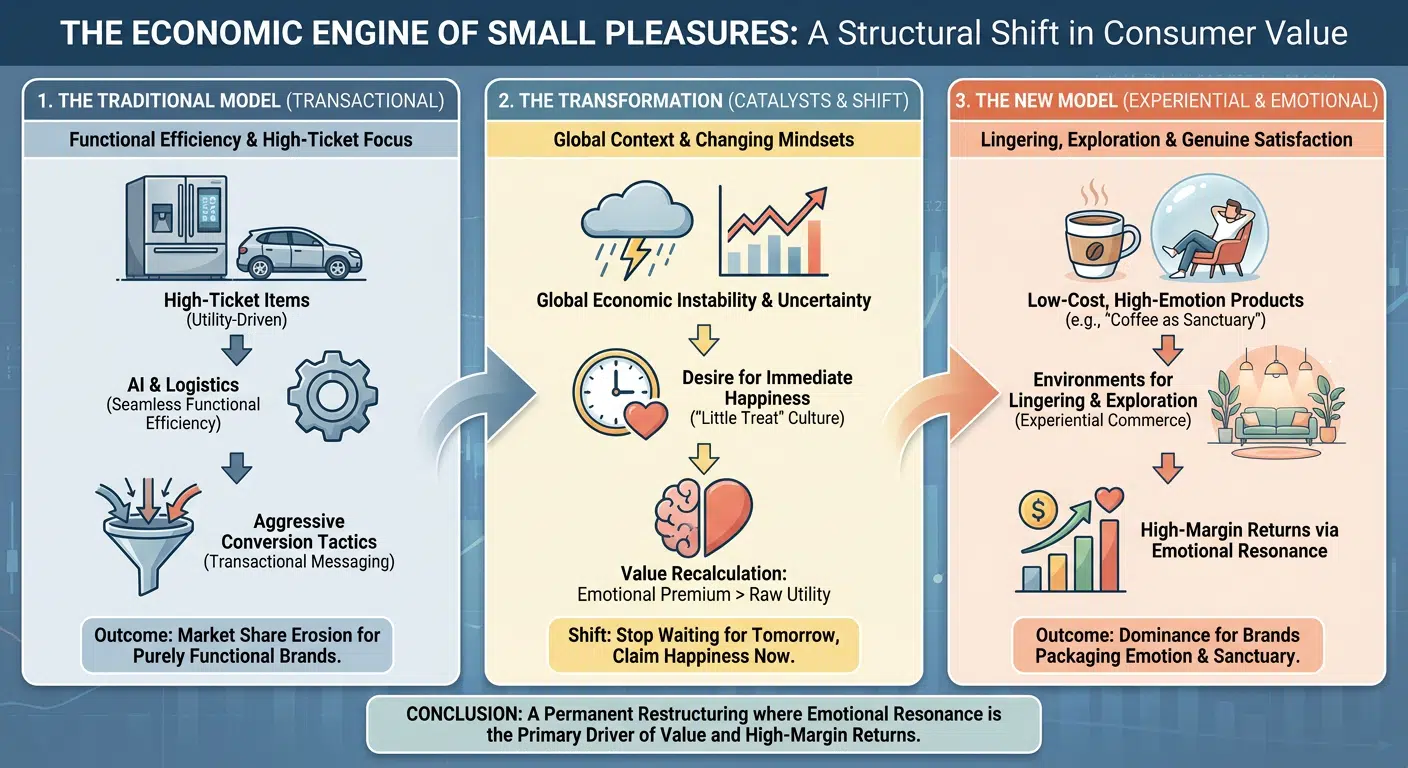
This financial evolution is not a temporary trend. It is a permanent restructuring of how value is calculated in the minds of buyers.
Transitioning from Transactional to Experiential Commerce
Retailers and digital platforms are waking up to a harsh reality. Functional efficiency is simply no longer enough to secure a competitive advantage. When artificial intelligence can seamlessly handle the logistics of finding the cheapest or fastest option, human marketers must compete on a completely different battlefield. They must offer an emotional premium.
Brands that continue to rely on transactional messaging are seeing their market share erode. The modern buyer is looking for a momentary escape. They want the act of purchasing to feel like a deep breath in the middle of a chaotic day. This requires a total overhaul of the traditional sales funnel. We must replace aggressive conversion tactics with environments that encourage lingering, exploration, and genuine satisfaction.
Global Market Context and Financial Impact
Global economic fluctuations and an overarching sense of instability have conditioned consumers to stop waiting for tomorrow. They are claiming their happiness right now. This is the exact mindset driving the “little treat” culture that has taken over social commerce.
Financially, this shift is creating incredible opportunities for businesses that know how to package emotion. High-margin returns on low-cost items are now driven almost entirely by the emotional resonance of the purchase rather than the raw utility of the product. A five-dollar coffee is no longer just caffeine. It is a fifteen-minute sanctuary. Companies that understand how to market the sanctuary rather than the coffee are the ones dominating their respective industries.
The Psychology of the Healing Economy
To effectively build campaigns in this new era, we must deeply understand the mental state of the modern consumer. The psychological drivers behind these purchases are complex and rooted in a desperate need for balance.
This brings us to the concept of the healing economy. People are actively searching for products, content, and experiences that act as a salve for digital burnout.
Combating Digital Exhaustion Through Tactile Engagement
We spend our days staring at glowing rectangles, processing an unnatural amount of data. It is no surprise that consumers are practically begging for sensory relief. They want to touch, feel, and experience things that ground them in the physical world.
There is a growing appetite for friction and raw authenticity. Polished, flawless aesthetics are being rejected because they feel untrustworthy and exhausting to maintain. Brands are responding by investing heavily in sensory intelligence. They are designing retail spaces with softer lighting, creating packaging with unique textures, and launching products that encourage manual, tactile interaction.
The Rise of the Gleamer Mindset
Consumer behavior analysts have identified a rising demographic driving this cultural shift. These individuals are often referred to as “Gleamers.” They are not defined by age or income bracket. They are defined by their active pursuit of play, community, and personal resilience.
For this demographic, play is not a frivolous distraction. It is a vital coping mechanism. There is a proven, documented link between everyday mindfulness actions and sustained brand loyalty. When a brand successfully facilitates a moment of uncomplicated joy for a Gleamer, that brand earns a level of trust that no traditional advertising campaign could ever buy.
Strategic Pillars of Joy Commerce
Recognizing the psychological need for small pleasures is only the first step. Translating these insights into a workable, measurable framework requires a completely new operational playbook.
Marketers must now balance the technical demands of modern search algorithms with the deeply human need for emotional connection. This requires mastering a dual approach to audience engagement.
Deploying the Dual-Track Marketing System
Today’s marketing landscape is complicated by the presence of a new intermediary. Brands are no longer just selling to humans. They are selling to the AI proxies and digital assistants that consumers use to filter their options. This reality forces us to adopt a dual-track marketing system.
We have to appeal to the logic of the machine and the heart of the user simultaneously. This means our technical foundations must be flawless while our creative execution remains deeply empathetic.
Generative Engine Optimization and Empathy
The operational side of this strategy relies heavily on advanced search visibility techniques. Generative Engine Optimization is critical here. We must structure our data, utilize entity-based SEO, and build robust knowledge graphs so that AI agents can easily understand and recommend our products.
However, being recommended by an AI is only half the battle. Once the AI delivers the user to our digital doorstep, the emotional anchor must take over. We have to utilize empathy-based storytelling to foster a genuine, immediate connection. The technical optimization gets you in the room. The micro-joy secures the relationship.
Knowledge Graphs and the Architecture of Delight
Delivering a relevant micro-joy requires deep technical context. This is where advanced knowledge graphs become absolutely vital. AI agents do not inherently understand human emotion. They rely on entity-based structuring to map exactly what digital assets or real-world experiences trigger positive responses for specific demographics.
By feeding search engines highly structured data about the emotional utility of a product, brands ensure their offerings surface at the precise moment a user’s digital footprint indicates they need a psychological lift. The architecture of delight is built on a foundation of meticulously organized data.
When we shift from being merely indexed to being actively cited by an AI proxy, the quality of our backend data directly dictates the quality of the user’s emotional experience.
Humor and Gamification as Engagement Drivers
Joy is not a passive emotion. It is an active pursuit that requires participation. Passive, broadcast-style marketing campaigns consistently fail to register in an economy where attention is fiercely guarded.
To break through the noise, we have to invite the consumer to play a role in a shared narrative. Humor and gamification are the most effective tools for achieving this level of engagement.

Transforming Touchpoints into Participatory Playscapes
The most successful campaigns of 2026 do not talk to their audience. They create environments where the audience can play. This transforms a standard brand touchpoint into a memorable event.
Integrating absurd humor and surreal elements into campaigns creates interactions that are inherently shareable. People want to share things that make them smile. By lowering the stakes and focusing on fun, brands can build an ecosystem of low-pressure, high-reward engagement.
Social Utility and Meaningful Play
Gamification must go beyond simple points and badges. It needs to connect immersive play worlds with tangible, real-world objectives. When consumers feel that their small moments of joy are contributing to a larger social good, the emotional impact is magnified.
This shared sense of purpose turns casual buyers into fierce brand advocates. It proves that a company is not just interested in extracting money, but is actively invested in enriching the community it serves.
Industry Execution and Real-World Application
Theoretical frameworks are useless without tangible proof of market success. We need to look closely at how major players are putting these concepts into action right now.
The following breakdown illustrates exactly how leading global brands are weaponizing micro-joy to capture attention and build lasting loyalty across wildly different sectors.
Micro-Joy Implementation Across Key Sectors
| Brand Sector | Campaign Focus | Core Strategy |
| Retail | Experiential Plush Toy Stores | Creating immersive retail worlds where the checkout process is a theatrical event, generating meaningful moments of happiness. |
| Technology | Routine Digital Habit Integration | Transforming mundane online activities like paying bills into interactive games that fund real-world environmental projects. |
| Education | Relentless Mascot Interactions | Utilizing humor, slight absurdity, and gamified progress tracking to build massive brand recall and user retention. |
The Unexpected Frontier: B2B and Enterprise SaaS
The principles of the micro-joy economy are not limited to consumer goods. Enterprise software and business intelligence platforms are traditionally devoid of emotion. Integrating micro-joy into professional tools is currently proving to be a massive differentiator for user retention.
Developers managing complex microservices architectures and agency teams handling massive content workflows face severe daily cognitive loads. When a B2B platform offers a micro-reward for a successful code deployment or simplifies a dense data visualization with a beautifully intuitive interface, it fundamentally reduces daily friction.
This approach is no longer a gimmick. It is a proven strategy for combating SaaS churn. Professionals are consumers too, and they desperately crave moments of digital relief within their daily work environments.
Trust has become the most scarce and valuable asset in the modern digital economy. Consumers have been burned by misleading claims, hidden fees, and data privacy scandals. They are highly skeptical of anything that feels too polished or corporate.
Earning and maintaining this trust requires a radical departure from the marketing tactics of the past decade. Total transparency is the new baseline expectation.
The Rise of De-Filtered Content
Audiences possess an incredibly highly tuned radar for inauthenticity. They immediately reject homogenized, heavily edited content. To build trust, marketing must now permeate the messy, uncurated, and quiet moments of daily life.
We have to shift away from hyper-polished campaigns and embrace raw narratives. Showing the human side of a business, including the mistakes and the behind-the-scenes reality, builds a bridge of empathy between the brand and the buyer.
Cultural Alignment and Corporate Integrity
The demand for authenticity extends far beyond visual aesthetics. There must be total alignment between a company’s internal corporate culture and its external marketing claims. Consumers will investigate a brand’s labor practices, environmental impact, and executive behavior.
If a brand preaches the value of micro-joy and healing but treats its employees poorly, the public backlash will be swift and brutal. Avoiding accusations of hypocrisy requires genuine commitment to ethical practices from the ground up.
The Horizon of Happiness: Where We Go From Here
The era of the aggressive hard sell is officially over. The digital landscape has evolved, and consumer priorities have fundamentally shifted. The brands that will dominate the remainder of this decade are those that clearly understand their role as facilitators of comfort rather than just purveyors of goods.
This is not about lowering our ambitions. It is about refocusing them on what actually matters to the people we are trying to reach. The Micro-Joy Economy requires us to embed warmth, humor, and simple pleasure into the capillary levels of daily life.
By optimizing for technical visibility while remaining fiercely dedicated to human empathy, we can secure consumer loyalty in an increasingly fragmented world. The future of marketing does not belong to the loudest voice in the room.
It belongs to the brand that knows exactly how to make its audience smile on a difficult Tuesday afternoon.