

Waiting at a charging station while an electric vehicle slowly powers up can disrupt plans and highlight one of the biggest challenges in EV adoption. Limited availability, inconsistent speeds, and unreliable networks continue to frustrate drivers—especially during long-distance travel.
It often feels like filling a fuel tank with a straw—inefficient and time-consuming. These issues remain a key barrier to widespread electric vehicle use.
With Europe aiming to install 3 to 3.5 million public chargers by 2030, the push for better infrastructure is accelerating.
The Future of Fast Charging is set to transform this experience. Innovations such as ultra-fast DC charging, wireless charging, vehicle-to-grid (V2G) systems, solar-powered solutions, and smarter charging networks promise to reduce wait times and lower energy costs.
The road ahead points to faster, more efficient, and more accessible EV charging.
The Current State of Fast Charging
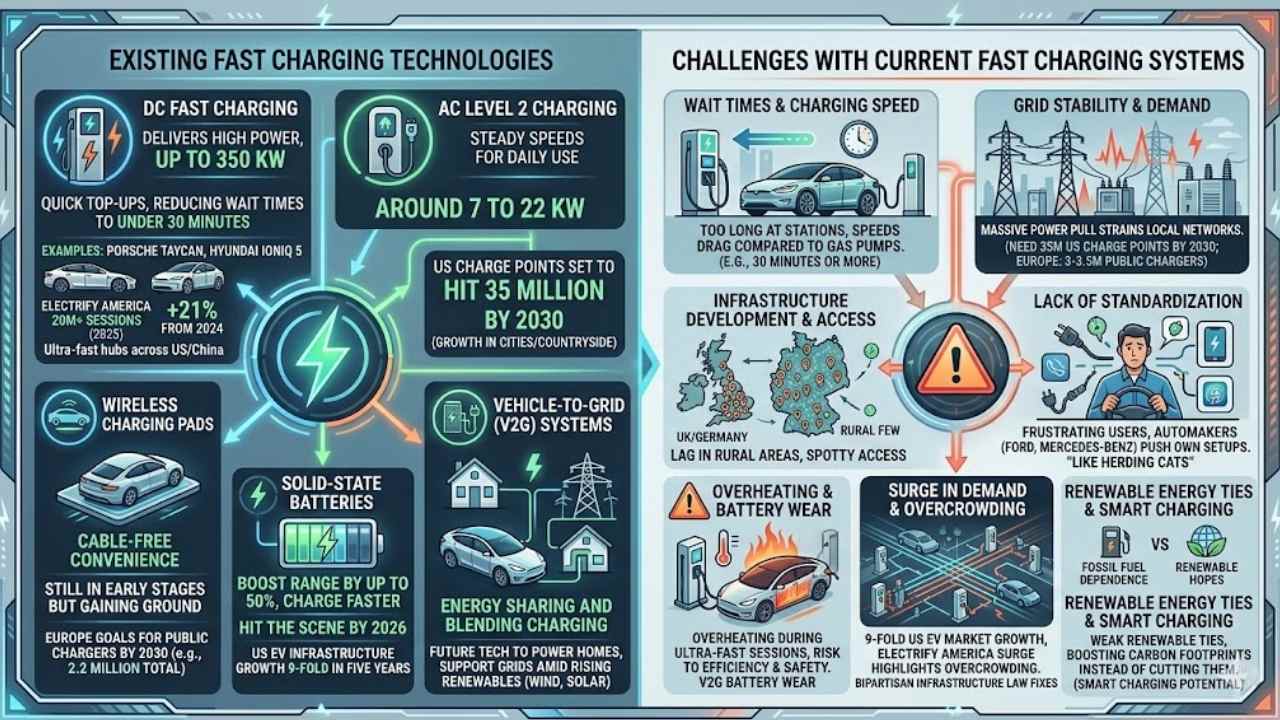
Electric cars now charge faster than ever, with tech like DC fast chargers hitting speeds up to 350 kW in places like the United States and China, cutting wait times to under 30 minutes for many models such as the Porsche Taycan or Hyundai Ioniq 5.
Yet, folks often face headaches from inconsistent stations, high costs, and battery strain that can shorten vehicle life, making folks wonder if the grid can keep up as more drivers plug in.
Overview of existing fast charging technologies
Let’s talk about where fast charging stands today, folks.
| Technology Type | Key Features | Real-World Examples and Stats |
|---|---|---|
| DC Fast Charging | Delivers high power, often up to 350 kW, for quick top-ups. | Electrify America handled over 20 million sessions in 2025, with a 21% jump from 2024. Networks like this push ultra-fast hubs across the US. |
| AC Level 2 Charging | Offers steady speeds at home or work, around 7 to 22 kW, perfect for daily use. | The US now has about 4 million charge points, set to hit 35 million by 2030. This growth makes access easier in cities and countryside spots. |
| Wireless Charging Pads | Allows cable-free power transfer, still in early stages but gaining ground for convenience. | Europe aims for 3 to 3.5 million public chargers by 2030, adding hundreds of thousands each year to reach 2.2 million total. Innovations here tie into that push. |
| Solid-State Batteries | Boost range by up to 50%, charging faster than old lithium-ion types. | These batteries hit the scene by 2026, part of the EV market’s 9-fold infrastructure growth in the US over five years. |
| Vehicle-to-Grid Systems | Let cars send power back to homes or grids, blending charging with energy sharing. | Future tech will power homes from EVs, supporting grids amid rising renewable use like wind and solar. |
Challenges with current fast charging systems
Fast charging for electric vehicles sounds great, but it hits some real snags today. Drivers often wait too long at stations, with charging speeds that drag on compared to gas pumps.
Imagine pulling up for a quick top-off, only to kill time for 30 minutes or more. Grid stability takes a hit too, as these systems pull massive power and strain local networks. In the United States, we have about 4 million charge points now, but experts say we need 35 million by 2030 to keep up with electric mobility growth.
Europe faces a similar crunch, aiming for 3 to 3.5 million public chargers by then, yet they must add hundreds of thousands each year to hit 2.2 million total. Infrastructure development lags in rural areas, leaving folks in places like the UK or Germany with spotty access to ev fast charging.
Public charging points often lack standardization, frustrating users who juggle different plugs and apps. Think of it like herding cats, every automaker from Ford to Mercedes-Benz pushes their own setup.
Overheating batteries during ultra-fast sessions pose risks, cutting down on efficiency and safety. Vehicle-to-grid tech, or V2G, promises help, but current systems struggle with grid integration and battery wear.
In the US, the Bipartisan Infrastructure Law pumps money into fixes, yet the electric vehicle charging market must grow nine-fold in five years to match demand. Places like Electrify America saw over 20 million sessions in 2025, up 21% from 2024, but that surge highlights overcrowding at hubs.
Smart charging could ease this, yet renewable energy ties remain weak, boosting carbon footprints instead of cutting them.
Emerging Technologies in Fast Charging
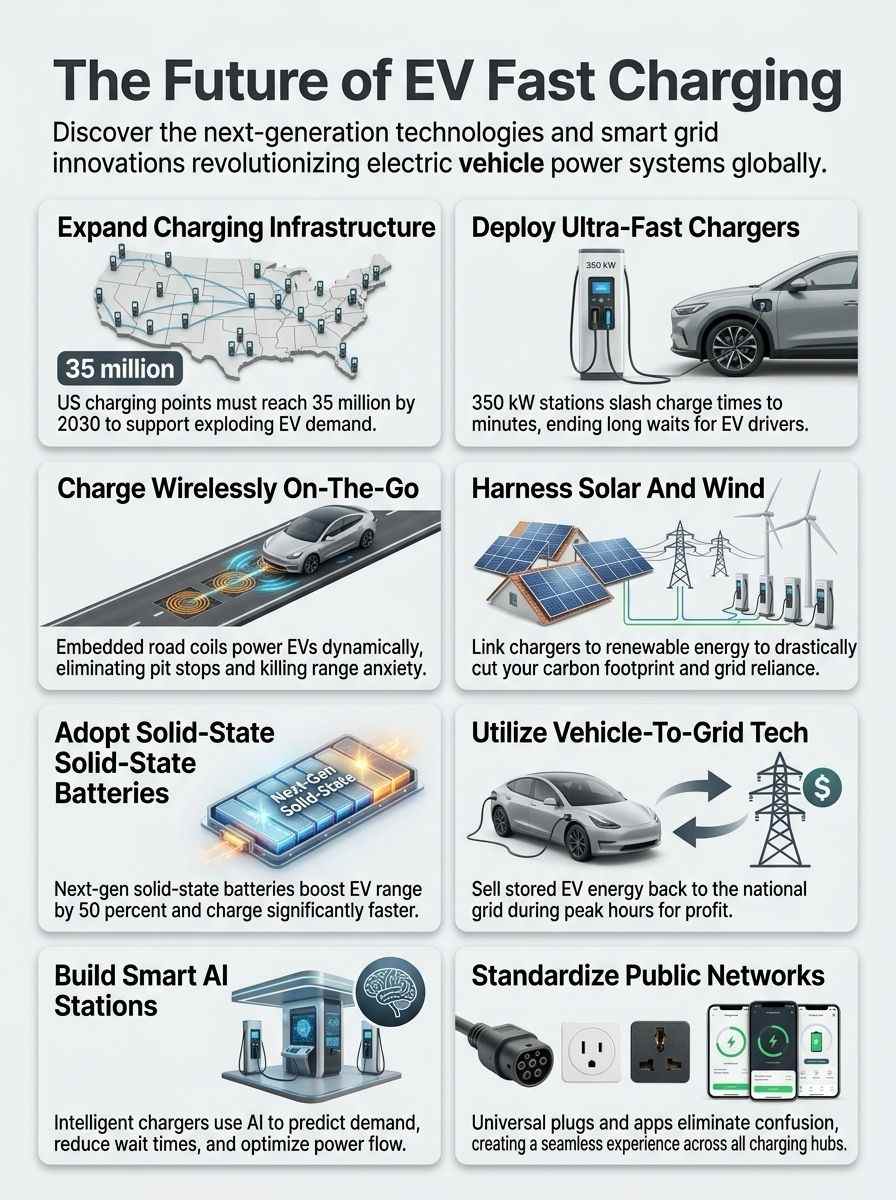
Imagine, your electric car zips back to full power in under 10 minutes, thanks to super-quick direct current stations pumping out more than 350 kilowatts. And what if you could ditch the cords altogether with pads that charge wirelessly, or tap into sun panels that pull energy straight from the sky, making your drive feel like a breeze?
Ultra-fast DC charging (350 kW+)
Ultra-fast DC charging hits speeds of 350 kW or more, slashing EV charging time to minutes instead of hours. Imagine you pull up to a station, plug in your Kia EV6 or Genesis GV60, and you’re back on the road fast.
Companies like Electrify America lead the charge here, with their network handling over 20 million sessions in 2025 alone. That marks a 21% jump from 2024, showing how demand for quick power-ups grows.
In the US, charging stations could balloon from about 4 million now to 35 million by 2030, thanks to programs like the National EV Infrastructure Program.
This tech pairs well with innovations like solid-state batteries, set to boost EV range by up to 50% by 2026. Europe pushes hard too, aiming for 3 to 3.5 million public chargers by 2030, adding hundreds of thousands each year to hit around 2.2 million total.
Networks from EVgo expand ultra-fast hubs, making them pop up in cities and rural spots alike. EV owners, you get the perk of less downtime, plus ties to renewable energy for a greener ride.
Wireless charging innovations
Wireless charging innovations promise to change how we power electric vehicles, making life easier for drivers everywhere. Imagine pulling into your garage, and your car starts charging without plugging in a single cord, like magic under your tires.
Experts call this inductive charging, where power flows through magnetic fields from pads on the ground to your vehicle. This tech cuts down on hassle, especially for busy folks who forget to plug in at night.
Companies like Rivian and Volvo already test these wireless systems in their latest models. Dynamic charging takes it further; it lets you charge while driving on special roads, no stops needed.
Dynamic wireless charging technology is among the next-level innovations transforming electric vehicles in 2026, says an IEA report from the Global EV Outlook 2025.
This on-the-go solution fits right into sustainable transportation goals, backed by government initiatives in places like the European Union and the United States. Picture highways with built-in coils, powering your BMW 530e or plug-in hybrids as you cruise.
Such systems tie into renewable energy, like solar-powered charging, to reduce your carbon footprint. Infrastructure grows fast too; the US expects its charge points to jump from 4 million now to 35 million by 2030, including wireless options.
Drivers gain from this shift, with less range anxiety and smoother trips.
Solar-powered charging solutions
Solar power lights up the path for electric vehicle charging, folks. Imagine: stations harness the sun’s energy to juice up your ride without tapping the grid all day. BYD and CATL push boundaries with blade battery 2.0 tech, blending solar sources for ultra-fast charging.
Electric light-duty vehicles benefit big time, cutting costs and that pesky carbon footprint. Greencars reports show how these setups tie into renewable energy, making EV life greener in places like the United States and India.
You get real perks with solar-powered spots, like reduced reliance on fossil fuels. Think about it, your car charges under the sun while you grab coffee. The US electric vehicle charging market grows fast, with a near 9-fold jump in infrastructure over five years.
Battery storage pairs perfectly here, storing solar juice for night use or peak times. SAIC-GM-Wuling Auto explores these in models like the Denza Z9 GT EV, boosting efficiency. Nations such as France and the Netherlands roll out incentives under schemes like PM E-Drive, fueling this sunny shift.
Bi-Directional Charging and Vehicle-to-Grid (V2G)
Imagine your electric car as a helpful buddy, not just sucking up juice but dishing it out too, through bi-directional charging that flips the script on power flow. With V2G tech linking your ride to the national grid, you could sell extra energy during peak times, easing blackouts and padding your wallet—stick around to see how this game-changer boosts your daily drive.
How V2G supports energy grids
Electric cars with vehicle-to-grid (V2G) tech act like giant batteries on wheels. They send stored energy back to the national grid during peak demand. This bi-directional charging stabilizes power supply, cuts blackouts, and eases strain from renewable sources like wind and solar.
Imagine your EV pitching in to keep the lights on for everyone, a real team player in the energy game.
Future EV technology pushes this further, letting cars power homes too. Experts project these innovations will advance fast through 2030 and beyond. Owners gain perks, like earning cash for sharing juice with the grid.
Sne Research highlights how such systems boost efficiency, making the automotive industry greener in general.
Benefits for EV owners
EV owners stand to gain big from bi-directional charging. This tech turns your car into a power player, helping you save money and stay green.
- You cut energy bills when your EV sends power back to the grid during peak times, like selling lemonade on a hot day, and with ev incentives like those in the pm e-drive scheme, you pocket extra cash rewards for joining vehicle-to-grid programs.
- Your electric car powers your home during outages, a real lifesaver in storms, and fact number nine shows this vehicle-to-home shift hits full swing soon, keeping lights on without a generator.
- Grid support means utilities pay you for stored energy, boosting your wallet, especially in places like the united kingdom where rules push for smart setups under the eu energy performance in buildings directive.
- You reduce your carbon footprint by tying into renewable sources, think of it as your car dancing with the wind and sun, and integrating with solar-powered solutions makes every charge cleaner.
- Convenience spikes with plug and charge features, no fussing with apps or cards, and autocharge tech from networks like electrify america streamlines sessions, which jumped 21 percent from 2024 to 2025.
- You access more perks through digital optimization, like apps that schedule cheap charging, and with lithia & driveway expanding hubs, rural spots get ultra-fast options too.
- Your EV’s battery lasts longer thanks to smarter management in v2g systems, avoiding deep drains, and emerging flash charging technology pairs well, offering quick top-ups without wear.
- Incentives grow your savings, from tax breaks to rebates, and in the us, the market booms with a nine-fold infrastructure jump in five years, putting money back in your pocket.
- You join a community effort, stabilizing grids for all, and as europe adds hundreds of thousands of chargers yearly toward 2.2 million by 2030, your participation feels like teaming up for a win.
Dynamic Charging Systems
Picture zipping down the road in your electric car, pulling power right from the pavement without stopping. This on-the-go tech, like inductive lanes built into highways, demands big upgrades in road setups, from embedded coils to smart grid links, sparking talks on rules for alternative fuels infrastructure.
Charging while driving (on-the-go solutions)
Dynamic charging lets you power up your electric vehicle right on the road, no stops needed. Roads embed special coils that send energy wirelessly to your car as you cruise along. This tech acts like a magic carpet for your battery, keeping it topped off during long hauls.
Experts at Electrek, including Kevin Jennings, highlight how alternative fuels infrastructure regulation speeds up its rollout. Picture zipping down the highway, your EV sipping power from the pavement like a runner grabbing water mid-race.
This on-the-go solution shines with dynamic wireless charging technology, set to transform electric vehicles in 2026. Cars grab energy from embedded road systems, slashing range anxiety for good.
Drivers love the freedom; it’s like your vehicle never runs on empty. Such innovations fit into broader grids, making trips smoother and greener.
Infrastructure requirements for dynamic charging
Electric cars will soon charge on the move, thanks to dynamic systems. This tech promises to change how we think about refueling, like magic carpets for your battery.
- Special roads need embedded coils to transfer power wirelessly to vehicles as they drive, and this setup requires massive upgrades to highways, much like laying tracks for a high-speed train; dynamic wireless charging technology stands out as a next-level innovation set to transform electric vehicles by 2026, demanding precise alignment between road tech and car receivers for safe, efficient energy flow.
- Power grids must supply steady, high-voltage electricity to these road sections, akin to feeding a hungry beast without interruption; think of it as building a network that handles surges, similar to how Europe plans to add hundreds of thousands of chargers each year to hit its 2030 goal of about 2.2 million units, ensuring dynamic systems don’t overload local energy supplies.
- Sensors and smart controls play a key role in monitoring vehicle speed and position, acting like vigilant guardians to prevent energy waste or safety issues; envision it as a dance where the road and car sync perfectly, drawing from innovations like solid-state batteries that promise up to 50% more range by 2026, which could pair well with on-the-go charging to extend trips without stops.
- Billing systems have to track usage in real time, sort of like a toll booth that never sleeps, making sure drivers pay only for the power they grab while cruising; this ties into broader trends, such as the US expecting its charge points to jump from around 4 million now to 35 million by 2030, creating a fair way to handle costs in dynamic setups.
- Safety features include barriers against electromagnetic interference, protecting nearby devices and people, much like shielding a fragile egg in a storm; with electric vehicle charging innovation projected to advance through 2030 and beyond, these requirements will integrate with renewable sources, reducing the carbon footprint as seen in solar-powered solutions that support such dynamic tech.
Integration with Renewable Energy Sources
Imagine your electric car sipping power straight from the sun or wind, like a thirsty traveler finding an oasis in the desert. Wind turbines and solar panels team up with EV stations to cut down emissions, making every charge a step toward a cleaner planet—want to learn how this green magic powers your ride?
Role of wind and solar energy in EV charging
Wind turbines and solar panels play a big role in powering electric vehicle chargers. They capture clean energy from nature, which cuts down on dirty fossil fuels. Imagine your EV plugs in at a station fueled by the sun or breeze, zipping you along without guilt.
Europe pushes hard for this shift, aiming to install 3 to 3.5 million public chargers by 2030. That means adding hundreds of thousands each year to hit about 2.2 million total. In the US, charge points jump from 4 million now to 35 million by then, many tied to renewables.
This growth slashes carbon footprints, making drives greener for everyone.
EV owners gain from smart ties between solar power, wind energy, and their cars. Future tech lets vehicles send juice back to homes, like a helpful neighbor sharing tools. Innovations keep advancing through 2030 and beyond, boosting the US market nearly nine times in five years.
Solid-state batteries add up to 50% more range by 2026, pairing well with these sources. Dynamic wireless charging hits the scene that year too, often powered by sun or wind. Think of it as refueling on the fly, no stops needed, all while keeping the planet in mind.
Reducing carbon footprint through smart energy use
Smart energy use cuts your carbon footprint, folks, by pairing electric vehicles with clean power sources like solar panels and wind turbines.
| Key Ways to Reduce Footprint | Details and Facts |
|---|---|
| Solar and wind power charge EVs | Imagine you plug in your car at home, and sunlight or breezes from turbines feed the juice. Europe targets 3 to 3.5 million public chargers by 2030. They must add hundreds of thousands each year to hit 2.2 million total. This setup slashes emissions, no more fossil fuels in the mix. |
| Smart grids manage energy flow | These systems act like traffic cops for power, directing clean energy right to your EV. Solid-state batteries emerge as game-changers, they promise 50% more range by 2026. Your car charges smarter, uses less dirty power, and you feel good about it. |
| Vehicle-to-home tech shares power | Future EVs power homes, think of your car as a backup generator on wheels. Dynamic wireless charging transforms rides in 2026, it lets you top up on the go with road-embedded coils. This cuts waste, boosts efficiency, and trims that carbon trail we all hate. |
| Growth in US charging spots | Charge points jump from 4 million now to 35 million by 2030. Electrify America handled over 20 million sessions in 2025, up 21% from 2024. You get more spots tied to renewables, like solar farms feeding stations, making every trip greener. |
| Market boom drives clean habits | The US EV charging scene grows nine times in five years. Innovations advance through 2030 and beyond, they weave in tools like energy management apps. Owners track usage, shift to off-peak times with wind or solar peaks, and watch emissions drop, easy as pie. |
Expansion of Public and Commercial Charging Networks
Imagine zipping through the city, or cruising rural roads, and spotting ultra-fast charging hubs everywhere you turn, making electric vehicle ownership a breeze for folks in bustling downtowns and quiet countryside spots alike.
These hubs, think massive stations pumping out 350 kW or more, are popping up like daisies in spring, promising quicker pit stops and fewer range worries that keep drivers grinning from ear to ear.
Growth of ultra-fast charging hubs
Ultra-fast charging hubs are booming across the globe, folks, and they’re set to make EV life way easier for all of us.
| Growth Highlights | Key Details |
|---|---|
| Europe’s big push | Europe targets 3 to 3.5 million public chargers by 2030. They need to add several hundred thousand chargers each year to hit their goal of about 2.2 million chargers by then. Imagine it as a massive road trip upgrade, no more range anxiety on those long drives. |
| US explosion in charge points | The number of charge points in the United States jumps from around 4 million now to an estimated 35 million by 2030. That’s like turning every corner store into a power pit stop, huh? |
| Electrify America’s surge | Electrify America’s network handled over 20 million charging sessions in 2025. Sessions rose 21% from 2024 to 2025, showing folks love these quick zap spots more each year. |
| Market boom ahead | The US electric vehicle charging market grows nearly nine times in the next five years. Hubs with ultra-fast DC charging at 350 kW or more lead this charge, folks, think of them as the superheroes of quick power-ups for your ride. |
Increased accessibility in urban and rural areas
Electric vehicles are popping up everywhere, and charging spots need to keep pace in cities and countryside alike. Folks in bustling downtowns or quiet farm towns no longer hunt for a plug like it’s a needle in a haystack.
Europe aims to install about 3 to 3.5 million public chargers by 2030, adding several hundred thousand each year to hit a goal of around 2.2 million. That push makes life easier for drivers, cutting down range anxiety no matter where you roam.
In the US, charge points will jump from 4 million now to 35 million by 2030, a whopping 9-fold growth in infrastructure over the next five years. Networks like Electrify America saw over 20 million sessions in 2025, up 21% from 2024, showing real momentum.
This expansion hits urban hubs with quick stops at malls or offices, while rural spots get chargers at gas stations or community centers. Imagine zipping through a small town and topping off your battery without a detour, like grabbing coffee on the go.
Public networks grow to bridge those gaps, making EVs practical for everyone from city commuters to country road trippers. Chargers pop up in unexpected places, turning long drives into smooth sails.
Growth in these areas sparks more adoption, as people see charging as easy as pie.
Future Trends in Fast Charging
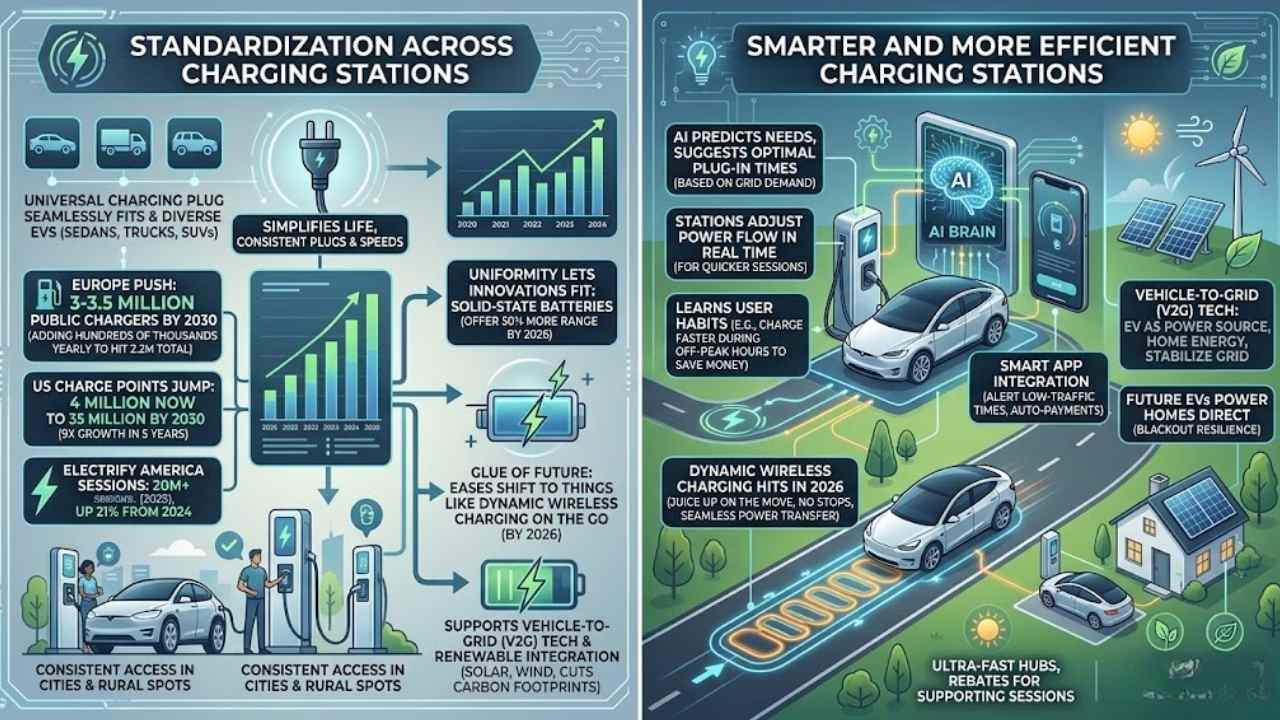
Imagine charging your electric car as quick as grabbing a coffee, with standards that work everywhere. Smart stations, powered by AI, will predict your needs and cut wait times, making road trips a breeze.
Standardization across charging stations
Standardization makes charging stations work the same way everywhere, and that simplifies life for electric vehicle drivers. Picture plugging in your EV without worrying about different plugs or speeds, like using the same key for every door.
Europe pushes this idea hard, aiming for 3 to 3.5 million public chargers by 2030. They plan to add hundreds of thousands each year to hit about 2.2 million total. In the US, charge points jump from 4 million now to 35 million by 2030, a nine-fold growth in five years.
Electrify America saw over 20 million sessions in 2025, up 21% from 2024. This uniformity lets innovations like solid-state batteries, offering 50% more range by 2026, fit right in.
Think of standardization as the glue holding fast charging’s future together, easing the shift to things like dynamic wireless charging on the go by 2026. It supports vehicle-to-grid tech, where EVs power homes and stabilize energy grids.
Renewable sources, from solar to wind, integrate better with standard setups, cutting carbon footprints. Drivers get consistent access in cities and rural spots, no more hunting for the right station.
These changes keep electric vehicle innovation rolling strong through 2030 and beyond.
Smarter and more efficient charging stations
Charging stations are evolving fast, folks. They promise to make your EV experience smoother and more eco-friendly than ever.
- Imagine: smarter charging stations use AI to predict your needs, like suggesting the best time to plug in based on grid demand. They cut wait times and boost efficiency. Europe targets 3 to 3.5 million public chargers by 2030, with several hundred thousand added each year to hit 2.2 million total. That growth means stations get intelligent, adjusting power flow in real time for quicker sessions.
- Efficiency jumps with solid-state batteries, set to offer 50% more range in EVs by 2026. Stations adapt to these batteries, delivering optimized charges that extend vehicle life. In the US, charge points will balloon from 4 million now to 35 million by 2030, a nine-fold surge. You benefit from stations that learn your habits, like charging faster during off-peak hours to save you money.
- Dynamic wireless charging hits the scene in 2026, letting you juice up on the move. Stations embed tech in roads for seamless power transfer, no stops needed. Electrify America’s network logged over 20 million sessions in 2025, up 21% from 2024. These smart spots integrate with apps, alerting you to low-traffic times and even handling payments automatically.
- Vehicle-to-grid tech turns your EV into a power source, supporting home energy needs. Stations enable this bi-directional flow, letting cars feed electricity back to grids or houses. Future EVs will power homes directly, a game-changer for blackouts. With renewable integration, like solar and wind, stations reduce your carbon footprint by prioritizing clean energy during charges.
- Public networks expand with ultra-fast hubs in cities and rural spots, making access a breeze. Stations grow smarter, using data to manage loads and prevent overloads. The US market sees massive growth, pushing infrastructure that talks to your car for custom charging plans. EV owners gain perks, such as rebates for grid-supporting sessions, turning your drive into a smart energy partner.
Final Thoughts
Fast charging tech keeps evolving, from ultra-fast DC stations to wireless pads and solar setups that power your ride. We explored V2G systems that let your EV feed the grid, plus dynamic roads that juice up cars on the move.
These ideas fit right into daily life, simple to adopt with growing networks like Electrify America’s hubs. Imagine slashing your carbon footprint while zipping through traffic, that’s the real win for a greener planet.
Check out reports on Europe’s 3 million charger goal by 2030 for more details, or explore solid-state battery news for range boosts. Grab your keys and join the electric revolution, it might just change how you drive forever.
Frequently Asked Questions (FAQs) About the Future of Fast Charging
1. What’s next for fast charging speeds in our gadgets?
Fast charging will hit new highs with tech that juices up your phone in under 10 minutes, like a pit stop for your battery. Imagine plugging in during a quick coffee break, and boom, you’re good to go all day.
2. Will electric vehicles charge faster in the future?
You bet, electric cars are gearing up for ultra-fast charging that cuts wait times to mere minutes. This shift, like trading a slowpoke for a racehorse, means road trips without the long pit stops.
3. Are there cool new materials coming for better battery life?
Scientists are cooking up advanced stuff like solid-state batteries to boost charging without the heat hassle. These could make your device last longer on a single charge, turning battery anxiety into a thing of the past. Picture it as upgrading from a leaky bucket to a sturdy tank.
4. What about wireless charging; is it getting quicker soon?
Wireless pads are evolving to match wired speeds, so you can ditch the cords for good. It’s like magic, but real, making your mornings smoother without the tangle.





















