

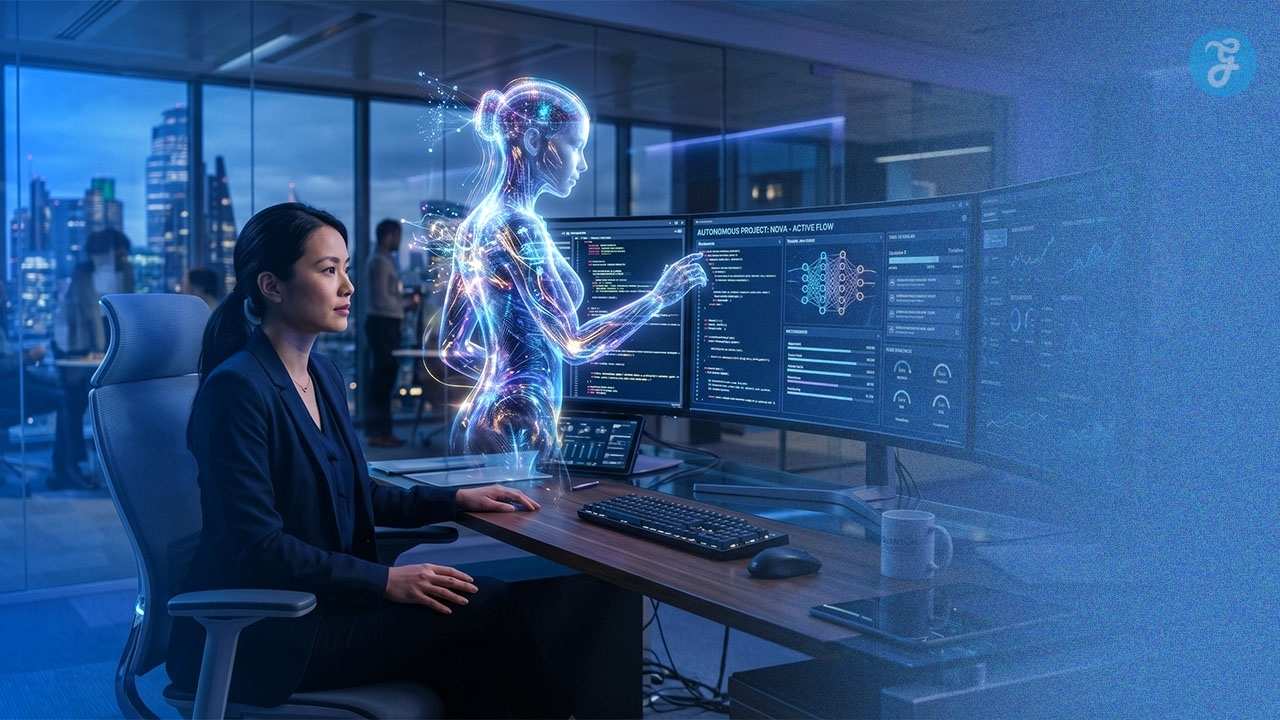
Autonomous AI agents are fundamentally rewriting the rules of the modern workplace. For the past few years, the corporate world has been captivated by the novelty of generative text. We have grown accustomed to typing a prompt and waiting for a machine to spit back an answer. That era is already ending.
The narrative of artificial intelligence is rapidly moving away from passive conversational interfaces toward systems capable of independent action. We are witnessing the arrival of digital colleagues that do not just talk but actually do the work.
This is not a distant science fiction scenario. This is a current and accelerating reality. Companies across the globe are integrating sophisticated algorithms that can manage projects, execute marketing campaigns, and even write complex software code without constant human supervision.
As a content strategist or a business leader, understanding this transition is no longer optional. It is a fundamental requirement for navigating the next decade of digital enterprise.
Understanding Autonomous AI Agents
Autonomous AI agents go far beyond what older tools can do. They think, plan, and act on their own to solve real problems in your business.
Defining Autonomous Agents
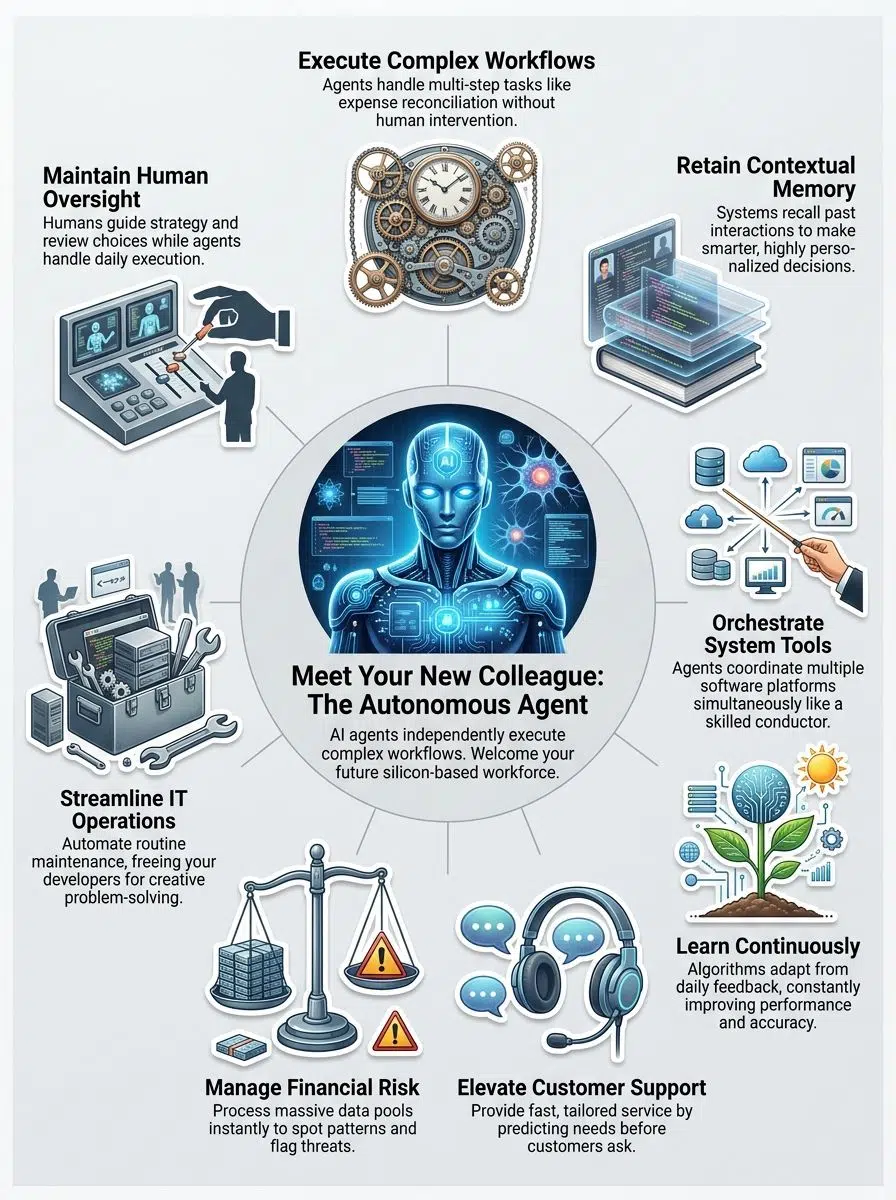
Intelligent systems that operate independently represent a major shift in how businesses handle work. These agents execute complex workflows that require real thinking and planning.
For example, Gartner predicts that 40% of enterprise applications will include task-specific AI agents by 2026. This means they are rapidly becoming standard equipment for growing companies.
An autonomous agent can book your flights, cancel reservations, and reconcile your expenses without you lifting a finger. Machine learning powers these systems, allowing them to learn from patterns and improve over time.
Unlike simple programs that just answer direct questions, these agents take initiative. They combine decision support capabilities with workflow orchestration to handle tasks that once required human hands.
Autonomous AI agents are poised to serve as future colleagues in the workplace.
The shift toward autonomous agents marks a turning point in digital transformation. Businesses are moving past simple experiments and integrating these systems directly into their daily operations.
Task automation now means intelligent systems that understand context, recall previous interactions, and adapt their approach. By 2026, AI will handle workflows that extend far beyond basic data entry.
These agents work alongside humans, with people providing the final check on the system’s decisions. Process optimization happens naturally as these colleagues learn what works best. Organizations that redesign their workflows around this new workforce gain significant advantages in speed and accuracy.
The Dawn of the Proactive Machine
The initial wave of enterprise AI was defined by reactivity. A user had to ask a specific question to get a specific result. The next phase is defined by proactive execution.
From Conversational Parrots to Independent Actors
To understand the magnitude of this shift, we must first clearly delineate the boundary between generative text tools and genuine agency. A standard chatbot is essentially a highly advanced text predictor. It requires a human operator to hold its hand through every step of the process. If a task requires ten steps, the human must prompt the machine ten separate times.
Autonomous AI agents break this dependency loop. You do not give an agent a prompt. You give an agent a goal. Once assigned an objective, the agent will independently research the topic, formulate a multi-step plan, execute the required actions, and even troubleshoot errors along the way. If it encounters a roadblock, it does not simply stop and wait for human input. It pivots, tries a new approach, and continues working until the objective is met.
This leap from reactive prompting to proactive problem solving is the most significant technological advancement since the invention of the graphical user interface. It transforms the computer from a static tool into an active participant in the business process.
The Anatomy of a Digital Coworker
Underneath the hood, these new systems operate fundamentally differently from the chatbots that dominated the early 2020s. They are built on a complex architecture that mimics human cognitive processes.
How Autonomous AI Agents Actually Think and Execute
Breaking down the architecture of agency is essential for making the technology tangible. An autonomous system relies on several core pillars to function in a corporate environment. First is the reasoning engine. Modern large language models serve as the brain of the agent, allowing it to understand context and make logical deductions.
Second is memory. Unlike early chatbots that forgot the conversation as soon as the window was closed, true agents possess both short-term and long-term memory. They remember past interactions, learn from previous mistakes, and build a persistent understanding of their environment.
Third is tool use. A digital agent is useless if it cannot interact with the software ecosystem of the company. Today’s agents are equipped with the ability to browse the internet, query databases, send emails, and operate third-party applications through API integrations.
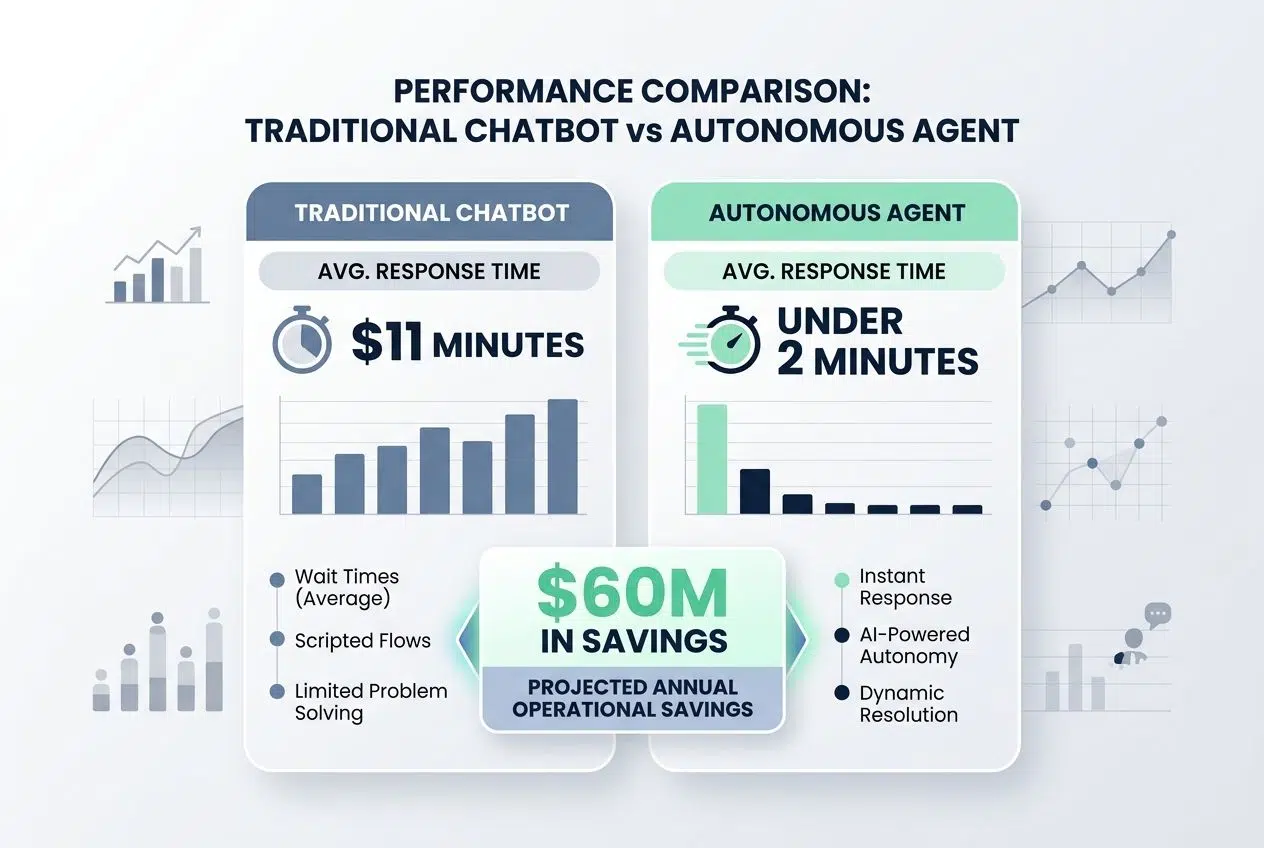
| Feature | Traditional Chatbots | Autonomous AI Agents |
| Primary Function | Answer questions and generate text | Execute multi-step goals |
| Operation Mode | Reactive (requires constant prompting) | Proactive (works independently) |
| Context Retention | Limited to the current session | Persistent memory across sessions |
| System Access | Isolated to the chat interface | Direct access to APIs and enterprise software |
| Error Handling | Fails and waits for human correction | Self-corrects and attempts alternative methods |
This structural difference is profound. It means you are no longer interacting with a software program. You are managing a synthetic employee.
Restructuring the Corporate Hierarchy
As these systems deploy into the enterprise, the traditional pyramid of corporate management will face an existential stress test. The workplace was designed around human limitations. It was designed around the need for managers to oversee junior staff.
When Your Middle Manager Is an Algorithm
The immediate impact of autonomous AI agents will not just be on entry-level tasks. It will fundamentally disrupt how workflows are delegated and monitored. Consider the role of a traditional middle manager. A significant portion of their day is spent tracking project progress, following up with team members, and ensuring deadlines are met.
An agentic system can handle these logistical tasks with perfect accuracy and zero fatigue. It can automatically track key performance indicators, flag bottlenecks in the production pipeline, and dynamically reassign resources based on real-time data. This shift will force organizations to flatten their hierarchies.
When digital entities handle the bulk of administrative oversight, human managers will need to pivot. They will transition from tracking task completion to focusing on high-level strategy and organizational culture. The manager of the future will not manage people doing the work. They will manage the algorithms doing the work, while focusing their human capital on creative direction and critical relationship building.
The New Economics of Productivity
Zooming out from the individual desk, the widespread adoption of digital labor will rewire the macroeconomic landscape. The fundamental constraints of human labor are time and physical capacity.
Infinite Scalability and the End of the 40-Hour Week
When cognitive labor becomes infinitely reproducible and operates continuously without fatigue, the traditional metrics of time and output collapse. A human marketing team might take three weeks to research, write, design, and launch a comprehensive campaign. A multi-agent system can complete the exact same process in a matter of hours.
This introduces a level of economic scalability that was previously impossible for service-based and knowledge-based industries. If a software company needs to double its output, it no longer needs to double its human headcount. It simply needs to allocate more server space and increase the computing power of its agentic workforce.
| Economic Metric | Carbon Labor (Human Workforce) | Silicon Labor (Agentic Workforce) |
| Availability | 40 hours per week | 24/7 continuous operation |
| Scaling Cost | High (recruitment, benefits, office space) | Low (marginal server and API costs) |
| Training Time | Weeks or months of onboarding | Instant deployment across the network |
| Output Consistency | Variable based on fatigue and mood | Perfectly consistent execution |
The implications for global commerce are staggering. We will likely see the rise of million-dollar companies run by a single human acting as an orchestrator for a vast network of autonomous AI agents. However, this also presents a severe challenge for the global labor market. Society must prepare for a transition period where routine cognitive tasks are rapidly democratized.
The Trust and Alignment Deficit
Giving a machine the ability to speak is one thing. Giving it the keys to corporate databases and financial tools introduces entirely new threat vectors.
Giving Keys to the Kingdom: Security and Ethics
The risks associated with agentic AI scale linearly with the amount of freedom and access they are granted within an organization. A generative text model experiencing a hallucination might output a weirdly phrased email. An autonomous agent experiencing a hallucination might accidentally delete a production database or send sensitive financial data to the wrong client.
Security in the age of autonomous systems requires a complete paradigm shift. We can no longer rely on perimeter defense. We must implement strict access controls and robust oversight mechanisms directly within the agent’s operating environment. This involves creating “sandboxed” environments where agents can test their proposed actions before executing them in the real world.
Furthermore, the alignment problem becomes critical. How do you ensure that an agent acting independently is perfectly aligned with the ethical guidelines and brand voice of the company? If an agent is tasked with maximizing user engagement on a social media platform, it might autonomously decide to publish highly controversial content because that achieves the mathematical goal.
Companies will need to develop complex ethical guardrails to prevent synthetic labor from causing massive reputational damage.
The Human Premium in an Automated World
As digital agents commoditize standard cognitive tasks, the market value of uniquely human traits will skyrocket. The fear of mass unemployment often overshadows the more nuanced reality of technological shifts.

Redefining Value When Execution is Commoditized
Survival in this new era requires a pivot toward skills that algorithms struggle to replicate. Agents are phenomenal at execution, data processing, and logical deduction. They are terrible at unstructured problem solving, deep empathy, and moral judgment.
The professionals who thrive in the coming decade will be those who lean heavily into their humanity. Copywriters will transition into conceptual strategists. Software developers will become system architects. Data analysts will evolve into behavioral interpreters. The goal is no longer to be the fastest typist or the most efficient coder. The goal is to be the best thinker.
We will see the emergence of a “human premium” in the marketplace. Just as handmade goods carry a higher price tag than factory-produced items in the physical world, authentic human insight will carry a massive premium in the digital world. Clients and consumers will pay a premium for strategy, empathy, and creative direction that originated from a human mind.
Embracing the Synthetic Workforce
The arrival of independent algorithms in the workplace is not a future possibility. It is a present reality that demands adaptation. Organizations that try to ban or ignore these tools will find themselves outpaced by competitors operating at machine speed.
The Inevitable Integration of Silicon and Carbon Talent
The most successful companies will not use agents to simply replace humans. They will use agents to augment human capability. We are entering an era of deep collaboration between silicon and carbon talent. Imagine a newsroom where autonomous AI agents continuously monitor global data feeds, translate foreign broadcasts in real time, and compile initial briefings. The human journalists are then free to focus entirely on deep investigative reporting, source building, and crafting a compelling narrative.
This hybrid model represents the true potential of the technology. It frees human workers from the drudgery of data processing and repetitive administration. It allows us to elevate our work and focus on the tasks that actually require human ingenuity. Organizations must begin auditing their workflows today. They must identify which processes can be handed over to digital labor and which processes require human oversight.
Finally: Orchestrating the Next Era of Enterprise
Autonomous AI agents represent a fundamental shift in how organizations operate. We are moving far beyond simple interactions to true digital colleagues. These agents execute complex workflows, make intelligent decisions, and learn from every interaction. The integration of autonomous systems into our daily operations will be complex and challenging.
It will require us to rewrite job descriptions, overhaul security protocols, and completely rethink our approach to productivity. We are moving from being individual contributors to becoming conductors of a digital symphony. The transition will be disruptive, but the reward is a future where human potential is no longer bottlenecked by the limits of our own processing power.
The next colleague you hire may not have a pulse, but they will absolutely push you to become a better, more strategic version of yourself.





















