
Are you dreaming of becoming a doctor, but feel stuck on where to start your studies? Many aspiring med students face high costs and tough competition at home, leaving them stressed and unsure. It’s like trying to climb a mountain without a map, right? You want quality training that fits your budget and opens doors worldwide.
Did you know that over 200,000 international students pursue medical degrees abroad each year? This trend shows how global options can transform your path.
In this post, we’ll guide you through the best countries for studying medicine, breaking down key factors like costs, programs, and real-world perks. We’ll help you pick a spot that matches your goals and eases those worries.
Ready to explore?
Factors to Consider When Choosing a Country for Studying Medicine
Picking a spot to study medicine abroad, yeah, it’s like choosing your next adventure, full of twists and turns that shape your future as a doctor. Think about what matters most to you, from top-notch schools to real-world hospital time, and you’ll find a place that clicks.
Quality of medical education
Quality of medical education stands out as a top factor for international students eyeing study abroad programs in healthcare. Top medical schools offer strong curricula that blend theory with hands-on clinical training, you know, like engaging in real patient care early on.
Accreditation matters a ton here; it ensures your degree programs gain global recognition, opening doors to medical licensure worldwide. Imagine being in a lab with cutting-edge tools that boost your skills big time.
Countries vary in how they structure medical education, from innovative approaches to time-tested methods. International universities often rank high for their rigorous admission requirements and focus on global medicine.
Students gain from diverse educational opportunities that shape well-rounded doctors. Tuition fees tie into this quality, but let’s shift gears to tuition costs and affordability next.
Tuition costs and affordability
While top-notch medical education sets the foundation for your career, you also need to weigh the price tag that comes with it. Tuition fees vary wildly across countries, and affordability plays a big role in your choice as an international student.
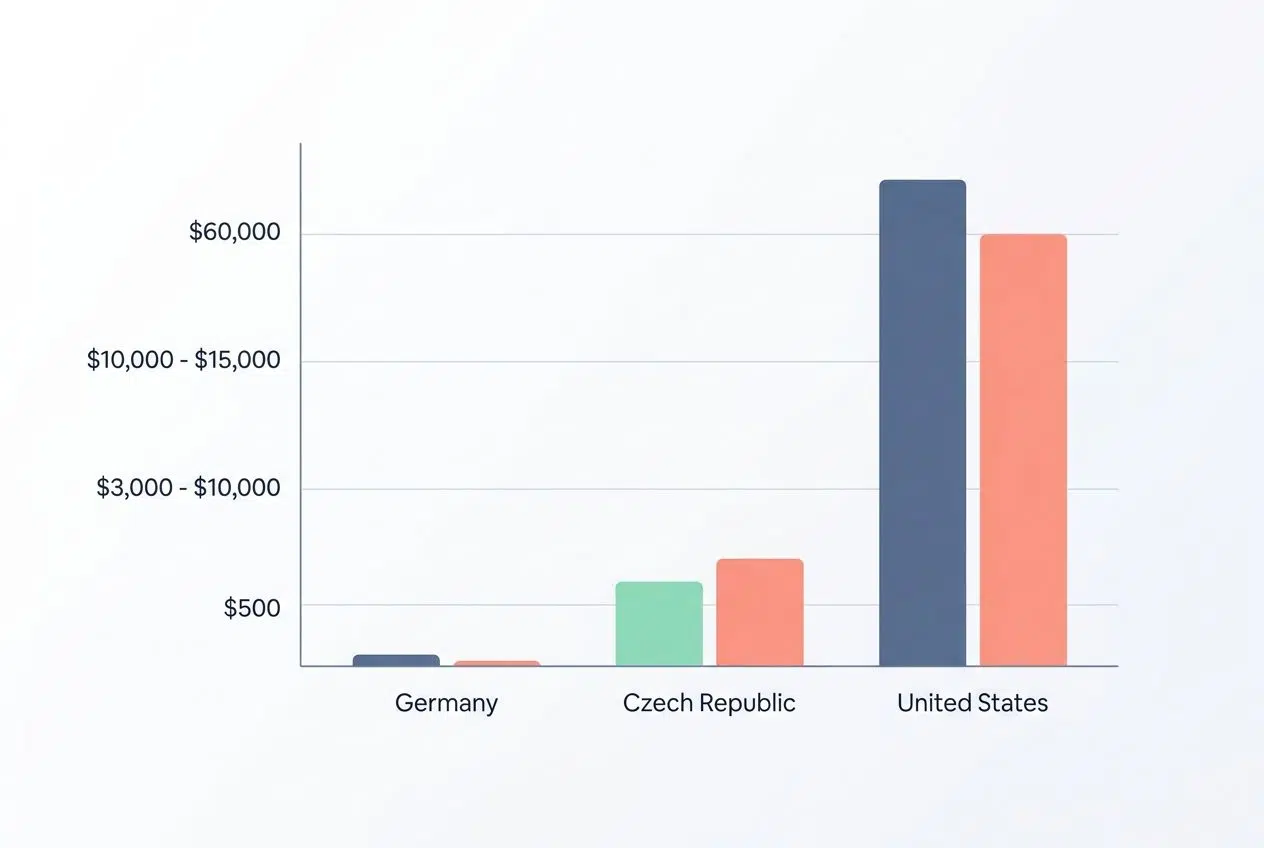
In places like Germany, you might pay next to nothing for medical school, thanks to public funding that keeps costs low for everyone. Consider this: annual tuition there often dips below $500 for EU students, and non-EU students face around $3,000 to $10,000, making it a steal compared to other spots.
Medical education in the United States, on the other hand, can hit you with bills over $60,000 a year at private universities, but scholarships and financial aid help ease the sting for many.
Don’t forget hidden gems like the Czech Republic, where degree programs run about $10,000 to $15,000 annually, blending quality with budget-friendly vibes.
Studying medicine abroad isn’t just about the degree; it’s about finding a path that fits your wallet too, says Dr. Elena Rossi, a global healthcare advisor.
Countries like Canada offer a middle ground, with tuition fees averaging $20,000 to $30,000 per year for international students in strong healthcare programs. Factor in living costs, and you see why affordability matters for long-term success.
Admission requirements sometimes tie into funding options, so scout scholarships early. In Australia, expect around $40,000 yearly, but the global recognition of their medical schools justifies it for many.
Language of instruction can affect costs too; English-taught courses in the Netherlands might add a premium, yet they open doors to diverse clinical training without breaking the bank.
Language of instruction
Language plays a big role in your medical education journey, especially as an international student. Many top medical schools offer programs in English to attract students from around the world.
Picture yourself in a classroom, soaking up healthcare programs without struggling over every word. Countries like the Netherlands and Australia shine here with their English-taught degree programs.
They make studying abroad smoother for non-native speakers. You avoid the headache of learning a new tongue on top of a tough medical curriculum.
Some spots, like Germany or Spain, teach mainly in the local language. That can feel like jumping into the deep end if you’re not fluent. International students often take extra language courses to keep up with admission requirements and clinical training.
Think about your comfort level; picking a place with your preferred language of instruction sets you up for success in global medicine.
Opportunities for clinical experience
Clinical training forms a key part of medical education for international students. You gain hands-on skills in real hospitals and clinics. Some countries offer early exposure to patients, like in the United States or Canada, where you rotate through diverse healthcare programs.
Imagine you’re treating cases from urban emergencies to rural care, building your confidence fast. That variety sharpens your abilities in global medicine.
Countries like Australia and Germany provide strong clinical opportunities in their degree programs. Students engage in practical work with advanced tools and mentors. Think about networking with doctors from around the world during these sessions.
It boosts your resume for future medical licensure. Plus, you adapt to different systems, making you a versatile doctor ready for any challenge.
Top Countries for Studying Medicine Abroad
Dreaming of swapping your hometown for a global medical adventure, where top schools mix cutting-edge labs with real-world patient care? Stick around, you won’t want to miss the scoop on spots that could launch your doctor dreams sky-high.
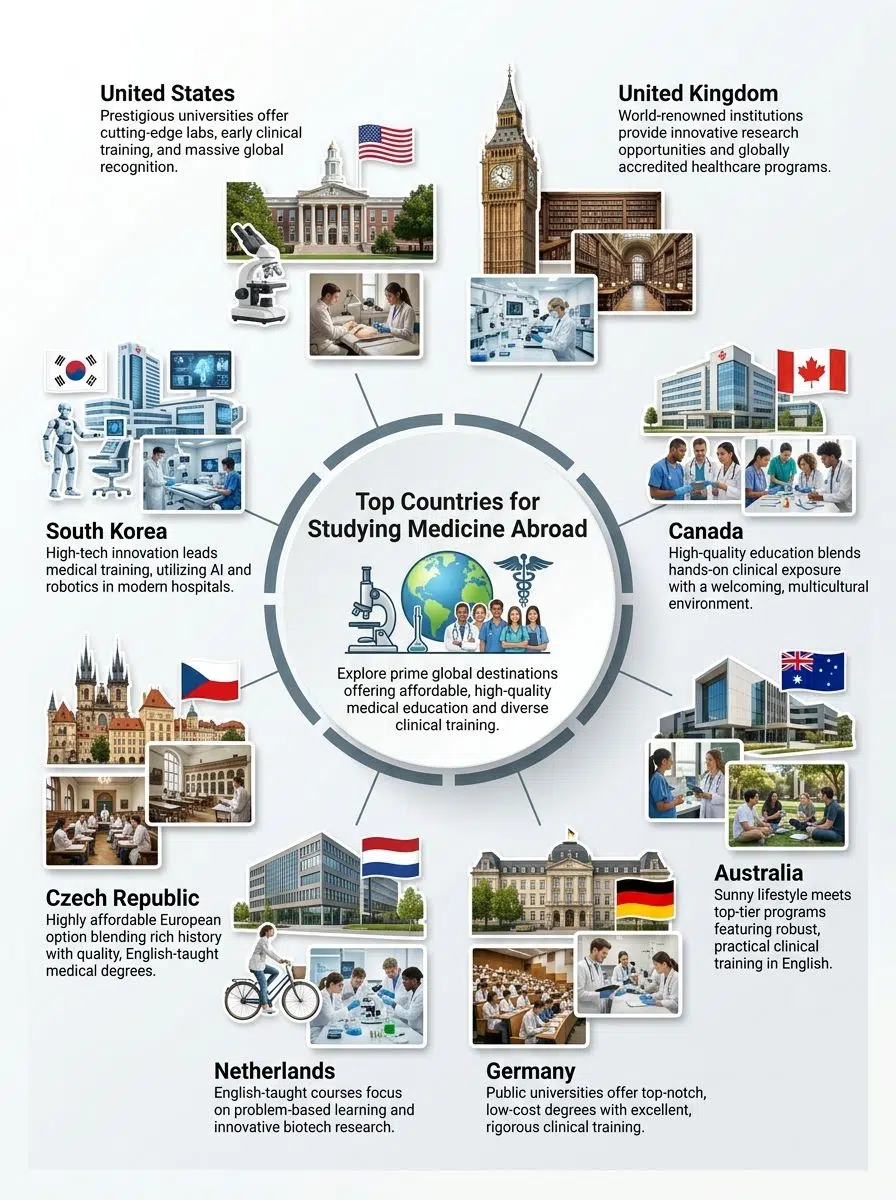
United States: Prestigious universities and advanced facilities
The United States draws international students to its medical schools with top-notch programs. Think of places like Harvard Medical School or Johns Hopkins University, which lead in medical education.
These spots offer advanced facilities, from cutting-edge labs to high-tech hospitals. You get hands-on clinical training early on, which builds real skills. Tuition fees run high, often over $50,000 a year, but scholarships help many.
English serves as the language of instruction, so it fits well for study abroad seekers. Imagine exploring diverse healthcare programs among global medicine experts. International students thrive here with strong accreditation and degree programs that open doors worldwide.
Admission requirements include solid test scores and interviews, yet the payoff shines in career boosts. Opportunities for research add that extra spark, like working on breakthrough treatments. Canada or Australia might cost less, but the US delivers prestige that sticks.
United Kingdom: World-renowned institutions and research opportunities
Studying medicine in the United Kingdom opens doors to some top-notch medical schools, like Oxford and Cambridge, that draw international students from all over. These places boast world-renowned institutions with cutting-edge research opportunities, perfect for anyone eager to explore global medicine.
Imagine being in labs where breakthroughs happen daily; it feels like being part of a real-life medical adventure. Tuition fees here average around 9,000 to 38,000 pounds per year, but scholarships make it more affordable for study abroad hopefuls.
Clinical training stands out with practical experience in diverse healthcare programs, giving you a leg up in degree programs.
International universities in the UK offer English as the language of instruction, so no worries about barriers if English is your jam. Think of it as joining a club where medical school rankings shine bright, with accreditation from bodies like the General Medical Council ensuring your education counts worldwide.
Admission requirements include strong grades and entrance exams, but the payoff includes networking in a hub of educational opportunities. For healthcare studies, you get exposure to an innovative curriculum that blends theory with real-world practice, making your time overseas both fun and fruitful.
Canada: High-quality education and diverse clinical exposure
Crossing the pond from the UK’s storied halls, let’s hop over to Canada, where medical education shines with a fresh, welcoming vibe. Canada offers high-quality medical schools that rank among the world’s best, such as the University of Toronto and McGill University.
International students flock here for degree programs that blend top-notch curriculum with hands-on clinical training. Tuition fees for these healthcare programs often range from 20,000 to 60,000 Canadian dollars a year, but scholarships can ease the load, you know? Admission requirements include strong grades, MCAT scores, and sometimes interviews, all in English or French, depending on the spot.
Picture yourself in diverse clinical settings, from bustling city hospitals to rural clinics, gaining exposure to varied patient cases. Study abroad programs in Canada emphasize global medicine, helping you build skills for medical licensure worldwide.
Educational opportunities abound, with a focus on innovative healthcare studies that adapt to real-world needs. International universities here welcome you with open arms, fostering a multicultural environment that feels like home away from home.
Australia: Strong medical programs and global recognition
Just like Canada’s diverse clinical exposure draws many international students, Australia steps up with its sunny vibes and top-tier medical schools that shine on the global stage.
Picture yourself in a land where beaches meet cutting-edge labs; universities like the University of Sydney and the University of Melbourne offer robust medical education with a focus on practical clinical training.
These programs boast high accreditation standards, and tuition fees often range from $40,000 to $60,000 per year, making them a solid pick for study abroad adventures.
International students flock here for degree programs that blend innovative curriculum with real-world healthcare experiences, think hands-on rotations in bustling hospitals. With English as the language of instruction, you skip language barriers and dive straight into global medicine networks.
Admission requirements include strong grades and entrance exams like the UCAT, opening doors to medical licensure pathways recognized worldwide. Australia delivers not just education, but a lifestyle that boosts your adaptability in diverse healthcare systems.
Germany: Affordable tuition and excellent training programs
Germany offers top-notch medical education for international students on a budget. Public universities charge little to no tuition fees, often under $500 per semester for administrative costs.
You enter rigorous degree programs at places like Heidelberg University or Ludwig Maximilian University of Munich. These medical schools boast accreditation from global bodies, ensuring your credentials shine worldwide. Imagine yourself in labs with cutting-edge tech, learning from experts who push boundaries in healthcare programs.
International students come here for study abroad options with strong clinical training. Admission requirements include good grades and sometimes a test like the TMS for medicine. Language of instruction varies; some programs teach in English, but many use German, so brush up if needed.
You gain practical experience in hospitals early on, building skills in diverse healthcare systems. Costs stay low, with living expenses around $10,000 to $12,000 a year in cities like Berlin.
This setup lets you focus on your curriculum without debt piling up, like a smart investment in your future as a doctor.
Netherlands: English-taught courses and innovative approaches
Just across the border from Germany, the Netherlands shines with its own appeal for international students chasing medical education. Imagine you explore English-taught courses at top spots like Maastricht University or the University of Amsterdam, where programs blend cutting-edge tech with hands-on learning.
These schools rank high in global medicine lists, often in the top 50 worldwide, and they focus on problem-based methods that spark real-world skills. Tuition fees sit affordably low for EU students at about 2,200 euros per year, while non-EU students pay around 32,000 euros, but scholarships ease that load.
Clinical training ramps up early, giving you diverse healthcare exposure in a country known for its bike-friendly cities and open culture.
International students flock here for study abroad programs that promise innovation, like simulation labs and research in biotech. Think of it as a fresh twist on medical schools, where the curriculum adapts to global health trends, and accreditation ensures your degree opens doors worldwide.
Admission requirements include strong grades and English tests, but the vibe feels welcoming, almost like joining a close-knit team. Opportunities for networking abound, with events linking you to pros in Europe and beyond.
Czech Republic: Affordable European option with quality education
Switching gears from the Netherlands’ focus on English-taught courses and fresh ideas in medicine, let’s head east to the Czech Republic. This spot shines as an affordable European choice for quality medical education.
International students flock here for top-notch medical schools like Charles University in Prague. Founded in 1348, it ranks high in global medicine rankings. Tuition fees stay low, often under $15,000 a year for degree programs.
You get solid clinical training in modern hospitals, too. Imagine yourself wandering Prague’s historic streets while exploring healthcare programs. The curriculum blends theory with hands-on practice, and many courses come in English for ease of study abroad.
Admission requirements include good grades and entrance exams, but the process feels straightforward. Graduates often praise the global recognition of their medical licensure. Plus, living costs run cheaply, around $800 a month, making it a smart pick for budget-savvy people chasing educational opportunities in global medicine.
Spain: Culturally rich environment and solid medical programs
Spain offers a vibrant mix of culture and strong medical education for international students. Imagine strolling through historic streets in Madrid or Barcelona, then starting hands-on clinical training at top medical schools.
Universities like the University of Barcelona and Complutense University of Madrid provide solid degree programs with global accreditation. Tuition fees stay affordable, often under $5,000 a year for EU students, and many courses include English options alongside Spanish.
You gain diverse healthcare exposure in a system blending public and private care. International students love the sunny lifestyle and rich traditions that build cultural awareness.
Programs focus on practical skills, with rotations in busy hospitals. Admissions require strong grades and sometimes entrance exams like the BMAT. Study abroad here means building a global network amid fiestas and siestas. South Korea steps up next with cutting-edge tech in medical training.
South Korea: Advanced technology in medical training
Spain offers a vibrant cultural backdrop for medical studies, but if high-tech innovation calls to you, shift your gaze eastward to South Korea. This nation leads in advanced technology for medical training.
Students engage with cutting-edge tools like AI and robotics at top medical schools. Seoul National University stands out with its global rankings and modern labs. International students find English-taught programs at places like Yonsei University.
Tuition fees hover around $5,000 to $10,000 per year, making it affordable to study abroad. Clinical training happens in high-tech hospitals, such as Asan Medical Center. Healthcare programs blend theory with practical tech experience.
Admission requirements include strong grades and language skills. Degree programs earn global recognition, boosting careers in global medicine. Think about practicing simulations with virtual reality; it’s like stepping into the future of healthcare.
Benefits of Studying Medicine Abroad
Imagine stepping into a new world where you treat patients from all walks of life, yeah, that exposure to varied healthcare setups sharpens your skills like nothing else. Plus, you build connections across borders that could launch your career sky-high, and adapting to different cultures turns you into a more compassionate doctor, don’t you think?
Access to diverse healthcare systems
Studying medicine abroad opens doors to diverse healthcare systems. You gain hands-on exposure in places like Germany or Canada, where public health models differ from those in your home country.
Picture treating patients in a bustling European clinic, then shifting to high-tech hospitals in South Korea. This variety builds your skills in global medicine. International students often thrive here, adapting to unique clinical training methods.
Diverse systems mean you learn from real-world practices in medical schools across continents. Take Australia, with its focus on rural healthcare programs. Or explore Spain’s culturally rich setups that blend tradition and modern care.
Such experiences boost your adaptability for future medical licensure worldwide. They prepare you for healthcare studies that go beyond textbooks, making you a well-rounded doctor.
Opportunities for global networking
Beyond exploring diverse healthcare systems, you open doors to global networking that can shape your medical career. Picture chatting with peers from around the world in a bustling campus cafe, swapping stories about patient care in different cultures.
International students in study abroad programs build ties with future doctors, professors, and healthcare professionals from places like the United States, the United Kingdom, and Australia. These connections often lead to joint research or job tips down the line.
Think about joining global medicine conferences or online forums tied to your medical school. You might team up with someone from Germany on a project, or grab coffee with a mentor from Canada who shares insights on medical licensure.
Such bonds boost your resume and spark ideas for healthcare programs back home. They turn classmates into lifelong allies, ready to collaborate on global health challenges.
Enhanced cultural awareness and adaptability
Global networking opens doors to new connections, and it naturally boosts your cultural awareness too. Imagine chatting with classmates from around the world in a bustling medical school abroad.
You explore diverse traditions, like sharing meals from different cultures during study breaks. This exposure sharpens your adaptability, a key skill for international students in medical education.
Think about treating patients from varied backgrounds; it hones your empathy and flexibility in healthcare programs.
Study abroad programs push you to step out of your comfort zone, building resilience in global medicine. Imagine figuring out a new city’s public transport while learning about local health customs.
Such experiences foster cultural sensitivity, vital for medical schools and degree programs. International universities often include community projects that blend clinical training with cultural immersion.
You gain tools to thrive in diverse teams, enhancing your career in studying medicine overseas.
Tips for Choosing the Right Country
Picking a country for medical studies can feel like chasing a dream in a foreign maze, so first, match your career dreams with places that spark your passion. Dig deep into visa hurdles and job paths after you graduate, and you’ll spot the winner that fits like a glove.
Assess your career goals and preferences
Think about what you want from your medical career. Do you dream of cutting-edge research in bustling labs, or hands-on work in diverse clinics? Match those goals to countries that shine in those areas.
For instance, pick the United States for top medical schools with global rankings if prestige drives you. International students often find that aligning preferences, like English language of instruction, makes the journey smoother.
Imagine thriving in a place that fits your vibe, not just any spot on the map.
Weigh tuition fees against your budget too, as affordable options like Germany keep dreams alive without breaking the bank. Consider how clinical training abroad boosts your skills for future healthcare programs.
Study abroad programs vary, so choose one that sparks your passion for global medicine. Once you’ve nailed down your goals, begin researching visa requirements and post-graduation opportunities.
Research visa requirements and post-graduation opportunities
Check visa rules early for your chosen country as an international student. Different places have unique needs, like student visas for medical schools in the US or UK. You apply through embassies, and some require proof of funds or health checks.

Miss a step, and your study abroad dreams hit a snag. Post-graduation, look at work options too. Countries like Canada offer pathways to stay and practice medicine after your degree program. In Germany, low tuition fees pair with chances to join healthcare programs long-term.
Explore how nations handle medical licensure for graduates. Australia lets international students network in global medicine, often leading to residencies. The Czech Republic provides affordable admission requirements, with visas that extend for job hunts.
Picture chatting with alumni about their journeys, it makes the process less of a puzzle. Balance these with your goals in medical education.
Final Words
You’ve explored top spots like the US, UK, and Germany for medical studies, each offering strong programs and real-world training. These choices make picking a country simple and smart, fitting your budget and goals without hassle.
Studying abroad boosts your skills in diverse health systems, opening doors to global careers and fresh perspectives. Check out resources like university websites or student forums for more details on applications and visas.
I once chatted with a friend who studied in Australia, and he raved about the hands-on experiences that shaped his path. Go ahead, chase that medical dream overseas; it could change your life for the better.
Frequently Asked Questions (FAQs) on Best Countries For Studying Medicine
1. What makes the United States one of the best countries for studying medicine abroad?
Picture this: you’re diving into top-notch programs at places like Harvard, with cutting-edge labs that feel like stepping into the future. It’s a real game-changer for aspiring doctors, offering hands-on experience that sticks with you. Plus, the diverse culture here keeps things exciting, like a melting pot of ideas.
2. Why pick the United Kingdom for your medical education overseas?
The UK boasts historic schools like Oxford, where tradition meets modern tech in a way that’s hard to beat. You’ll get rigorous training that opens doors worldwide, and hey, who wouldn’t love afternoon tea breaks between lectures?
3. Is Germany a top choice for studying medicine abroad on a budget?
Absolutely, Germany shines with its tuition-free public universities for international students, making it a smart pick if you’re watching your wallet. Think of it as getting a world-class education without the hefty price tag, like finding a hidden gem. Programs focus on practical skills, blending theory with real hospital time that builds confidence fast.
4. How does Australia stand out among the best countries for medical studies abroad
Australia offers sunny campuses and innovative courses that emphasize research, perfect for those who dream big in healthcare. It’s like surfing waves of knowledge, with a laid-back vibe that makes learning fun.