

The South African immigration landscape has shifted significantly as we move through 2026, with the Department of Home Affairs prioritizing a digital-first approach and a more rigorous points-based selection process. For highly skilled professionals globally, the critical skills work visa remains the most viable and efficient gateway into the local economy, provided you understand the specific regulatory changes implemented over the last 18 months.
How We Selected Our 12 Critical Facts About South Africa’s Critical Skills Visa Requirements
To compile this list of essential insights, we analyzed the latest 2026 immigration regulations and the updated gazetted list of high-demand occupations. Our selection criteria focused on the legal thresholds that determine success or failure in the current application environment.
-
Regulatory Relevance: We prioritized facts that align with the new points based system.
-
Practical Impact: We looked at the logistical hurdles that most often cause delays for applicants.
-
Future Proofing: We included insights regarding long term residency and citizenship pathways.
The following criteria served as the foundation for our assessment of the current visa landscape.
| Criteria | Importance | Focus Area |
| Points Threshold | High | Automatic qualification via occupation |
| Employment Status | High | Mandatory job offer requirements |
| Accreditation | Medium | Professional body and SAQA rules |
| Long term Security | Medium | Transition to Permanent Residency |
Here are 12 Critical Facts South Africa Critical Skills Visa 2026 Requirements
Success in the current environment requires more than just a degree; it requires a strategic alignment of your professional history with South Africa‘s national economic goals. These 12 facts highlight the critical pillars of the 2026 visa framework.
1. Automatic 100 Points Under the New System
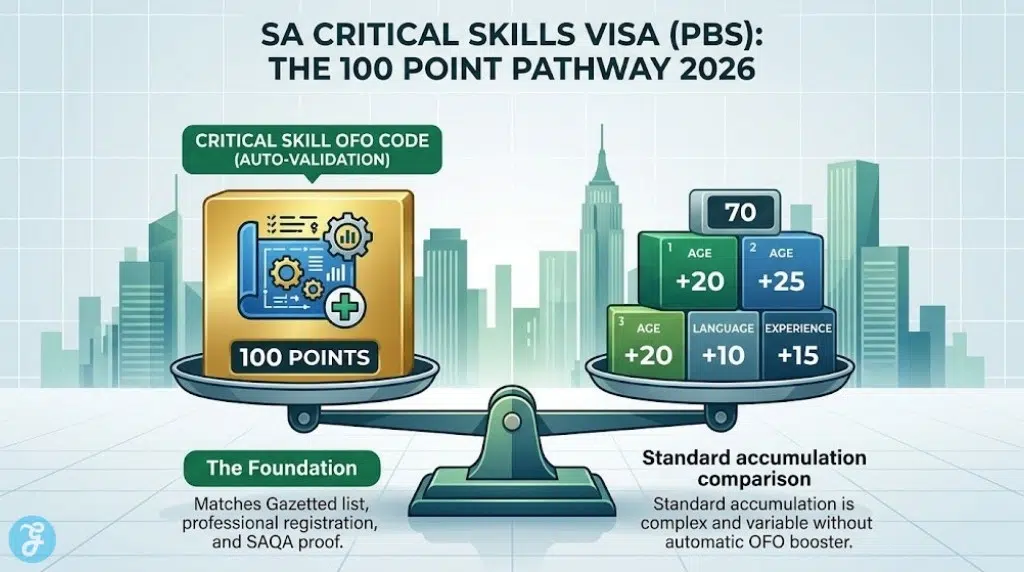
In 2026, South Africa utilizes a Points Based System (PBS) to evaluate all work visa applications, requiring a minimum score of 100 to qualify. The most significant benefit of this category is that if your specific job title appears on the official Critical Skills List, you are automatically awarded the full 100 points, effectively bypassing the need to accumulate scores through language or salary metrics. This streamlined scoring ensures that the most needed experts reach the country without unnecessary bureaucratic friction.
Best for: Professionals in ICT, Engineering, and Science whose roles are pre identified as national priorities.
Why We Chose It: This rule simplifies the complexity of the points scorecard for eligible candidates.
Things to consider: You must still provide a valid certificate from a professional body to unlock these points.
2. Mandatory Job Offer Requirement
The days of moving to South Africa for 12 months to search for work are over. In 2026, every applicant for a critical skills visa must have a formal, signed contract or a firm offer of employment from a registered local company at the time of submission. This requirement ensures that every person entering the country is immediately contributing to the workforce and the tax base, reflecting the government’s shift toward high utility migration.
Best for: Individuals who have already secured a position with a South African firm.
Why We Chose It: It is the most significant procedural shift from the previous immigration era.
Things to consider: The contract must meet specific labor law standards regarding leave and remuneration.
3. The SAQA Evaluation Bottleneck Relief
Waiting for the South African Qualifications Authority (SAQA) to verify foreign degrees used to take months, stalling thousands of applications. Under the current 2026 rules, you can now submit your visa application using only the proof of application to SAQA, provided you meet all other criteria. This change acknowledges the slow pace of academic verification and prevents it from hindering the entry of essential personnel.
Best for: Applicants in urgent roles who cannot wait for lengthy verification cycles.
Why We Chose It: This pragmatic update removes one of the most common administrative hurdles in the process.
Things to consider: The Department of Home Affairs will only issue a 12 month visa while the evaluation is pending.
4. Compulsory Professional Body Registration
Having a degree is no longer sufficient on its own. You must be registered with the relevant South African professional council or board associated with your skill, such as ECSA for engineers or IITPSA for IT professionals. These bodies act as the ultimate gatekeepers of quality, ensuring that foreign practitioners meet the same rigorous standards as their local counterparts.
Best for: Regulated professionals who want to ensure their application is legally compliant.
Why We Chose It: It serves as the primary verification mechanism for the authenticity of an applicant’s skills.
Things to consider: Some professional bodies require a separate competency exam before registration is granted.
5. Minimum NQF Level 7 Threshold
While there are occasional exceptions for specialized artisans, the vast majority of roles on the 2026 Critical Skills List require a minimum qualification equivalent to a South African National Qualifications Framework (NQF) Level 7. This generally equates to a Bachelor’s Degree or a highly specialized Advanced Diploma. This academic standard ensures that the skills being imported are of a high professional grade, supporting the country’s move toward a knowledge-based economy.
Best for: University graduates with a clear academic track record in technical fields.
Why We Chose It: It establishes a clear quality baseline for the foreign talent being imported.
Things to consider: If your degree is evaluated as NQF Level 6, you will likely be disqualified regardless of your experience.
6. Direct Pathway to Permanent Residency
The critical skills visa remains the most reliable route to obtaining Permanent Residency (PR) in South Africa. If you can demonstrate that you have at least five years of post-qualification experience in your field and hold a valid job offer, you can apply for PR under Section 27(b) of the Immigration Act. This long term stability is a major draw for families looking to plant roots in the region and build a stable future.
Best for: Professionals looking to make South Africa their permanent home and eventual place of citizenship.
Why We Chose It: PR provides a level of security and flexibility that temporary work visas cannot match.
Things to consider: The processing time for PR is significantly longer than the initial work visa.
7. Family Integration and Accompanying Rights
South African law allows holders of this visa to bring their immediate family members with them. Spouses and dependent children are eligible for accompanying visas, which allow them to reside in the country for the duration of the main applicant’s work permit. This compassionate approach to immigration policy recognizes that skilled individuals are more likely to stay and thrive if their family unit is intact.
Best for: Skilled expats who do not want to leave their families behind during their contract.
Why We Chose It: Family stability is a key factor in the long-term retention of high-value skills.
Things to consider: Spouses are not automatically allowed to work and must apply for their own work permits if they find employment.
8. Exemption from Department of Labour Certification
Unlike the General Work Visa, the Critical Skills category does not require the employer to advertise the position in local newspapers or seek a certificate from the Department of Employment and Labour. This effectively cuts months off the recruitment timeline for South African companies, allowing them to remain competitive in the global market. This exemption is based on the pre-established fact that these skills are in short supply locally.
Best for: Employers who need to fill specialized vacancies as quickly as possible.
Why We Chose It: This exemption is the primary reason the Critical Skills Visa is the “Gold Standard” of work permits.
Things to consider: The employer must still prove that the company is in good standing with the tax authorities.
9. Strict OFO Code Alignment
Every occupation on the government list is linked to a specific Organising Framework for Occupations (OFO) code. Your job description, contract, and letters of recommendation must perfectly match the tasks described under that specific code to avoid a rejection. This technical alignment is the first thing immigration officers check, making it a “make or break” component of the application.
Best for: Detail-oriented applicants who want to minimize the risk of technical refusals.
Why We Chose It: It is the specific metric used by immigration officials to verify that a role is truly “critical.”
Things to consider: Slight variations in job titles can lead to a mismatch if the duties do not align with the OFO definition.
10. The Trusted Employer Scheme (TES) Advantage
If your prospective South African employer is a member of the Trusted Employer Scheme, your application will likely be fast tracked. TES members benefit from a simplified document checklist and dedicated processing streams at the Department of Home Affairs. This partnership between government and major industry players represents a modern attempt to reduce the friction of high value hiring.
Best for: Candidates joining large multinational corporations or major South African enterprises.
Why We Chose It: It represents a modern, collaborative approach between the government and the private sector.
Things to consider: Small or medium businesses are less likely to have TES status, though the standard visa remains available.
11. No “Locally Sourced” Proof Required
In this visa category, the government accepts that the skills listed are in short supply nationally. This means the applicant does not have to provide a motivation letter explaining why a South African citizen was not hired for the role, significantly reducing the administrative burden on the hiring manager. This specific lack of a search requirement is one of the most attractive features for corporate HR departments.
Best for: HR departments that want to avoid the legal complexities of proving a skills shortage.
Why We Chose It: It acknowledges the reality of the global war for talent in specialized sectors.
Things to consider: This rule only applies if the job title is an exact match for the gazetted list.
12. Annual Updates to the Critical Skills List
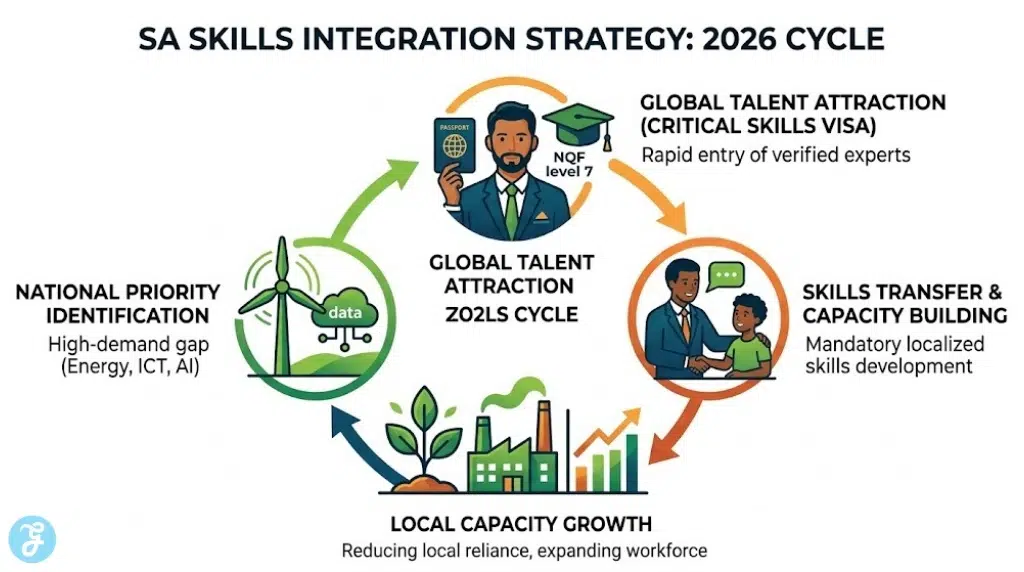
The list is not static; it is updated frequently to reflect the changing needs of the South African economy. In 2026, there has been a notable increase in roles related to renewable energy, cybersecurity, and data science, reflecting the country’s infrastructure and tech goals. Staying current with these updates is vital, as a profession that is critical today might be removed tomorrow as local capacity grows.
Best for: Professionals in emerging tech sectors who may not have qualified in previous years.
Why We Chose It: Regular updates ensure the system remains relevant to current market demands.
Things to consider: If a skill is removed from the list while your application is pending, it can create significant legal complications.
An Overview Of the South Africa Critical Skills Visa 2026
Understanding where your profile fits within the current immigration tiers is essential for a successful move. This comparison highlights how the critical skills route differs from other common work related pathways available this year.
| Feature | Critical Skills Visa | General Work Visa | Remote Work (Nomad) Visa |
| Points Required | 100 (Automatic) | 100 (Calculated) | N/A (Income based) |
| Job Offer | Mandatory (Local) | Mandatory (Local) | Mandatory (Foreign) |
| PR Pathway | Yes (Direct) | Yes (After 5 years) | No |
| DEL Certificate | Not Required | Required | Not Required |
| Max Validity | 5 Years | 5 Years | 1 Year |
Our Top 3 Picks and Why?
-
ICT Specialists: Software developers and data scientists are the most consistent winners in this category. With the 2026 tech boom in Cape Town and Johannesburg, these roles have the highest approval rates and the fastest professional body turnaround times.
-
Green Energy Engineers: As South Africa continues its energy transition, solar and wind energy experts are in high demand. These roles often benefit from simplified professional registration processes due to the national urgency of the power crisis.
-
Health Science Researchers: Specialized medical researchers are vital for the country’s growing biotech sector. We chose this because these professionals often qualify for immediate Permanent Residency if they have the requisite experience and publications.
How to Choose the Right South Africa Critical Skills Visa 2026 by Yourself?
Choosing to apply for a work permit is a major financial and life decision that requires careful planning. Use the following framework to determine if you are ready to begin your application for the 2026 season.
The Selection Framework
-
Audit Your Qualifications: Ensure your degree is from an accredited institution and likely to be evaluated as NQF Level 7 or higher by SAQA.
-
Confirm Your OFO Code: Download the latest government gazette and find the specific code that matches your daily tasks, not just your job title.
-
Assess Professional Standing: Contact the relevant South African professional body to determine their specific requirements for foreign members.
-
Review Your Contract: Check that your salary is market related and that your employer is registered and in good standing with the government.
The following matrix helps you decide if the critical skills route is the best choice for your current professional situation.
| Choose Critical Skills Visa if… | Choose an Alternative Visa if… |
| Your role is on the gazetted 2026 list. | You have a job offer for a role not on the list. |
| You want a direct pathway to residency. | You only want to live in SA for 6 to 12 months. |
| You have a high level technical degree. | You are an intra company transferee. |
| You want to work for any employer in your field. | You are working remotely for a foreign company. |
The Final Checklist
-
Have you confirmed that your job title and duties match the latest gazetted list?
-
Do you have your proof of application or final certificate from SAQA?
-
Have you obtained a letter of confirmation from the relevant professional body?
-
Is your passport valid for at least 30 days beyond the intended stay?
-
Have you secured a signed employment contract from a South African company?
Securing Your Future in the Rainbow Nation
The South African immigration system in 2026 is designed to be more transparent and predictable, provided you strictly adhere to the technical requirements of the points based system. By ensuring your professional registration is in order and your qualifications are correctly aligned with the national list, you can navigate the application process with confidence. This visa remains the premier choice for professionals who wish to contribute to a growing economy while enjoying the unique lifestyle opportunities that South Africa provides to its skilled immigrant community.
Frequently Asked Questions About South Africa Critical Skills Visa 2026
How long does it take to get a decision in 2026?
Answer: Standard processing times for this visa currently range between 4 and 8 weeks. If you are applying through a Trusted Employer Scheme member, you may see a decision in as little as 3 weeks.
Can I change employers while on a critical skills visa?
Answer: Yes, you can change employers provided the new role is within the same critical skill category and you update the Department of Home Affairs with your new contract.
Is there an age limit for this visa category?
Answer: There is no formal age limit for the critical skills visa. However, if you are over the age of 60, you may be required to provide additional medical documentation to ensure you are not a burden on the state.
What happens if my skill is removed from the list?
Answer: If your skill is removed while your visa is valid, you can usually stay until the expiry of your current permit. However, you may need to find a new visa category when it comes time to renew.
Do I need to undergo a medical exam?
Answer: Yes, all applicants must provide a medical report and a radiological report (chest X ray) that are no older than six months at the time of the application.






















