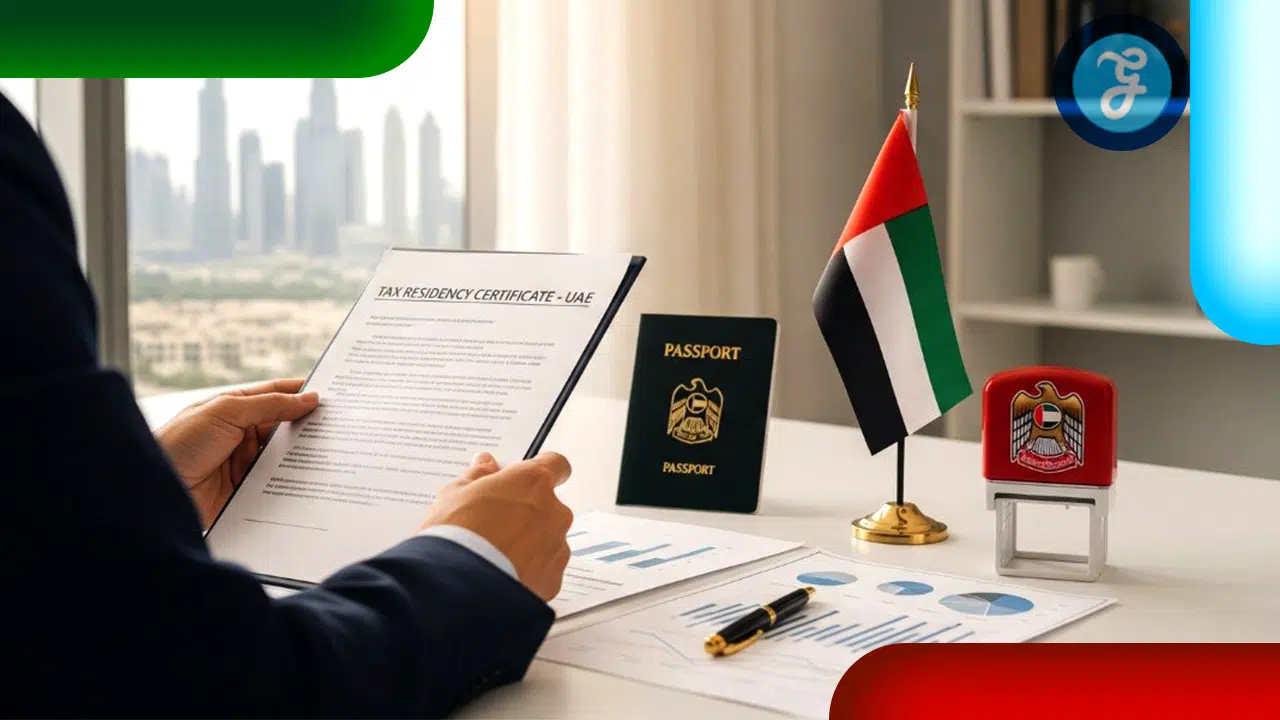
Are you tired of high taxes eating into your hard-earned money, especially if you work abroad or run a business? Many expats face this headache, juggling complex rules from their home countries while dreaming of a simpler life in a sunny spot like Dubai.
Did you know that the United Arab Emirates offers a tax-free income environment for residents, thanks to its double taxation agreements with over 100 countries?
This blog post breaks down the steps to become a tax resident in Dubai legally, from meeting the physical presence criteria like the 183-day rule to getting your tax residency certificate from the Federal Tax Authority.
Stick around, you’ll thank me later.
What is Tax Residency in Dubai?
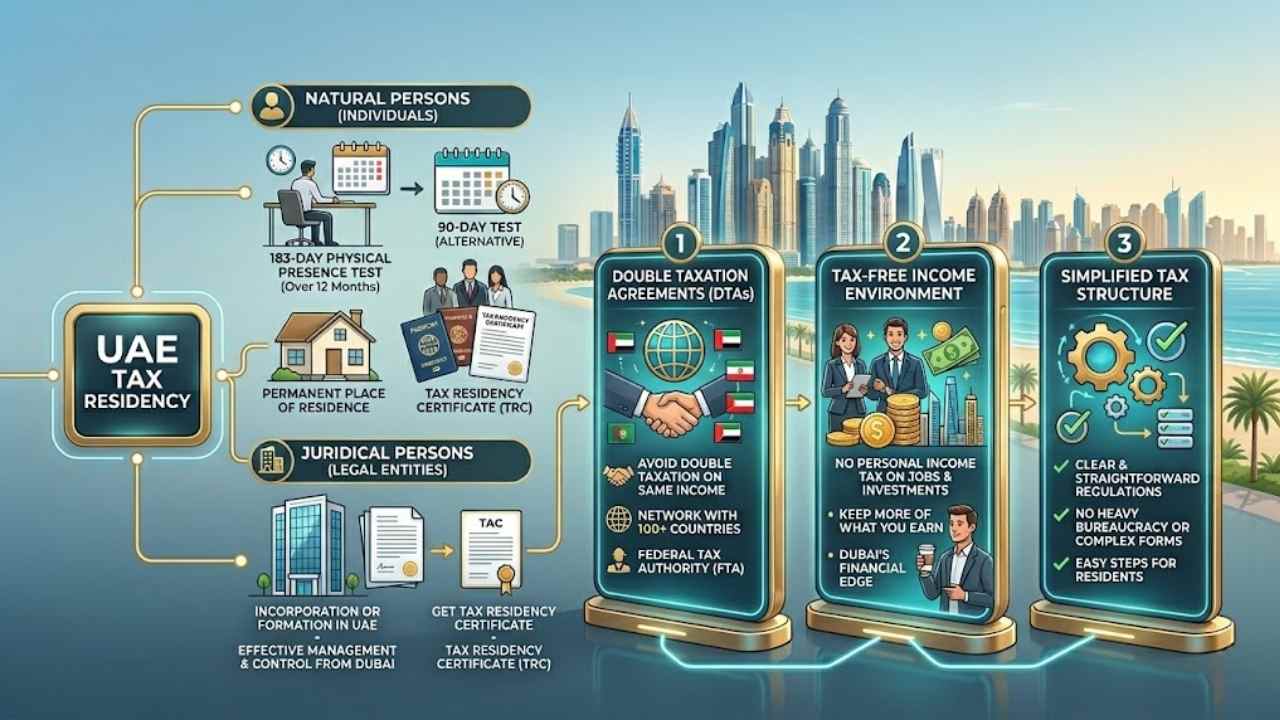
Tax residency in Dubai means you count as a resident for tax purposes in the UAE. Folks, think of it like planting roots in a sunny spot where taxes feel lighter. Natural persons qualify by meeting rules in UAE tax legislation.
Spend at least 183 days in the UAE over 12 straight months, and you hit the main mark. Or, try the 90-day test as another path for individuals. Keep a permanent place of residence here too, that seals the deal.
Government tips clarify these steps for everyday people like you. Legal entities, or juridical persons, get residency just by setting up in the UAE. They incorporate or form right here.
This ties into effective management and control from Dubai.
Double tax treaties play a big role, easing burdens across borders. The Federal Tax Authority, or FTA, issues a tax residency certificate, called a TRC, to those who qualify. Natural persons and companies both get them under UAE tax residency rules.
Imagine: you work hard, prove your ties, and snag that UAE tax residence certificate. It opens doors to tax compliance without the usual headaches. Residence permits and Emirates ID help show your spot.
Corporate tax fits in, but Dubai keeps things simple for residents. Stay on top of tax periods, and you thrive in this tax residence setup.
Benefits of Becoming a Tax Resident in Dubai
Imagine, you’re sipping coffee in Business Bay, and your earnings stay yours without heavy taxes biting in. With access to Gulf Cooperation Council deals and a straightforward corporate income tax setup, Dubai turns your financial game into a winning streak, making you wonder why you waited so long.
Access to Double Taxation Agreements (DTAs)
Dubai draws folks from all over, and tax residency here opens doors to sweet deals through Double Taxation Agreements. These pacts, folks call them DTAs, stop you from paying taxes twice on the same income.
For example, you earn money in one country but live in Dubai. A DTA steps in like a fair referee, it cuts down your tax bill. The Federal Tax Authority, or FTA, handles these in the UAE.
They link up with over 100 countries, including Gulf Cooperation Council members. Get your Tax Residency Certificate, known as TRC, and you tap into this network. It proves your status under UAE tax laws or those DTAs.
Natural persons qualify if they meet rules like the 183-day physical presence test.
Folks often chat about how DTAs boost business, especially with free zone companies. Set up one, and you gain from these agreements right away. Say you run a tech firm in Business Bay, DTAs shield your profits from double hits.
The cabinet of the UAE backs these with clear guides. Pranav Shah and Tanvi Maniar, experts from EY-Parthenon, share tips on this. They point out how DTAs tie into corporate income tax perks.
Add in blockchain for secure deals, and you see the edge. A 90-day test also works for residency, it fits busy lives. Proof of income, like a salary certificate, seals the deal for your TRC.
Tax-Free Income Environment
Imagine ditching those hefty tax bills that eat into your hard-earned cash, like a sneaky thief in the night. Dubai offers a tax-free income setup for residents, letting you keep more of what you make from jobs or investments.
People flock here for this perk, especially with the Federal Tax Authority (FTA) overseeing a system that skips personal income taxes. A legal entity counts as a UAE tax resident if formed in the UAE, paving the way for tax perks under Double Taxation Agreements (DTAs).
Natural persons qualify by hitting the 183-day physical presence rule in a 12-month stretch, or the 90-day test as an alternative. Grab employment in the UAE, buy real estate, or register a free zone company to lock in that residency certificate and enjoy the ride.
Dubai’s tax-free vibe feels like finding an oasis in a desert of deductions, says Sowmya Mathew, a corporate finance expert.
This environment ties into broader trends, like sustainability and technology in free zone companies. Wealth management pros often pair it with M&A strategies or private equity moves.
The FTA’s Tax Residency Certificate (TRC) acts as your golden ticket, backed by proof like a memorandum of association for businesses. Additional government guidance clarifies needs, such as a primary residence alongside physical stays.
Folks in financial services or energy & resources sectors love how this simplifies excise returns and boosts assurance in geostrategy plays.
Simplified Tax Structure
Dubai’s tax setup stays straightforward for residents. You avoid personal income taxes altogether. Legal entities count as UAE tax residents right after they form in the country. Natural persons meet clear rules, like the 183-day physical presence in a 12-month span.
Or try the 90-day test instead. This keeps things simple, no heavy jargon or endless forms. Picture it like a smooth road trip, free from bumpy detours in tax rules. Groups like Freemont Oneworld Group help with people and regulatory services to cut through any risk.
They guide on transformation and IFRS standards too.
Extra guidance from the government clears up details for folks. You need a primary residence here, plus proof of stay. Employment visas open doors to this easy system. So does buying property or setting up a free zone company.
Tools from EY.ai and EY Wavespace™ boost your grasp on these basics. Keelin Kane shares insights on global innovation institute ties, mixing in Zayed the Giving spirit for community focus.
Even the digital tourist tax refund scheme fits into this clean framework, dodging complexity.
Legal Requirements for Tax Residency in Dubai
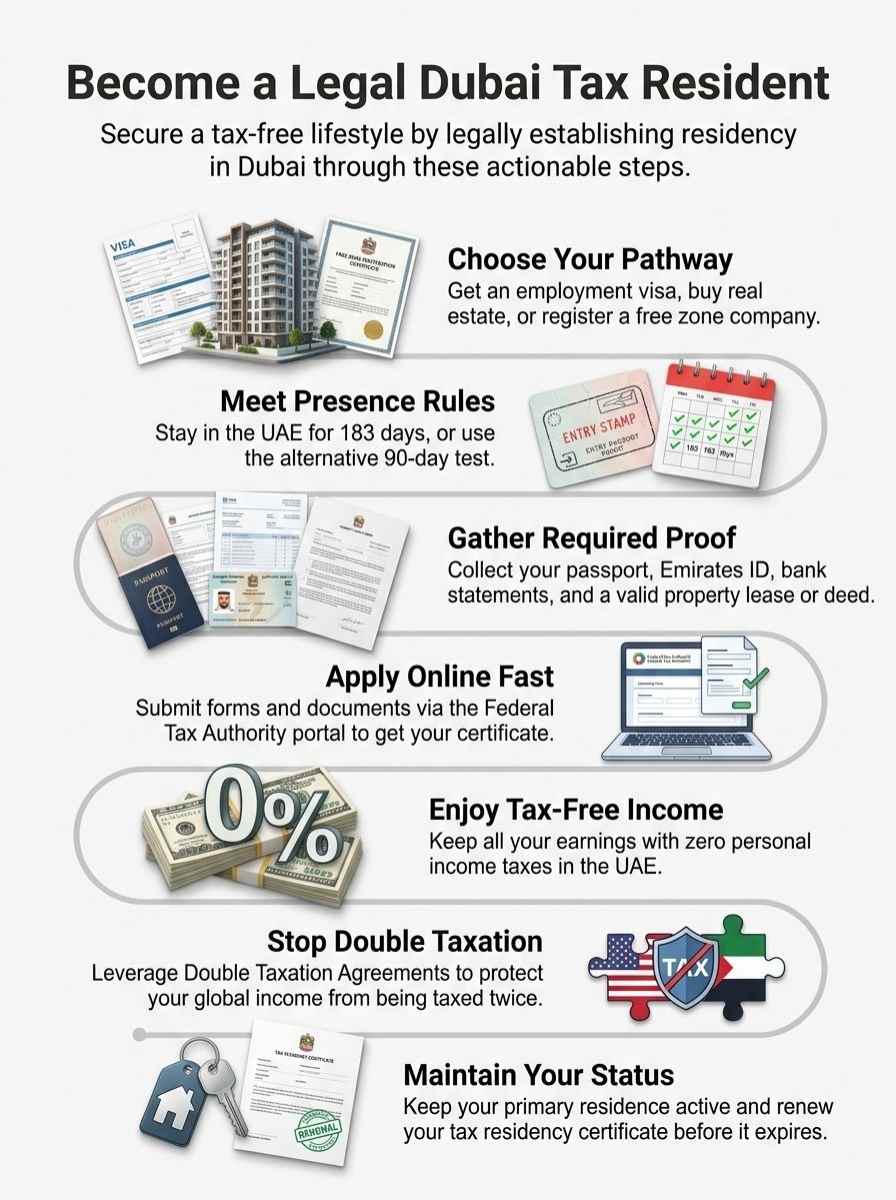
Hey, if you’re eyeing tax residency in Dubai, you gotta hit key rules set by the Federal Tax Authority, like proving your stay with a rental contract or utility bill and showing ties through work or investments, and who knows, maybe even link in programs like the Labaih initiative for extra perks—stick with me to uncover all the steps!
Physical Presence Criteria (90 or 183 Days Rule)
Natural persons qualify as UAE tax residents by meeting specific conditions in UAE tax legislation. Spend at least 183 days in the UAE over a consecutive 12-month period, and you hit the primary criterion for tax residency.
This rule acts like a key that unlocks your status, no tricks involved. UAE authorities set this bar to confirm your real ties here. Pair it with a primary residence in the UAE, and your case strengthens.
Government guidance clarifies these points for folks like you aiming to settle in. Think of it as planting roots in Dubai’s sunny soil. Officials review your time spent carefully. They want proof of your commitment.
Additional rules help sort out the details for everyone.
Folks often choose the 90-day test as an alternative path to tax residency status in the UAE. Stay for at least 90 days, show strong connections, and you might qualify too. This option fits those with busy lives, juggling work and travel.
UAE tax laws outline these paths clearly. Combine this with efforts like the Labaih initiative, which promotes community ties. Even cybersecurity pros find Dubai appealing for its safe digital scene.
Authorities issue extra guidance to make requirements crystal clear. You provide evidence of your stays and activities. This approach keeps things fair for natural persons. Dubai welcomes contributors who follow these steps.
Proof of Residency Documentation
You need solid proof to show you’re a tax resident in Dubai. Gather these documents early to avoid headaches down the road.
- Show your physical presence with stamped passport pages or entry/exit records that prove you spent at least 183 days in the UAE over a 12-month stretch, as the main rule demands.
- Use bank statements or utility bills to confirm your primary residence in the UAE, tying into that key requirement for natural persons under tax laws.
- Provide your UAE residence visa from employment, which acts as strong evidence since getting a job here is one of three top ways to qualify and snag that residency certificate.
- Submit property ownership papers if you bought real estate in Dubai, yeah, that counts as a smart path to establish your tax residency status legally.
- Include company registration docs from a free zone if you set up a business there, opening the door to a residence certificate and full tax resident perks.
- Attach any additional government guidance papers that clarify rules for natural persons, helping you meet those specific conditions in UAE tax legislation.
- Offer lease agreements or rental contracts to back up your 90-day alternative test for presence, giving you another shot at proving residency without the full 183 days.
- Present your tax residency certificate application forms, which the Federal Tax Authority reviews for folks who qualify under UAE laws or Double Taxation Agreements.
Activity and Contribution Evidence
Natural persons qualify as UAE tax residents by showing real ties to the country. Think of it like planting roots in a new garden, you need to nurture them. Meet the 183-day physical presence rule in a 12-month stretch, or opt for the 90-day test as another path.
Prove your primary residence sits in the UAE, with documents like utility bills or lease agreements. Government guidance spells out these steps for clarity, so follow them to avoid mix-ups.
Show your activities and contributions through work, property ownership, or business setup. Get an employment visa to enter the job market here. Buy real estate in Dubai, and that counts as a solid tie.
Register a free zone company for another strong link. These actions help the Federal Tax Authority see your commitment. Tax residency certificates go to those who fit under UAE tax laws or Double Taxation Agreements.
Keep records handy, folks, it makes the process smoother.
How to Obtain a Tax Residency Certificate
You want that shiny certificate proving your tax home in Dubai, right? Start by logging into the Federal Tax Authority portal, grab your passport copy, Emirates ID, and lease agreement, then hit submit to kick off the approval dance.
Application Process Through the Federal Tax Authority
Applying for a tax residency certificate in Dubai starts with the Federal Tax Authority. This process helps you prove your status under UAE tax laws or Double Taxation Agreements.
- Head to the Federal Tax Authority’s online portal to kick off your application, where you’ll find forms intended for natural persons or legal entities. Fill them out with details like your physical presence in the UAE, aiming for that 183-day rule over 12 months, or the alternative 90-day test if it fits your situation. Submit proof of your primary residence here, too, since it’s key alongside time spent in the country. Think of it as piecing together a puzzle, each document showing your ties to Dubai.
- Gather required documents before you hit submit, including your passport, visa, and evidence of employment or property ownership in the UAE. Include bank statements or utility bills to back up your activity and contributions, proving you’re not just passing through. Officials review these to confirm you qualify as a UAE tax resident, based on laws that cover everyone from workers to company owners.
- Pay any fees through the portal, usually a small amount to process your request. The authority issues certificates to all who meet criteria under UAE tax rules or DTAs, so double-check government guidance for the latest on natural persons’ requirements. It’s like getting a golden ticket, but only if your paperwork sings the right tune.
- Wait for approval, which often comes in a few weeks if everything lines up. Track your status online, and reach out to support if snags pop up, like missing docs. This step locks in your tax residency, opening doors to benefits in a tax-free setup.
- Receive your certificate digitally or by mail once approved, valid for proving residency in international dealings. Use it wisely for things like avoiding double taxation abroad, and keep records handy for renewals. Folks who buy real estate or register free zone companies often breeze through this, as those paths strengthen your case.
Required Documents for Tax Residency Certificate
You want to grab that tax residency certificate in Dubai, right? Gather these key papers to make the process smooth as silk.
- Passport copy: Submit a clear copy of your valid passport, folks, because it proves your identity and ties into those physical presence rules like the 183-day or 90-day tests for natural persons under UAE tax legislation.
- Emirates ID: Hand over your Emirates ID card, which shows you qualify as a UAE tax resident, especially if you meet criteria through employment visas, real estate purchases, or free zone company registration.
- Proof of address: Provide a rental agreement or property deed to confirm your primary residence in the UAE, a must alongside spending at least 183 days in a 12-month stretch or hitting the 90-day alternative for tax residency status.
- Employment contract or business license: Include your job contract if you got residency via employment, or your free zone company papers if that’s your path, as these link directly to the three main ways to establish tax residency in Dubai.
- Bank statements: Show recent bank statements from a UAE account to demonstrate activity and contribution evidence, supporting your case under Double Taxation Agreements and UAE tax rules for natural persons.
- Visa copy: Attach a copy of your UAE residence visa, crucial for those who qualify through the 183-day physical presence rule or the 90-day test, as outlined in further government guidance for tax residents.
- Application form: Fill out the official form from the Federal Tax Authority, which issues certificates to all who meet UAE tax legislation or DTA standards, whether you’re a legal entity incorporated in the UAE or a natural person with proof.
- Tax returns or financial docs: Add any recent tax filings or income proofs to back your simplified tax structure benefits, ensuring you comply with local and international tax laws while maintaining residency status.
Methods to Become a Tax Resident in Dubai
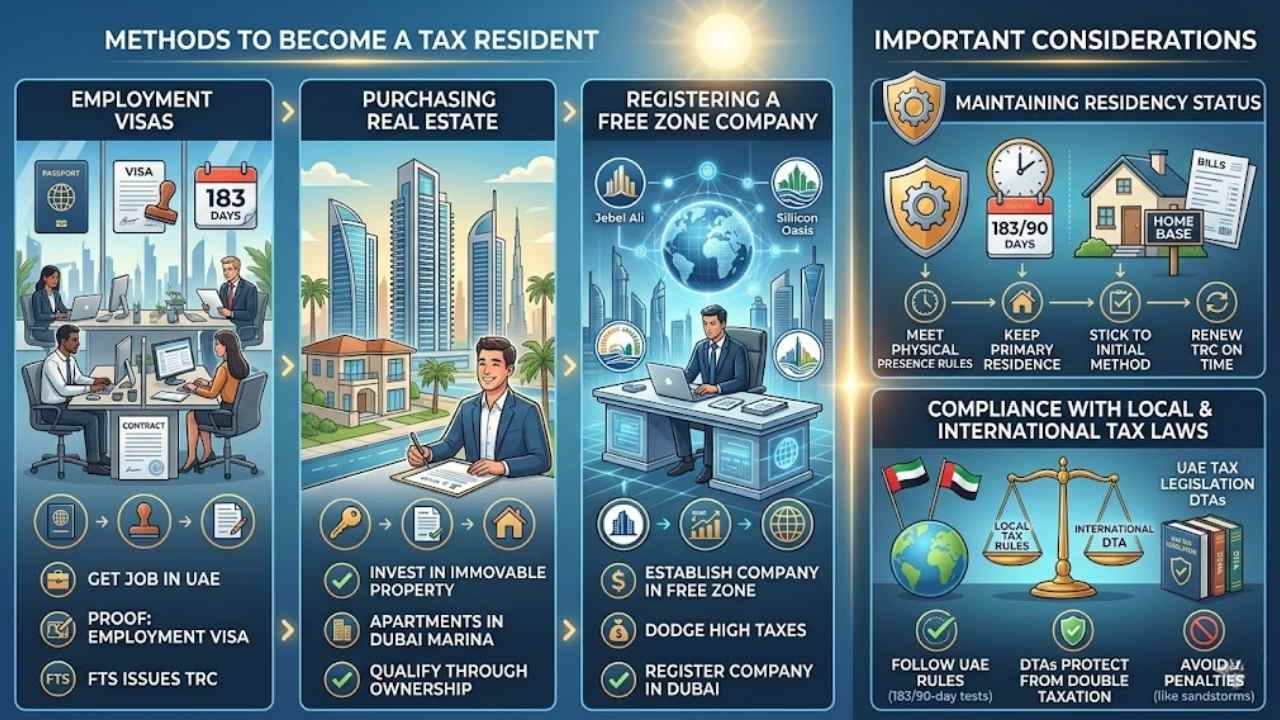
You might think moving to Dubai for tax perks sounds like a dream, but several paths make it real, from landing a job there to investing in property. Picture yourself setting up shop in a bustling free zone, or securing that golden visa through work—each option opens doors to your new tax life, so keep reading for the details.
Employment Visas
Get a job in the UAE, and you open the door to tax residency. This path counts as one of three main ways to snag a UAE residence certificate. Picture yourself landing work in Dubai, it sets you up for that tax-free income vibe.
Officials look at your employment visa as solid proof. You meet the rules, like spending 183 days here in a 12-month stretch, or even the 90-day test if that fits better. Natural persons qualify this way under UAE tax laws.
Add in a primary residence, and you’re on track.
Folks chase this route for those double taxation agreements perks. Register with the Federal Tax Authority after you arrive. They issue tax residency certificates to qualifiers. Think of it as your ticket to a simplified tax structure.
Activity evidence from your job helps seal the deal. Government guidance spells out these steps for clarity. UAE tax legislation backs it all up.
Purchasing Real Estate in Dubai
Buy property in Dubai, and you open a door to tax residency. This method stands as one key path to get a UAE residence certificate. People often choose homes or apartments in lively areas like Dubai Marina.
You qualify for residency by owning immovable property here. Think of it as planting roots in a sunny spot, where your house becomes your ticket to tax perks. Authorities check your ownership papers to confirm this status.
Many expats pick this route for its ease and long-term appeal.
Invest in real estate, and tie it to the 183-day or 90-day presence rules for full tax residency. You need a primary residence in the UAE to meet these criteria. Officials from the Federal Tax Authority review your setup.
They issue certificates based on UAE tax laws or DTAs. Picture chatting with a real estate agent over coffee, sealing the deal that changes your tax game. This approach works well if you run a free zone company too, blending business with home life.
Registering a Free Zone Company
Set up a free zone company in Dubai, and you open doors to tax residency. This path lets you gain a UAE residence certificate, which helps qualify you as a tax resident. Imagine yourself as a business owner, exploring Dubai’s vibrant economy while dodging high taxes back home.
You register the company in one of Dubai’s free zones, like Dubai Silicon Oasis or Jebel Ali Free Zone. Authorities issue tax residency certificates to those who meet UAE tax rules or Double Taxation Agreements.
Natural persons qualify by showing they fit the bill under local laws.
Grab this option if you run a business or want to start one. It counts as a key way to establish residency, along with jobs or property buys. Meet the 183-day physical presence rule in a 12-month stretch, or try the 90-day test for flexibility.
Keep your primary residence in the UAE too, folks. Government guides clarify these steps for natural persons. You contribute to the economy this way, and it feels like hitting two birds with one stone.
Important Considerations for Tax Residency
Think of maintaining your residency status like tending a garden; skip the upkeep, and those tax perks could wilt away fast. Stick to UAE rules and global pacts on taxes, folks, to dodge penalties that hit like a sandstorm.
Maintaining Residency Status
You got your tax residency in Dubai, now keep it solid. Folks slip up by ignoring the rules, so let’s chat about staying on track.
- Meet the physical presence rules to hold your UAE tax residency status; spend at least 183 days in the UAE over a 12-month stretch, or hit the 90-day test if that fits your life better, because the government checks this stuff closely.
- Keep your primary residence in the UAE, as it’s a key piece alongside those day counts; think of it like rooting your home base here, with bills and ties that show you’re not just passing through.
- Stick to the methods that got you residency, like holding onto your employment visa, owning that immovable property, or running your free zone company; drop any, and you risk losing your status, so treat them like gold.
- Follow UAE tax legislation and Double Taxation Agreements to stay compliant; the Federal Tax Authority issues guidance on this, and ignoring it could mean big headaches, like audits or revoked certificates.
- Gather proof of your activities and contributions in the UAE, since natural persons need to show they’re truly settled; collect documents that prove your ties, and renew them as needed to avoid any slip-ups.
- Renew your tax residency certificate through the Federal Tax Authority when it expires; they issue these to qualified folks under the rules, so submit fresh docs on time, or you might find yourself starting over from scratch.
- Watch for updates in government guidance, as they’ve put out more details on requirements for tax residents; stay in the loop, maybe set a calendar reminder, because changes happen and you don’t want to get caught off guard.
Compliance with Local and International Tax Laws
Stay on top of UAE tax rules, folks, because they keep things straightforward for residents. Natural persons qualify as UAE tax residents by meeting conditions in UAE tax legislation, like the 183-day physical presence rule within a 12-month period.
Imagine you’re sipping coffee in your Dubai apartment, but you must follow local laws to avoid any hiccups. Extra government guidance clarifies requirements for folks like you seeking residency status.
Tax residency certificates get issued to those who qualify under UAE tax legislation or Double Taxation Agreements, so grab that proof to show you’re legit. Having a primary residence in the UAE, along with physical presence, seals the deal for qualification.
Oh, and don’t forget, a 90-day test offers another path if the longer stay doesn’t fit your vibe.
Get into compliance with international tax laws, and you’ll see how DTAs protect you from double taxation. UAE tax residents access these agreements, which smooth out dealings with other countries.
See it as a bridge over choppy waters, keeping your income safe. Follow these rules, and you dodge penalties that could sting like a bee. UAE authorities issue certificates for all who meet the criteria, so use them wisely in global dealings.
Stay active in your residency, contribute through work or property, and compliance becomes second nature.
Final Thoughts
You’ve learned the basics of tax residency in Dubai, from meeting the 183-day rule or 90-day test to using paths like employment visas, buying property, or setting up a free zone company.
These steps make the process simple and quick, with clear documents through the Federal Tax Authority that fit busy lives. Gaining this status opens doors to tax-free income and Double Taxation Agreements, boosting your finances and cutting global tax hassles big time.
Check out UAE government sites for more tips, or talk to a local advisor for custom help. Go ahead, chase that Dubai dream, it could change your world like it did for me when I first moved there and felt the freedom hit.
FAQs
1. What steps do I take to become a tax resident in Dubai legally?
First, get a residence visa, like an employment or investor one, to start your journey. Live in Dubai for at least 183 days a year, it’s like planting roots in the desert sand. Then, apply for a tax residency certificate from the Federal Tax Authority, and voila, you’re set.
2. Do I need to own property to qualify as a tax resident in Dubai?
No, owning property helps, but it’s not a must. You can qualify through work or family ties instead.
3. How long does the process take to become a legal tax resident in Dubai?
It often takes a few weeks to a couple of months, depending on your visa type. Picture it like waiting for a camel to cross the road, steady but sure. Just gather your documents early to speed things up.
4. What benefits come with being a tax resident in Dubai legally?
You enjoy zero personal income tax, which feels like finding an oasis in a financial desert. Plus, it opens doors to business perks in the UAE.