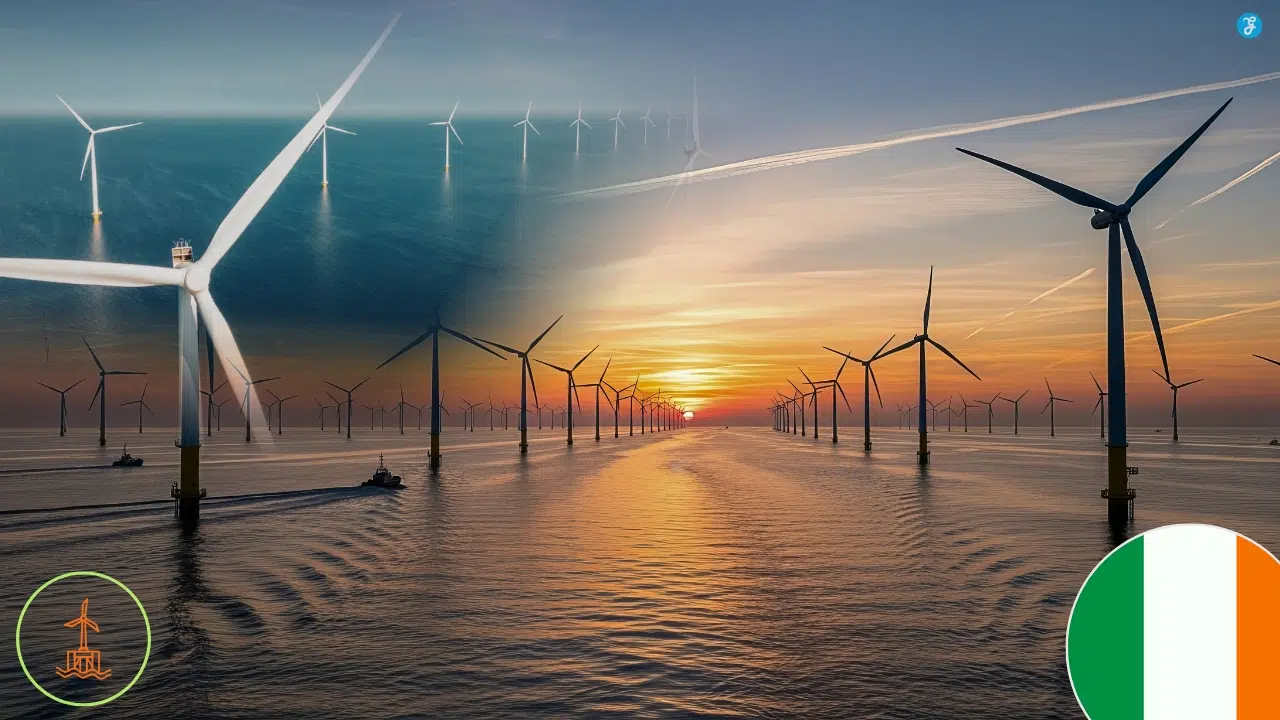
Ireland is standing at the threshold of a generational energy shift. With a maritime territory ten times the size of its landmass and some of the highest average wind speeds in the world, the story of Ireland’s offshore wind potential in 2026 is moving from visionary policy to tangible reality. Driven by the legal mandates of the Climate Action Plan and the strategic rollout of the Future Framework, Ireland is positioning itself to not only decarbonize its own grid but to become a primary exporter of green energy to mainland Europe.
Identifying the Core Pillars of Ireland’s Maritime Future
To identify the most critical developments for 2026, we analyzed the latest ORESS auction results, the March 2026 implementation report for the South Coast DMAP, and the current construction status of major interconnectors. Our selection criteria focused on project bankability, legislative progress, and the technical shift toward floating platforms. These seven facts represent the current industrial and economic state of a sector that is projected to be worth billions to the Irish economy by the next decade.
The following pillars define Ireland’s path to becoming a European renewable energy hub and outline the specific milestones required to reach net-zero targets.
The 7 Most Essential Facts About Ireland’s Offshore Wind Potential
Navigating the Irish offshore sector requires an understanding of the phased approach the government has taken to ensure grid stability and developer certainty.
1. The 37 GW Long-Term Statutory Ambition
As of early 2026, Ireland has locked in a legally binding roadmap for offshore generation. While the immediate focus is the 5 GW target by 2030, the long-term vision is massive, targeting 20 GW by 2040 and at least 37 GW by 2050. For a country with a current peak demand of roughly 6 GW, this capacity is designed specifically for the production of green hydrogen and large-scale electricity export to the European Union.
Best for: International infrastructure investors and green hydrogen developers seeking a high-volume, long-term market.
Why We Chose It:
-
It provides a clear 25-year investment horizon for the global supply chain.
-
It places Ireland at the top of the OECD for per-capita renewable potential.
-
It aligns the national grid with the wider energy security goals of the European Union.
Things to consider: Reaching the 37 GW mark will depend heavily on the rapid commercialization of floating wind technology, as most of this capacity lies in deep Atlantic waters.
2. The Success of the ORESS Auctions and Tonn Nua
The Offshore Renewable Electricity Support Scheme (ORESS) has successfully awarded its first several gigawatts of capacity. In late 2025, the Tonn Nua project off the Waterford coast was awarded to a joint venture at a competitive price. This, combined with previous auction rounds, means Ireland now has a firm pipeline of nearly 4 GW of projects moving through the final planning stages in 2026.
Best for: Supply chain companies looking to time their entry into the Irish market based on confirmed project pipelines.
Why We Chose It:
-
It demonstrates that Ireland can attract top-tier global developers and utility companies.
-
The competitive strike prices prove that Irish offshore wind can be cost-effective compared to fossil fuels.
-
It provides the first-mover momentum needed to build local port and infrastructure confidence.
Things to consider: The next major auction is expected to target specific areas on the south coast, necessitating detailed environmental preparation.
3. The South Coast DMAP: A Plan-Led Revolution
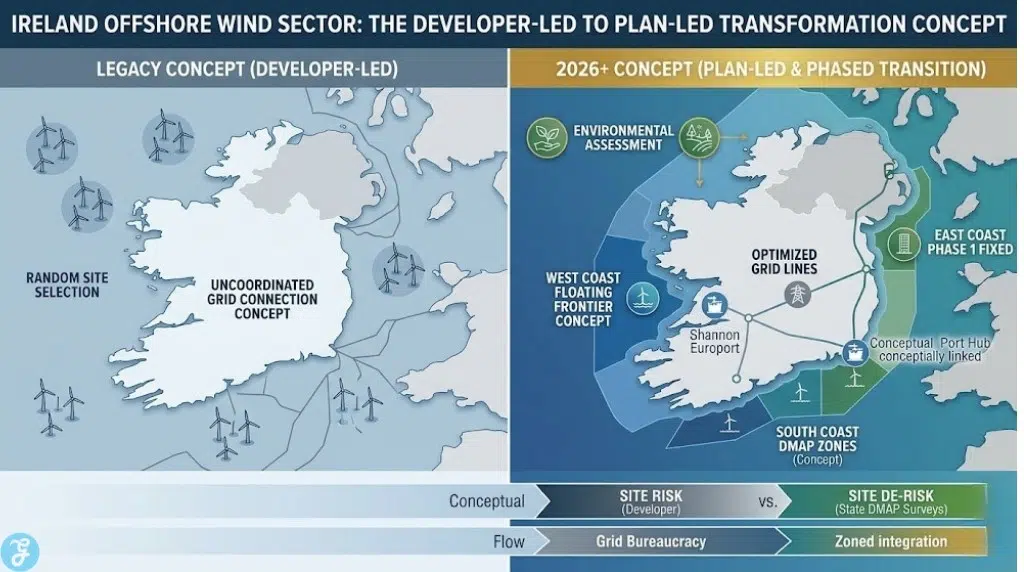
Ireland has officially moved away from the developer-led model to a plan-led approach through Designated Maritime Area Plans (DMAPs). The South Coast DMAP, approved by the national assembly, identifies specific zones for development. In March 2026, the government confirmed that surveys for multiple areas are underway to streamline the planning process for future developers and reduce ecological impact.
Best for: Environmental consultants and marine spatial planners who require high-resolution data on site suitability.
Why We Chose It:
-
It reduces the planning risk for developers by pre-identifying viable maritime zones.
-
It ensures that biodiversity and local fishing interests are integrated into the grid design from the start.
-
It represents the first-ever comprehensive marine spatial plan for Irish energy.
Things to consider: Developers must still undergo rigorous project-level environmental assessments before any offshore construction begins.
4. Codling Wind Park: The 2026 Construction Anchor
The Codling Wind Park, located off the Wicklow coast, remains Ireland’s flagship offshore project. With a planned capacity of up to 1,300 MW, it is a massive joint venture moving through the final stages of the planning system. As of early 2026, the project is preparing for construction activities expected to ramp up in late 2026 and 2027 to meet the critical 2030 operational goal.
Best for: Local contractors and engineering firms seeking large-scale work packages in the Leinster region.
Why We Chose It:
-
At full capacity, this single project will provide over 25 percent of Ireland’s 2030 offshore target.
-
It is the most advanced of the Phase 1 projects currently in the Irish system.
-
It will serve as the primary learning project for the domestic offshore supply chain.
Things to consider: The final turbine count and heights are subject to specific grant permissions expected later this year.
5. The Floating Wind Frontier and Atlantic Innovation
While Phase 1 projects use fixed-bottom foundations, the future of Irish energy lies in the deep waters of the Atlantic. Research projects concluding in early 2026 have provided critical data on how floating platforms behave in harsh conditions. This data is now being used to design the first Phase 2 floating arrays, which will be essential for reaching the 2040 and 2050 targets.
Best for: Research institutions and technology firms specializing in deep-water mooring and floating foundation design.
Why We Chose It:
-
Floating wind is the only way to unlock the massive energy potential of Ireland’s West Coast.
-
It allows for deployment further offshore, reducing the visual impact on coastal communities.
-
It positions Ireland as a global testbed for next-generation offshore technology.
Things to consider: Floating wind remains more expensive than fixed-bottom, necessitating higher support prices in early-stage pilot auctions.
6. The 2026 Interconnection Milestone
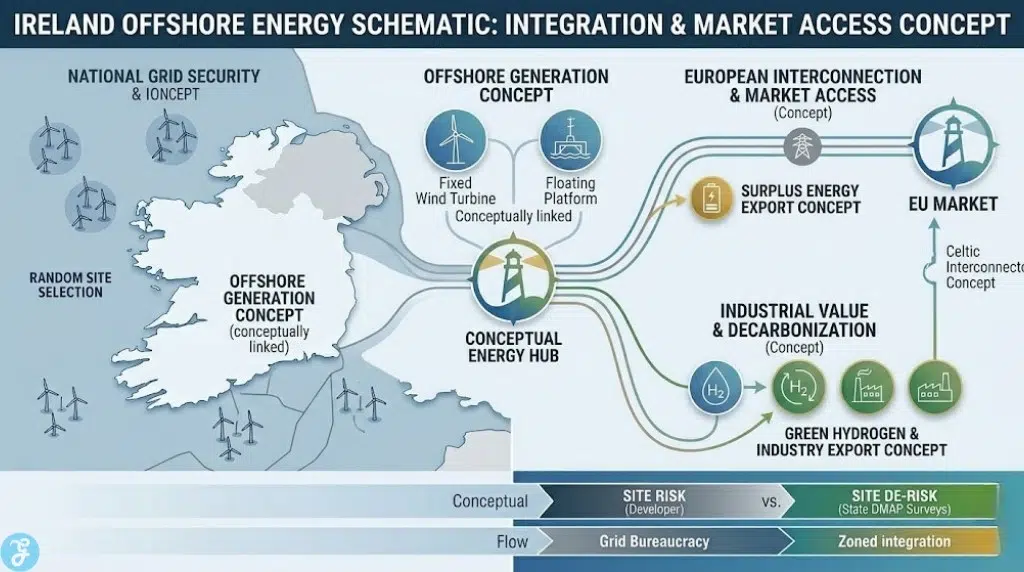
The 700 MW Celtic Interconnector, linking Ireland to France, is reaching a critical milestone. As of early 2026, terrestrial works in Ireland are nearing completion. This subsea cable is the first direct electrical link between Ireland and continental Europe, allowing the nation to export surplus wind power directly to the internal EU market.
Best for: Energy traders and large-scale industrial users who benefit from a more integrated European power grid.
Why We Chose It:
-
It provides a market vent for the surplus energy Ireland will generate on high-wind days.
-
It increases national energy security by allowing for imports during low-wind periods.
-
It is a prerequisite for Ireland becoming a net exporter of renewable electricity.
Things to consider: Full commissioning and first power flow are currently expected by 2028 following the completion of the French converter stations.
7. The Port Infrastructure Gap and 2026 Reinvestment
Despite the massive potential, Ireland faces a significant infrastructure bottleneck. In 2026, the government is accelerating a multi-port strategy to bridge this gap. Key developments include new berths at the Port of Cork, planning applications for the Rosslare Europort hub, and large-scale floating wind plans for the Shannon Estuary. Without these deep-water quays, Ireland would remain dependent on foreign ports for construction.
Best for: Port authorities, logistics providers, and civil engineering firms involved in marine construction.
Why We Chose It:
-
It is the make-or-break factor for the Irish offshore wind industry’s local economic impact.
-
Targeted developments will be the first in Ireland capable of large-scale marshalling and assembly.
-
Strategic locations are moving to become global hubs for floating wind through international alliances.
Things to consider: Current analysis suggests Ireland needs a dedicated port infrastructure fund to keep pace with the 2030 construction deadlines.
Visualizing the Growth of Ireland’s Offshore Capacity
To understand the scale of the transition, it is helpful to look at the capacity milestones established in the 2026 Future Framework. These targets represent a massive scaling of infrastructure over the next two decades.
The table below outlines the statutory targets for offshore wind capacity and the primary focus of each development phase.
| Milestone Year | Target Capacity | Primary Focus Area |
| 2030 | 5 GW | Fixed-bottom (East and South Coasts) |
| 2040 | 20 GW | Floating wind transition (West Coast) |
| 2050 | 37 GW | Full export and Green Hydrogen Economy |
| 2026 Status | ~4 GW | Projects Auctioned or in Planning |
The 3 Most Critical Factors for Success
Of the seven facts discussed, the 37 GW Ambition, the Codling Wind Park, and the Celtic Interconnector are the most critical. The 37 GW target provides the scale that attracts global capital, while Codling Wind Park is the first project that will actually change the national generation mix in this decade. The Celtic Interconnector is the physical plug that connects Ireland to the European market. Together, these three ensure that Ireland has the scale, the immediate progress, and the market access to succeed as a major energy provider.
A Strategic Framework for the Irish Offshore Market
For businesses looking to engage with the Irish offshore sector in 2026, following a structured roadmap is essential. The market is shifting toward a plan-led model that requires early engagement with provincial and national authorities.
The Selection Framework:
-
Identify Phase 1 Opportunities: Focus on the supply chain needs of major projects off the east coast for the 2026 to 2028 period.
-
Monitor DMAP Implementation: Use the South Coast DMAP reports to identify future survey and environmental work.
-
Assess Port Readiness: Align logistics and storage needs with the developments in Cork, Rosslare, and Shannon.
Decision Matrix:
The matrix below helps prioritize your strategy based on your primary business goals for the current year.
| If your goal is… | Then your 2026 strategy should be… |
| Immediate Contract Value | Target the Codling Wind Park supply chain. |
| Long-term Market Entry | Establish a base in the Shannon Foynes hub. |
| Data and Consultancy | Monitor the Regional Level Surveys in the South Coast. |
Final Compliance Checklist for 2026
Before committing to long-term contracts or site development, ensure your projects are aligned with the latest regulatory updates. Use the following points to audit your strategy.
-
Have you reviewed the March 2026 South Coast DMAP Progress Report?
-
Is your business registered with the ORESS Community Benefit Fund rulebooks?
-
Have you checked the latest Maritime Area Consent updates for regional ports?
-
Are your skills aligned with the 2026 Offshore Wind Workforce training standards?
-
Have you evaluated the Celtic Interconnector impact on your long-term energy pricing?
Harvesting the Power of the Atlantic
Ireland’s offshore wind story in 2026 is one of rapid professionalization. By moving to a plan-led model and securing multi-gigawatt pipelines through ORESS, the country has moved beyond the potential phase and into active development. The challenge now lies in the physical execution: building the ports, training the specialized workforce, and completing the interconnectors. If these enabling infrastructures are delivered, Ireland is well on its way to becoming the green battery of Europe, turning its legendary wind into a permanent national asset.
Frequently Asked Questions (FAQ)
Why has Ireland only built a small amount of offshore wind so far?
Ireland historically focused on onshore wind development. The offshore industry required a new legislative framework and a new regulatory body, both of which are now fully operational as of 2026, allowing for the current surge in project approvals and auctions.
What is the difference between fixed-bottom and floating wind?
Fixed-bottom turbines are anchored directly to the seabed and are suitable for shallow waters like the Irish Sea. Floating wind uses buoyant platforms moored to the sea floor, allowing for generation in much deeper, windier waters off the Atlantic coast.
Will these offshore wind farms increase the cost of electricity?
Recent auctions have secured prices that are competitive with wholesale electricity. In the long term, a high-renewable grid reduces Ireland’s dependence on expensive imported gas, leading to more stable and lower energy costs for the consumer.
How do the DMAPs help local coastal communities?
Designated Maritime Area Plans ensure that development is concentrated in specific zones, reducing the impact on the wider marine environment. Additionally, all projects must contribute to a Community Benefit Fund, which provides millions of euros annually to local projects.
Can Ireland really export its wind power to Europe?
Yes. Through the Celtic Interconnector to France and existing links to the UK, Ireland can sell excess power during high-wind periods. There are also plans for further interconnectors and green hydrogen production to maximize the value of Ireland’s wind resource.