What Does It Mean To Productize Your Digital Services?
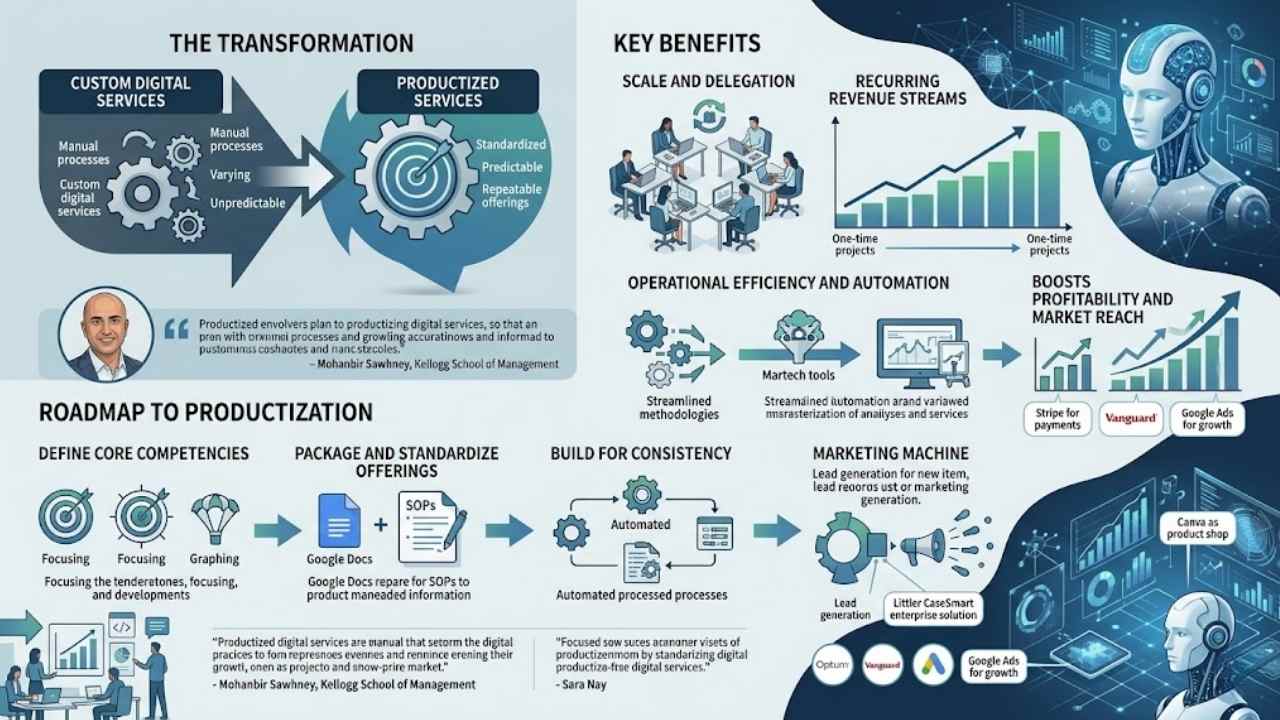
Productized services turn your custom digital services into standardized, predictable, and repeatable offerings. You scale them and delegate tasks with ease. Think of it like turning a handmade quilt into a factory line of cozy blankets, ready for anyone.
Custom digital services firms often rely on one-time project-based income. Productization shifts that to sustainable, recurring revenue streams. Firms focus on one or two core competencies they excel at, like specialization in search engine marketing or SEO strategist work.
They strip away non-core offerings to pour resources into high-value, specialized services. This boosts profitability through greater scale and market reach. Services transform into enterprise solutions that support automation.
You deliver consistent results without extra time or client edits for each job. Productization reclaims your time by cutting customization and repetitive processes on client projects.
Firms develop value-add services to stand out in competitive markets, much like Accenture or JPMorgan do with their business models. Imagine a freelancer in Silicon Valley using Stripe for payments, or Canva turning design into a digital product shop.
Productization applies to software-as-a-service (SaaS) and service subscription models. It converts internal services into consumer-ready products.
Productization is the key to turning services into a marketing machine that drives lead generation and recurring revenue, says Mohanbir Sawhney from the Kellogg School of Management.
This approach helps professional services, from freelancing to big firms like Littler Mendelson with their Littler CaseSmart. You create a streamlined methodology, perhaps using Google Docs for SOPs or Martech tools for efficiency.
Organizational transformation happens when you productize your services, making client experience smoother and sales calls easier. Think of it as building a productized kit, strategy first, for business model innovation.
Service providers, even in the United States, use this to differentiate, like Optum or Vanguard in their fields. Dr. Jeetender Kumar might call it the path to artificial intelligence-powered scaling.
Sara Nay could add how it fits into a very good productized guide, blending with Google Ads for growth. Service Performance Insight shows how it leads to higher profit margins and improved processes.
Benefits of Productizing Digital Services
Imagine turning your digital services into a smooth-running marketing strategy that scales like wildfire. You boost profit margins, delight clients with consistent results, and simplify sales pitches that close deals faster than ever.
Increased efficiency and scalability
Productized services boost efficiency by turning your custom work into standard packages that you can repeat with ease. You strip away extras and focus on core strengths, like specializing in just one or two areas where you shine.
This shift lets you automate tasks and delegate them to your team, freeing up your time for growth. Firms see big gains here, as they reclaim hours lost to endless tweaks on each client job.
Think of it as building a smooth marketing machine that runs without constant fixes.
Scalability jumps when you convert services into products, such as SaaS models or subscription plans. Your offerings reach more clients without extra effort, creating steady revenue streams that beat one-off projects.
Business tips from experts like Daniela Cintra show how this product development strategy scales operations fast. You deliver consistent results every time, no edits needed, which amps up profit margins through wider market reach.
It’s like turning a solo act into a full band, playing to bigger crowds with the same energy.
Higher profit margins
Productizing digital services ramps up your profit margins by shifting from custom jobs to scalable products. Firms ditch one-time project income for sustainable, recurring revenue streams.
This change lets you reach more markets without extra effort on each client. You reclaim time by cutting out repetitive custom tweaks. Specialization shines here; focus on one or two core skills you nail.
Strip away low-value extras to pour energy into high-profit offerings. Tools like the marketing machine help automate delivery, making your operation a well-oiled profit engine.
Converting services into products increases profitability by allowing firms to achieve greater scale and market reach.
Value-add services set you apart in crowded fields. Predictable results come without endless client edits or added hours. Enterprise solutions emerge, ready for delegation and growth.
Think of it as turning your expertise into a subscription model, like SaaS. Very good productized guides, such as the copy kit clinic, show how to package these with clear pricing.
Your bottom line grows as you scale up, serving more clients efficiently.
Improved client experience
Clients love consistency, and productized digital services deliver just that. You get predictable results every time, without the hassle of endless edits or surprises. Firms convert custom work into standardized offerings, making everything repeatable and easy to scale.
This setup reclaims time by cutting out repetitive processes on each project. Imagine signing up for a service subscription model, like SaaS, where outcomes feel reliable and smooth.
No more one-time gigs that leave you guessing; instead, enjoy sustainable recurring revenue that builds trust over time.
Think about the relief of knowing exactly what you’ll receive. Productization strips away non-core extras, focusing on core competencies that solve specific problems. You experience higher quality without the back-and-forth of customization.
Firms specialize in one or two strengths, turning internal services into consumer-ready products. This boosts your satisfaction, as deliveries stay consistent and efficient. Plus, it differentiates in crowded markets, offering value-adds that feel customized yet streamlined.
Easier marketing and sales processes
Productized services make marketing a breeze. You pitch clear packages with fixed prices and deliverables, like ready-made meals instead of cooking from scratch each time. Firms create sustainable, recurring revenue streams this way, ditching those one-time project headaches.
Picture telling a client exactly what they get, no haggling over custom tweaks. Converting services into products boosts profitability too, as you reach more markets with ease. Think of it as turning your skills into a subscription box that sells itself.
Sales processes speed up with standardized offerings. You deliver consistent results without extra time or client edits for every deal. Specialization helps here, focusing on core strengths to stand out in crowded fields.
Productization transforms internal work into consumer-ready gems, like SaaS tools or service subscriptions that hook repeat buyers. Value-add services differentiate your firm, reclaiming your time from endless custom jobs.
It’s like having a vending machine for your expertise, simple and scalable.
Steps to Productize Your Digital Service Offerings
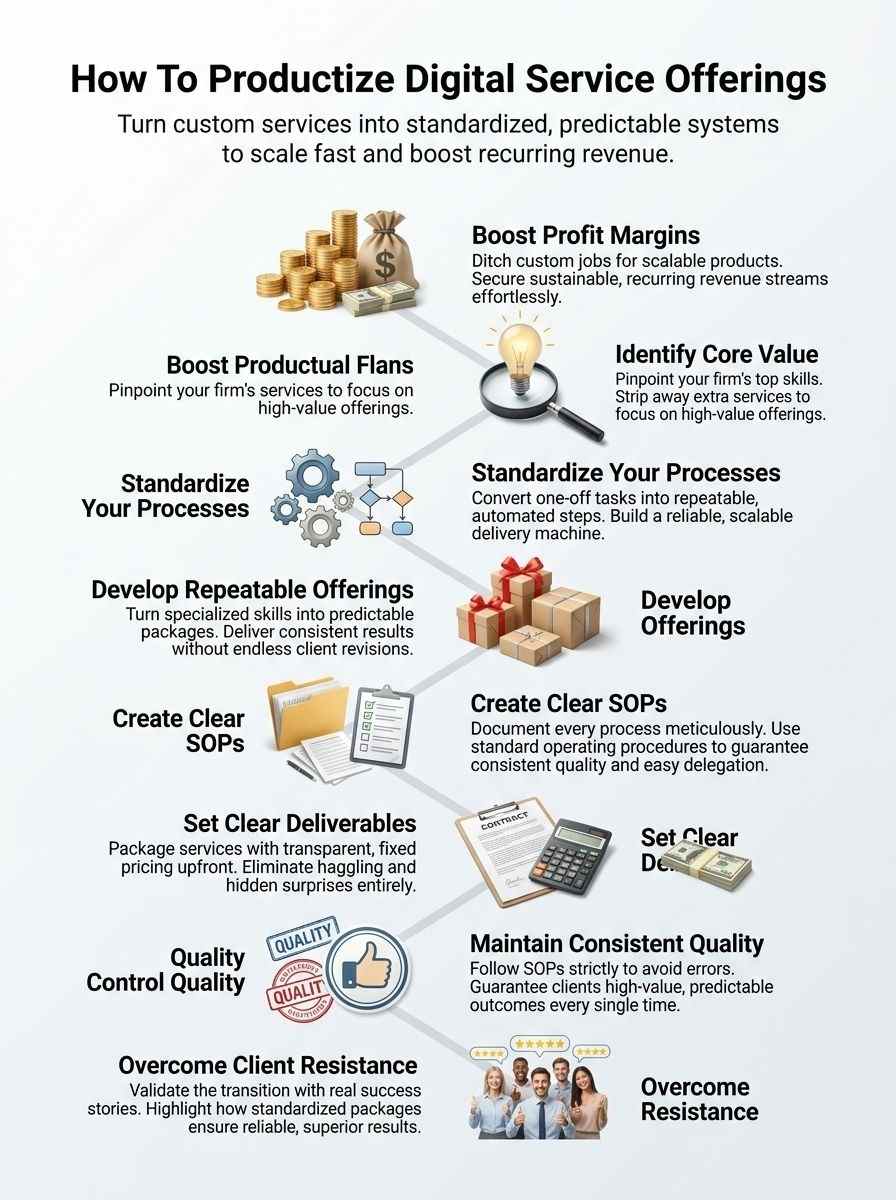
Ready to turn your freelance gigs into a smooth-running machine? Imagine this, you spot the heart of what clients love about your work, then lock in those methods like a well-oiled assembly line, and boom, you’ve got packages that sell themselves without the custom hassle.
Identify the core value of your service
Start by examining what your digital service truly delivers. Think of it like peeling an onion to find the juicy center. You offer custom work, but the core value lies in those one or two skills your firm nails every time.
Specialization drives this process. Firms focus on core competencies they excel at, stripping away the extras. This shift turns scattered efforts into sharp, high-value services.
Picture a chef ditching side dishes to perfect the main course. Custom digital services firms develop value-add options through this focus. They differentiate in crowded markets. Productization converts those custom services into standardized offerings.
You create predictable, repeatable results that scale and delegate easily. Clients get consistent outcomes without endless tweaks.
Standardize your processes
Productized services turn your custom work into standardized offerings, and that starts with your processes. You convert those one-off tasks into repeatable steps, like turning a wild garden into neat rows.
Firms focus on core competencies, stripping away extras to specialize in what they do best. This creates predictable delivery, no more tweaks for each client. Think of it as building a reliable machine that runs smooth every time.
Automation plays a big role here, making services scalable like enterprise solutions. You reclaim time by ditching repetitive custom jobs, boosting profit through wider reach. Picture a subscription model where results stay consistent, freeing you to delegate and grow.
Specialization helps firms stand out in crowded markets, turning internal tools into ready products for recurring revenue.
Develop repeatable offerings
Start by focusing on your core strengths. Pick one or two areas where you shine, like web design or content marketing. Specialization builds repeatable offerings that scale easily.
Firms strip away extra services to zero in on high-value ones. This shift turns custom work into predictable packages.
Automation plays a big role here. Transform services into enterprise solutions with tools like Zapier or Trello for smooth delegation. You deliver consistent results every time, no extra tweaks needed per client.
Picture ditching those endless revisions; now, you reclaim hours by cutting repetitive tasks. Think of SaaS models or subscriptions that keep revenue flowing steady, like a well-oiled machine.
Create step-by-step SOPs
Productizing your digital services means turning custom work into something repeatable. Standard Operating Procedures, or SOPs, make this happen by laying out clear steps for consistent results.
- SOPs act like a roadmap for your team, converting those one-off custom digital services into standardized offerings that you can scale and delegate without hassle. They focus on your core competencies, stripping away the extras so you deliver predictable results every time, no extra client edits needed. Think of it as your secret sauce for reclaiming time, ditching repetitive tweaks on each project.
- Start by documenting every process in your service, from start to finish, to build that repeatable framework. This turns internal services into consumer-ready products, like SaaS models, boosting your profitability through greater scale. It’s all about specialization, honing in on one or two strengths to create sustainable revenue streams instead of chasing one-time gigs.
- Make each SOP step clear and actionable, using simple language that anyone can follow, to ensure consistent quality across engagements. By doing this, you transform services into enterprise solutions ripe for automation, making delegation a breeze and opening doors to recurring income. Picture a busy firm owner finally breathing easy, knowing deliveries happen on autopilot.
- Include timelines, tools, and responsibilities in your SOPs to streamline delivery and cut down on customization chaos. This approach differentiates your firm in competitive markets, letting you package value-add services that support predictable outcomes. Hey, it’s like turning a chaotic kitchen into a well-oiled machine, where profits soar without the constant firefighting.
- Test your SOPs with a small project to spot gaps, then refine them for even better efficiency. Firms that do this see higher margins, as productization eliminates non-core offerings and focuses resources on what you excel at. It’s empathetic to your team’s workload too, creating a system that scales without burning everyone out.
- Share SOPs digitally, maybe via shared docs or project management apps, to make them accessible and easy to update. This builds a foundation for subscription models, where clients get consistent results without the back-and-forth. Imagine telling a client, “We’ve got this down to a science,” and actually meaning it, boosting their experience big time.
Package services with clear deliverables and pricing
Package your services with clear deliverables and pricing to make them feel like ready-to-buy products. Think of it as wrapping a gift, complete with a bow and a tag that spells out exactly what the buyer gets.
You convert custom digital services into standardized offerings, ones that promise predictable results every time. This approach strips away non-core extras, so you focus on high-value specialties that shine.
Clients love the transparency; they see fixed prices upfront, no hidden surprises or endless back-and-forth edits. It turns your work into something scalable, like a subscription model that keeps revenue flowing steady.
Service firms often use this step to boost profits and reclaim time. Imagine ditching those repetitive tweaks for each project; instead, you deliver consistent outcomes through repeatable packages.
Tools like pricing calculators help set those clear rates, while concepts such as value-based billing replace old hourly fees with straightforward options. Specialization plays a big role here, letting you concentrate resources on what you do best.
Readers, picture transforming internal processes into consumer-ready gems, maybe even SaaS-style setups that automate delivery and spark recurring income. This method differentiates you in crowded markets, all without the hassle of constant customization.
How to Design a Productized Service
Start by digging into customer needs through surveys and brainstorming sessions, like chatting with folks to uncover what bugs them most. Then, craft a simple process that fixes those issues fast, turning your ideas into a reliable package that clients love.
Conduct market research and ideation
You need solid market research to kick off productizing your digital services. Talk to potential clients through surveys and interviews. Find out what problems keep them up at night.
Look at competitors, too. Spot gaps where your skills shine. This step uncovers the core value in your offerings, like turning custom work into standardized packages.
Ideation comes next, sparking ideas for repeatable services. Brainstorm with your team, jot down wild concepts. Focus on specialization, ditching non-core stuff to excel in one or two areas.
Picture transforming internal processes into SaaS models or subscriptions. This creates scalable, profitable streams without endless custom tweaks.
Define specific problems to solve
Focus on the pains your clients face every day. Pick issues that match your strengths, like slow website loads for e-commerce shops or messy email campaigns for small teams. Specialization shines here, folks, it lets you zero in on one or two core skills you rock at.
Strip away the extras, concentrate on high-value fixes that turn custom work into streamlined packages. This approach builds enterprise solutions, ready for automation and easy scaling.
Think of it as spotting the leak in a boat before it sinks. Clients crave predictable results, no endless tweaks per project. By tackling exact problems, you craft repeatable offerings, boost profit margins through wider reach.
Imagine a subscription model for SEO tweaks, delivering consistent wins without fresh custom setups each time. Productization reclaims your time, ditches repetitive hassles, and sets up recurring revenue streams that feel like a steady paycheck.
Develop a streamlined delivery system
Streamline your delivery system by building automation into every step. Think of it like an assembly line for your digital services, where tasks flow without hitches. Services transform into enterprise solutions that support this automation.
Firms focus on delegation and scaling, just as fact three points out. You cut out repetitive processes on each client project. This reclaims your time, like fact ten describes. Automation tools, such as Zapier or project management software, handle the heavy lifting.
They ensure predictable delivery of consistent results, no extra time or client edits needed.
Picture your system as a well-oiled machine, humming along with standard operating procedures, or SOPs. You develop repeatable offerings that scale easily. Productized services become consumer-ready products, often in SaaS or subscription models.
Specialization helps here; strip away non-core offerings to concentrate on what you excel at. Consistent quality shines through, boosting profitability with greater scale and market reach.
Clients get the same high-value results every time, making your business a reliable powerhouse.
Challenges in Productizing Digital Services
Turning your custom work into set packages sounds easy, but it often feels like juggling fire while walking a tightrope. You might wrestle with keeping things uniform without losing that personal touch clients crave, or face pushback from folks who cling to old ways like a kid with a favorite toy.
Balancing customization with standardization
Productization turns your custom digital services into standard packages, but you face a real tug-of-war here. Clients often crave that personal touch, like a tailor-made suit, yet standardization keeps things efficient and scalable.
Think about it, you strip away non-core offerings to focus on one or two core competencies, as specialization drives success. This shift creates repeatable offerings with clear deliverables and pricing, boosting profit margins without endless tweaks.
Firms reclaim time by ditching repetitive custom work on each project, leading to sustainable recurring revenue instead of one-off gigs.
Standard processes, like step-by-step SOPs, ensure consistent quality and predictable results, no extra client edits needed. You balance this by offering value-add services that differentiate in competitive markets, perhaps through automation in enterprise solutions.
Imagine a service subscription model, it transforms internal ops into consumer-ready products, much like SaaS. Overcome client pushback with empathy, show how this setup improves their experience and scales your business.
Delegation becomes a breeze, and hey, who doesn’t love higher profits from greater market reach?
Ensuring consistent quality
Firms face a real hurdle in keeping quality steady when they productize digital services. You standardize processes to make offerings repeatable, but that shift can tempt you to cut corners on details.
Think of it like baking the same cake recipe over and over; one wrong measurement, and the whole batch flops. Productized services convert custom work into predictable setups, yet you must watch for slip-ups that harm results.
Specialization helps here, as firms focus on core strengths they excel at, stripping away extras to boost consistency. Services transform into enterprise solutions with automation, delivering consistent outcomes without extra tweaks for each client.
Clients might push back, wanting that old custom touch, but you counter this by creating step-by-step SOPs. These guides act like a trusty roadmap, ensuring every delivery hits the mark.
Productization reclaims your time by ditching repetitive custom fixes, leading to higher profit margins through scale. Imagine delegating tasks without worry, knowing quality stays high.
Firms develop value-add services that stand out, turning internal processes into consumer-ready products like SaaS models. This approach builds trust, as predictable results keep clients coming back for more.
Overcoming client resistance to change
Clients often stick to custom services like glue, fearing they’ll lose that personal touch. You know the drill, they worry standardized offerings won’t fit their needs. Show them real wins instead.
Point out how productization creates predictable results without endless tweaks. It reclaims your time by ditching repetitive custom work on each project. Share a quick story: one firm I heard about switched to repeatable packages, and clients loved the consistent quality.
They got higher profit margins too, from scaling those specialized competencies.
Ease their fears with empathy, like saying, “I get it, change feels risky.” Then highlight benefits. Explain that productized services build recurring revenue streams, not just one-off projects.
They turn internal processes into consumer-ready products, think SaaS models for easy delegation. Stress specialization, focus on one or two core strengths to deliver value-add that stands out.
This way, you balance standardization with enough flexibility, ensuring consistent quality that wins them over.
Key Takeaways for Successful Productization
You learned how to turn custom digital services into standardized packages, boost efficiency with clear processes like SOPs, and tackle challenges such as balancing customization. These steps make implementation a breeze, you just identify core value, standardize tasks, and price offerings clearly for quick wins. Productizing matters because it ramps up profits, scales your business, and frees up time from endless client tweaks. It transforms one-off projects into steady revenue streams, solving the headache of unpredictable income for service firms. Check out books on SaaS models or online courses for in-depth explorations into automation tools. Go ahead, apply these ideas today, and watch your digital services soar like a well-oiled machine.
Final Thoughts
You’ve seen how productizing turns your custom digital services into scalable packages, with steps like standardizing processes and crafting clear SOPs. These methods prove simple to apply, boosting your efficiency without endless tweaks for each client.
Think about the impact, folks, as this shift creates steady revenue and frees up your time for what you love. Check out resources like online courses on SaaS models or books about service scaling for more tips.
Go ahead, start small today, and watch your business soar like a well-oiled machine.
FAQs
1. What does productize mean for my digital service offerings?
Productizing turns your loose services into neat packages, like wrapping a gift that clients can grab off the shelf. It makes things scalable, with fixed pricing and clear value, so you avoid custom chaos every time. Think of it as turning your expertise into a ready-to-buy product, saving you headaches and boosting sales.
2. Why bother to productize my digital services?
It frees you from trading time for money, letting your business grow without constant hustle. Clients love the clarity, and you dodge the feast-or-famine cycle that plagues freelancers.
3. How do I start productizing my offerings?
First, list your core skills and bundle them into tiers, like basic, pro, and premium options. Test with your target audience, tweak based on feedback, and set prices that reflect real value; it’s like baking a cake, measure twice, cut once.
4. What pitfalls should I watch for when productizing?
Don’t overcomplicate packages, or you’ll confuse folks like a tangled ball of yarn. Skip assuming everyone needs the same thing; tailor to niches for better fit. Always keep updating your offerings to stay fresh, avoiding stale bread that no one wants.