I constantly hear people asking how to crack the Scandinavian job market. Moving to a new country is a massive life event, and finding the right legal pathway can feel incredibly overwhelming. If you are looking at Northern Europe, Norway stands out as one of the absolute best places to live and work right now. The country is famous for its stunning fjords, high standard of living, and an incredible work-life balance that actually lets you see your family before dinner time. But how do you actually get there legally? For most professionals outside the European Union, the magic ticket is the Norway Skilled Worker Visa.
You might think you know how immigration works based on the notoriously stressful systems in the United States, the UK, or Canada. However, the Norwegian immigration system has its own unique rules, quirks, and massive benefits that often catch people completely off guard. From incredibly fast processing times to rules about starting work before your paperwork is even finalized, the system is designed to be efficient, fair, and worker-friendly. This guide will walk you through exactly what this work permit entails, uncover seventeen surprising facts about the process, and provide a straightforward manual on how to apply successfully in 2026.
What is the Norway Skilled Worker Visa?
The Norway Skilled Worker Visa is the primary legal pathway for non-EU and non-EEA professionals who want to build a career in Norway. It grants you the explicit right to live and work in the country, provided you have specialized skills or higher education that Norwegian employers desperately need right now. The Norwegian Directorate of Immigration, commonly known as UDI, oversees this residence permit for work to ensure local labor standards remain incredibly high.
I noticed that unlike temporary guest worker programs in other countries, this pathway is actually designed to integrate you into Norwegian society long-term. You get the exact same workplace rights, vacation days, and healthcare access as a local citizen from day one.
| Feature | Details |
| Official Name | Residence Permit for Work (Skilled Worker) |
| Governing Body | Norwegian Directorate of Immigration (UDI) |
| Primary Requirement | A valid, formal job offer from a Norwegian employer |
| Education Needed | University degree, vocational training, or special qualifications |
| Pathway to PR | Yes, eligible after 3 years of continuous legal stay |
17 Surprising Facts You Probably Did Not Know
When people start researching Norwegian immigration, they usually brace themselves for a massive bureaucratic headache. While there is certainly paperwork involved, the rules themselves are quite progressive and refreshingly straightforward. The system favors complete transparency over arbitrary lotteries, which takes a massive amount of anxiety out of the application process. I have dug through the latest UDI regulations for 2026 to find the most interesting quirks of this system. Here are seventeen facts that might completely change how you view moving to Norway.
1. There Are No Annual Visa Quotas
If you have ever looked into the H-1B visa in the United States, you know the absolute stress of the annual lottery system. The US actively caps the number of skilled worker visas it hands out each year, meaning even highly qualified people miss out simply due to bad luck. Norway does not do this at all. There are no annual quotas, caps, or stressful lotteries for the standard Norway Skilled Worker Visa.
If you meet the educational requirements, possess a clean criminal record, and have a valid job offer that meets the mandatory salary threshold, UDI will approve your visa. The government lets the actual labor market dictate how many foreign workers come in. This demand-driven model means you never have to worry about missing an arbitrary deadline or losing a randomized draw.
| Quota Policy Feature | Norway’s Approach | Other Countries (e.g., US/UK) |
| Annual Limit | Unlimited (Based on demand) | Strictly Capped |
| Selection Method | Merit and valid job offer | Lottery systems or point thresholds |
| Approval Certainty | Guaranteed if requirements are met | Highly uncertain |
2. It Offers a Fast Track to Permanent Residency
Many popular expat destinations make you wait five to ten agonizing years before you can even think about staying permanently. In Norway, the timeline is much shorter and much more appealing to professionals looking to settle down. If you hold this specific permit and live in the country continuously, you become eligible to apply for permanent residency in Norway after just three short years.
During this time, you simply need to maintain your employment and complete mandatory Norwegian language and social studies classes. Once you have permanent residency, you no longer need an employer sponsor to stay in the country. You can start your own business, switch careers entirely, take time off, and eventually apply for a Norwegian passport.
| PR Requirement | Details for Skilled Workers |
| Time Required | 3 years of continuous legal residence |
| Employment Status | Must hold a valid skilled worker permit during the period |
| Language Tests | Must complete required Norwegian language tuition |
3. You Can Sometimes Start Working Before Visa Approval
Immigration processing usually leaves you in a frustrating limbo, unable to earn a paycheck while you wait for a piece of plastic in the mail. Norway has a brilliant, practical workaround called the early employment start scheme. Under certain strict conditions, if you have submitted your online application and handed your physical documents to the local police, you can get official permission from the police to start your new job before UDI makes the final visa decision.
This is a massive relief for employers in fast-paced sectors like tech and engineering who need you to start immediately. It also allows you to start earning Norwegian Kroner to fund your expensive relocation right away. Keep in mind, you cannot change employers while on this temporary pre-approval.
| Early Start Scheme | Key Conditions |
| Who Approves It? | The local Norwegian police district |
| When Can You Apply? | Only after submitting all physical documents |
| Employer Constraint | You are locked to that specific employer until final approval |
4. A University Degree Is Not Always Mandatory
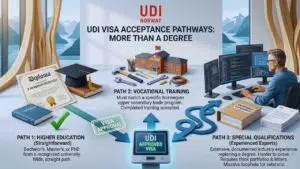
While having a bachelor’s or master’s degree makes the visa application straightforward, it is not an absolute requirement for every single applicant. UDI also heavily respects vocational trades and practical expertise. They accept completed vocational training at an upper secondary school level, provided there is a corresponding training program in Norway. In rare cases, you might even qualify through “special qualifications.”
This means if you have extensive, documented, long-term work experience that gives you the exact same competence as someone with a formal degree, you can still get the visa. It is much harder to prove, requiring thick portfolios and reference letters, but it is a massive loophole for veteran software developers or self-taught industry experts.
| Education Pathway | UDI Acceptance Criteria |
| Higher Education | Bachelor’s, Master’s, or PhD from a recognized university |
| Vocational Training | Must match a specific Norwegian upper secondary trade |
| Special Qualifications | Extensive, documented industry experience replacing a degree |
5. Your Spouse Can Work Without Restrictions
When you move your family across the world, one of the biggest concerns is whether your partner will be legally allowed to work and contribute to the household. Some countries issue dependent visas that strictly forbid the spouse from finding employment, which puts a huge financial strain on the family unit. Norway takes the exact opposite approach.
If you are granted a Norway Skilled Worker Visa, your spouse or registered partner can join you through standard family immigration. Their residence permit gives them the immediate right to work full-time anywhere in Norway without needing their own employer sponsorship. They can work in retail, join a tech startup, or even launch their own local business from day one.
| Spousal Rights | Norway’s Policy |
| Work Authorization | Granted automatically with family immigration permit |
| Sponsorship Needed? | No, they do not need their own employer sponsor |
| Job Restrictions | None; they can work in any field or be self-employed |
6. Changing Employers Does Not Always Require a New Visa
There is a common, terrifying misconception among expats that if you quit your job on a work permit, you get deported the very next day. While your visa is legally tied to your employment, Norway offers some practical flexibility. If you find a new job that is the exact same type of position as your old one, you simply switch employers.
You do not need to apply for a brand new visa or pay the massive application fee again. As long as the new job still requires your skilled qualifications and pays according to Norwegian union standards, you transition smoothly. You only need to apply for a new permit if you radically change your actual profession, like moving from accounting to graphic design.
| Job Change Scenario | Visa Action Required |
| Same Profession, New Company | No new visa needed; just notify authorities |
| New Profession, Same Company | Must apply for a new skilled worker permit |
| Fired / Laid Off | 6-month grace period to find a matching job |
7. There Is No Strict Age Limit
A lot of popular immigration programs, especially working holiday visas or point-based systems in Canada and Australia, heavily penalize applicants who are over the age of thirty. They want young blood. The Norwegian system does not discriminate based on your birth year. There is absolutely no maximum age limit for this permit.
As long as you are over eighteen, possess the required skills, and have a willing employer ready to pay you fairly, you are entirely eligible to apply. Whether you are a twenty-five-year-old rising star or a fifty-five-year-old seasoned executive looking for a quieter life, your professional expertise and your job offer are the only things that truly matter to UDI.
| Age Factors | Impact on Application |
| Under 18 | Not eligible for the skilled worker permit |
| 18 to 30 | Fully eligible; no special youth advantages |
| Over 50 | Fully eligible; no point deductions or penalties |
8. You Can Wait in Norway While Your Application Processes
If you already have a concrete job offer, applying from your home country and waiting months to travel can be agonizing. Under specific circumstances, skilled workers who need a visa to enter Norway can apply for a special entry visa, commonly known as a D-visa. This allows you to travel to Norway, hand your physical documents directly to the local police, and wait inside the country while UDI processes your main residence permit.
While you cannot work on this entry visa without the early employment permission mentioned earlier, it allows you to start settling in. You can use this time to hunt for an apartment, set up a bank account, and get your kids enrolled in local schools.
| D-Visa (Entry Visa) | What You Need to Know |
| Purpose | To enter Norway and wait for the main permit decision |
| Work Rights | None, unless granted early employment start |
| Where to Apply | Norwegian embassy or VFS center in your home country |
9. High Minimum Salary Thresholds Protect You
Norway does not have a universal statutory minimum wage written into law, which often surprises foreigners coming from the US or UK. Instead, salaries are fiercely negotiated through incredibly strong trade unions. However, to get this visa, the government enforces strict salary minimums to ensure you are not undercutting local workers or being exploited by cheap companies.
Following recent adjustments to reflect wage growth, the figures for 2025/2026 are highly protective. For a master’s degree role, your minimum gross salary must be at least NOK 599,200 per year. For a bachelor’s degree, it is NOK 522,600. In reality, most skilled tech and engineering jobs pay way above this floor.
| Education Level | Minimum Annual Salary (Pre-Tax) |
| Master’s Degree | NOK 599,200 |
| Bachelor’s Degree | NOK 522,600 |
| Exceptions | Only if documented as standard for a specific rural region |
10. You Get Full Access to Norwegian Healthcare
Unlike the US or parts of the Middle East where temporary guest workers have to buy wildly expensive private health insurance, holding a residence permit in Norway automatically protects you. From the moment you register your move at the local tax office and receive your national identity number, you are fully enrolled in the National Insurance Scheme.
You get full access to the public healthcare system on the exact same terms as a Norwegian citizen. You will pay small, heavily subsidized deductible fees for basic doctor visits (which cap out annually), but major medical care, surgeries, emergency room visits, and maternity care are covered entirely by the state.
| Healthcare Coverage | What is Included |
| General Practitioner | Small subsidized fee (caps at an annual limit) |
| Hospital / Surgery | Fully covered by the state |
| Dependents | Spouse and children get the exact same coverage |
11. Staffing Agency Workers Are Eligible
You do not necessarily need a permanent, open-ended contract with a single corporate company to get this visa. You can actually be employed by a Norwegian staffing or recruitment agency. This is incredibly common in the oil, gas, maritime, and construction sectors where project-based work dictates the market.
The main catch here is that the agency must provide a concrete, written list of assignments that are planned for you, and those assignments must be confirmed by the actual end-clients you will be working for. The permit will usually only be granted for the exact duration of those specific assignments, up to one year at a time, but it is a perfectly valid entry route.
| Agency Work Rules | UDI Requirements |
| Employer Type | Registered Norwegian staffing/recruitment agency |
| Documentation | Concrete list of assignments confirmed by end-clients |
| Visa Duration | Usually limited to the duration of the specific project |
12. Processing Times Are Surprisingly Fast

Bureaucracy is notoriously slow everywhere, but Norway runs a surprisingly tight and digital ship. Once you have submitted all your paperwork online and attended your in-person appointment to give your biometrics, the processing time is remarkably short. For most clean applications, UDI usually processes the visa in just four to eight weeks.
Compared to the months or even years it takes to process work visas in North America, the Norwegian system is refreshingly fast. This speed allows both you and your prospective employer to plan your relocation, flight bookings, and onboarding with actual confidence rather than guessing game timelines.
| Application Stage | Average Timeline |
| Online Submission | Immediate |
| Document Handover | Depends on VFS/Police appointment availability |
| UDI Decision | 4 to 8 weeks after document handover |
13. You Cannot Work as a Freelancer or Digital Nomad
A massive point of confusion in the modern era of remote work is the digital nomad lifestyle. The Norway Skilled Worker Visa absolutely does not allow you to move to Norway just to work remotely for your current employer back in your home country. You also cannot run your own side business, sell goods online, or take on independent freelance clients if you hold this specific permit.
The visa is strictly, legally tied to employment with the Norwegian company that sponsored you. If you want to be self-employed or freelance, you have to navigate a completely separate, much more heavily scrutinized visa category for independent contractors.
| Visa Type | Permitted Work | Prohibited Work |
| Skilled Worker Visa | Full-time work for the sponsoring Norwegian employer | Freelancing, remote work for foreign companies, side hustles |
14. Graduates in Norway Get a Special Job Seeker Extension
If you are an international student who just finished a grueling degree at a Norwegian university, you do not have to pack your bags and leave the day after graduation. Norway actively wants to retain the young talent it just spent years educating. Non-EU graduates can apply for a special job seeker visa in Norway, which gives them up to one full year to stay in the country and look for skilled employment.
You can even work part-time in unskilled jobs to support yourself during this search. Once they find a qualifying job, they transition directly to the main work permit without ever having to fly home and restart the process.
| Graduate Benefit | Details |
| Who Qualifies? | Non-EU graduates of Norwegian higher education |
| Duration | Up to 12 months to search for skilled work |
| Transition | Seamless switch to Skilled Worker Visa upon securing a job |
15. The Visa is Tied to Your Specific Profession
While you can change employers without too much hassle, you absolutely cannot easily change your actual career path. If you get a visa to work as a senior software engineer, you cannot suddenly quit and take a job as a marketing manager, a bartender, or a real estate agent. Your residence permit is legally granted based on the specific, documented qualifications needed for the job you were originally offered.
UDI approved you because you are an engineer. If you want to pivot to a completely different type of role, you have to submit a brand new visa application, prove your qualifications for that new field, and wait for approval before starting.
| Career Pivot Rules | Can You Do It? |
| Different Company, Same Role | Yes, freely allowed |
| Promotion within Same Field | Yes, freely allowed |
| Entirely New Profession | No, requires a brand new visa application |
16. Your Employer Acts as Your Sponsor
You cannot simply apply for this visa because you really want to hike the fjords and live in Oslo. The entire legal process hinges completely on the employer. The company must be legally registered in Norway, and they essentially vouch for you to the Norwegian government. They handle the UDI job offer form, outline your duties, and prove that they are offering standard working hours.
They also have to prove that the job genuinely requires your specific expertise and cannot easily be filled by a local. This employer-driven model ensures that immigrants have guaranteed, stable income the exact moment they step off the plane.
| Sponsor Duties | Employer Responsibilities |
| Legal Status | Must be a registered business in Norway |
| Documentation | Must provide the official UDI offer of employment form |
| Compliance | Must guarantee Norwegian standard wages and hours |
17. Strict Rules Prevent Fake Job Offers
To combat immigration fraud and human trafficking, Norway introduced a brilliant digital system where the employer must actively confirm the job offer through a secure government portal. As of recent UDI updates, before you can even submit your final application online, your employer has to log into their side of the UDI system and generate a unique confirmation code.
You then plug this exact code into your application. This digital handshake seamlessly prevents desperate applicants from forging employment contracts just to get across the Norwegian border, ensuring the integrity of the entire immigration system.
| Anti-Fraud Measure | How It Works |
| Employer Portal | Employer logs into the UDI system digitally |
| Confirmation Code | Generates a unique code linked to the job offer |
| Applicant Use | Applicant must use this code to submit the final application |
How to Apply for the Norway Skilled Worker Visa
Understanding the facts is only the first step; navigating the actual application process requires careful attention to detail. The process is remarkably straightforward if you follow the exact instructions provided by UDI. I highly recommend triple-checking your documents before submitting anything to avoid unnecessary, painful delays. Here is a comprehensive guide to getting your application approved smoothly in 2026 without losing your mind.
Step 1: Secure a Valid Job Offer
Everything starts with the job hunt. You need to apply for jobs in Norway from your home country, attend remote interviews, and receive a formal, written employment contract. The contract must clearly state your gross salary, your working hours, and the duration of your employment. Keep in mind that the job must require your specific skilled qualifications, and your future employer must be willing to wait for your visa to be processed before you start.
Step 2: Gather Your Documentation
Once the contract is signed, you need to collect a specific set of documents. UDI provides a personalized checklist on their website based on your exact nationality, but you will always need certain staples. You need a valid passport and copies of all used pages. You need the signed employment offer form, which is a specific UDI document that both you and your employer must fill out together. You must provide proof of your education, such as university degree certificates and transcripts. All documents must be officially translated into English or Norwegian.
Step 3: Submit the Application Online
With your documents ready to go, you will head to the UDI web portal and create a personal account. You will fill out the extensive application form with your personal details, your educational background, and information about your new job. This is also where you will enter that digital confirmation code provided by your Norwegian employer. Once the form is complete, you will be prompted to pay the application fee online using a standard credit or debit card.
Step 4: Attend Your Appointment
Applying online is only half the battle. You must hand in your physical documents and provide your biometric data, which includes your fingerprints and a digital photograph. If you are applying from your home country, you will usually book an appointment at a VFS Global visa application center or the nearest Norwegian embassy. If you are already in Norway legally, you will book an appointment with the local police station. Your application processing time officially begins the day you hand in these physical documents.
Expected Costs and Processing Times
Moving countries is a highly expensive endeavor, and you need to budget appropriately for the government fees and massive relocation costs. The application fee for the Norway Skilled Worker Visa is currently NOK 6,300 for adults. This fee is strictly non-refundable, meaning if your application is rejected because you missed a document, you will not get your money back. Beyond the visa fee itself, the cost of moving to one of the world’s most expensive countries requires serious financial planning.
If you are bringing a spouse, the family immigration permit costs an additional NOK 10,500 per adult, though there is usually no fee for dependent children. You also need to factor in the cost of physical travel to the embassy, flight tickets, and renting an apartment. Renting in Oslo usually requires a hefty security deposit equal to three months of rent upfront. As for processing times, you can generally expect a decision within four to eight weeks, provided UDI does not need to ask your employer for additional, tedious information.
Final Thoughts
Securing a Norway Skilled Worker Visa requires diligence, patience, and a solid professional background, but the rewards absolutely justify the effort. Norway offers a working culture that genuinely respects human beings. Unpaid overtime is incredibly rare, taking your five weeks of paid vacation is virtually mandatory, and the entire society places a massive emphasis on spending time outdoors rather than chained to a desk. I find it fascinating how the system prioritizes worker well-being and family life from day one.
By understanding the unique facets of the Norwegian immigration system, from the absolute lack of annual quotas to the progressive rules on spouse employment and new salary thresholds, you can navigate the process with total confidence. Ensure your documentation is flawless, maintain open and honest communication with your prospective employer, and prepare yourself for an incredible new chapter. The Norway Skilled Worker Visa is more than just a piece of plastic; it is your legal gateway to one of the most balanced, prosperous, and beautiful countries on earth.
Frequently Asked Questions (FAQs)
People constantly flood forums with questions about moving to Norway, and a lot of wild misinformation floats around out there. I have compiled the most pressing and uncommon questions based on current search trends to give you clear, factual answers. If you are planning a move, understanding these nuances can save you a massive amount of stress down the line.
1. Do I need to speak Norwegian to get the skilled worker visa?
No, Norwegian language proficiency is not a legal requirement to obtain the Norway Skilled Worker Visa. Many multinational companies in Norway, especially in the tech, maritime, energy, and engineering sectors, operate entirely in English. However, learning Norwegian is highly recommended for your own social integration and will be legally required later if you eventually wish to apply for permanent residency or a passport.
2. What happens if my employer fires me or the company goes bankrupt?
If your employment is terminated unexpectedly, you do not have to pack your bags and leave the country that same afternoon. Under Norwegian immigration rules, you are generally allowed to stay in Norway for up to six months to look for new employment. If you find a new job that requires the exact same skilled qualifications, you can transition smoothly without leaving the country.
3. Can I do freelance work on the side while holding this visa?
No. Your residence permit for work is tied exclusively to the employer who sponsored you. You cannot take on freelance gigs, drive for delivery apps, or start a side hustle selling goods online. You are only legally permitted to work the job outlined in your UDI employment offer form.
4. Are there any specific regions in Norway that desperately need workers?
Yes. While Oslo is the tech and finance hub, Northern Norway actively struggles to attract and retain skilled professionals due to the harsh climate. Municipalities in the far north often offer incredible incentives, such as writing off portions of student debt, lower income taxes, and significantly cheaper housing to attract foreign workers in healthcare, engineering, and education.
5. Can my children attend public school for free?
Yes. If you are granted a skilled worker permit, you have the right to apply for family reunification for your children under the age of eighteen. Once they arrive and are legally registered, they have immediate, full access to the Norwegian public school system, which is entirely free and globally recognized for its high quality.