Building a great software product is only half the battle. Figuring out how to charge for it is where many founders hit a brick wall. You can have the slickest interface and the most robust backend, but if your billing structure confuses potential buyers, they will simply bounce to a competitor. The software as a service industry relies heavily on recurring revenue, making your choice of pricing structure one of the most critical decisions for long-term viability. Finding the right approach goes beyond simply covering costs; it requires aligning the value your product delivers with how your customers actually prefer to pay.
A well-optimised pricing page acts as a powerful conversion lever, often outperforming customer acquisition efforts in driving sustainable growth. If you are struggling to convert traffic into paid subscribers, your product might not be the problem. Choosing the right SaaS pricing models can transform your revenue trajectory and help you capture the true value of what you have built. Let us break down the most effective frameworks you can use to monetise your platform.
1. The Flat Rate Pricing Model
Simplicity is the ultimate sophistication, and the flat rate approach embodies this philosophy perfectly. By offering a single product with a complete set of features at one fixed price, you eliminate decision fatigue for your prospective buyers. This strategy mirrors traditional software licensing but operates on a recurring subscription basis, usually billed monthly or annually. When users do not have to calculate complex usage metrics or debate over which tier they need, they move through the sales funnel much faster.
Core Mechanics of Flat Rate Billing
When a customer lands on a flat rate pricing page, they see exactly what they get and exactly what it costs. There are no complex calculators or usage tiers to navigate. This straightforward value proposition builds immediate trust and accelerates the sales cycle, as buyers do not need to forecast their future usage to determine their budget. It is a brilliant way to stand out in a crowded market where competitors hide their best features behind expensive enterprise plans. Basecamp is a famous example, famously charging a flat monthly fee regardless of how many employees use the software.
Best for: Early-stage startups, simple utility tools, and products with a highly uniform customer base.
Why We Chose It: It offers unparalleled clarity and simplicity, which drastically reduces friction during the checkout process and makes revenue forecasting incredibly predictable for your finance team.
Things to consider: It fundamentally lacks flexibility and scalability, meaning you risk undercharging enterprise clients who derive massive value, while simultaneously overcharging smaller users who only need basic features.
Before deciding if a single price point is right for your business, review this breakdown of its primary advantages and drawbacks to see how it aligns with your goals.
| Aspect | Description | Market Impact |
| Revenue Predictability | Highly stable and easy to forecast based on subscriber count. | Excellent for securing early-stage funding. |
| Customer Friction | Minimal, as there is only one choice to make during checkout. | Higher initial conversion rates. |
| Market Capture | Limited, as it alienates users needing more or less functionality. | Leaves money on the table with large clients. |
2. Tiered Pricing Strategy
Stepping away from the one-size-fits-all approach, tiered pricing allows companies to segment their market and capture a broader audience. By creating distinct packages, usually labelled as basic, professional, and enterprise, you can align different feature sets and price points with specific buyer personas. This is arguably the most common framework you will see across the industry today. It acknowledges that a solo freelancer and a multinational corporation have vastly different needs and budgets, allowing you to cater to both simultaneously without diluting your brand.
Structuring Effective Tiers
The psychological power of tiered pricing lies in the anchoring effect. Often, companies will highlight a middle tier as the most popular option, guiding users toward a price point that maximises both conversion rates and average revenue per user. Each tier is carefully crafted to provide just enough value to satisfy its target persona while leaving enough out to incentivise upgrading. When a small business grows and needs more advanced reporting or priority support, the upgrade path is already clearly defined.
Best for: Maturing software companies with diverse customer segments ranging from solo entrepreneurs to large corporations.
Why We Chose It: It provides a clear upgrade path for growing customers and allows businesses to maximise revenue extraction across different market segments without needing multiple distinct products.
Things to consider: Too many tiers or confusing feature breakdowns can overwhelm potential buyers, leading to analysis paralysis and abandoned carts on your pricing page.
Here is a quick comparison of how different tiers function within this model to help you structure your own offerings.
| Tier Level | Target Audience | Focus Area |
| Basic / Starter | Freelancers and small teams | Essential core features, low barrier to entry to encourage sign-ups. |
| Pro / Growth | Mid-sized businesses | Advanced features, priority support, and team collaboration tools. |
| Enterprise | Large corporations | Custom solutions, dedicated account management, and high-level security compliance. |
3. Usage-Based Pricing
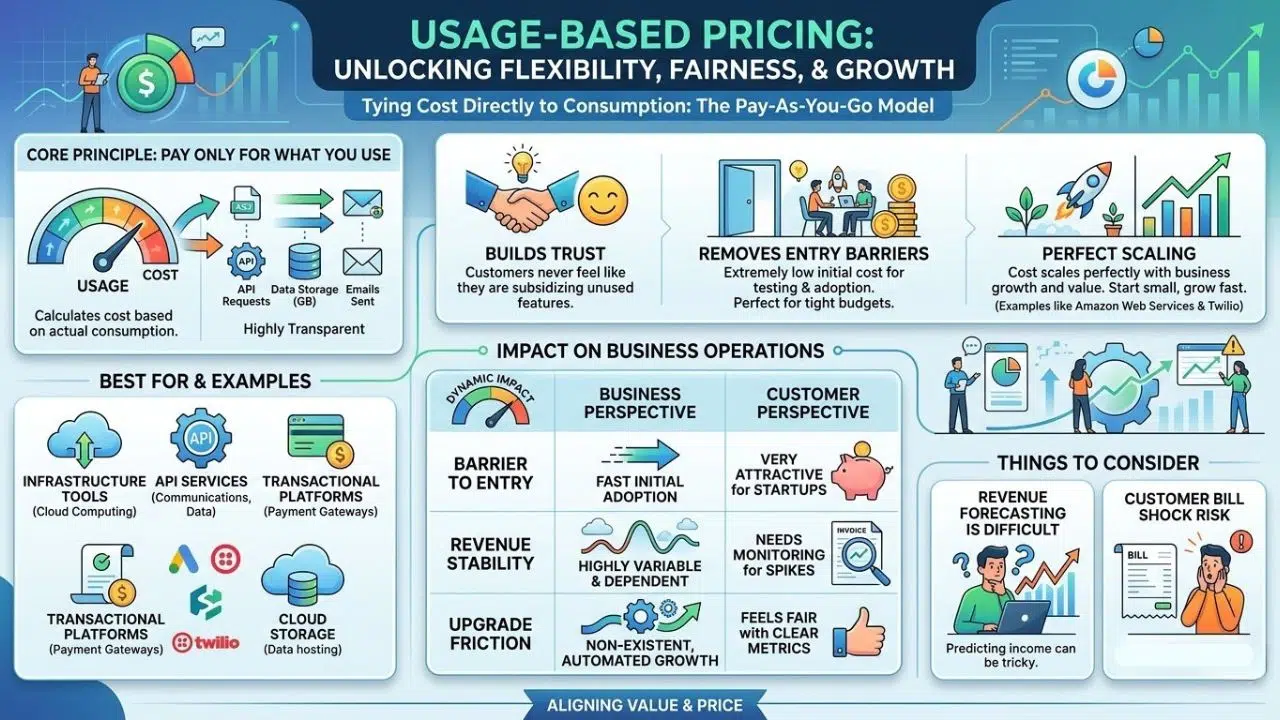
In an era where customers demand fairness and flexibility, the usage-based model ties the cost directly to consumption. Often referred to as pay-as-you-go, this structure ensures that users only pay for what they actually use, whether that is measured in API requests, gigabytes of storage, or emails sent. This approach is highly transparent and builds significant trust because clients never feel like they are subsidising features or capacity they do not need. It completely shifts the conversation from software licensing to direct utility value.
Aligning Cost with Customer Value
This model shines in infrastructure and platform services where the utility scales perfectly with business growth. It completely removes the barrier to entry for new users, as they can start for pennies and only scale their spend as they see a return on investment from your platform. Think of Amazon Web Services or Twilio; developers love these platforms because they can prototype for free and only pay substantial bills once their own applications become successful and generate revenue.
Best for: Infrastructure tools, cloud storage, API services, and transactional platforms like payment gateways.
Why We Chose It: It creates a perfect alignment between the value the customer receives and the price they pay, virtually eliminating objections about unused software features.
Things to consider: Revenue forecasting becomes notoriously difficult, and customers may experience bill shock if their usage spikes unexpectedly during a busy month.
To better understand the dynamics of consumption-based billing, consider the following points regarding how it impacts your business operations.
| Dynamic | Impact on Business | Customer Perspective |
| Barrier to Entry | Extremely low, encouraging rapid initial adoption and product testing. | Very attractive for startups with tight budgets. |
| Revenue Stability | Highly variable and dependent on customer activity levels. | Requires careful monitoring of usage spikes. |
| Upgrade Friction | Non-existent, as expansion revenue happens automatically without a sales call. | Feels fair as long as the pricing metrics are clear. |
4. Per-User Pricing
Perhaps the most ubiquitous model in the software industry, per-user pricing charges a fixed monthly fee for every individual who requires access to the platform. It is a highly predictable and easy-to-understand model that scales organically as your customer’s company grows. If your tool is designed to improve team communication or workflow management, tying your revenue directly to the number of people using it makes logical sense. It is simple to explain to procurement departments and easy for clients to budget for annually.
The Dynamics of Seat-Based Billing
The appeal of this model lies in its straightforward math. A company with ten employees pays exactly ten times what a solo user pays. It is the go-to standard for collaboration tools, project management software, and customer relationship management systems where the core value is derived from team participation. Slack and Salesforce have built massive empires on this exact premise, leveraging internal network effects to drive account expansion as clients hire more staff.
Best for: Collaboration tools, CRMs, and internal communication platforms where team-wide adoption is necessary for success.
Why We Chose It: It is universally understood by B2B buyers and provides a highly predictable revenue stream that scales naturally with the client’s internal headcount.
Things to consider: It often incentivises password sharing among team members and can penalise companies for widespread adoption, leading to artificial limits on your product’s internal growth.
The table below outlines the key operational aspects of seat-based models and how they influence user behaviour.
| Metric | Business Implication | Potential Drawback |
| Scalability | Scales perfectly with the client’s internal headcount growth. | Clients may purge inactive users to save money. |
| Value Perception | Easy to justify when the software is essential for daily tasks. | Can diminish if casual users are billed at the same rate as power users. |
| Churn Risk | High if the company downscales or if seat licences remain unused for months. | Requires strong onboarding to ensure high daily active usage. |
5. Feature-Based Pricing
Instead of limiting users or usage volume, this model gates specific functionalities behind higher price points. Customers pay based on the complexity and depth of the tools they need to access, making it a pure play on value differentiation. This strategy forces you to deeply understand what specific features drive tangible business results for your clients. It works brilliantly when you have a core product that appeals to the masses, but highly specialised add-ons that only enterprise clients or power users genuinely require.
Gating Premium Capabilities
The success of feature-based pricing hinges on a deep understanding of your product’s core versus premium features. Essential workflows are included in lower tiers, while advanced reporting, custom integrations, or enhanced security compliance are reserved for higher-paying customers. A common practice is putting features like Single Sign-On or dedicated success managers into the highest tier, as these are administrative requirements for large corporations rather than functional needs for small businesses.
Best for: Complex software suites that serve both novice users and highly technical power users simultaneously.
Why We Chose It: It allows companies to effectively monetise their research and development by charging a premium for advanced, high-value functionalities.
Things to consider: Determining which features belong in which tier requires intense market research, and getting it wrong can cause widespread user frustration if essential tools are locked away.
Review this structural guide on how features are typically distributed across plans to maximise upgrades.
| Feature Category | Plan Level | Example Functionality |
| Core | Basic | Standard dashboards, essential tools, email support. |
| Advanced | Professional | Custom reporting, third-party integrations, team permissions. |
| Premium | Enterprise | Single Sign-On, audit logs, white-labelling, API access. |
6. The Freemium Strategy
Offering a free version of your product is a powerful way to acquire users rapidly and build brand awareness. The freemium approach gives users unrestricted access to a basic version of your software forever, rather than cutting them off after a 14-day trial. The goal is to get your product embedded into their daily workflow. Once they rely on it, you introduce friction points—like storage limits, watermarks, or locked advanced features—that prompt them to upgrade to a paid tier to continue scaling their work.
Converting Free Users to Paid Subscribers
The biggest challenge with freemium is striking the right balance. Give away too much, and users will never feel the need to pay; give away too little, and they will abandon the product before seeing its value. Successful freemium models rely on massive top-of-funnel user acquisition, knowing that only a small single-digit percentage will ever convert to paid. Tools like Spotify and Zoom have mastered this, using their free tiers as a massive marketing engine that fuels their enterprise sales pipeline.
Best for: Consumer-facing software, viral collaboration tools, and products where user-generated content drives growth.
Why We Chose It: It drastically lowers customer acquisition costs by replacing traditional marketing spend with product-led growth and word-of-mouth referrals.
Things to consider: Supporting thousands of free users incurs real server and support costs, which must be subsidised by the small fraction of users who actually upgrade.
Examine how the freemium model balances free access with monetisation triggers in the table below.
| Strategy Component | Purpose | Example Execution |
| The Free Hook | Drive massive user adoption and habit formation. | Unlimited basic video calls with a 40-minute time limit. |
| The Friction Point | Create a compelling reason to enter credit card details. | Needing to host a webinar longer than 40 minutes. |
| The Upgrade Path | Seamlessly transition the user to a paid tier. | One-click upgrade to the Pro plan for unlimited call durations. |
Architecting a Sustainable Monetisation Strategy
Selecting the perfect setup from the various SaaS pricing models available is never a set-it-and-forget-it endeavour. The most successful software companies constantly evaluate their packaging and pricing against market trends, customer feedback, and internal metrics like customer acquisition cost and lifetime value. Whether you opt for a straightforward flat rate, an intricate usage-based system, or a complex hybrid model, the ultimate goal remains the same. You must clearly communicate the value of your product while removing friction from the buying journey.
Do not be afraid to experiment. Test different pricing tiers, monitor how your users behave, and adjust accordingly. Your pricing page is a living document that should evolve alongside your software and your target market. By staying adaptable and closely aligning your fees with the tangible value you provide, you will build a sustainable, profitable business that thrives in any economic climate.
Frequently Asked Questions (FAQs)
It is common for founders and marketers to encounter similar roadblocks when structuring their monetisation strategies. Here are some of the most pressing questions regarding software pricing.
How often should a SaaS company change its pricing?
Companies should review their pricing strategy at least once a year. Adjustments should be driven by the introduction of new features, shifts in the competitive landscape, and overall inflationary pressures, rather than arbitrary timelines. Routine audits ensure you are not leaving money on the table.
What is the freemium model and does it actually convert?
The freemium model offers a stripped-down version of the product for free indefinitely, relying on a small percentage of users to upgrade to a paid plan. It converts well when the free version provides genuine utility but intentionally restricts advanced features that power users desperately need to scale their operations.
How do you prevent churn when increasing subscription prices?
Communicating the reason for the increase transparently is vital. Grandfathering existing customers into their current rate for a specific period, or clearly demonstrating the new value and features added to the platform, helps mitigate backlash and reduces subscriber cancellation during the transition.
Why is per-user pricing becoming less popular in some sectors?
As companies look to cut costs, per-user pricing can actively discourage product adoption across an entire organisation. Many modern tools are moving towards usage-based or feature-based models to ensure clients feel they are paying for actual value and output, rather than just empty seats.
Final Thoughts
Building a sustainable software business requires constant iteration, and your billing strategy is no exception. Whether you lean towards the simplicity of a flat rate, the scalability of seat-based billing, or the fairness of consumption metrics, the goal is always to align your price with the tangible value you deliver to the customer.
The most successful SaaS pricing models are those that evolve naturally alongside your product and your target market. Keep testing your checkout flow, listen to the objections raised during sales calls, and do not be afraid to adjust your tiers as you introduce more advanced features. By remaining adaptable and focusing on clear communication, you will not only reduce churn but also unlock new avenues for predictable, long-term growth.