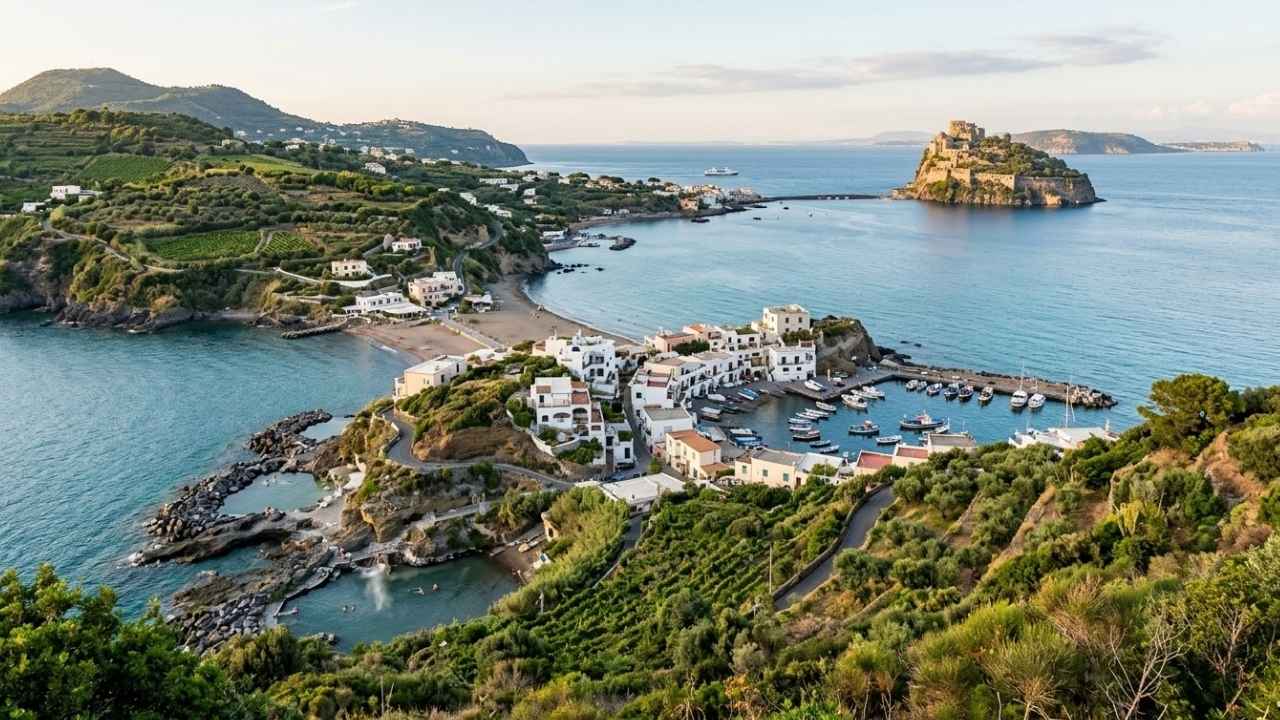
There are destinations that become famous because of one specific image: a beach, a monument, a photograph repeated endlessly in guidebooks and on social media. Ischia works differently. Anyone arriving expecting a spectacular place from the very first minute may need a little time to understand why the island has become one of the most visited spots in southern Italy.
There is no single scene that explains its success. What emerges instead is a sum of details: green hills, seaside villages, narrow roads that change the landscape at every turn, small hotels, historic thermal spas, and a sense of calm that is not always easy to find in better-known destinations in the Gulf of Naples.
That combination leads many travelers to arrive planning to stay only a few days, then end up extending their trip. The island does not force anyone into a fixed schedule. It allows visitors to improvise, move around without hurry, and let the journey organize itself, something that, on holiday, is often worth more than any perfect itinerary.
A large, varied island, less predictable than it seems
Seen from the ferry, Ischia does not make the same impression as Capri. It does not have that dramatic vertical profile that is instantly recognizable. It is broader, more irregular, with areas covered in vegetation and roads that climb inland before descending again toward the sea. That shape influences everything. Each town has a different atmosphere, and within just a few kilometers the landscape changes completely.
In Ischia Porto, most of the activity is concentrated, with ferries arriving constantly and streets full of shops and restaurants. In Forio, the pace is different, quieter, with open squares and pale houses facing the water. Sant’Angelo, by contrast, feels detached from time, with narrow alleyways and terraces overlooking the sea in near-total silence.
That variety explains why the island cannot be exhausted in a single day. There is always the feeling that something is still left to see, even when it is not entirely clear what that something is.
Thermal waters and the habit of taking the day slowly
One of Ischia’s best-known features is its thermal waters, found in different parts of the island since ancient times. There are historic spas, thermal parks surrounded by greenery, and natural pools where hot water rises from the volcanic ground. Many people travel here for precisely that reason, looking for rest more than activity.
What matters most, though, is the atmosphere created around these places. No one seems to be in a rush. People spend hours moving between the water, the sun, and the terraces, as if time itself had slowed down. That feeling gradually spreads to the rest of the trip. Meals grow longer, walks have no timetable, and plans change along the way.
When the stay lasts several days, accommodation plays an important role in shaping the experience of the island. Some prefer large hotels, but many travelers look for quieter places near the center, where it is easy to get around on foot. In that context, Hotel Floridiana in Ischia becomes a useful reference, an example of the kind of lodging often chosen by those who want to maintain a certain independence and avoid unnecessary travel during their holiday.
Beaches, trails, and small villages that invite you to keep moving
Although many people associate Ischia with its spas, the island has much more to offer. There are wide beaches such as Maronti, rocky areas where the water is particularly clear, and corners where the sea mixes with thermal springs. Not everything is concentrated in one place, and that forces visitors to move around the island in order to understand it.
The winding roads lead from one village to another, passing unexpected viewpoints along the way. At times the view opens onto the gulf; at others, vineyards, hills, or isolated houses appear. That constant sense of movement keeps the trip from becoming repetitive, even when the stay lasts several days.
There are also gardens, castles, and paths that climb to higher areas from which the whole island can be seen. They are not mandatory stops, but they help make it clear that Ischia is not just a beach destination. It is a place where the landscape changes continuously.
A place many discover out of curiosity and remember for completely different reasons
Some trips are remembered because of one particular photograph. Others because of a memorable excursion. In Ischia, what often stays in the memory is not a single moment, but a general feeling: the slow rhythm, the ease of arranging the day, the way the sea is always somewhere in the background, even when one is not looking for it.
It is common to hear travelers say that they did not expect much from the island and yet ended up enjoying it far more than they imagined. Perhaps because it does not force anyone to follow a rigid plan. Perhaps because it allows people to rest without becoming bored. Or perhaps because it has that difficult-to-explain quality that makes certain places work best when they are experienced without excessive expectations.
That is why Ischia continues to appear in the recommendations of those who know southern Italy well. Not as the most spectacular destination, nor as the most famous, but as one of those places where the journey seems simple at first… and then it becomes harder than expected to decide when it is time to leave.