
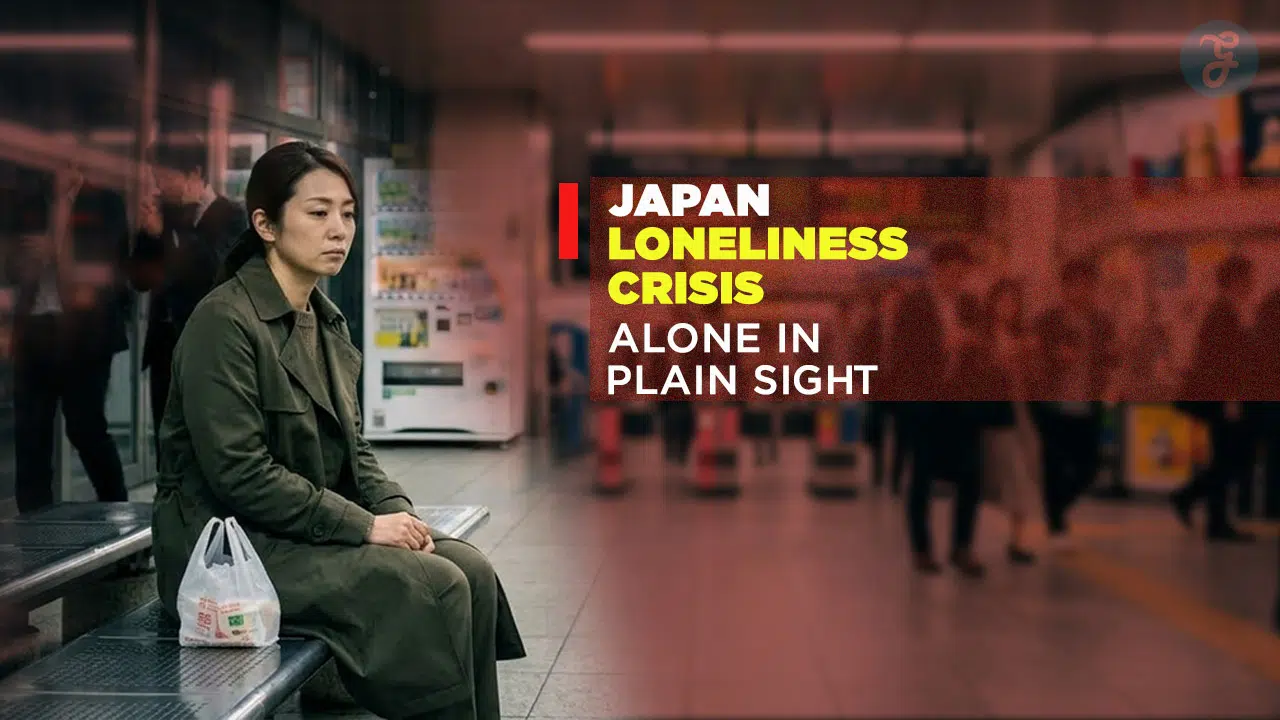
The door to a Tokyo apartment stays shut for three weeks while a television glows against an empty chair. Outside, the world moves at lightning speed, yet for many, the silence lasts for weeks. While most elderly deaths are found quickly, the National Police Agency found that lonely deaths among those under 65 actually take much longer to be discovered, often staying hidden behind a closed door for over a month. This is the stinging reality of the Japan loneliness crisis. It is a quiet emergency that proves a society can be perfectly ordered yet fundamentally broken. Japan is often seen as a glimpse into the future, but this progress comes with a heavy tax.
According to official data released by the National Police Agency in April 2025, a total of 76,020 people died alone at home in 2024. Perhaps most staggering is that nearly 7,000 of these individuals were not discovered for over a month. This is not just a tragedy for the elderly. It is a systemic collapse of human connection that serves as a global warning.
We often mistake proximity for community. Living in a high-density city does not mean you are seen. In Japan, the rise of solo culture has turned isolation into a consumer product. You can buy a solo wedding package or eat in a booth designed to prevent eye contact. You can even rent a sister or a grandfather for an afternoon. These services are clever and convenient, but they are also deeply sad. They treat the symptoms of a lonely heart without curing the cause.
The High Cost of a Frictionless Life
The workplace often feeds this fire. Long hours and rigid social codes leave little room for real life. For many, the office is the only social circle. When that circle breaks, the floor falls away. This leads to the phenomenon of hikikomori, where over one million people have simply stepped out of society. They are not lazy. They are overwhelmed by a world that demands perfection but offers no warmth.
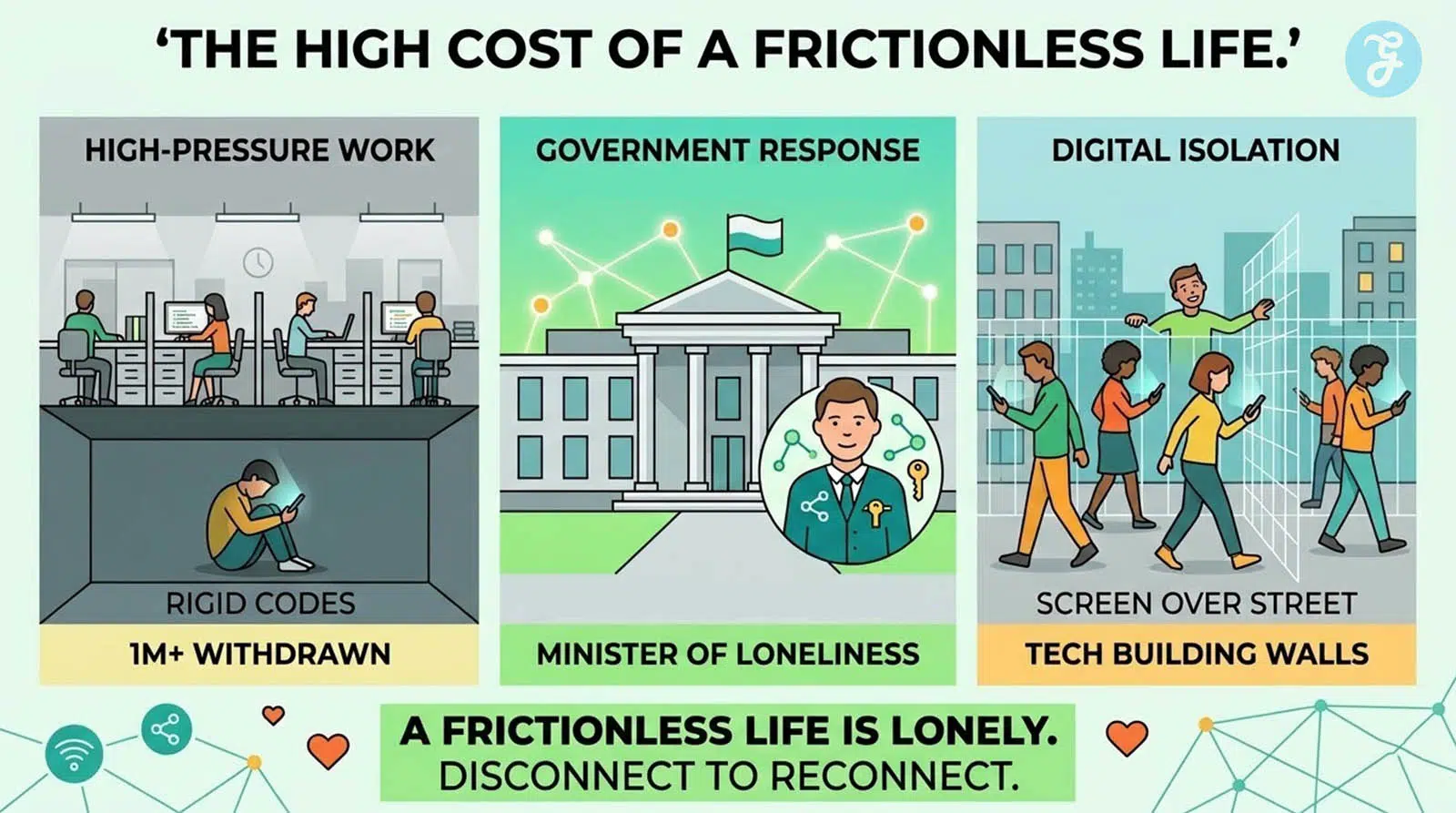 The government has noticed. Japan now has a Minister of Loneliness and new laws to map out social isolation. This is a bold move that treats loneliness as a public health priority rather than a private shame. But can a state office replace a neighbour? Can a policy rebuild a family?
The Japan loneliness crisis is a mirror for every modern city. We are building smarter homes and faster networks, but we are also building walls. We trade the messiness of human interaction for the ease of an app. We choose the screen over the street. We are becoming more connected to data and less connected to each other. To solve this, we must look beyond efficiency. We need to value human-centric design and workplaces that see people as more than units of labour. Connection requires effort and a bit of friction. A frictionless life is a lonely one. If we continue to prioritise the digital over the physical, we risk the same quiet isolation. We must choose to look up and reach out.
The Commercialisation of Solitude
Market forces in Tokyo have a curious way of turning a social void into a business model. This shift is known as the Ohitorisama movement. It celebrates the party of one. In the past, doing things alone carried a certain stigma. Now, it is a lifestyle choice that is being packaged and sold. Businesses are racing to accommodate the growing number of people who navigate life without a partner or a peer group. This commercial shift is a core part of Japan’s loneliness crisis. It offers a soft landing for those who have fallen out of traditional social circles.
The wedding industry is a prime example of this change. Companies like Cerca Travel now offer solo wedding packages. A client can spend two days at a luxury hotel. They choose a dress or a traditional kimono. They get professional hair and makeup. They even have a formal photoshoot. There is no groom. There is no bride on the other side. There are no guests. It is a ceremony of self-appreciation. For many, it is a way to mark a milestone that society usually reserves for couples. It is beautiful in its own way. Yet, it also highlights how solitary life is being formalised.
Then there is the rental industry. This goes beyond hiring a car or a tuxedo. In Japan, you can rent a human being. Agencies provide “friends” to go to a concert with or “relatives” to fill a seat at a funeral. Some people hire a fake spouse to impress their parents during a holiday. These services provide a temporary patch for a permanent problem. They offer the illusion of connection without any of the long term effort. It is a transactional fix for an emotional need.
This rise in solo services matches the shift in how people live. By the year 2050, researchers expect over 44 percent of Japanese households to consist of just one person. The family unit is shrinking. The neighbourhood tie is fraying. When we can buy companionship by the hour, the incentive to build real relationships fades. Why risk the messiness of a real friendship when you can pay for a polite stranger?
The market is efficient at filling gaps. It is less effective at building community. These products make isolation comfortable. They make it easy to stay alone. While these businesses solve daily inconveniences, they do little to stop the deepening Japan loneliness crisis. We are creating a world where every human need has a price tag. In that world, the only thing we cannot afford is genuine human connection.
The “Lonelygenic” Environment
The way we build our cities is changing the way we feel. Experts now speak of “lonelygenic” environments. These are urban spaces designed for maximum efficiency but minimum human contact. In Tokyo, every square metre is optimised for transit or commerce. We have traded the messy public square for the private high-rise. This shift is a quiet engine behind Japan’s loneliness crisis. It creates a physical world where you can live for years without ever needing to speak to a neighbour.
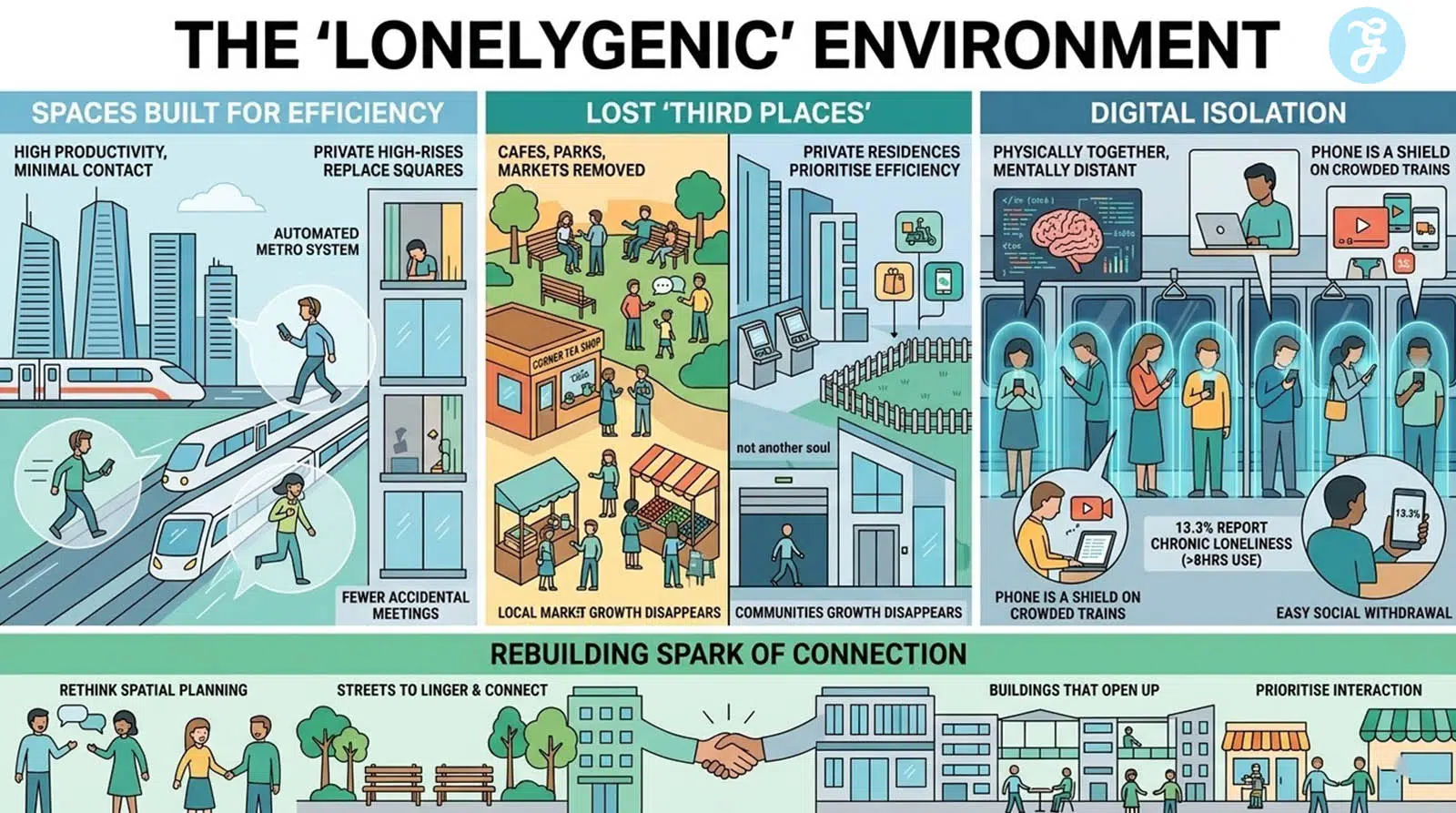 We are witnessing the death of the “third place.” These are the spots between home and work where the community used to grow. Think of the local market, the small park, or the corner tea shop. These spaces are disappearing. They are being replaced by high-density residences that offer total privacy. In these new buildings, you can enter the garage, take a lift, and reach your door without seeing another soul. This is a triumph of engineering but a failure of society. When we remove the chance for accidental meetings, we remove the spark of connection.
Modern living has become a form of digital enclosure. We are physically together but mentally miles apart. The statistics are alarming. Research from 2025 indicates that 13.3 per cent of individuals using smartphones for more than eight hours daily report chronic loneliness. The screen acts as a wall. We scroll through the lives of others instead of participating in our own. In a city like Tokyo, the phone is a shield. It allows us to navigate a crowded train while remaining entirely isolated.
This environment makes social withdrawal easy. It is comfortable to stay inside. It is convenient to order food through an app. It is simple to work from a laptop. But this convenience has a price. We are losing the stamina for real-world interaction. Human connection is often unpredictable and slow. Modern urban design hates slow things. It prizes the fast and the effortless. By building cities that do not require us to talk, we have built a world where we have forgotten how to listen.
The Japan loneliness crisis is not just a mental health issue. It is a spatial one. To fix it, we must rethink how we share space. We need to build “tension” back into our lives. We need streets that encourage us to linger. We need buildings that open up rather than shut down. If we continue to design for isolation, we will continue to feel it. A city that functions perfectly but feels empty is not a success. It is a warning that we have forgotten what cities are for.
The Digital Purgatory of the Modern Soul
The crisis in Japan is often described through numbers, but its true weight is found in the objects left behind. When a “lonely death” occurs, cleaners frequently find rooms filled with the artifacts of a life lived through a screen. There are stacks of unread mail eclipsed by the blue light of a smartphone that stayed plugged in long after its owner’s heart stopped. This is the digital purgatory of the modern soul. We have built a world where you can be “trending” online while being entirely forgotten by the person living six inches away on the other side of a concrete wall.
This environment breeds a specific kind of emotional malnutrition. We are consuming high volumes of “social data” but zero per cent of the actual human presence required for nervous system regulation. The Japan loneliness crisis highlights a terrifying paradox. The more we optimise for a life without friction, the more we erode the calluses that make us resilient. Real connection is difficult. It requires the courage to be seen in our most unpolished moments. By outsourcing our social needs to “rental” relatives or automated services, we are effectively amputating our capacity for genuine intimacy. We are not just losing our neighbours; we are losing the version of ourselves that knows how to belong.
The Economic and Demographic Burden
The weight of this crisis is felt most heavily in the quietest homes. Japan is currently grappling with the 8050 crisis, a reality now shifting into the 9060 crisis as the population ages. This term describes a heartbreaking domestic reality. It refers to 80-year-old parents who are the sole providers for their 50-year-old children. While 76 per cent of solitary deaths involved those over 65, the data reveals a chilling trend among the young, with hundreds of people in their twenties and thirties also found dead and alone. These adult children are often hikikomori. They are individuals who have spent decades in total social withdrawal.
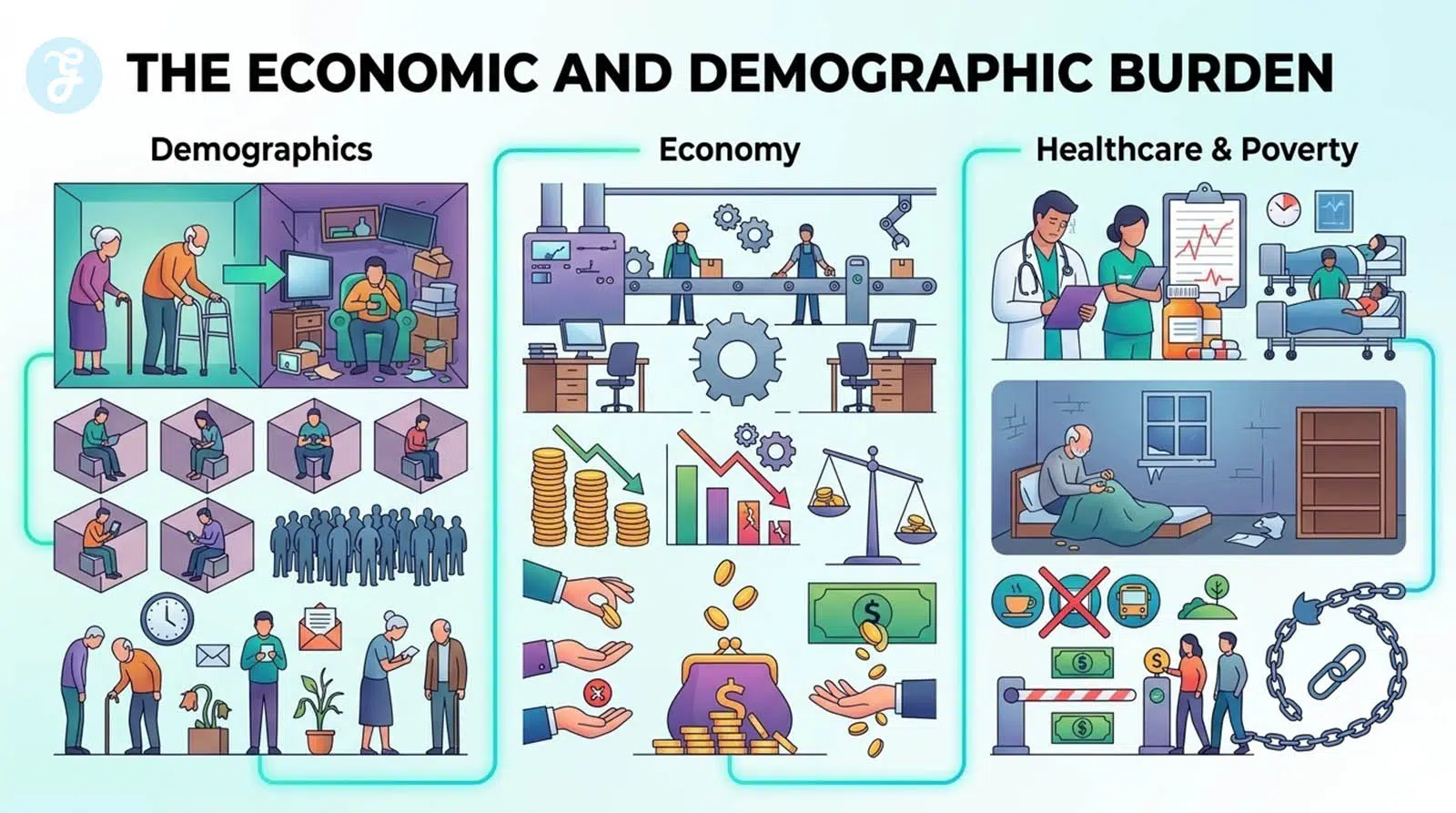 Current estimates suggest that 1.46 million people are living this way. It is a demographic ticking time bomb. As the parents age and pass away, these isolated adults are left with no safety net. Many have not held a job or spoken to a peer in twenty years. They are functionally invisible to the state until a crisis occurs.
This is not just a family tragedy. It is a massive economic drain. The World Health Organization noted in 2024 that isolation fuels significant workforce deficits. A lonely population is a less productive one. When over a million people remain entirely outside the labour market, the national economy loses its most essential engine. The healthcare system also feels the strain. Loneliness is linked to higher rates of chronic illness and mental health struggles. It places a billion-dollar burden on public funds every year.
Poverty adds another layer of difficulty to Japan’s epidemic of loneliness. Data from the Borgen Project in 2025 shows that 20 per cent of Japan’s elderly live in relative poverty. This is a cruel paradox in one of the world’s wealthiest nations. When you are struggling to pay for basic heating or medicine, socialising becomes impossible.
Poverty acts as a physical barrier to reintegration. It keeps people trapped in small, cold apartments. It prevents them from joining community groups or taking a bus to see a friend. This cycle of debt and distance makes the crisis nearly impossible to break without direct financial intervention. We are seeing a generation that is not just socially isolated, but economically stranded.
The Ministerial Response: A Policy Experiment
The Japanese government has decided that silence is no longer an option. In April 2024, the Act on Promotion of Measures for Loneliness took effect. This law mandates local authorities to create support networks. It formalises the role of the Minister of Loneliness. This is a bold experiment in public policy. It moves the issue from the private sphere into the halls of power. Japan is one of the few nations to treat a feeling as a matter of state.
Yet, a troubling question remains. Can a government department cure a broken heart? Legislation can provide funding. It can build centres. It can hire staff. But it cannot force a person to feel connected. Some critics argue that an emotional crisis requires a human solution, not a bureaucratic one. A law can provide a safety net, but it cannot provide a friend.
Grassroots initiatives are trying to bridge this gap. You can now find “Dementia Cafes” across the country. These are spaces where the elderly and their carers can meet without judgement. There are also “Tsunagari Supporters” or connection volunteers. These individuals go door to door to check on isolated residents. They offer a human face to a cold policy. These small acts of kindness are the real frontline. They suggest that while laws are necessary, the cure for the Japan loneliness crisis is always another person.
The Framework for Emotional Infrastructure
We are currently witnessing a global shift in how human presence is valued. Japan is the first to formalise this crisis, but the underlying patterns are universal. The focus on hyper-efficiency has inadvertently engineered out the small, unplanned interactions that sustain the human spirit. When a city is designed to be frictionless, it also becomes heartless. We have prioritised the user over the citizen and the consumer over the neighbour. This is not a personal failure of the isolated, but a design flaw in modern life. To reverse this, we must consciously rebuild the “social scaffolding” that once came for free. It requires a move from digital convenience back to physical community. This crisis of isolation is a clear signal that a society cannot survive on data alone. It needs the messy, unpredictable, and often inefficient warmth of real connection to remain resilient.
A Mirror for the West
Japan is not a distant anomaly; it is a pioneer of a new global reality. The isolation unfolding in Tokyo reflects a quiet struggle occurring in major cities across the West. While we celebrate the arrival of smarter homes and near-instantaneous connectivity, we are often inadvertently constructing our own barriers. In the pursuit of a lifestyle defined by ease, we have begun to prize the predictable solitude of an app over the challenging complexity of human presence.
To address this, our focus must shift from pure digital efficiency toward a more human-centric philosophy. We must redesign our professional lives to see employees as more than mere units of production and re-imagine our urban landscapes as spaces that compel us to engage with one another. True community cannot be engineered through a screen; it requires the deliberate effort and “friction” of real-world interaction. We are learning, through the lens of Japan’s struggle, that a life without obstacles is often a life without company. To move forward, we must look beyond our devices and choose the vulnerability of reaching out.