

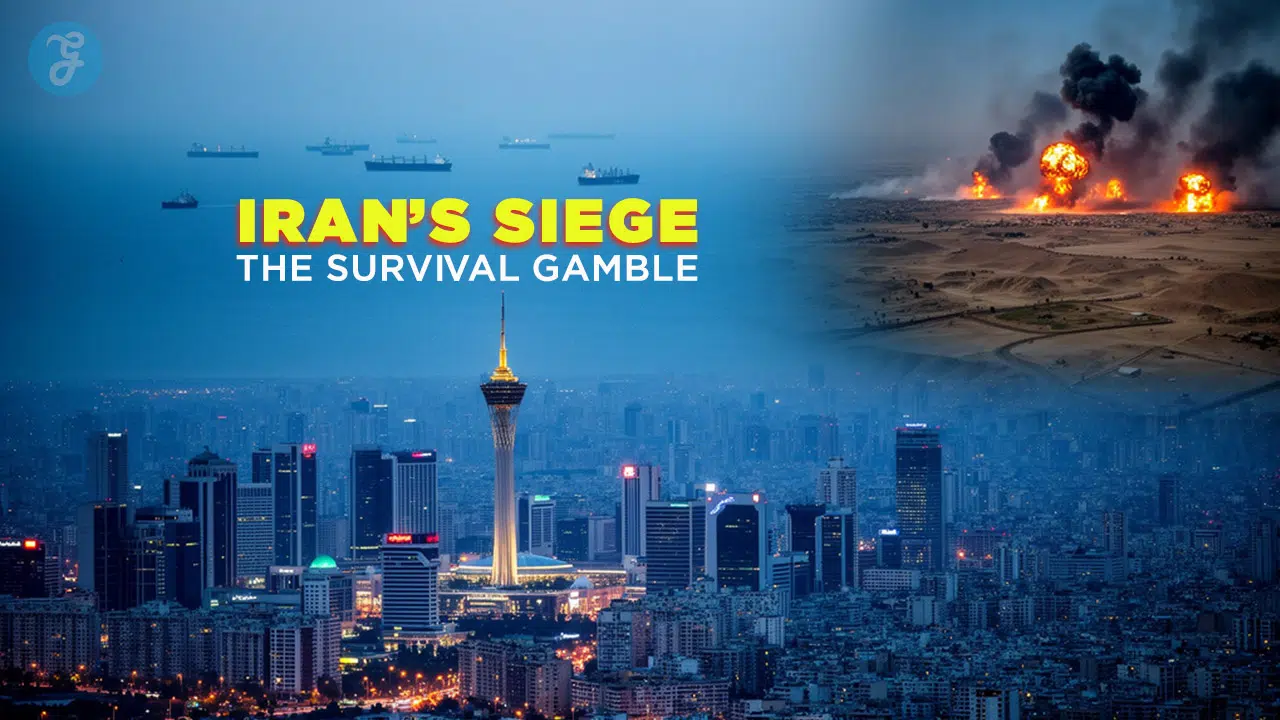
Tehran is walking a high wire. While missiles trade places between Iran and Israel, a different kind of battle is happening in the corridors of the Gulf. On 7 March 2026, President Masoud Pezeshkian offered an unexpected apology to his Arab neighbours. He expressed “personal regret” for Iranian strikes that hit civilian hubs in Dubai and Saudi Arabia during the first week of the Iran Israel War 2026. There is a catch: they must refuse to let the United States or Israel use their land for attacks. This is not a sudden change of heart. It is a cold and calculated move to keep the Persian Gulf quiet while the north burns.
The Pivot of Misconception
However, the apology is already fraying. By 8 March, Pezeshkian claimed the enemy had misconceptions about his conciliatory tone, asserting that Tehran has no choice but to respond to pressure. This U-turn, coupled with debris from intercepted projectiles causing a massive tower fire in Dubai Marina, proves that the internal power struggle between civilian diplomacy and IRGC kinetic reality remains unresolved.
Iran Israel War 2026: The Logic of the Apology
In fact, Iran is facing an existential threat. Following the death of Supreme Leader Ali Khamenei on 28 February, the new leadership in Tehran is under siege.
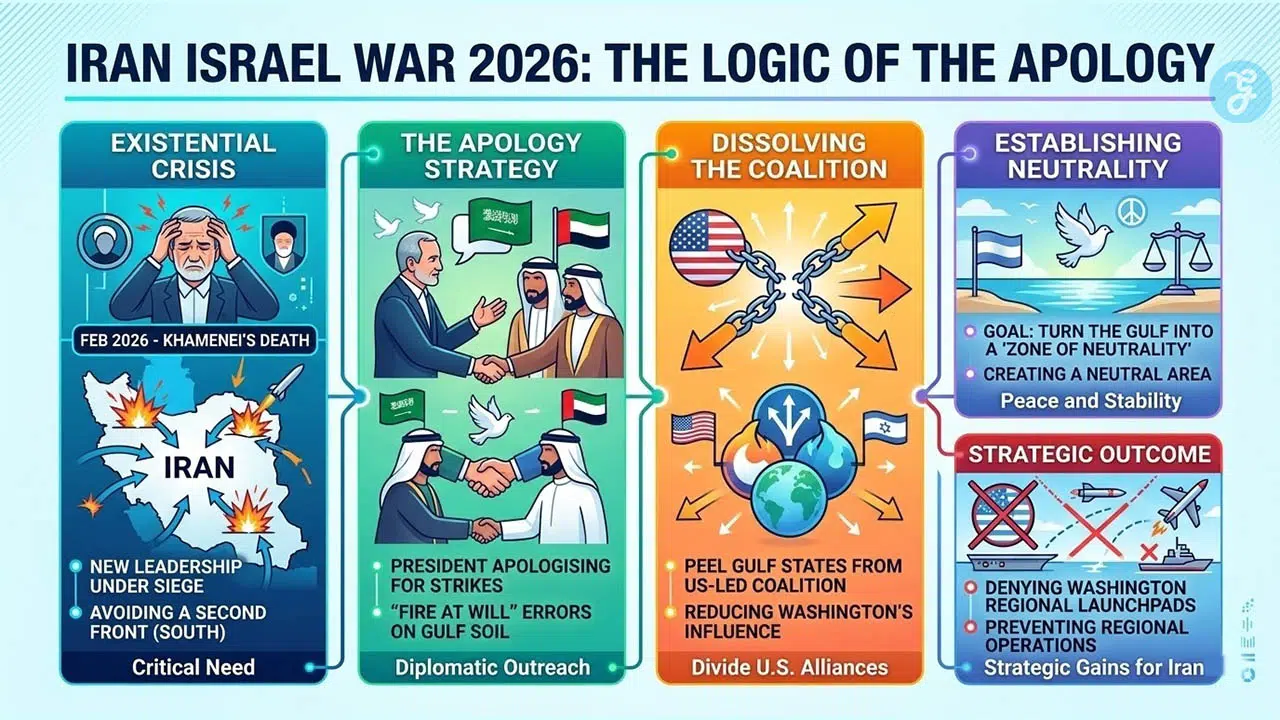 They cannot afford a second front in the south. By apologising for “fire at will” strikes that hit Saudi and Emirati soil, Pezeshkian is trying to peel the Gulf states away from the U.S. led coalition. He wants to turn the Gulf into a zone of neutrality. If he succeeds, he denies Washington its most important regional launchpads.
The Saudi Warning
Riyadh is not playing along. Earlier today, the Saudi Ministry of Defence reported the interception of four drones in a claimed intrusion toward the Shaybah oil field near the Emirati border. While the Ministry announced the threats were successfully neutralised, the timing of the reported sighting, coming just 48 hours after the apology from Pezeshkian, has been met with sharp rhetoric from the Kingdom. The message from Riyadh is clear because words are not enough. Iran is trying to present itself as a partner in regional security, but the ongoing friction on the ground tells a far messier story.
Survival Over Pride
Tehran’s “strategic restraint” is a survival manual. With its proxies like Hezbollah and the Syrian regime weakened, Iran stands alone. It is betting that the Gulf’s own desire for stability will keep them out of the fight. This is a desperate attempt to frame the war as a private duel with Israel and the U.S. while keeping the oil flowing in the south. It is a gamble that depends entirely on whether the Gulf states believe an apology can replace a missile.
The Levant vs The Gulf
The geography of Iranian warfare is a tale of two different playbooks. In the Levant, Tehran views conflict as a tool for expansion. In the Gulf, war is a threat to its very existence. This distinction explains why Iran is comfortable seeing Beirut or Gaza in flames while it desperately tries to keep the waters of the Persian Gulf still. In the north, the Iran Israel War 2026 has seen the Levant turn into a scorched-earth buffer zone. For decades, Iran treated Lebanon and Syria as forward bases. They were disposable assets designed to keep the fighting away from Iranian soil. When Hezbollah launched its massive rocket barrage on 2 March, it was acting as the shield for a regime in mourning. Tehran can afford the chaos in the Levant because the cost is largely borne by others. The destruction of Lebanese infrastructure or the fall of the Assad regime in Syria is a tactical blow; however, it does not stop the lights from staying on in Tehran.
A Bridge Too Close to Burn
The Persian Gulf is a different story. This is the only remaining lung for Iran. If the Levant is about ideological reach, the Gulf is about physical survival. Roughly 20% of global oil and a large chunk of liquefied natural gas flow through the Strait of Hormuz. For a country under the heavy weight of 2025 snapback sanctions, these waters are the only way to move goods and bring in hard currency. Any real war in the Gulf would lead to an immediate blockade. We have already seen the first signs of this. As indicated by open-source maritime tracking, since the U.S. and Israeli strikes began on 28 February, tanker traffic has plummeted. Brent crude has teased the $100 mark.
If Iran continues to target Gulf airports or oil refineries, it will find itself in a cage of its own making. China, the only major power still buying Iranian oil, has no appetite for a closed Strait. Beijing needs stable energy prices to fuel its own economy. By attacking the Gulf, Tehran risks alienating its last great protector. There is also the matter of military reality. In the Levant, Iran fights through proxies and shadow networks. In the Gulf, any escalation quickly turns into a direct naval and air confrontation with the U.S. Fifth Fleet. Tehran is learning that it cannot bully its neighbours while its own house is on fire.
- Conventional Mismatch: The 2025 Twelve-Day War proved the Iranian navy cannot survive a direct engagement with Western naval systems in open water.
- Tactical Admission: Strategic Restraint in the south is a desperate plea for time while the northern front collapses.
The “Neutrality” Trap
Tehran’s apology to the Gulf is not just a gesture of peace. It is a tactical ultimatum. By offering a handshake with one hand and holding a missile controller in the other, Iran is setting a “neutrality trap” for its neighbours. The message to Riyadh, Abu Dhabi, and Doha is blunt: if you host the American military, you host a target.
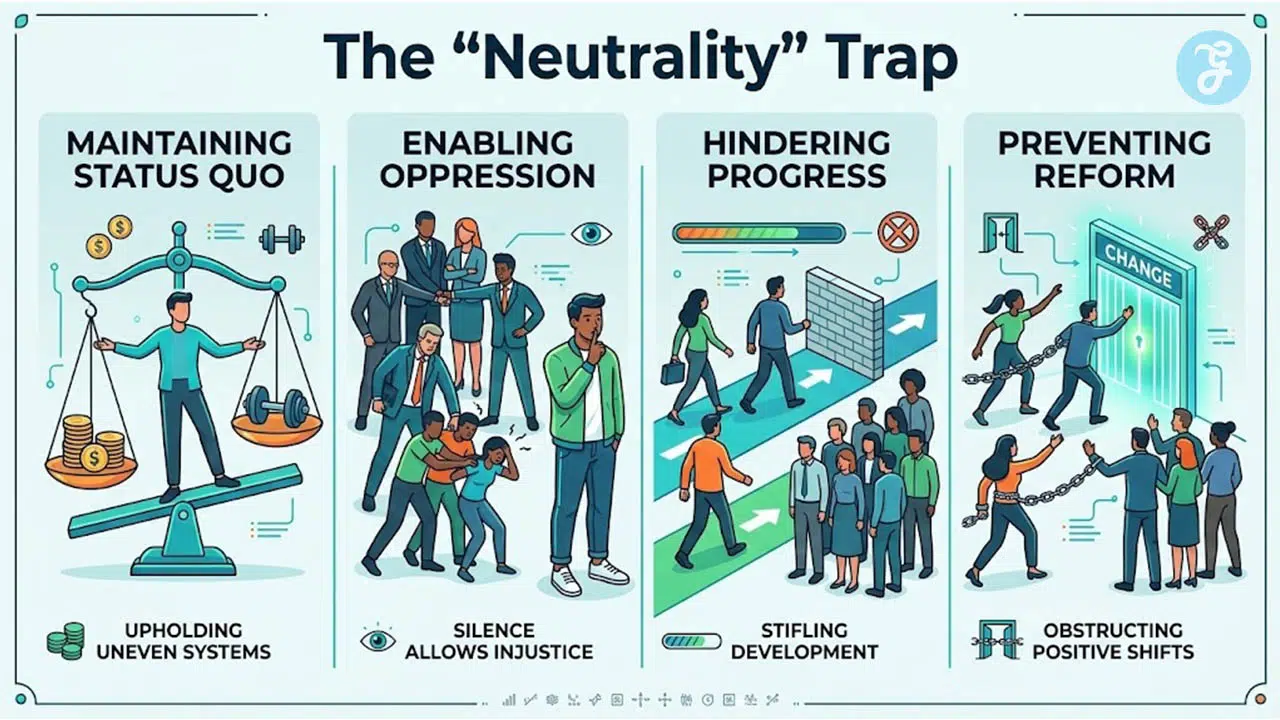 This strategy relies on the term “legitimate military objectives.” Following the U.S. and Israeli strikes on 28 February, Iranian officials sent a formal letter to the United Nations. They argued that any base used to launch an attack on Iranian soil loses its sovereign protection. In Tehran’s eyes, a hangar in Qatar or a runway in the UAE becomes an Iranian battleground the moment a Western jet takes off from it.
We are seeing this play out in real time. On 7 March, while President Pezeshkian was speaking of “brotherhood,” the Revolutionary Guard (IRGC) was busy targeting the Al Dhafra Air Base in the UAE. They claimed they hit a U.S. air combat centre. By striking these specific points, Iran is trying to make the cost of the U.S. alliance too high for the Gulf states to bear. They want the GCC to choose between their security partnership with Washington and the physical safety of their own cities.
The Strategic Off-Ramp
This puts the Gulf states in an impossible position. For years, they have relied on the U.S. umbrella for protection. Now, that same umbrella is acting as a lightning rod. The Twelve Day War of 2025 and the current March 2026 escalation have shown that U.S. defences are not a perfect shield. Drones and missiles are still getting through. If a Gulf capital allows its territory to be used as a launchpad, Iran treats it as a co-belligerent.
The trap is working to a degree. Regional intelligence leaks in early March suggest that several Gulf allies have already restricted the U.S. from using their airspace for offensive sorties into Iran. They are happy to host defensive systems, but they are terrified of being the origin point for a strike that levels Tehran. They know that a wounded Iranian regime will not hesitate to lash out at the nearest available target. By framing this as a legal right to self-defence, Tehran is trying to give the Gulf states a political off-ramp. The apology allows Arab leaders to say their concerns were heard, while the threat of further strikes gives them the excuse they need to say no to Washington. It is a sophisticated form of coercive diplomacy. Iran is betting that the fear of a local fire is stronger than the commitment to a distant ally.
A Gilded Cage of Trade
Money is driving this diplomacy as much as military fear. Iran relies on the UAE and Oman to breathe. Even with the September 2025 snapback sanctions in place, these trade routes keep the Iranian economy from total collapse. For Tehran, the Gulf states are more than neighbours. They are a financial oxygen mask.
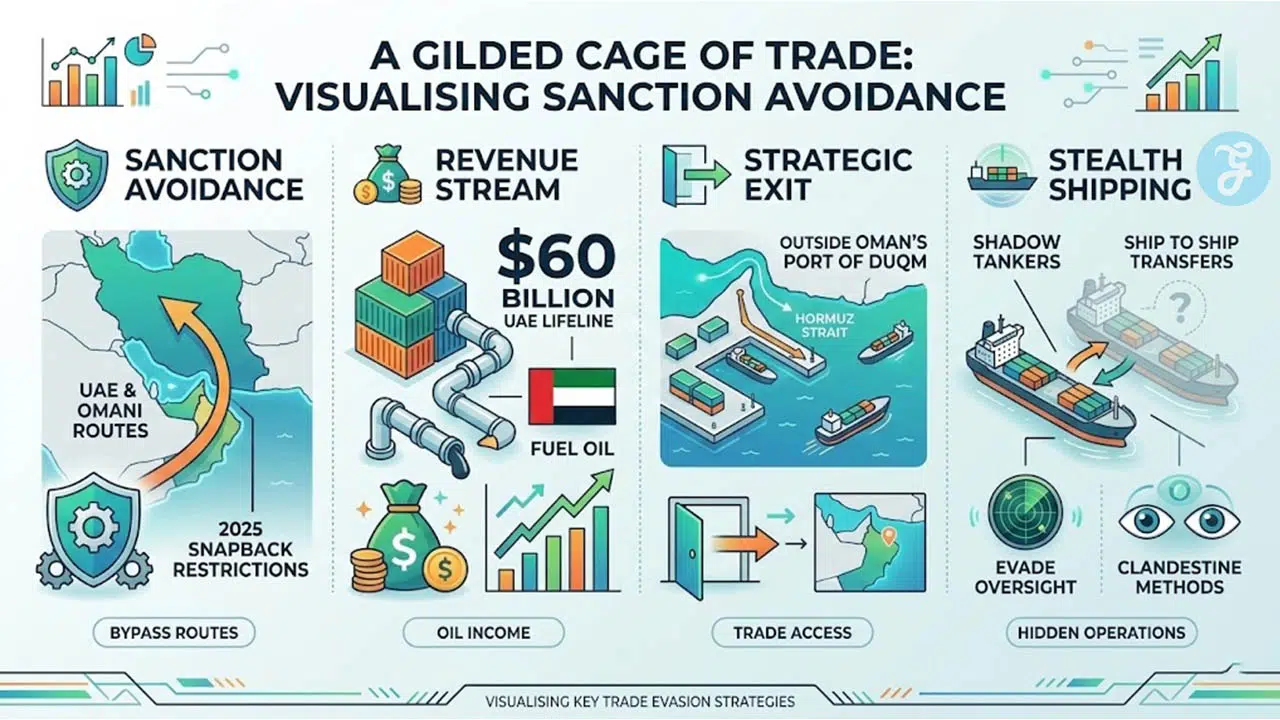 The 2025 snapback was a sea change. It brought back the heavy UN restrictions that had been shelved for a decade. It targeted everything from shipping lines to the Central Bank of Iran. On paper, the Iranian economy should be frozen. In reality, the ports of the UAE tell a different story. Abu Dhabi’s maritime networks facilitated the transit of nearly 70% of those fuel oil exports last year. This trade provides Iran with a roughly $60 billion lifeline.
Oman plays a quieter but equally vital role. Muscat has spent billions on the Port of Duqm. This facility sits strategically outside the Strait of Hormuz on the Arabian Sea. It offers a back door for trade that bypasses the most dangerous chokepoints. While the world watches the missiles, Iranian shadow tankers use Omani waters to move crude through ship-to-ship transfers. This opaque network makes it almost impossible for Western regulators to shut down the flow of cash.
Iran Israel War 2026: The Economic Insurance Policy
Digital currency has also become a tool for survival. In late 2025, Iranian crypto activity spiked. IRGC-linked addresses moved over $3 billion to procure dual-use equipment and support regional networks. Much of this digital traffic is facilitated through brokers operating out of Gulf financial hubs. These small and agile firms are harder to catch than traditional banks. They allow Tehran to settle international bills without ever touching the dollar-dominated banking system.
Closing the Strait of Hormuz would be an act of economic suicide. Tehran knows that a permanent blockade would alienate its only remaining powerful buyers. China still takes in over 1.3 million barrels of Iranian crude every day. If Iran chokes the Strait, it destroys the very route its own oil must take to reach Beijing. It would also strand the LNG exports of Qatar and the UAE, which make up 20% of global supply. Tehran’s Strategic Restraint is an admission that it lives in a gilded cage. It must keep its neighbours safe because it cannot afford to lose the markets they provide. The apology to the Gulf is not just about peace. It is an insurance policy for a regime that is running out of friends and time. Iran is betting that as long as the oil flows and the trade continues, the Gulf states will have a vested interest in keeping the war from their door.
The Geopolitical Vacuum
Iran’s regional strategy is currently a hollow shell. For decades, Tehran relied on a “forward defence” doctrine. It used Syria and Lebanon as human shields to keep its enemies at a distance. That shield has shattered. The fall of the Assad regime in late 2024 and the systematic decapitation of Hezbollah’s leadership have left the Iranian heartland exposed for the first time in 40 years.
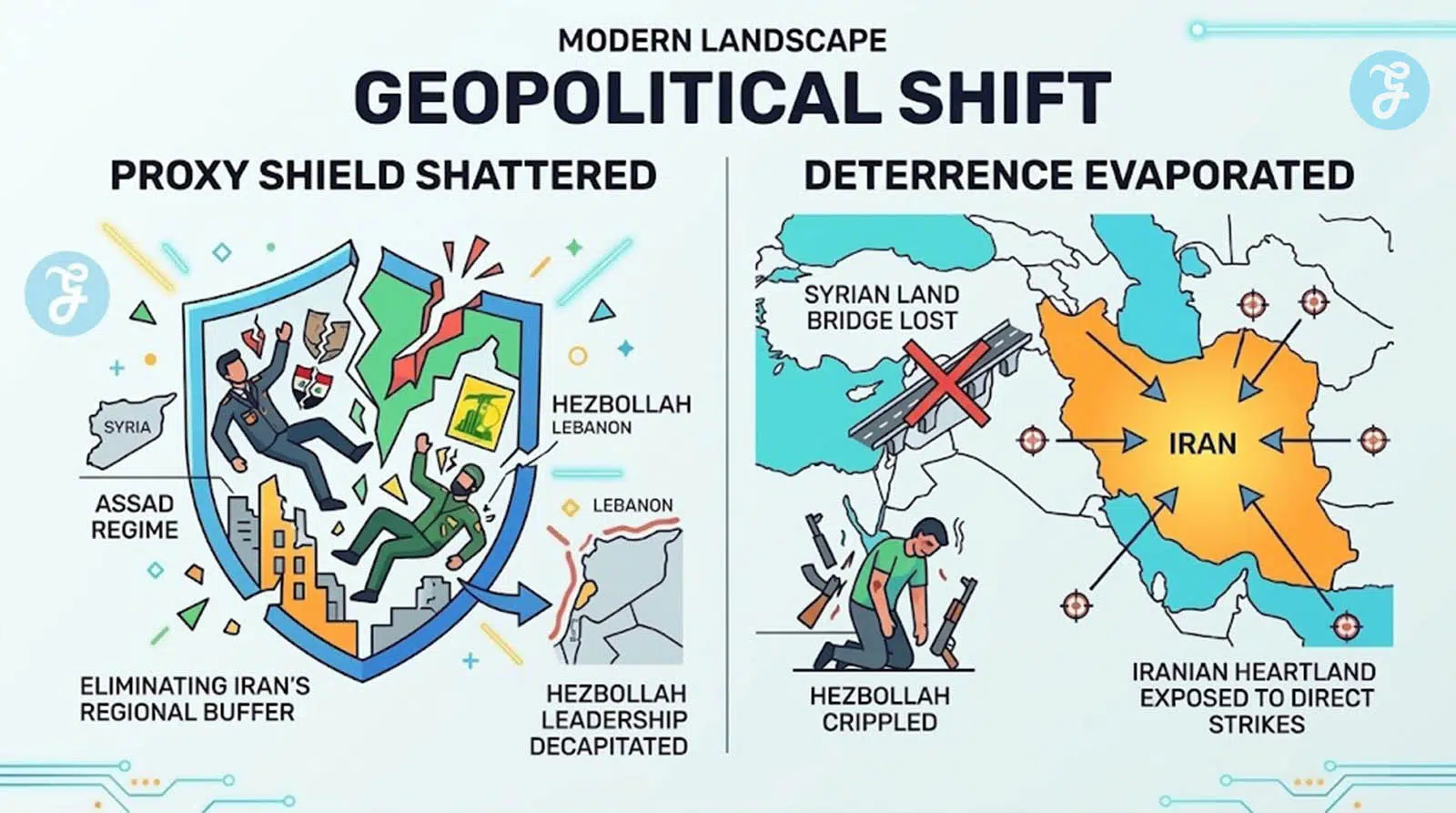 The collapse of Bashar al-Assad was the first domino. Syria was the vital land bridge connecting Tehran to the Mediterranean. When the rebel offensive captured Damascus in December 2024, Iran lost its most reliable state ally. Today, a transitional government led by Ahmed al-Sharaa is busy scrubbing the Iranian presence from the country. Syria is no longer a transit point for Iranian missiles. Instead, it is a country looking toward Saudi investment and Western re-engagement. For Tehran, this is a strategic catastrophe. The “Axis of Resistance” now has a massive, gaping hole in its centre.
In Lebanon, the situation is equally dire. Hezbollah, once the crown jewel of Iran’s proxy network, is fighting for its life. The death of Hassan Nasrallah in September 2024 was a blow from which the group has not recovered. While Naim Qassem has taken the helm, he is leading a fractured movement. The Israeli ground operations south of the Litani River and the massive air campaign this month have degraded Hezbollah’s missile stocks and killed its veteran commanders. Even more damaging is the political shift in Beirut. The Lebanese government is now openly demanding that Hezbollah disarm. The group is being treated as a liability by its own people, not a protector.
This creates a dangerous vacuum. Without a strong Hezbollah to threaten northern Israel, the Israeli Air Force can focus its entire weight on Iranian soil. Tehran can no longer count on a “distraction” in the Levant to pause a strike on its nuclear facilities. The deterrent that Iran spent forty years and billions of dollars building has evaporated in less than eighteen months.
This vulnerability explains the frantic diplomacy in the Gulf. Iran is cornered. It has lost its proxies, its Supreme Leader is dead, and its economy is on life support. The “Strategic Restraint” toward the south is not a choice made from a position of power. It is a desperate attempt to prevent the Gulf from becoming yet another front in a war that Iran is already losing. Tehran is discovering that when your walls in the north crumble, you have no choice but to beg your neighbours in the south for a ceasefire.
The Intelligence Ledger: A Clinical Necessity
This is not a diplomatic pivot; it is a clinical survival protocol. By offering a conditional apology to the Gulf, Tehran is attempting to decouple its northern theatre from its southern lifeline. The 7 March address by President Pezeshkian reveals a leadership that has accepted the loss of its forward defence in the Levant and is now fortifying its last mile in the Gulf.
The hidden mechanic here is the neutralisation of U.S. regional leverage. By framing Gulf states as legitimate targets only if they act as launchpads, Iran is effectively pushing the GCC to block American offensive operations. This creates a functional barrier to U.S. airpower from within the region. If Riyadh and Abu Dhabi enforce neutrality to save their own desalination plants and oil hubs, the Pentagon loses the proximity required for a sustained decapitation campaign.
Looking toward 2030, this shift marks a significant test for the U.S. security promise. The Gulf states are realising that Washington can initiate a war but cannot always insulate its allies from the fallout. We are entering an era of strategic autonomy, where the GCC may move toward a permanent security pact with Tehran to bypass Western-led escalations. Iran is betting that its neighbours prefer a cold, Iranian-managed peace to a hot, American-led regime change that leaves the entire region in the dark.
The Shift in Leverage
The current conflict is rewriting the regional balance of power. While the public focus remains on the kinetic exchanges in the Levant, the structural shifts in the economy and the deep state tell a different story. Below is a breakdown of who is genuinely gaining ground and who is sustaining the most significant strategic losses.
| Stakeholder | Declared Status | Tactical Reality |
| Iran IRGC | Resilient | Lost its forward shield in Syria and Lebanon; now exposed to direct strikes. |
| The GCC | Vulnerable | Gaining “Strategic Autonomy” by dictating terms of U.S. base usage. |
| China | Neutral | Securing discounted energy and expanding influence as the Gulf’s primary buyer. |
| U.S. Navy | Dominant | Maintaining control of the seas but facing a diplomatic blockade on land bases. |
| Tehran Civilians | Safe | Facing the highest risk as the war shifts from proxies to the Iranian heartland. |
A Gamble for Survival
Tehran’s “strategic restraint” is not a sign of peace. It is the final, desperate calculation of a regime under total siege. By 9 March 2026, the Islamic Republic has reached its most vulnerable point since the 1979 revolution. With the Supreme Leader dead, the economy on life support, and its regional shield in tatters, the state is fighting for its own skin. The apology to the Gulf is not an act of grace; it is an admission that Tehran cannot afford to fight everyone at once. The death of Ali Khamenei on 28 February has triggered a transition that the clerical elite were never ready for. The appointment of the Interim Leadership Council, and the subsequent rise of Mojtaba Khamenei, happens against a backdrop of domestic celebration and international pressure. While the IRGC tries to project strength through missile salvos, the civilian leadership knows the truth. Every strike that accidentally hits a Gulf neighbour risks bringing the full weight of the GCC and the U.S. Fifth Fleet into a direct war for which Iran is unprepared.
A High-Stakes Bluff
The collapse of the Assad regime in Damascus and the rapid disarmament of Hezbollah in Lebanon have left Iran naked. The “forward defence” that once kept Israeli jets away from Tehran is gone. For the first time, the battlefield is not a proxy’s backyard; it is the Grand Bazaar and the fuel depots of Karaj. By calling for “brotherhood” and offering apologies to Riyadh and Abu Dhabi, President Pezeshkian is attempting to freeze the southern front. He is begging for a neutrality that gives the new leadership room to breathe while they deal with the inferno in the north. This is a high-stakes bluff. Iran is offering the Gulf states a choice: help us survive, or we will take the global energy market down with us. The closure of the Strait of Hormuz is the ultimate “poison pill.” It is a move that would destroy Iran’s remaining trade with China just as quickly as it would cripple the West. For now, the world is watching a cornered power trying to navigate its way out of a dead end. Tehran is not looking for a new era of regional friendship. It is simply looking for a way to make sure that when the dust settles on the Iran Israel war 2026, there is still a regime left to lead.
Disclaimer: Editorialge maintains a steadfast commitment to responsible reporting on the evolving conflicts in West Asia involving Israel, Iran, U.S., Gulf nations and non-state actors like Hezbollah, Hamas, Houthis, Islamic State, and others. In an environment where digital disinformation is widespread, we cannot independently verify every social media post or claim involving national and non-state actors. Our priority remains factual accuracy and the exercise of extreme caution when documenting all regional media.





















