

Many people feel stuck picking a programming language to learn. Choosing between Python and JavaScript can be confusing, especially for beginners who want the best skills for future jobs in 2026. You may wonder which one is easier to start with or which has more job opportunities.
Python is now used in fields like data science and artificial intelligence, while JavaScript powers almost every website you visit. This guide breaks down “Learning To Code In 2026: Python Vs Javascript,” showing key facts, differences, and smart ways to pick the right path for your goals.
Get ready, and you will soon know exactly where to begin your coding journey!
Why Compare Python and JavaScript in 2026?
Python and JavaScript lead the way for programming languages in 2026. Job postings keep growing, especially for those with coding skills in these two areas. Python powers data science, artificial intelligence, and automation, while JavaScript rules web development and user interface work.
Big companies like Google and Facebook use them every day.
“The best way to get a job in tech is to know both Python and JavaScript.”
New frameworks and tools keep coming up fast. Tech changes quickly; learning one language last year may not fit today’s needs. Comparing them helps you pick what matches your career goals or a project need right now.
Next up are the key differences between Python and JavaScript.
Python vs. JavaScript: Key Differences
Python and JavaScript each have their own style and quirks. Think of them as two different vehicles. One is a heavy-duty truck built for power and hauling data, while the other is a speedy sports car built for quick maneuvers on the web.
Picking the right one can shape your path in coding, so it pays to know what sets them apart.
Syntax and Learning Curve
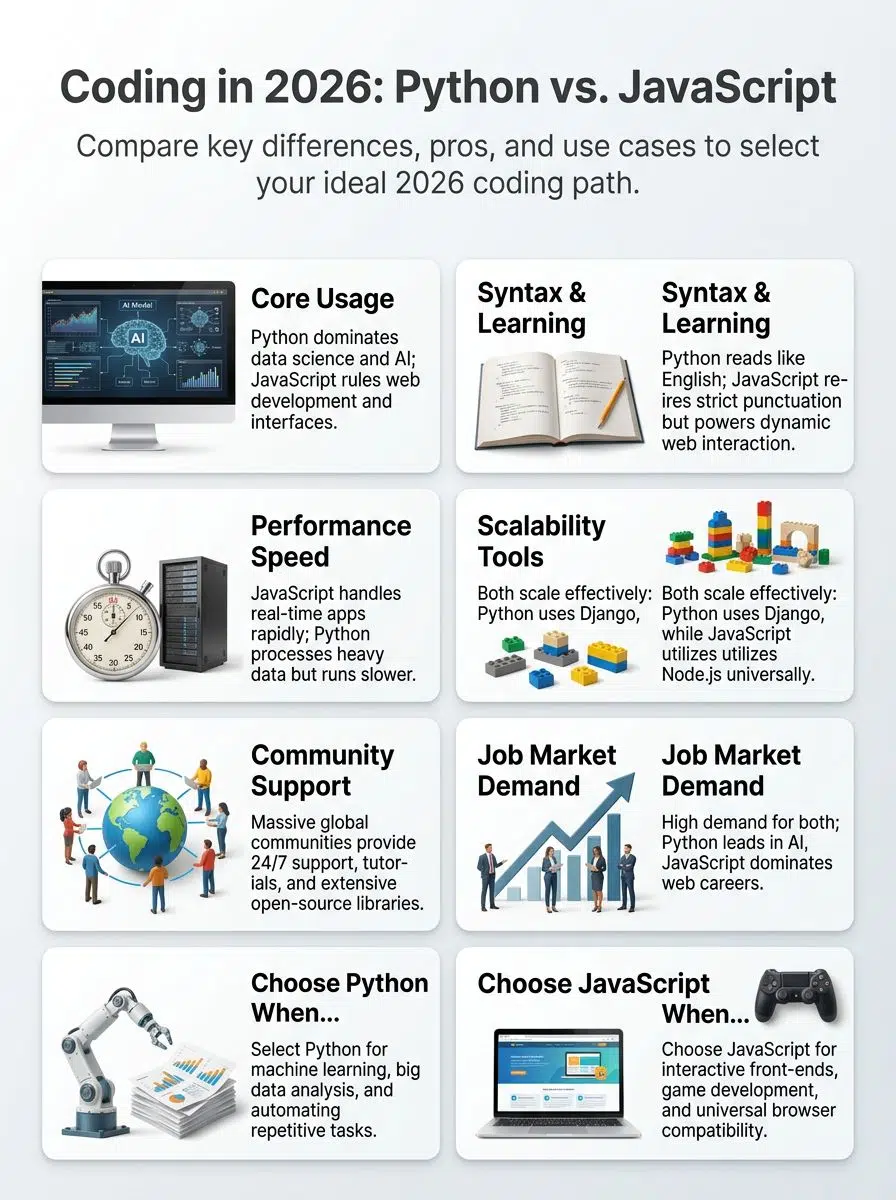
Coding with Python often feels like talking to a friend. Its syntax uses plain words, simple spacing, and fewer curly brackets than other programming languages. Many beginners say they learn faster with Python tutorials since the language reads almost like English.
For example, a simple command in Python looks like print(“Hello”). This simplicity makes it beginner-friendly for technical education and building initial coding skills.
JavaScript cares more about punctuation. Every semicolon counts, and missing one can break your code in web development projects. It uses “curly braces.” {} to organize code blocks, which can feel cluttered to new eyes.
Learning JavaScript may take longer for some folks because of its extra rules and fast-changing frameworks. Even so, young coders in 2026 find tools online to help them along the learning curve.
Coders often compare both languages when choosing entry-level jobs or career opportunities in software development fields.
Performance and Speed
Python generally runs slower than JavaScript. The language processes code line-by-line, which adds time. However, the release of Python 3.13 introduced a “NoGIL” (free-threading) feature that has significantly boosted speed for complex tasks in 2026.
Many programmers pick JavaScript for apps that need fast results, like games or chat tools. Its “V8 engine” (the same tech powering Google Chrome) compiles code incredibly fast.
Node.js helps JavaScript handle lots of users at the same time without breaking a sweat. Python works well for simple scripts, but it can slow down with large amounts of data unless you use specialized libraries like NumPy.
Both languages keep getting updates to boost speed each year. In 2026, changes in hardware and new frameworks will improve how these programming languages perform on laptops and cloud platforms alike.
Scalability and Flexibility
Python handles big projects, like Dropbox and Instagram, with ease. Its clear style lets teams add new parts or change features fast. You can use frameworks like FastAPI to build high-performance backends that scale up as your user base grows.
JavaScript runs on both the front-end and back-end, making it easy to scale apps for millions of users. Think of Netflix or PayPal, which rely heavily on JavaScript to serve video and payments to the world.
Many developers pick frameworks like Django for Python or Next.js for JavaScript to grow their apps quickly. Both languages flex with many types of work, from building simple tools to powering huge websites.
As job opportunities rise in data science and web development in 2026, choosing a flexible language opens more doors for your career goals.
Community Support and Resources
People all around the world use these programming languages. Thousands join forums, chat rooms, and online groups every day. Big names like Stack Overflow have millions of questions and answers about Python and JavaScript.
You can find free courses, step-by-step tutorials, YouTube lessons, code examples, and more with just a quick search. Sites like FreeCodeCamp and Coursera offer updated 2026 curricula for both.
Helpful guides cover everything from beginner tasks to advanced tricks. Users share sample projects or help fix errors fast. Many local tech meetups let you make new friends who share your coding interests.
If you need a push to learn faster or solve problems together, this large developer community has your back 24/7!
Pros and Cons of Python
Python wears many hats, making it a favorite for beginners and pros alike. Yet, every bright side has its shadows. Stick around to see where Python shines and where it stumbles.

Pros of Python
Python grabs attention fast. Many people choose it for their first programming language because it offers a smooth entry into the tech world.
- English-Like Syntax: It reads like plain text, which keeps the learning curve gentle for beginners.
- AI Dominance: It is the primary language for AI tools like ChatGPT and Claude, making it essential for future technologies.
- Massive Community: With over 8 million developers, you can find answers to almost any problem on forums like Reddit’s r/learnpython.
- High Demand: Data science and automation jobs actively seek these skills, with entry-level salaries often starting around $73,000 in the US.
- Versatile Libraries: Tools like Pandas (for data) and PyTorch (for machine learning) let you build complex projects with just a few lines of code.
- Great for Prototyping: You can sketch out an idea and have a working model running in minutes, not days.
Cons of Python
Some people love coding with Python. Yet, it does have a few downsides that matter in 2026.
- Slower Execution: It is generally slower than compiled languages like C++ or Java, which can limit its use in high-speed gaming.
- Weak Mobile Support: Building mobile apps is tough because Python frameworks like Kivy are not as polished as JavaScript options.
- Memory Consumption: It uses more computer memory, which can increase costs for large-scale data projects on cloud servers.
- Runtime Errors: Bugs often only show up when you run the code, rather than while you are writing it (though tools like MyPy help fix this).
- Database Access Layers: Some developers find Python’s database layers less flexible than writing raw SQL queries for complex needs.
Moving next, let’s take a closer look at the good and bad sides of using JavaScript.
Pros and Cons of JavaScript
JavaScript is like the glue holding web pages together, making sites come alive and react. Some say it’s everywhere these days, yet a few quirks may leave even experts scratching their heads.
Pros of JavaScript
JavaScript is everywhere. People use it to build cool and interactive websites that work on any device.
- Runs Everywhere: Every modern web browser supports it, so your code works on phones, laptops, and tablets instantly.
- Full-Stack Capability: You can use it for the front end (visuals) and the back end (server) using Node.js.
- Huge Ecosystem: The npm registry has over 2 million packages, offering pre-made code for almost any feature you can imagine.
- Interactive UI: It powers dynamic features like drag-and-drop maps, animations, and instant chat forms.
- Job Volume: There are often more total job openings for JavaScript because every company needs a website.
- Modern Frameworks: Learning libraries like React or Vue can make you highly employable in the 2026 job market.
Cons of JavaScript
JavaScript stands as a top choice for web development, but it is not perfect. Some issues can slow down new learners and even experienced developers.
- Complex Debugging: Errors can be hard to track down because they might vary between browsers like Chrome and Safari.
- Security Risks: Since the code runs on the user’s computer, malicious actors can sometimes exploit it if you are not careful.
- “Callback Hell”: Managing complex tasks can lead to messy, nested code that is hard to read (though Async/Await features help fix this).
- Too Many Choices: The sheer number of frameworks (React, Angular, Svelte, Solid) can leave beginners feeling overwhelmed about what to learn first.
- Loose Typing: JavaScript allows odd behaviors, like adding a number to a word, which can cause silent bugs in your app.
Now that you have seen some pitfalls of using JavaScript, explore when Python proves to be a better pick for your coding journey next.
Use Cases of Python and JavaScript
Python and JavaScript each shine in their own corners of coding. Peek at how these two heavy hitters shape so many tools we use every day.
Python for Data Science, AI, and Automation
People use Python to solve problems with data, find patterns, and make smart programs. Schools teach it for coding skills because its syntax is simple. In 2026, most Data Science jobs ask for good Python knowledge.
Scientists trust it for research since many frameworks support artificial intelligence and machine learning tasks. For instance, the software behind self-driving cars and medical diagnosis tools is often written in Python.
Many companies rely on Python to automate boring jobs like sorting emails or pulling numbers from giant lists. NASA and Google use it daily; even kids can write small scripts that save hours of work each week.
JavaScript for Web Development and Interactive Apps
JavaScript shapes how websites and apps work. Every button click, animation, or popup you see online likely uses JavaScript. This programming language handles everything from live chat windows to fast-loading news feeds.
Big tech names like Google and Facebook use JavaScript in their user interface designs. By 2026, learning this skill will open doors for entry-level jobs in web development.
Frameworks such as React, Vue.js, and Angular let beginners build interactive pages faster than ever before. These tools also help create games and mobile apps that run smoothly right inside your browser.
If you want to make things people use every day on the internet, JavaScript gives you a strong start with endless job opportunities ahead.
When to Choose Python Over JavaScript
Python works great for data science, artificial intelligence, and automation. If you want to analyze big sets of numbers or work on future technologies like machine learning, Python leads the way. It is the language of choice for the modern AI revolution.

Libraries such as Pandas and TensorFlow make things simple even for beginners. Many entry-level jobs in software development ask for Python skills because its learning curve is gentle.
Big tech companies use Python a lot in 2026. It powers tools at NASA, Google, and Netflix. Beginners find it less stressful to write code using clear rules that look like plain English sentences.
Schools often start with Python too, since it helps learners grab coding basics fast before moving on to more complex programming languages or frameworks later on in their careers.
When to Choose JavaScript Over Python
Building websites and apps that users click, swipe, and scroll on? JavaScript takes center stage for user interface work. Browsers only speak JavaScript. No matter how strong other programming languages are in data science or artificial intelligence, they cannot match JavaScript in web development.
Websites such as Facebook, Twitter, and YouTube rely on it to make pages move fast and look sharp. If your dream is to join tech giants like Google or startups building interactive dashboards, learn JavaScript first.
Web development jobs keep growing faster than most careers in the United States. Over 180 million sites will use some form of the language by 2026. Frameworks like React.js and Vue.js help speed up projects while keeping code clean.
Want a career with flexible entry-level jobs? Many teams want coders who know how browsers think. JavaScript matches this need perfectly. Games running inside browsers also depend on their quick responses for fun, action-packed playtime with friends worldwide!
Even if you plan to branch into mobile apps later, using tools like React Native helps stack up real skills quickly.
Future Outlook of Python and JavaScript in 2026
Choosing JavaScript can make sense for web jobs, but what happens next matters too. Python will keep growing in data science and artificial intelligence. Experts say Python may power over 90% of AI projects by 2026, thanks to its easy code and huge support from the developer community.
Google’s TensorFlow and open-source models from Hugging Face keep boosting Python’s impact on machine learning.
JavaScript holds a big spot as websites get smarter every year. TypeScript, a stricter version of JavaScript, is becoming the standard for enterprise companies. Learning it alongside standard JavaScript is a smart move for 2026.
The number of entry-level job opportunities using both programming languages is expected to rise steadily through 2026, especially with remote work gaining ground in software development.
New tools keep making coding smoother. Beginners often find Python best for starting out, while JavaScript still rules anything you click or tap in your browser window.
Final Words
Python and JavaScript both give you great tools for coding in 2026, no matter your skill level. Each has simple steps to start, clear uses in jobs, and big groups ready to help if you get stuck.
Picking the right one can open doors to careers like building websites or digging into data science. If you want extra tips or tutorials, check out online courses or talk with developers on forums for quick answers.
Start your learning journey now because every line of code you write shapes your future.






















