

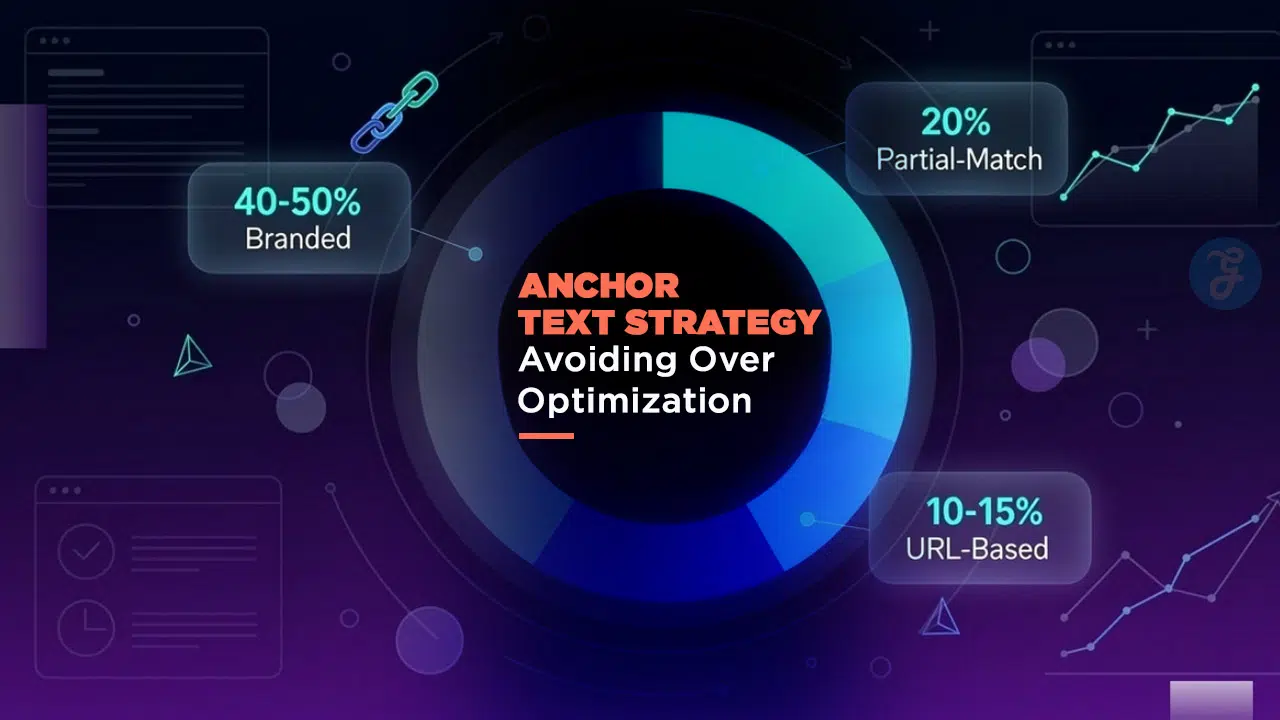
Ever poured so much sauce on a burger that it completely ruined the taste? That is exactly what happens with anchor text over-optimization. You start with good intentions—wanting to help Google understand your content—but if you force it, you end up with a mess that pushes your rankings down instead of up.
Staring at a sudden traffic drop and asking, “What went wrong?” is a common and frustrating experience.
For many website owners in the US, this became even more widespread after the aggressive Google Spam Updates rolled out in late 2025. Rankings can vanish almost overnight—one day your site is performing well for primary keywords, and the next, it is struggling to remain indexed.
In many cases, the root cause ties back to link signals and an over-optimized Anchor Text Strategy that no longer aligns with current algorithm standards.
The good news? Recovery is absolutely possible with the right adjustments and a smarter approach moving forward.
Below is a clear, step-by-step approach to identifying the root cause, cleaning up your link profile, and rebuilding a strategy that aligns with current best practices. Grab a coffee and get ready to turn things around.
What is Anchor Text Optimization?
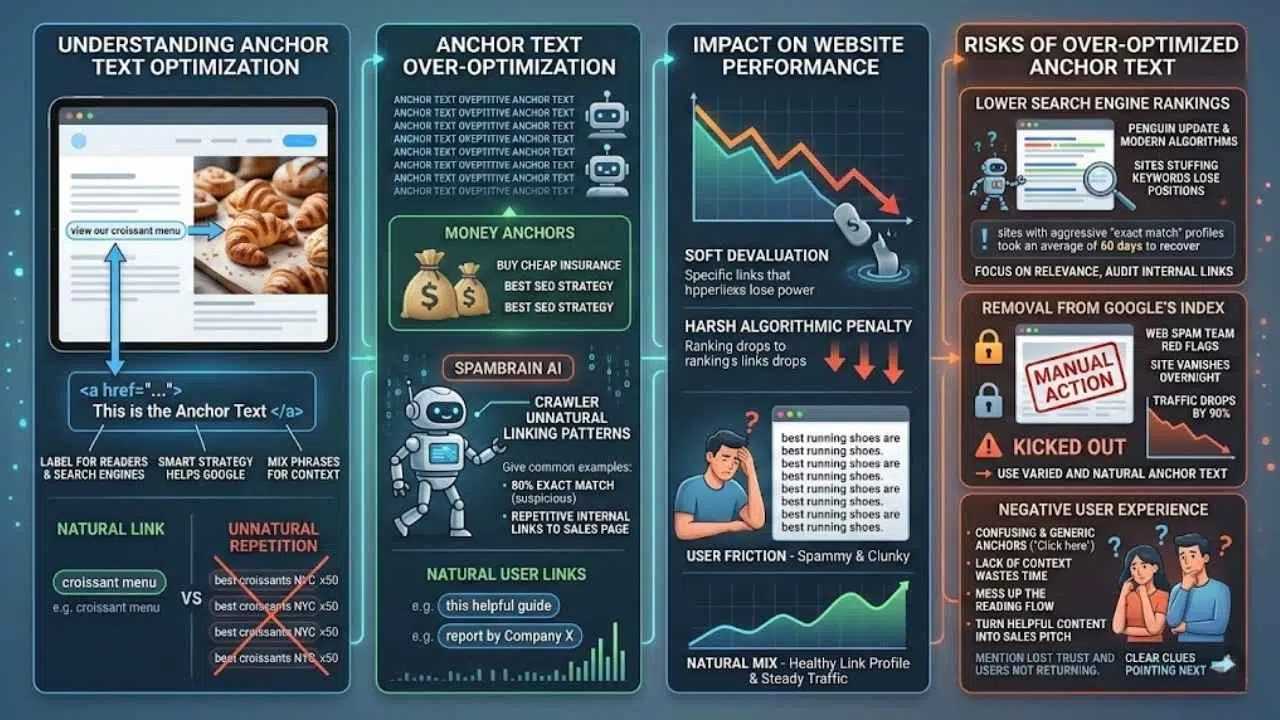
Anchor text optimization is simply the art of choosing the clickable words in a hyperlink. These words act as a label, telling both your readers and search engines what they can expect to find on the other side of the click.
When you look at the code, it is the part sandwiched between the tags:
This is the Anchor Text
A smart strategy helps Google understand your page’s topic without looking like you are trying to cheat the system. For instance, if you run a bakery, a natural link might say “check out our croissant menu” rather than just repeating “best croissants NYC” fifty times.
Mixing things up is the secret. Using simple, varied phrases gives context to your readers and keeps your site safe from penalty risks. It is about making the connection relevant and easy to follow for everyone who visits your site.
Understanding Anchor Text Over-Optimization
Over-optimization happens when you try too hard to rank for a specific term. It is like explaining a joke; if you have to say it too many times, it stops being funny and starts being annoying.
Definition and common examples
In the SEO world, this issue occurs when you use the exact same target keywords for your links over and over again. We often call these “Money Anchors” because they are the high-value terms you want to rank for, like “buy cheap insurance” or “best SEO strategy.”
If 80% of the links pointing to your site use those exact words, Google’s “SpamBrain” AI gets suspicious. It looks unnatural because real people rarely link that way. Instead, they might write things like “this helpful guide” or “the report by Company X.”
Another red flag is internal linking where every mention of a product links back to its sales page with the same keyword. This robotic repetition signals to algorithms that you are trying to manipulate the results rather than help the user.
How it impacts website performance
When you cross the line into over-optimization, your site can sink faster than a stone. Search engines like Google are designed to spot these patterns instantly.
The impact is usually a “soft” devaluation, where those specific links just stop counting, or a harsh algorithmic penalty that drops your entire page ranking. Users also feel the friction. If they see “best running shoes” highlighted in every paragraph, it feels spammy and makes the reading experience clunky. A natural mix of varied anchor text supports a healthier link profile and keeps your traffic steady.
Risks of Over-Optimized Anchor Text
Google does not play favorites with sites that cram keywords into anchor text. If you ignore the rules, the consequences can be severe, ranging from a slow decline in traffic to a complete disappearance from search results.
Lower search engine rankings
Search engines spot anchor text over-optimization quickly. If your links repeat the same keywords again and again, crawlers assume you are trying to trick their systems.
Sites with unnatural linking patterns often drop in rankings. This has been true since the famous Penguin update in 2012, but modern updates are even sharper. A 2025 study on link spam showed that sites with aggressive “exact match” profiles took an average of 60 days to recover even after fixing the issue.
Link building should focus on content relevance instead of stuffing target keywords into every hyperlink. Auditing your internal links helps keep your SEO strategy fresh and safe from penalty risks.
Removal from Google’s index
In extreme cases, Google can kick a website out of its search results entirely. This is known as a “Manual Action.” A site stuffed with links using the same keywords raises immediate red flags for the webspam team.
This kind of manipulation goes against Google’s SEO policies. Imagine pouring hours into your Link Building strategy only to vanish from search engine visibility overnight. Businesses have watched their web traffic drop by 90% after facing this type of penalty.
Even years later, you hear stories about big sites losing all their positions because they ignored best practices. To stay safe, use varied and natural anchor text that helps users find relevant content.
Negative user experience
Clicking on links stuffed with the same keyword over and over feels unnatural. Users get confused by repetitive or generic anchor text like “Click here” because it gives no clue about where the link might lead.
This lack of context wastes time, leaving people frustrated and less likely to trust your site. Crowded anchors mess up the reading flow, turning a helpful article into a sales pitch.
People want clear clues from anchor texts that point out what’s next. Lose their trust once, and many won’t return for another look at your digital marketing efforts.
Best Practices for Anchor Text Strategy
So, what does a “safe” link profile look like in 2026? The goal is to blend in, not stand out. You want your links to look like they happened naturally, even if you built them yourself.
Follow the Safe Ratio Rule
Most experts agree that diversity is your best defense. While there is no perfect magic number, analyzing top-ranking sites in the US reveals a common pattern for anchor text distribution. You can use this table as a general guide for your own strategy:
| Anchor Type | Safe Percentage Estimate | Example |
|---|---|---|
| Branded | 50% – 60% | “According to Nike…” |
| Partial Match | 15% – 20% | “Check out these running shoes for marathons” |
| Naked URL | 10% – 15% | “Visit https://www.nike.com” |
| Generic | 10% – 15% | “Click here to read more” |
| Exact Match | 1% – 5% (Use with caution) | “Buy running shoes” |
Notice how small the “Exact Match” category is? That is the danger zone. Keep those reserved for your most authoritative, high-quality links, and let the rest be natural.
Use natural and varied anchor text
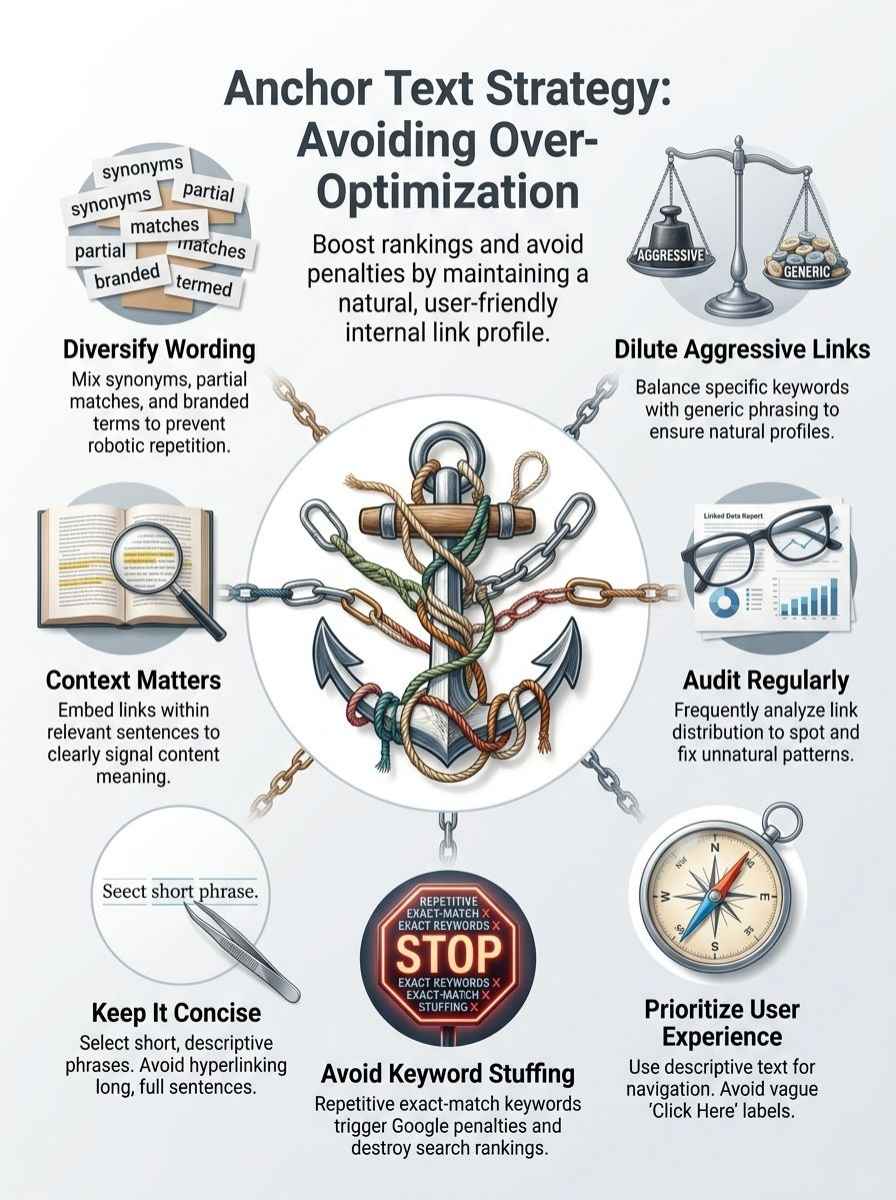
Links should sound like they belong in normal speech. Mix up the words you use so you do not repeat the same keyword or phrase every time.
Instead of hammering one term, rotate your keywords. Add related terms, sprinkle in phrases like “learn more about SEO strategy,” or use your brand name. This variation supports internal linking and helps pages reinforce content relevance without looking suspicious to algorithms.
Make sure your anchor choices provide context, fit naturally into sentences, and focus on user experience above all else. If a sentence reads awkwardly because of a link, rewrite it.
Avoid repetitive keyword stuffing
Search engines get suspicious fast if the same keyword shows up in anchor text repeatedly. Google’s algorithms target pages using tricks like this to game rankings.
Flooding your internal linking with phrases such as “SEO strategy” or “keyword optimization” will set off alarm bells. Instead of boosting search engine visibility, you risk getting bumped down in rankings.
Websites caught stuffing keywords lose trust, too. Users hate reading the same phrase a dozen times on one page—it feels forced and robotic. Keep anchor text short, clear, and fresh each time it appears. Swap out “search engine visibility” with options like “improve rankings” or “online presence” when possible.
Methods to Fix Over-Optimized Anchor Text
If you suspect you have already gone too far, do not panic. You can smooth things out with a few smart adjustments. Think of it as diluting a strong drink; you just need to add more mixers.
Dilute over-optimized keywords
The safest way to fix a ratio problem is to add more variety rather than deleting links. Start building new links that use Branded or Naked URL anchors. This naturally lowers the percentage of “exact match” keywords in your profile without you having to ask webmasters to change anything.
For your internal links, you have total control. Go through your blog posts and change “best coffee maker” links to something like “this model from Breville” or “our review.” This immediately reduces the keyword density and signals to Google that you are prioritizing user experience over rankings.
This approach keeps anchor text distribution natural and lowers risks tied to overoptimization, all while helping users move easily through your site’s link building map.
Mix up your anchor text with synonyms and related phrases. This trick helps keep your link profile natural, which is key for any smart SEO strategy in 2026.
For example, instead of repeating “SEO strategy,” use words like “digital marketing plan,” “search ranking methods,” or “optimization tactics.” Google’s Natural Language Processing picks up on this variety and rewards sites that speak like real people.
Don’t stick to the main keyword; swap it out for others tied closely in meaning. This boosts semantic variation and keeps search engine penalties at bay. Mix things up so users feel comfortable reading your links without tripping over stiff wording.
Add contextual relevance around the anchor
Context is king. It is not just about the blue clickable text; it is about the words surrounding it. Google reads the whole sentence to understand the link.
Use “SEO strategy for better rankings” instead of just “Click here.” This tiny tweak helps search engines match your link to real content relevance. Internal links work best inside meaningful phrases or short facts about your destination page.
Google prefers these natural hints over random keyword stuffing. By surrounding your links with relevant text, your website avoids over-optimization and maintains strong SEO performance.
Benefits of a Balanced Anchor Text Strategy
A balanced approach can boost how search engines view your site, making you stand out in a crowded space. It also gently guides readers, building trust and helping them find what they need without hassle.
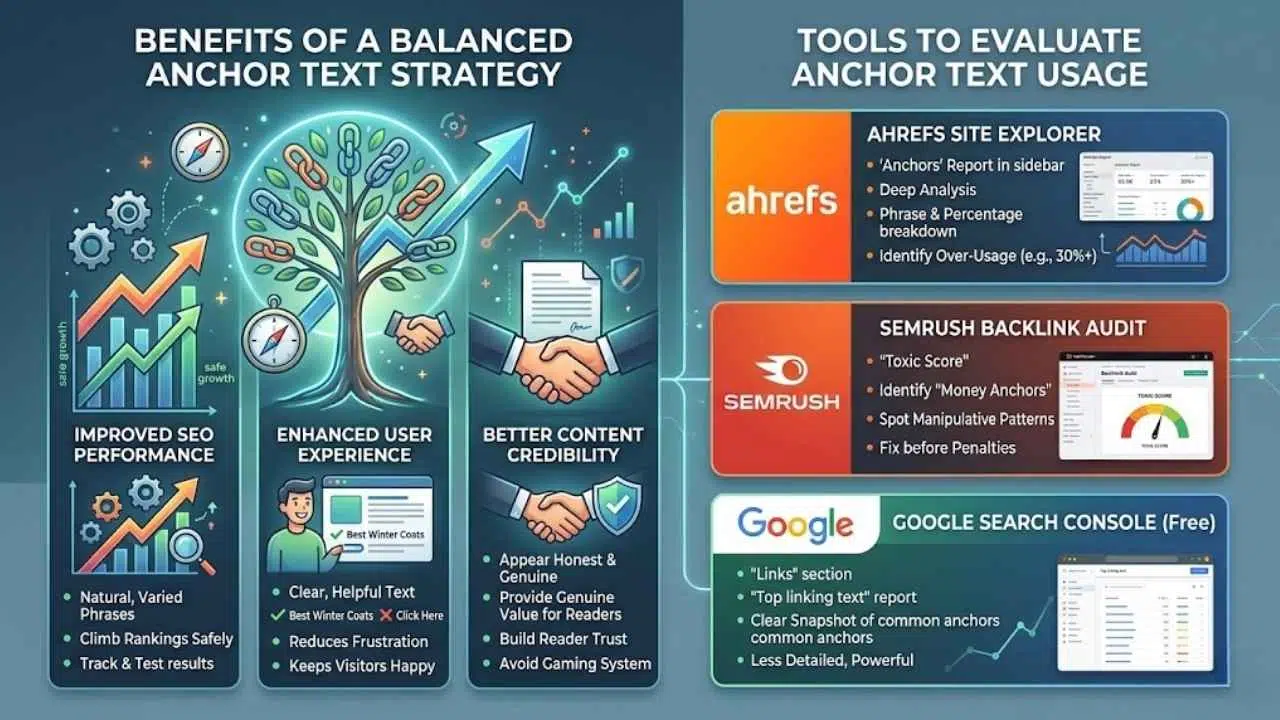
- Improved SEO performance: Search engines like Google spot keyword stuffing from a mile away. Using natural, varied phrases helps you climb the rankings safely. Tracking and testing anchor text ensures your results stay consistent.
- Enhanced user experience: Clear anchor text helps people understand where a link will lead. Words like “Best winter coats” are far more helpful than “Click here.” Relevant anchor text keeps visitors happy and reduces the frustration of clicking on hidden traps.
- Better content credibility: Balanced anchor text makes your content appear honest. Using natural phrases demonstrates that each link provides genuine value for readers, rather than simply trying to game the system.
Tools to Evaluate Anchor Text Usage
You don’t have to guess if your strategy is working. There are powerful tools that can audit your links in minutes and show you exactly where you stand. Here are the ones I rely on:
Ahrefs Site Explorer
Ahrefs is fantastic for deep analysis. You can plug in your website and go to the “Anchors” report in the sidebar. It breaks down every phrase linking to your site and shows you the percentage of each. If you see one keyword taking up 30% or more of your profile, you know you have work to do.
Semrush Backlink Audit
Semrush has a specific feature called the “Toxic Score.” It scans your backlinks and identifies “Money Anchors” that might be dangerous. It helps you spot patterns that look manipulative to Google so you can fix them before a penalty hits.
Google Search Console
For a free option, Google Search Console is your best friend. Under the “Links” section, look for the “Top linking text” report. It is less detailed than the paid tools, but it gives you a clear snapshot of how Google sees your site’s most common anchors.
Final Thoughts
A smart anchor text strategy is the safety net that keeps your SEO healthy and your readers happy. By mixing up your links and steering clear of repetitive keywords, you protect your site from penalties and make your content a joy to read.
Simple steps like checking your ratios and using natural language can save you from the headache of a ranking drop. If you are ever unsure, just ask yourself: “Does this help the user?”
Making these changes is a small effort that leads to bigger wins. Striking the right balance turns tricky keyword work into smooth sailing for everyone.






















