
Marketing automation used to be simple: “If a user clicks this link, send that email.” It was a rigid set of rules that you had to build manually. But in 2025, that doesn’t cut it anymore. We have entered the era of intelligent automation.
Today, you don’t just want a tool that follows your instructions; you want a tool that thinks with you. You need software that can predict when a customer is about to churn, write its own email subject lines, and automatically segment audiences based on behavior you didn’t even notice.
This is the shift from “static automation” to AI-driven growth.
If you are a CMO, marketing manager, or business owner looking to upgrade your tech stack, you are likely overwhelmed by the noise. Every software claims to have “AI” now. But which ones actually deliver value, and which are just using it as a buzzword?
We tested and analyzed the top players in the market to bring you the 6 best marketing automation tools with deep AI integration. We looked at their predictive capabilities, generative AI features, and how easily they fit into a real-world workflow.
Let’s dive in and future-proof your marketing strategy.
What to Look for in AI Marketing Automation Tools? (Our Ranking Criteria)
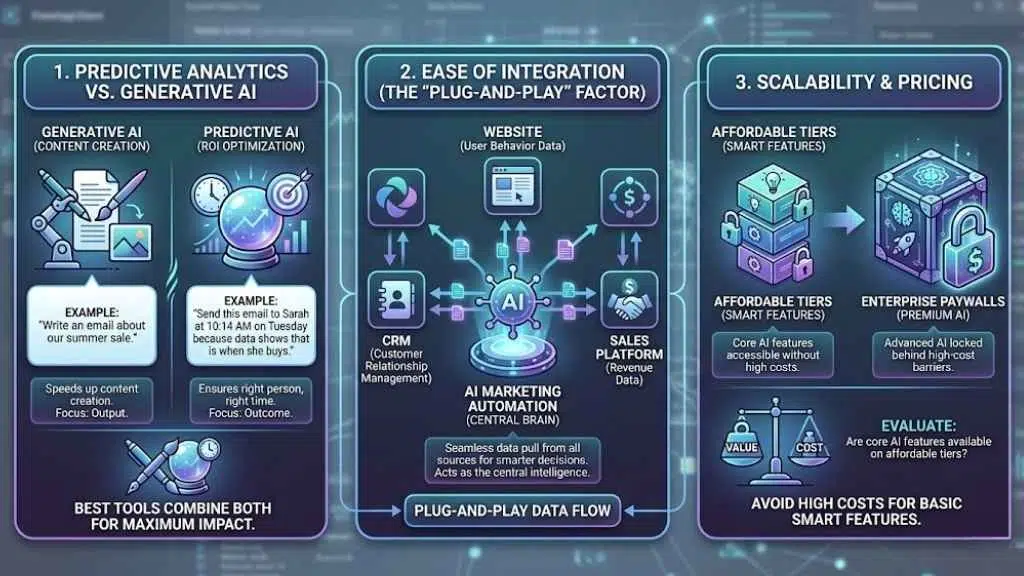
Before we look at the tools, it is critical to understand why we chose them. Not all “AI” is created equal. When evaluating marketing software in 2025, we look for three distinct layers of intelligence.
1. Predictive Analytics vs. Generative AI
Most people think of AI as ChatGPT—writing text or making images. That is Generative AI. It’s useful for speeding up content creation.
However, the real power for ROI lies in Predictive AI.
- Generative AI: “Write an email about our summer sale.”
- Predictive AI: “Send this email to Sarah at 10:14 AM on Tuesday because data shows that is when she buys.”
The best tools combine both. They help you create the content and ensure it lands in front of the right person at the perfect moment.
2. Ease of Integration (The “Plug-and-Play” Factor)
AI needs data to learn. If your automation tool cannot easily talk to your CRM, website, or sales platform, the AI is useless. We prioritized tools that act as a central brain, easily pulling data from everywhere to make smarter decisions.
3. Scalability & Pricing
AI features often come with a premium price tag. We evaluated whether the AI features are available on affordable tiers or locked behind “Enterprise” paywalls. You shouldn’t have to pay $5,000 a month just to get smart send-time optimization.
Top 6 Marketing Automation Tools with AI
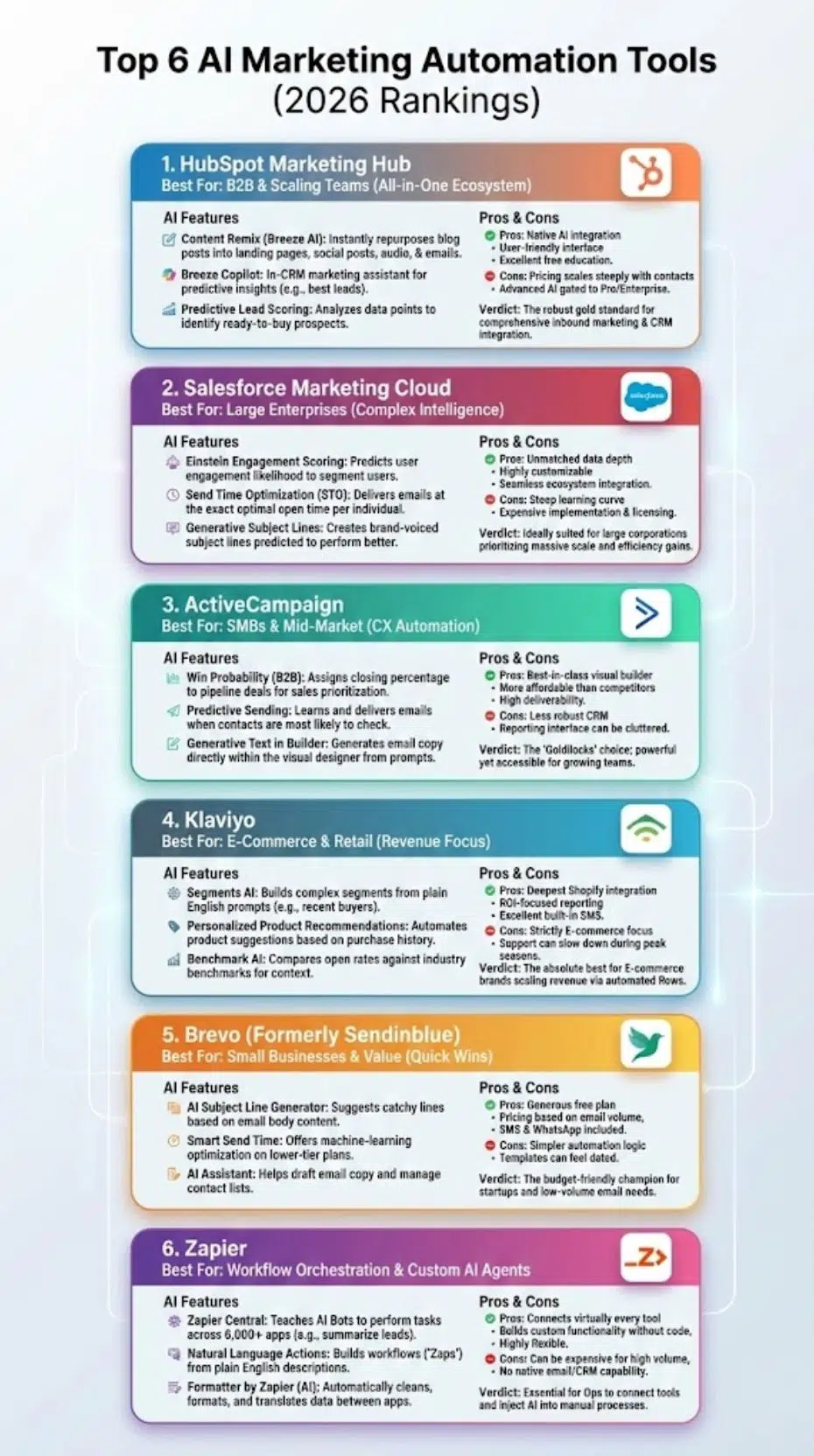
Here are the winners, ranked by their specific strengths.
1. HubSpot Marketing Hub (Best All-in-One AI Ecosystem)
Best For: B2B companies and scaling teams who want everything under one roof.
HubSpot has long been the king of Inbound Marketing, but their recent rollout of Breeze AI (their internal AI engine) has cemented their spot at the top. Unlike other tools that just slap a “Write with AI” button on a text box, HubSpot integrates intelligence into the entire customer journey.
Top AI Features
- Content Remix: This is a game-changer for lean teams. You can take a single blog post, and Breeze will instantly “remix” it into a landing page, three social media posts, an audio file, and an email newsletter. It understands the context and reformats the content for each channel automatically.
- Breeze Copilot: Think of this as a marketing assistant that lives inside your CRM. You can ask it, “Which leads from last week are most likely to close?” and it will surface them using predictive scoring.
- Predictive Lead Scoring: HubSpot analyzes thousands of data points to score your leads. It tells you who is ready to buy, saving your sales team from chasing cold prospects.
Pros:
- Extremely user-friendly interface.
- AI is native, not a bolted-on third-party plugin.
- Excellent free educational resources (HubSpot Academy).
Cons:
- Pricing gets steep quickly as your contact list grows.
- The most advanced AI features are often gated to “Pro” or “Enterprise” tiers.
Verdict: If you want a robust machine that handles email, social, content, and CRM in one place, HubSpot is the gold standard.
2. Salesforce Marketing Cloud (Best for Enterprise Intelligence)
Best For: Large enterprises with complex data needs and big budgets.
If HubSpot is a friendly Apple computer, Salesforce is a NASA supercomputer. It is complex, powerful, and runs on Einstein GPT, one of the most sophisticated AI engines in the business world. Salesforce is designed for organizations that have millions of customers and need to personalize experiences at a massive scale.
Top AI Features
- Einstein Engagement Scoring: This predicts how likely a user is to engage with your email or push notification. It segments users into “Likely to open,” “Likely to click,” or “Dormant,” allowing you to tailor your strategy automatically.
- Send Time Optimization (STO): Einstein analyzes the historical behavior of every individual subscriber and holds your email until the exact moment they are most likely to open it.
- Generative Subject Lines: It uses your brand voice to generate subject lines that are mathematically predicted to perform better.
Pros:
- Unmatched depth of data analysis.
- Highly customizable—if you can dream it, you can build it.
- Integrates seamlessly with the massive Salesforce ecosystem.
Cons:
- Steep learning curve; you might need a dedicated specialist to run it.
- Expensive implementation and licensing fees.
Verdict: Choose Salesforce if you are a large corporation where a 1% increase in efficiency equals millions of dollars in revenue.
3. ActiveCampaign (Best for Customer Experience Automation)
Best For: SMBs and Mid-Market companies who want advanced automation without the Enterprise price tag.
ActiveCampaign coined the term “Customer Experience Automation” (CXA). They excel at building complex, multi-path workflows that feel personal. Their AI approach is practical—focusing heavily on helping you send better emails and close more deals.
Top AI Features
- Win Probability: For B2B users, this AI looks at your sales pipeline and assigns a percentage specifically to how likely a deal is to close. This helps sales reps prioritize their day.
- Predictive Sending: Similar to Salesforce, it learns when your contacts check their email and delivers your message then.
- Generative Text in Email Builder: Stuck on copy? You can type a prompt like “Write a friendly follow-up for a webinar attendee,” and it generates options directly in the email designer.
Pros:
- Best-in-class visual automation builder.
- More affordable than HubSpot or Salesforce for similar feature sets.
- High deliverability rates.
Cons:
- The CRM is good, but not as robust as Salesforce or HubSpot.
- Reporting can sometimes feel a bit cluttered.
Verdict: The “Goldilocks” choice. It’s powerful enough for pros but accessible enough for small teams.
4. Klaviyo (Best for E-Commerce & Retail)
Best For: Online stores (Shopify, WooCommerce, Magento, BigCommerce).
If you sell physical products online, stop reading and just get Klaviyo. Their entire AI infrastructure is built around one goal: increasing Revenue Per Recipient (RPR). They don’t worry about B2B pipelines; they worry about repeat purchases and cart recovery.
Top AI Features
- Segments AI: This is incredible for non-technical marketers. Instead of manually selecting filters, you just type: “Create a segment of people who bought a t-shirt in the last 90 days but haven’t bought pants.” The AI builds the complex segment for you instantly.
- Personalized Product Recommendations: The AI analyzes purchase history to automatically populate emails with the specific products a customer is most likely to buy next.
- Benchmark AI: It compares your data against thousands of other brands in your industry to tell you if your open rates are actually good or bad.
Pros:
- Deepest integration with Shopify on the market.
- ROI-focused reporting (you can see exactly how many dollars an email generated).
- SMS marketing is built-in and excellent.
Cons:
- Strictly for e-commerce; not suitable for B2B or service businesses.
- Support can be slow during peak retail seasons (like Black Friday).
Verdict: The absolute best tool for e-commerce brands looking to scale revenue through automated flows.
5. Brevo (Formerly Sendinblue) (Best for SMBs & Value)
Best For: Small businesses, startups, and transactional email needs.
Brevo made a name for itself by being affordable and easy. Rebranding from Sendinblue, they have expanded into a full CRM suite. Their AI features are designed for the “busy business owner” who needs quick wins, not complex data science.
Top AI Features
- AI Subject Line Generator: A simple tool that suggests catchy subject lines based on your email body content.
- Smart Send Time: Even on lower-tier plans, Brevo offers machine-learning-based send time optimization, which is rare for budget-friendly tools.
- AI Assistant: Helps draft email copy and clean up contact lists.
Pros:
- Very generous free plan (unlimited contacts, just capped daily sends).
- Pricing is based on email volume, not the number of contacts (great for growing lists).
- Includes SMS and WhatsApp marketing.
Cons:
- Automation logic is simpler than ActiveCampaign.
- Templates can feel a bit dated compared to newer tools.
Verdict: The budget-friendly champion. Perfect if you are just starting out or have a massive list but low email volume.
6. Zapier (Best for Workflow Orchestration)
Best For: Connecting apps that don’t talk to each other and building custom AI agents.
Zapier isn’t a traditional “marketing automation tool” like the others (it doesn’t host your email list). However, it is the glue that makes automation possible. With their new Zapier Central and AI integration, it has become a powerhouse for custom workflows.
Top AI Features
- Zapier Central: This allows you to teach “AI Bots” how to perform tasks across 6,000+ apps. You can tell a bot: “When a new lead comes in from Facebook, summarize their profile using ChatGPT, add them to HubSpot, and Slack me the summary.”
- Natural Language Actions: You can build “Zaps” (workflows) just by describing what you want in plain English.
- Formatter by Zapier (AI-powered): Automatically cleans up data, formats phone numbers, or translates text as it moves between apps.
Pros:
- Connects virtually every tool on the internet.
- Allows you to build “custom” software functionality without coding.
- Extremely flexible.
Cons:
- Can get expensive if you have high-volume tasks.
- No native email marketing or CRM; you must connect it to other tools.
Verdict: Essential for the “Ops” side of marketing. Use Zapier to connect your other tools and inject AI into manual processes.
Top AI Marketing Automation Tools at a Glance
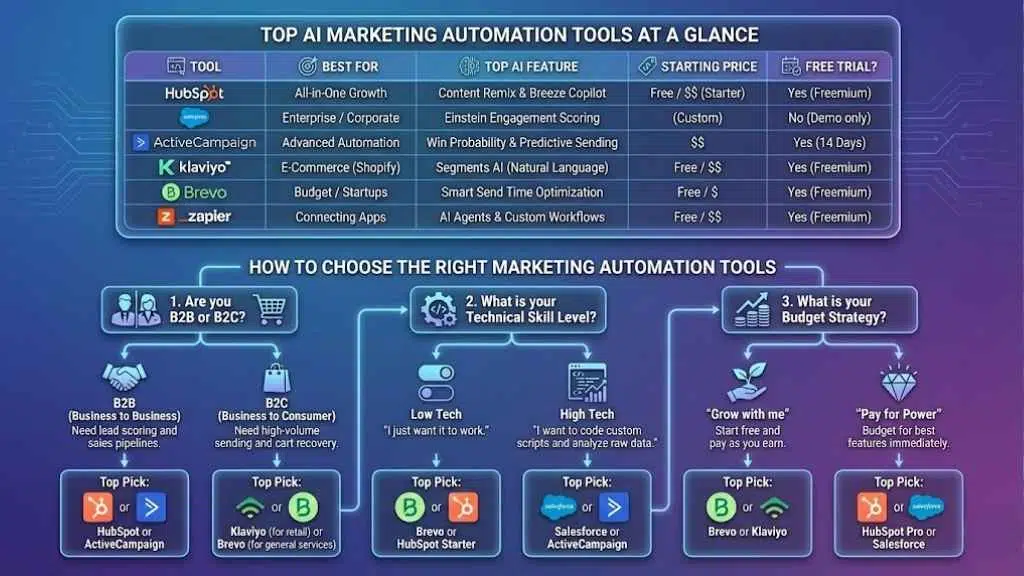
| Tool | Best For | Top AI Feature | Starting Price | Free Trial? |
| HubSpot | All-in-One Growth | Content Remix & Breeze Copilot | Free / $$ (Starter) | Yes (Freemium) |
| Salesforce | Enterprise / Corporate | Einstein Engagement Scoring | (Custom) | No (Demo only) |
| ActiveCampaign | Advanced Automation | Win Probability & Predictive Sending | $$ | Yes (14 Days) |
| Klaviyo | E-Commerce (Shopify) | Segments AI (Natural Language) | Free / $$ | Yes (Freemium) |
| Brevo | Budget / Startups | Smart Send Time Optimization | Free / $ | Yes (Freemium) |
| Zapier | Connecting Apps | AI Agents & Custom Workflows | Free / $$ | Yes (Freemium) |
How to Choose the Right Marketing Automation Tools
Choosing software is difficult. To make it easier, use this simple decision matrix based on your company type:
1. Are you B2B or B2C?
- B2B (Business to Business): You need lead scoring and sales pipelines.
- Top Pick: HubSpot or ActiveCampaign.
- B2C (Business to Consumer): You need high-volume sending and cart recovery.
- Top Pick: Klaviyo (for retail) or Brevo (for general services).
2. What is your Technical Skill Level?
- Low Tech: “I just want it to work.”
- Top Pick: Brevo or HubSpot Starter.
- High Tech: “I want to code custom scripts and analyze raw data.”
- Top Pick: Salesforce or ActiveCampaign.
3. What is your Budget Strategy?
- “Grow with me”: You want to start free and pay as you earn.
- Top Pick: Brevo or Klaviyo.
- “Pay for Power”: You have a budget and want the best features immediately.
- Top Pick: HubSpot Pro or Salesforce.
Final Thoughts: The Future is Automated
The gap between companies that use AI and those that don’t is widening. Using a tool like HubSpot or ActiveCampaign isn’t just about saving time on email blasts anymore. It is about delivering a personalized experience that feels like magic to your customer. If you are still sending the same generic newsletter to your entire list at the same time, you are leavin g money on the table.