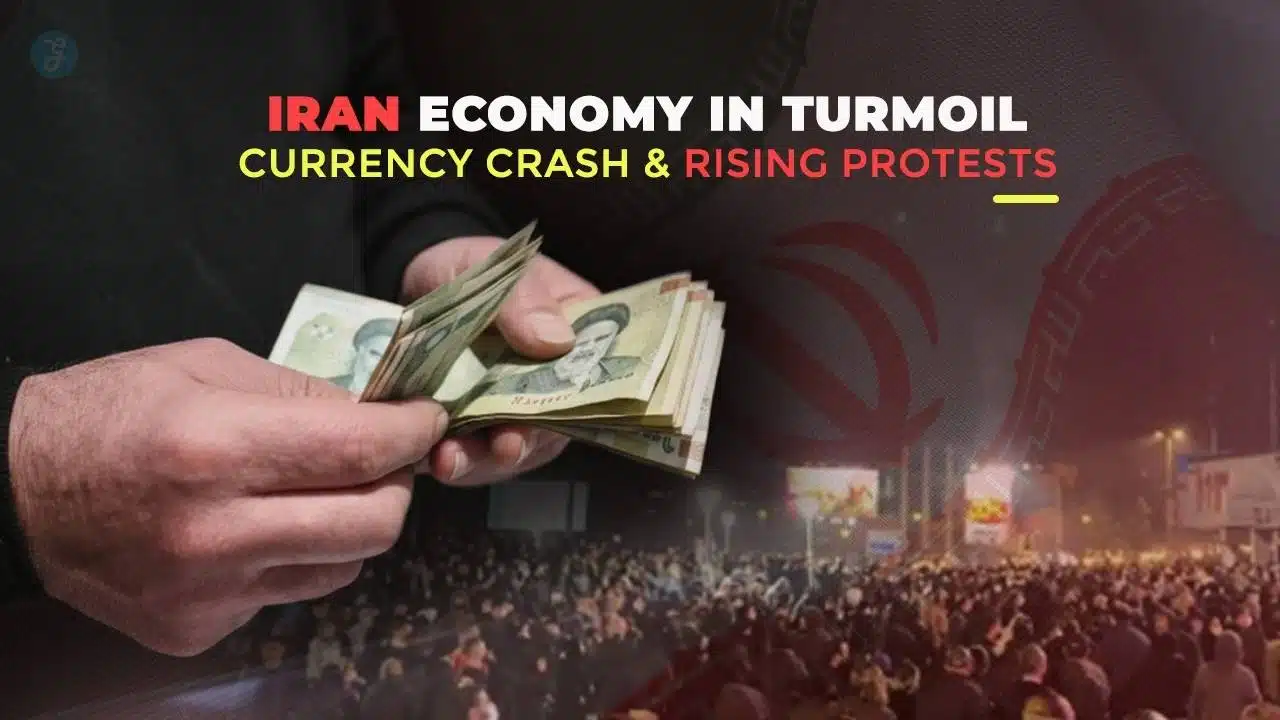
The Iran Currency Crisis 2026 has officially moved beyond the realm of regional instability and into the territory of state collapse. As of mid-January, the streets of Tehran are echoing not just with slogans, but with the silence of a marketplace that has ceased to function.
On January 19, digital currency exchanges across the Islamic Republic displayed a chilling metric: the Iranian Rial (IRR) trading at effectively “$0.00” against the US Dollar on standard banking software, unable to process the decimal places required for the new parallel rate of 1.5 million IRR to $1 USD. This financial cardiac arrest is not an isolated event; it is the detonator for a massive geopolitical explosion that global markets are only beginning to price in.
This analysis provides a comprehensive audit of the Iranian state in January 2026, dissecting the anatomy of the economic collapse, mapping the “Revolution of the Hungry,” and evaluating the regime’s desperate pivot toward a nuclear breakout.
Key Takeaways: The 2026 Crisis at a Glance
- The “Maduro Shock” Trigger: The US capture of Venezuelan President Nicolás Maduro in early January 2026 dismantled Iran’s primary sanctions-evasion network, causing an immediate currency crash.
- Currency Collapse: The Iranian Rial has hit a historic low of 1.5 million IRR per USD, causing hyperinflation of over 80% on food staples and freezing import supply chains.
- A “Revolution of the Hungry”: Unlike the ideological protests of 2022, the 2026 unrest is driven by starvation and survival, uniting the working class, pensioners, and religious conservatives against the regime.
- Geopolitical Isolation: With the fall of the Assad regime in Syria and the degradation of Hezbollah, Iran has lost its “Axis of Resistance,” leaving it strategically naked in the region.
- The Nuclear Wildcard: Facing an existential threat, Tehran has ramped up uranium enrichment to 90% (weapons grade), raising the immediate risk of a preemptive strike by Israel or the US in Q1 2026.
- Energy Market Risk: The potential closure of the Strait of Hormuz has added a “fear premium” to global oil prices, with Brent Crude spiking toward $112/barrel.
The Existential Convergence: Why This Time Is Different
While observers may rush to compare this to previous unrest, the current situation is structurally unique. The upheaval was triggered by the “Maduro Shock” on January 3, 2026, the US capture of Venezuelan President Nicolás Maduro, which severed the critical artery of Iran’s illicit oil trade. Without this financial lifeline, the regime in Tehran was left exposed to a chain reaction it was ill-prepared to handle.
Unlike the political unrest of 2009 or the “Woman, Life, Freedom” movement of 2022, the current crisis represents an existential convergence. The regime is facing a trifecta of catastrophes: the total evaporation of its currency, the collapse of its “Axis of Resistance” following the fall of allies in Syria, and a population that is no longer asking for reform, but for survival.
The Anatomy of Economic Collapse: When Money Dies
To understand the Iran Currency Crisis 2026, one must first look at the mechanics of the financial ruin that precipitated it. The Iranian economy has long been a “resistance economy,” built to withstand sanctions through a complex web of ghost fleets, money laundering, and barter trade with fellow pariah states. In 2026, that web unraveled.
The “Maduro Shock” and the Death of the Rial
For years, Venezuela served as a critical node in Iran’s sanctions-evasion network. Tehran exchanged condensate and technical expertise for Venezuelan gold and relied on PDVSA (Venezuela’s state-owned oil and natural gas company) to rebrand Iranian crude for Asian markets.
The “Maduro Shock” of January 3, 2026, was catastrophic. When the US Southern Command executed the extraction operation in Caracas, they didn’t just remove a dictator; they seized critical digital ledgers and financial data identifying the shell companies used by the Islamic Revolutionary Guard Corps (IRGC).
- The Intelligence Fallout: Within 72 hours, the US Treasury Department designated and blocked over 400 front companies in the UAE, Malaysia, and Turkey that were previously safe harbors for Iranian capital.
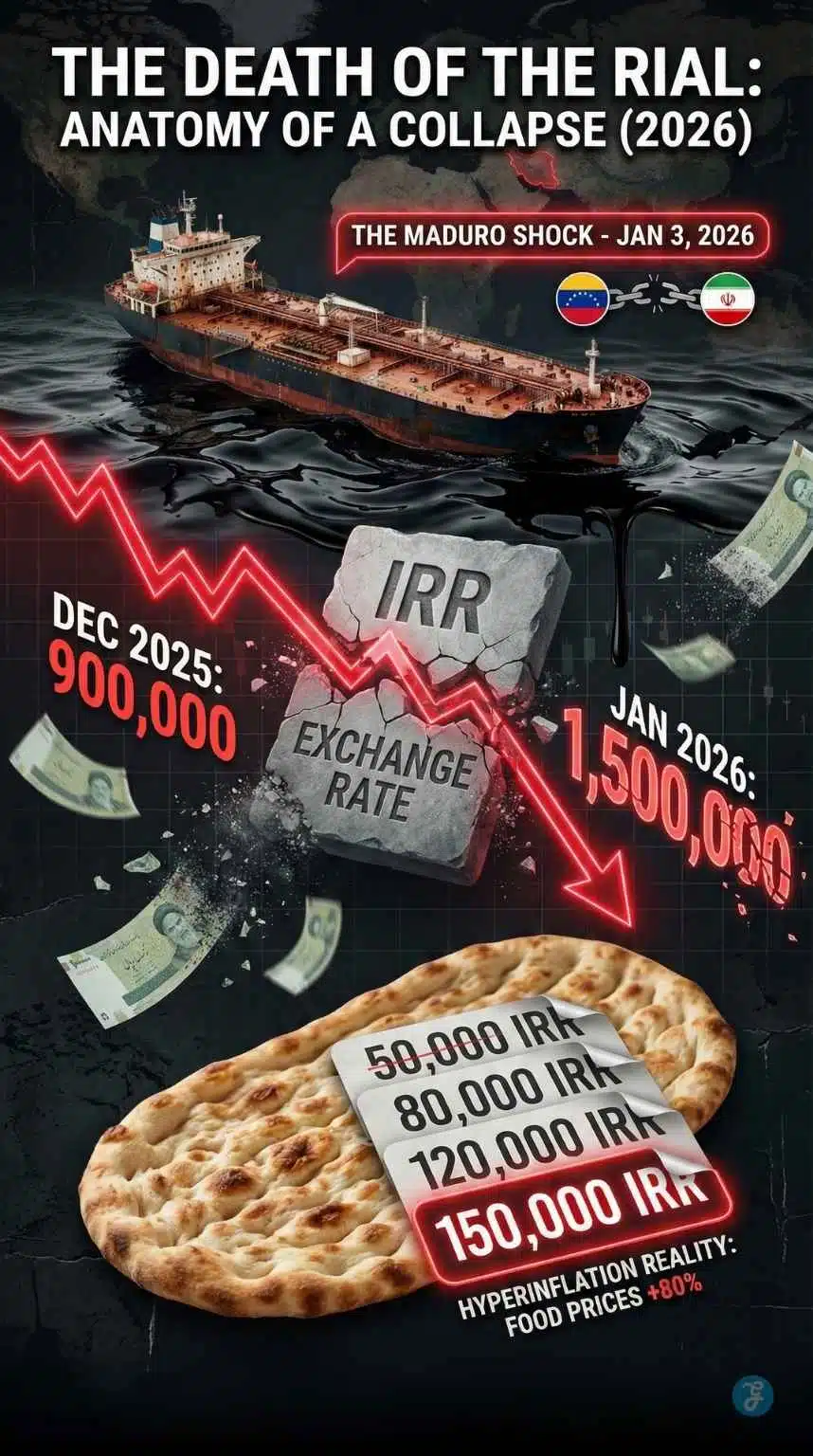
- The Market Reaction: The psychological floor of the market vanished. The Rial, which had been hovering precariously at 900,000 IRR/USD in December 2025, lost 60% of its value in two weeks, crashing to 1.5 million.
The “Maduro Shock” Economic Impact
This visually reinforces the speed of the crash.
| Economic Metric | Dec 2025 (Pre-Crisis) | Jan 19, 2026 (Current) | % Change / Impact |
| Exchange Rate (IRR/USD) | ~900,000 IRR | ~1,500,000 IRR | -66% Value Loss |
| Official Inflation Rate | 42% | 55% (Est.) | +13% |
| Real Food Inflation | ~50% | > 80% | Critical Hyperinflation |
| Oil Exports (bpd) | ~1.2 Million | < 200,000 | ~85% Drop (Ghost Fleet Grounded) |
| Price of Flatbread | 50,000 IRR | 150,000 IRR | 300% Increase |
Hyperinflation on the Ground
Official government statistics claim an inflation rate of 42%, but independent economists and on-the-ground reports suggest the real rate for food staples is approaching 75-80%.
- The Price of Survival: The cost of Nan-e Barbari (flatbread), a primary source of calories for the working class, has tripled since December. Rice is now considered a luxury good in provincial towns.
- Supply Chain Paralysis: Imports have frozen. With the exchange rate in freefall, importers cannot price their goods. Warehouses in the Bandar Abbas port are full, yet locked, as merchants refuse to release goods for a currency that loses value by the hour.
The Bazaar Strikes Back
Perhaps the most dangerous signal for the Supreme Leader is the revolt of the Bazaaris. Historically, the merchant class of the Grand Bazaar was the backbone of the 1979 revolution. In 2022, they were hesitant to join strikes. In 2026, they are leading them. Reports from Tehran, Tabriz, and Isfahan confirm that major bazaars have shuttered indefinitely.
Unlike previous strikes, this is not a political protest; it is simple bankruptcy. Merchants are liquidating assets and converting them into gold or cryptocurrency, effectively exiting the national economy. When the Bazaar turns, the regime loses its ability to distribute goods and maintain the patronage networks that keep the security forces loyal.
The Social Explosion: A Revolution of the Hungry
If the 2022 protests were a demand for dignity, the 2026 uprising is a desperate clawing for life. The demographic shift in the protesters has terrified the security establishment.
From “Woman, Life, Freedom” to “Bread, Freedom, Survival”
The crowds occupying the squares in January 2026 are visibly different from those four years ago.
- The New Coalition: While university students and women remain active, they have been joined by steelworkers from Ahvaz, farmers from Isfahan, and, significantly, the conservative poor who were once the regime’s ideological foot soldiers.
- Slogans of Despair: The chants have shifted from cultural grievances to visceral rage. “Death to the Dictator” is now accompanied by “We are hungry, we are armed”—a chilling development indicating the erosion of the regime’s monopoly on violence.
Geographic Spread: The Fall of the Strongholds
The Ministry of Interior has acknowledged “security incidents” in all 31 provinces. However, the true panic in Tehran stems from where these protests are happening.
- Qom and Mashhad: These cities, home to the major shrines and seminaries, are the spiritual heart of the Islamic Republic. In early January, crowds in Qom burned banners of the Supreme Leader and attacked the offices of clerical representatives. When the religious base turns on the Theocracy, the ideological legitimacy of the Velayat-e Faqih (Guardianship of the Islamic Jurist) evaporates.
The “Digital Wall” and Information Warfare
The regime has attempted to implement a total internet blackout, activating the “National Information Network” (NIN) to cut Iran off from the global web. However, 2026 technology has rendered this less effective than in 2019.
- Starlink Penetration: An estimated 15,000 to 20,000 active Starlink terminals are currently operating inside Iran, smuggled in over the last two years. These “digital lifelines” are allowing video evidence of the crackdown to leak out.
- The Casualty Count: The “Fog of War” is dense. State media claims fewer than 100 deaths “caused by terrorists.” Opposition groups, aggregating data from hospitals and morgues via the Starlink network, estimate the death toll at over 16,000.
- “The Blinding”: Medical reports leaked to the UN Human Rights Council detail a systematic policy of security forces aiming birdshot at the faces of protesters. Hundreds of young Iranians have arrived at trauma centers with ruptured globes, a tactic designed to permanently mark and terrorize the population.
The Geopolitical Checkmate: Alone in the Bunker
The domestic crisis is exacerbated by a hostile external environment. The Iran Currency Crisis 2026 is playing out in a vacuum of allies.
The Collapse of the “Axis of Resistance”
For decades, Iran’s defense doctrine relied on fighting its battles outside its borders—in Lebanon, Syria, Iraq, and Yemen. That forward defense perimeter has collapsed.
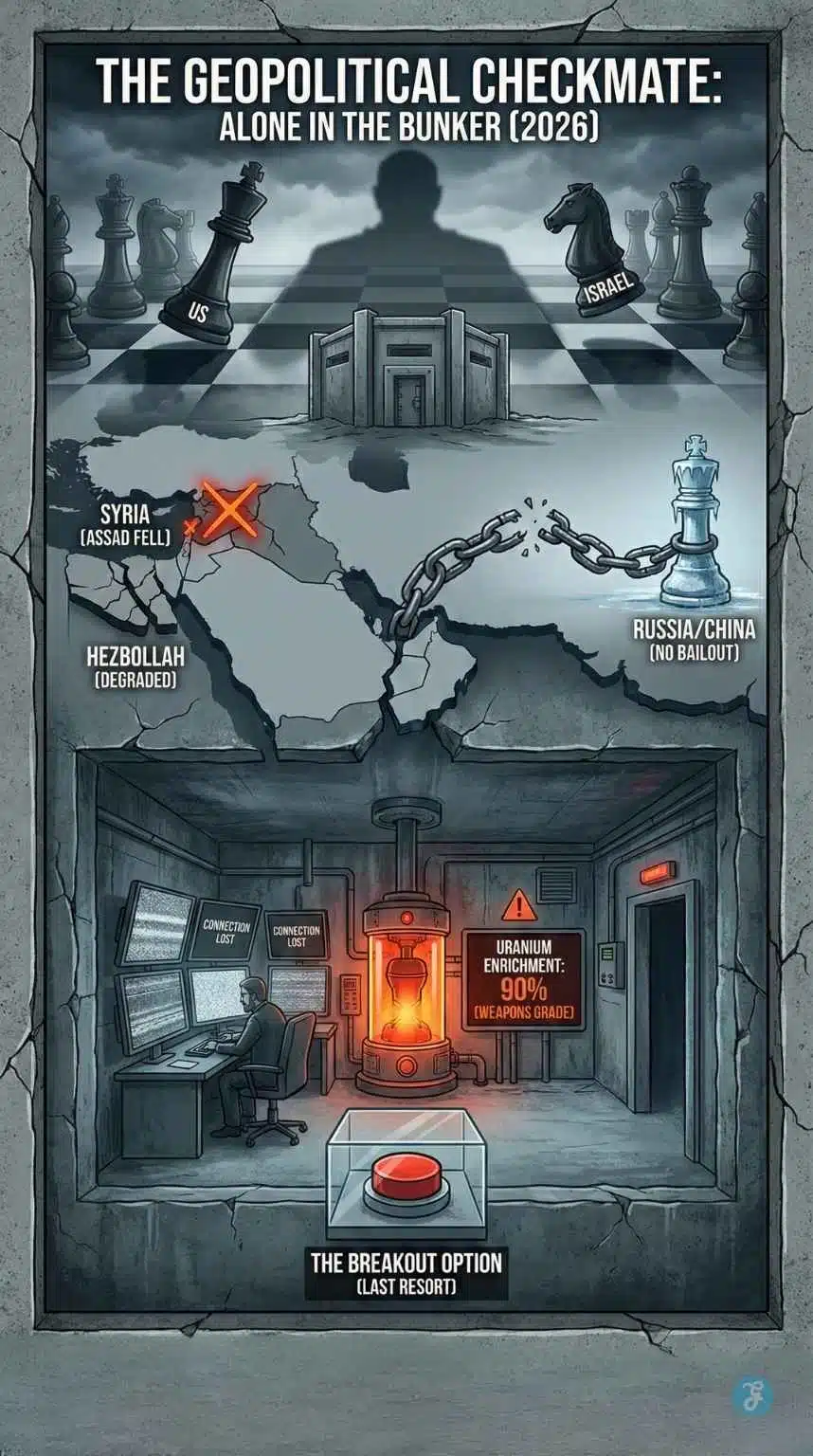
- The Syrian Void: The collapse of the Assad regime in late 2025 was the first domino. Without a friendly government in Damascus, the “Land Bridge” that allowed Iran to truck weapons to Hezbollah was severed.
- Hezbollah’s Degradation: Following the intense conflicts of 2024-2025, Hezbollah has been forced into a defensive posture in Lebanon, focusing on its own survival rather than projecting Iranian power. Tehran can no longer threaten Israel with a massive rocket barrage to distract from its internal woes.
The Transactionalist Betrayal: Russia and China
Tehran hoped that its “Look to the East” policy would save it. It has not.
- China: Beijing, dealing with its own slow-growth recovery and fearing secondary sanctions from the US “Maximum Pressure 2.0” campaign, has significantly reduced its purchase of Iranian oil. China has shifted its focus to stabilizing Saudi-Iran tensions only to protect its energy flow from the Arab Gulf, showing zero interest in bailing out the Rial.
- Russia: Bogged down in its own protracted stagnation and reliant on every ruble, Moscow has been unable to offer financial credit. The strategic partnership has proven to be a hollow shell when cash is required.
The Nuclear Breakout Option
Cornered and desperate, the regime has played its last card. On January 14, 2026, the IAEA confirmed that centrifuges at the Fordow facility had enriched uranium to 90% purity, weapons-grade.
- The Logic of Escalation: This is not necessarily a move to use the bomb, but to use the threat of the bomb to force the West to the negotiating table for sanctions relief. However, this is a high-stakes gamble.
- The Israeli Factor: With the US administration signaling unwavering support, fears of an Israeli preemptive strike on nuclear facilities in Q1 2026 are at an all-time high. The regime is betting that the world fears a nuclear Iran more than it hates the Mullahs.
The Internal Power Struggle: The Succession Crisis
Looming over the riots and the bankruptcy is the question of the Supreme Leader’s mortality. Ayatollah Khamenei, aged and frail, has not been seen publicly since the crisis began, fueling rumors of incapacitation.
Mojtaba vs. The Generals
The succession plan, long believed to favor Khamenei’s son, Mojtaba, is fracturing under the pressure of the uprising.
- The IRGC’s Calculation: The commanders of the Revolutionary Guards control the economy, the weapons, and the intelligence. In a scenario of total collapse, they view the Clergy as a liability. Analysts predict a silent coup where the IRGC marginalizes the religious leadership to establish a secular military dictatorship, hoping to quell the protests by scapegoating the Mullahs.
- Elite Exit Strategies: Flight data tracks a surge of private charters from Tehran to “safe” jurisdictions without extradition treaties. The elite are moving their families and their gold, a clear indicator that the inner circle does not believe the status quo will hold until the summer.
Factions & Survival Strategies
This helps clarify the complex internal dynamics and why the regime is fracturing.
| Power Center | Key Figures | Current Stance | 2026 Survival Strategy |
| The Clerical Establishment | Ayatollah Khamenei, Mojtaba Khamenei | Preservation | Rely on Basij militia; refuse all concessions; blame foreign “Zionist” plots. |
| IRGC Command (The Generals) | Top Commanders (Salami, Qaani) | Silent Coup | Prepare to sideline the Clergy if collapse is imminent; establish a secular military dictatorship. |
| The Bazaar (Merchants) | Grand Bazaar Guilds | Defection | Indefinite strikes; converting all assets to Gold/Crypto; funding protest logistics. |
| The “Street” (Protesters) | Youth, Pensioners, Oil Workers | Revolution | Total regime change; rejection of both Reformists and Hardliners; seeking a secular democracy. |
Future Scenarios: 2026 and Beyond
As we look toward the rest of 2026, three scenarios dominate the intelligence assessments.
- The North Korea Model: The regime survives through sheer brutality. It successfully tests a nuclear device, securing immunity from invasion, but the country is sealed off entirely. The economy reverts to a pre-industrial survival mode, and Iran becomes a hermit kingdom.
- The Military Transition: The IRGC removes the clerical class. They offer a “grand bargain” to the West—disarming the nuclear program in exchange for recognition of their military rule. This would end the Islamic Republic as a theocracy but maintain an authoritarian state.
- State Collapse (Syrianization): The security forces fracture. Some units side with protesters, others with the regime. The country descends into a civil war with ethnic separatists in Kurdistan and Baluchistan seizing territory. This is the nightmare scenario for global energy markets and regional stability.
The Energy Equation: The “Hormuz Premium” Returns
While the collapse of the Rial is a domestic tragedy, the collapse of the Iranian state is a global economic threat. Energy markets, which had priced in a “containment” scenario for years, are now panic-buying on the news of potential anarchy in the Persian Gulf.
The “Scorched Earth” Threat
Intelligence reports from the US Fifth Fleet indicate increased IRGC naval mining activity near the Strait of Hormuz.
- The Threat: The IRGC has long threatened that “if we cannot export oil, no one will.” With their oil trade zeroed out by the “Maduro Shock,” the incentive for restraint is gone. Analysts fear a desperate “lashing out” attack on Saudi or Emirati tankers to spike global prices and force international mediation.
- Market Impact: Brent Crude futures spiked to $112/barrel on January 15, with Goldman Sachs predicting a potential surge to $150 if the Strait is closed even partially. This “Hormuz Premium” is already causing inflationary headaches for the EU and Asian economies.
The Infrastructure Risk
Domestic strikes have spread to the oil & gas sector.
- Production Halt: Workers at the South Pars Gas Field and the Abadan refinery have reportedly walked off the job. This doesn’t just hurt exports; it means domestic power generation is failing. Rolling blackouts in Tehran are now lasting 12-16 hours, further inflaming public anger and paralyzing what remains of the industrial base.
The Cyber Front: Asymmetric Retaliation
While the streets burn, a silent, high-intensity war is raging in cyberspace. This is the first revolution where the “Digital Battlefield” is as critical as the physical one.
The Regime Lashes Out
Unable to strike the US or Israel kinetically without risking annihilation, the regime has unleashed its APT (Advanced Persistent Threat) groups.
- Operation “Stone Dust”: Cybersecurity firms have detected a massive wave of wiper-malware attacks targeting Saudi Aramco and UAE financial institutions in early January. This is interpreted as a warning shot to Iran’s neighbors: do not aid the collapse.
- Western Targets: US banks and critical infrastructure have seen a 400% increase in DDoS and phishing attempts attributed to Iranian state actors, specifically targeting the SWIFT network to disrupt the enforcement of new sanctions.
Hacktivism as Resistance
Conversely, the “Digital Wall” is being breached from the inside-out.
- “Edaalat-e Ali” (Justice of Ali): This hacktivist group has successfully breached the servers of the notorious Evin Prison again, leaking live CCTV footage of interrogations and the names of judges issuing summary execution orders. These leaks are being air-dropped to protesters’ phones via Bluetooth bridges, fueling the rage on the street and stripping the regime of its anonymity.
The “Day After” Void: Who Rules Next?
The most terrifying aspect of the 2026 Crisis for Western diplomats is not the fall of the regime, but the vacuum it leaves behind. Unlike 1979, there is no charismatic figure like Khomeini waiting in Paris to unite the factions.
The Leadership Vacuum
- The Crown Prince’s Dilemma: Reza Pahlavi, the exiled Crown Prince, has called for a “National Transition Council,” but fissures remain between republican, monarchist, and leftist opposition groups. The lack of a unified charter means that if the regime falls tomorrow, there is no interim government ready to step in.
- The Balkanization Risk: Without a strong central authority, there is a legitimate fear that power centers will fragment along ethnic lines, Kurds in the West, Baluchis in the Southeast, and Azeris in the Northwest, potentially turning Iran into a larger, more complex version of post-2011 Syria.
The IRGC Warlord Scenario
Intelligence agencies are closely monitoring regional IRGC commanders. The fear is that as the central command in Tehran weakens, provincial commanders may seize local assets (oil fields, silos, borders) and become de facto warlords, creating a patchwork state that is impossible to sanction or negotiate with effectively.
Comparison: 1979 Revolution vs. 2026 Crisis
While 1979 was a revolution of ideology led from the pulpit, 2026 is a revolution of survival driven by the empty wallet.
| Metric | 1979 Revolution | 2026 Crisis |
| Driver | Ideological (Anti-Western/Religious) | Economic (Survival/Anti-Poverty) |
| Leadership | Unified (Ruhollah Khomeini) | Fragmented (Grassroots/No Leader) |
| Military Loyalty | The Army (Artesh) declared neutrality | IRGC is fighting for its own survival |
| Global Context | Cold War (US vs. USSR proxy) | Isolation (Russia/China passive) |
| Technology | Cassette Tapes (propaganda distribution) | Starlink & Crypto (circumvention) |
Final Analysis: The Day After the Republic
The Iran Currency Crisis 2026 is the endgame of a 47-year ideological experiment. The Islamic Republic has outlived many predictions of its demise, but it has never faced a moment where the treasury was empty, the allies were gone, and the gun was the only tool left in the toolkit.
The convergence of the Rial’s collapse and the “Revolution of the Hungry” suggests that the status quo cannot persist. Whether the outcome is a new military dictatorship, a democracy, or a fractured state, the Iran of 2025 is gone. The world must prepare for what rises from the ashes.