The AI Translation Wars of 2026 mark a pivot from literal word-swapping to “meaning-first” communication. Google’s open-weight TranslateGemma prioritizes on-device privacy and developer flexibility, while OpenAI’s ChatGPT Translate targets the user experience with unprecedented cultural nuance and conversational refinement.
In a major dual-release week for January 2026, the global translation landscape has shifted overnight. This is not merely an update to existing tools; it is a fundamental clash of philosophies. On one side, Google DeepMind’s TranslateGemma represents the “democratization of the engine”, providing open-weight models that bring high-fidelity translation to local devices, from smartphones to private enterprise servers. On the other hand, OpenAI’s ChatGPT Translate represents the “sophistication of the interface”, a dedicated, cloud-powered platform that moves beyond literal conversion to offer “one-tap refinements” for tone, intent, and cultural context.
As we navigate the first weeks of 2026, the “Tower of Babel” is being rebuilt, not with bricks, but with neural parameters. The question for global businesses and individual users is no longer just “Is it accurate?” but “Where does my data go?” and “Does it sound like a human?” This deep-dive examines the technical, strategic, and practical implications of this AI showdown.
Key Takeaways from the 2026 AI Translation Wars
- Privacy vs. Nuance: Google is securing the infrastructure layer by enabling local and private deployment of translation models, allowing organizations to control where and how data is processed, while OpenAI is capturing the user experience by offering “cultural diplomacy” in its translations.
- Efficiency Gains: The 12B TranslateGemma model has demonstrated competitive or superior performance compared to larger legacy models on recent WMT-based evaluations, highlighting a broader industry shift toward higher ‘intelligence density’ rather than sheer parameter scale.
- Interactive Editing: OpenAI has transformed translation from a “one-shot” output into a collaborative process, allowing users to tweak tone (e.g., “make it more professional”) after the initial result.
- The Hybrid Future: 2026 will likely see a “Hybrid Translation” workflow where local models handle instant tasks (menus, signs) and cloud models handle sensitive or creative communications.
The Contenders: A Technical Breakdown
The January 2026 releases highlight two very different approaches to Large Language Models (LLMs) in linguistics. Google’s approach is modular and optimized for hardware diversity, whereas OpenAI’s is centralized and focused on the iterative dialogue of translation.
Google’s TranslateGemma: The Efficient Workhorse
Built on the Gemma 3 architecture, TranslateGemma is a family of open-weight models distilled from the broader Gemini 2.5 ecosystem. By using a specialized two-stage fine-tuning process, including Supervised Fine-Tuning (SFT) and Reinforcement Learning from Human Feedback (RLHF), Google has significantly improved efficiency and performance across model sizes, highlighting a broader industry shift toward higher “intelligence density” rather than sheer parameter scale.
The technical highlight is the 12B parameter model, which reportedly achieves higher scores on the WMT24++ benchmark and MetricX than larger, multi-billion parameter legacy systems. This makes it possible to run server-grade translation on a high-end consumer laptop without an internet connection.
OpenAI’s ChatGPT Translate: The Cultural Diplomat
OpenAI’s “quiet” launch of chatgpt.com/translate provides a dedicated dual-pane web UI. While ostensibly a direct competitor to Google Translate’s interface, the tool is powered by OpenAI’s proprietary large language model optimized for translation and contextual refinement, though OpenAI has not publicly disclosed the exact model architecture. Its standout feature is “Contextual Refinement.” Unlike a standard dictionary-style tool, users can request refinements such as professional, casual, simplified, or audience-appropriate tone adjustments through one-tap or follow-up prompts.
The “Diplomat” approach means the AI doesn’t just swap words; it understands the intent. For example, when translating a business proposal into Japanese, ChatGPT Translate can be guided to adjust levels of formality and politeness through follow-up refinement prompts, an area where traditional machine translation systems have historically struggled.
Comparative Analysis: Strategy & Market Positioning
For Developers and Enterprises: Google’s Open Strategy
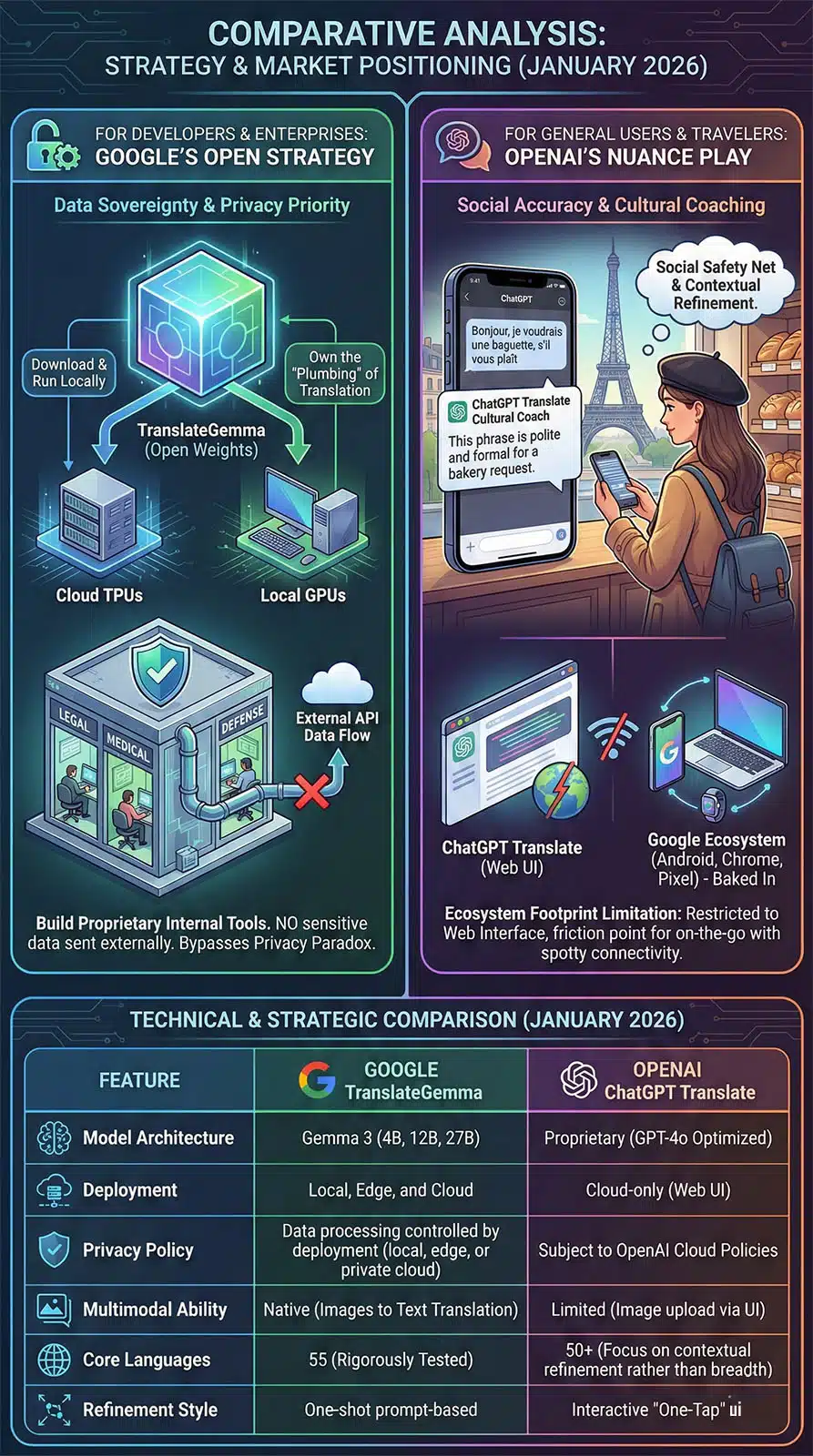
In 2026, data sovereignty is a top priority for global corporations. Google’s decision to release TranslateGemma with open weights is a calculated move to own the “plumbing” of the translation industry. By allowing companies to download the model and run it on their own hardware (Cloud TPUs or local GPUs), Google offers a solution to the “Privacy Paradox.”
Companies in the legal, medical, and defense sectors can now build proprietary internal translation tools that never send sensitive data to an external API. This bypasses the privacy concerns that have historically limited the use of OpenAI’s proprietary cloud-based models in highly regulated environments.
For General Users and Travelers: OpenAI’s Nuance Play
For the average user, the priority is rarely “offline weights” and more often “social accuracy.” If a traveler in Paris wants to ensure their request at a bakery doesn’t sound unintentionally rude, ChatGPT Translate provides a safety net. It explains why it chose a certain phrase, acting as a cultural coach.
However, OpenAI’s current limitation is its ecosystem footprint. While Google Translate is baked into Android, Chrome, and Pixel devices, ChatGPT Translate is currently restricted to a web interface. This creates a friction point for on-the-go usage where internet connectivity may be spotty.
| Feature | Google TranslateGemma | OpenAI ChatGPT Translate |
| Model Architecture | Gemma 3 (4B, 12B, 27B) | Proprietary (GPT-4o Optimized) |
| Deployment | Local, Edge, and Cloud | Cloud-only (Web UI) |
| Privacy Policy | Data processing controlled by deployment (local, edge, or private cloud) | Subject to OpenAI Cloud Policies |
| Multimodal Ability | Native (Images to Text Translation) | Limited (Image upload via UI) |
| Core Languages | 55 (Rigorously Tested) | 50+ (Focus on contextual refinement rather than breadth) |
| Refinement Style | One-shot prompt-based | Interactive “One-Tap” UI |
Technical & Strategic Comparison (January 2026)
The Performance Edge: Benchmarks and Multimodality
The battle for 2026 is also being fought on the quality of output. The WMT24++ benchmark has become the primary battleground for evaluating how these models handle low-resource languages (languages with less training data available on the internet).
Multimodal Dominance
Google’s TranslateGemma has a distinct advantage in Multimodality. It supports multimodal translation, retaining image-to-text capabilities from the Gemma 3 architecture, reducing reliance on external OCR pipelines and improving contextual accuracy in visual translations. This integration reduces the “translation lag” and improves accuracy by using visual context to help disambiguate text.
Contextual Adaptation
OpenAI leads in Adaptability. In 2026, the “Machine Translation Market Outlook” emphasizes that “context-blindness” is the leading cause of user dissatisfaction. ChatGPT Translate addresses this by allowing the user to follow up. If a translation feels too stiff, a user can simply click “Make it more casual,” and the model regenerates the text while maintaining the original meaning—a feature Google’s core translation engine has yet to replicate with the same conversational ease.
Use Case Performance Matrix
| Scenario | Preferred Tool | Reason |
| Legal Document Review | TranslateGemma (12B/27B) | Local processing ensures data privacy; high literal accuracy. |
| Customer Support Chat | ChatGPT Translate | Handles slang and frustrated tones with better empathy. |
| Hiking/International Travel | TranslateGemma (4B) | Runs offline on mobile devices; instant sign translation. |
| Creative Writing/Marketing | ChatGPT Translate | Adjusts brand voice and idioms for cultural resonance. |
| App Development | TranslateGemma | Open weights allow for deep integration and zero API costs. |
The “Missing Link” and Critical Flaws
Despite the massive leaps forward, both titans have notable gaps in their 2026 offerings.
Google’s Language Limitation
TranslateGemma is currently limited to 55 core languages. While these cover the majority of global trade, they pale in comparison to the broader language coverage of legacy Google Translate. For niche dialects or low-resource African and Southeast Asian languages, the open-weight models still have a long way to go. Google is relying on the developer community to use these open weights to fine-tune and “fill the gaps” for these missing languages.
OpenAI’s Connectivity and Feature Gap
OpenAI’s “Translate” interface is surprisingly bare-bones compared to the multi-featured Google ecosystem. As of early 2026, it lacks:
- Offline Support: A dealbreaker for many travelers.
- Document Uploads: While the main ChatGPT can handle PDFs, the specific Translate UI is still focused primarily on text and snippets.
- Voice Integration: While promised in marketing copy, real-time “interpreter mode” remains a secondary feature compared to Google’s hardware-integrated voice translation.
Infrastructure vs Context: Two Competing Visions for the Future of AI Translation
Market analysts and linguists remain divided over which translation strategy is best positioned to succeed over the long term. One line of thinking suggests that Google is prioritising scale and infrastructure by releasing open and efficient translation models that can be widely adopted by developers. By enabling integration across platforms and devices, this approach aims to embed Google’s technology deep within the global translation ecosystem, potentially making it the default foundation for future applications even when it operates behind the scenes.
Others point to changing user expectations as a decisive factor. As cross-border communication becomes more contextual and purpose-driven, there is growing fatigue with literal, machine-like translations. From this perspective, OpenAI’s emphasis on contextual awareness, tonal flexibility and quick refinement options reflects a broader shift in how users engage with language tools. Supporters of this view argue that translation increasingly functions as a social and professional interaction rather than a simple transfer of words, giving context-sensitive systems an edge in productivity-focused environments.
Future Outlook (2026): The Rise of Hybrid Translation
As we move toward the second half of 2026, the most likely outcome is not one-player-takes-all, but the emergence of Hybrid Translation ecosystems.
We expect to see smartphone manufacturers like Apple and Samsung integrate TranslateGemma-style local models for system-level privacy and instant tasks (like translating a text message or a camera view). Simultaneously, they will likely offer “Premium AI” plug-ins, perhaps powered by OpenAI or Gemini Ultra—for drafting high-stakes business emails or translating long-form literature where stylistic nuance is paramount.
The “Battle for the Tower of Babel” has effectively commoditized accuracy. In 2026, accuracy is the baseline; the new frontiers are Privacy, Nuance, and Local Autonomy.
Beyond Tools: What the Translation War Means for Power, Policy, and Society
The rivalry between Google’s TranslateGemma and OpenAI’s ChatGPT Translate extends well beyond product features or technical benchmarks. At its core, this battle reflects a broader realignment in how language, power, and digital sovereignty intersect in the AI era. Translation, once treated as a neutral utility, is increasingly shaping geopolitics, workplace dynamics, and cultural influence.
Language as Digital Infrastructure
For decades, language tools were considered “soft technology.” Useful, but peripheral. That assumption no longer holds. In 2026, translation systems are becoming foundational digital infrastructure, comparable to operating systems or cloud platforms. Whoever controls the underlying translation layer effectively shapes how information flows across borders, institutions, and communities.
Google’s TranslateGemma strategy aligns closely with this infrastructural logic. By releasing open-weight models that can be deployed locally or within private clouds, Google is positioning translation as a modular building block. Governments, enterprises, and developers can integrate it deeply into their systems without ongoing dependency on a third-party API. This approach resonates strongly with regions pursuing digital self-reliance, particularly in Europe, parts of Asia, and the Global South, where concerns over data sovereignty and technological dependence are growing.
In contrast, OpenAI’s model reflects a service-oriented philosophy. ChatGPT Translate operates as a centralized, cloud-based interface that emphasizes adaptability, conversational intelligence, and user-facing refinement. Rather than embedding itself invisibly into infrastructure, OpenAI seeks to remain present at the interaction layer — where decisions, tone, and intent are shaped in real time.
The Policy and Regulation Dimension
The divergence between open infrastructure and centralized experience also maps neatly onto global regulatory trends. As governments tighten AI governance frameworks, translation tools are increasingly scrutinized for how they handle sensitive data.
In regulated sectors such as healthcare, law, defense, and public administration, the ability to process text locally is not just a preference but often a legal requirement. TranslateGemma’s local deployment capability directly addresses these constraints, allowing institutions to comply with data localization laws while still benefiting from advanced AI translation.
OpenAI’s cloud-first model, while powerful, continues to face friction in such environments. Even with strong privacy assurances, the perception of external data exposure remains a barrier. As a result, ChatGPT Translate is more naturally suited to consumer, creative, and knowledge-work contexts rather than compliance-heavy institutional workflows.
This split may lead to a bifurcated market: one dominated by open, locally deployable models for regulated and infrastructure-heavy use cases, and another driven by cloud-based, experience-centric tools for professionals and individuals.
Economic Implications and the Cost Curve
Another underappreciated dimension of the translation wars is cost. Open-weight models like TranslateGemma fundamentally alter the economics of language services. Once deployed, marginal translation costs approach zero, especially for high-volume or repetitive tasks. This has significant implications for industries that rely heavily on multilingual content, including e-commerce, logistics, global customer support, and international media.
For enterprises, this shift reduces long-term dependency on per-call API pricing models. It also opens the door for customized, domain-specific translation systems trained on proprietary data, a capability that was previously cost-prohibitive.
OpenAI’s approach, meanwhile, emphasizes value over volume. ChatGPT Translate is designed to justify its cost by delivering higher-quality outputs in situations where nuance, persuasion, or cultural sensitivity matter. In this model, translation is not a commodity but a premium service layered with intelligence and interaction.
The result is a segmentation of value: scale-driven efficiency on one end, and context-driven refinement on the other.
Cultural Power and Linguistic Norms
Translation systems do more than convert language; they influence which linguistic norms are amplified and which are marginalized. Historically, dominant languages and standardized dialects have benefited disproportionately from machine translation advances.
TranslateGemma’s current limitation to 55 core languages reflects a pragmatic focus on performance and reliability, but it also raises questions about inclusivity. While open weights allow communities to fine-tune models for underrepresented languages, the burden of that work shifts to developers, researchers, and local institutions.
ChatGPT Translate, by focusing on tone and social context, subtly shapes how languages are “performed” in professional and digital settings. Its ability to adjust formality, politeness, or emotional register can influence cross-cultural communication norms — particularly in business and diplomacy. Over time, such tools may standardize certain styles of interaction, reinforcing globalized communication patterns while potentially flattening local linguistic variation.
Workforce and Professional Impact
For translators, editors, and language professionals, the 2026 translation shift is neither purely threatening nor purely empowering. Routine translation tasks are increasingly automated, especially with high-performing local models. However, demand is growing for roles that involve post-editing, cultural consulting, and quality assurance — areas where human judgment remains essential.
ChatGPT Translate’s collaborative refinement model hints at a future where professionals act less as direct translators and more as language strategists, guiding AI outputs to meet specific social or institutional goals. TranslateGemma, meanwhile, may underpin large-scale automated systems that free human experts to focus on higher-level linguistic and cultural challenges.
A Question of Trust
Ultimately, the success of either approach depends on trust — not just technical reliability, but institutional and cultural confidence. Enterprises must trust that local models are secure and maintainable. Users must trust that cloud-based systems respect their data and intentions. And societies must trust that AI-mediated language does not distort meaning in ways that erode understanding.
In this sense, the translation wars of 2026 are a microcosm of the broader AI debate. They force a reckoning with fundamental questions: Who controls the tools that shape global communication? Where should intelligence reside… on devices, in clouds, or somewhere in between? And how much human agency should remain in the loop?
Final Thoughts and Verdict
The dual release of TranslateGemma and ChatGPT Translate signals the end of the “General Purpose” translator era.
- Google’s Verdict: They have secured the Infrastructure Layer. By offering open-weight models that outperform legacy systems, they have made themselves indispensable to developers and privacy-conscious enterprises.
- OpenAI’s Verdict: They have captured the Experience Layer. By focusing on the “Diplomacy” of language, they have made translation a tool for connection rather than just comprehension.
For the global citizen in 2026, the winner is clear: communication is becoming cheaper, more private, and significantly more human.