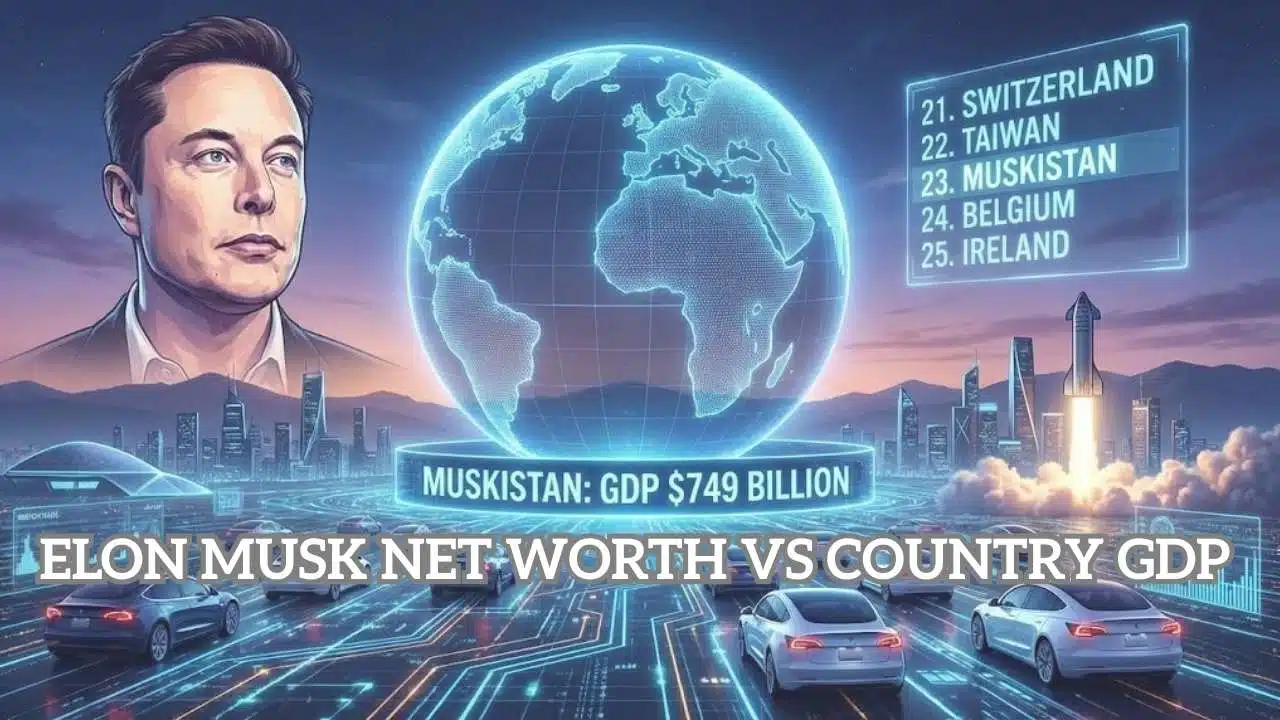
If you earned $1 million every single day since the birth of Jesus, you would today have roughly $740 billion. You would still be poorer than Elon Musk. As of late December 2025, the Tesla and SpaceX CEO’s net worth has hit a staggering $749 billion. The number is so large it has lost its meaning in the context of personal wealth.
We can no longer compare Musk to other billionaires like Jeff Bezos or Larry Ellison; the gap is too wide. To truly understand the scale of his influence, we have to stop treating him as an individual and start treating him as a sovereign economic entity.
Welcome to “Muskistan”—a non-state superpower with no borders, a private space program that rivals China’s, and an economy larger than 85% of the nations on Earth.
The Economic Rankings: Where Does “Muskistan” Sit?
To grasp the geopolitical weight of $749 billion, we must look at the global GDP rankings. If we treat Musk’s personal capital as a national Gross Domestic Product (GDP), the results are disorienting.
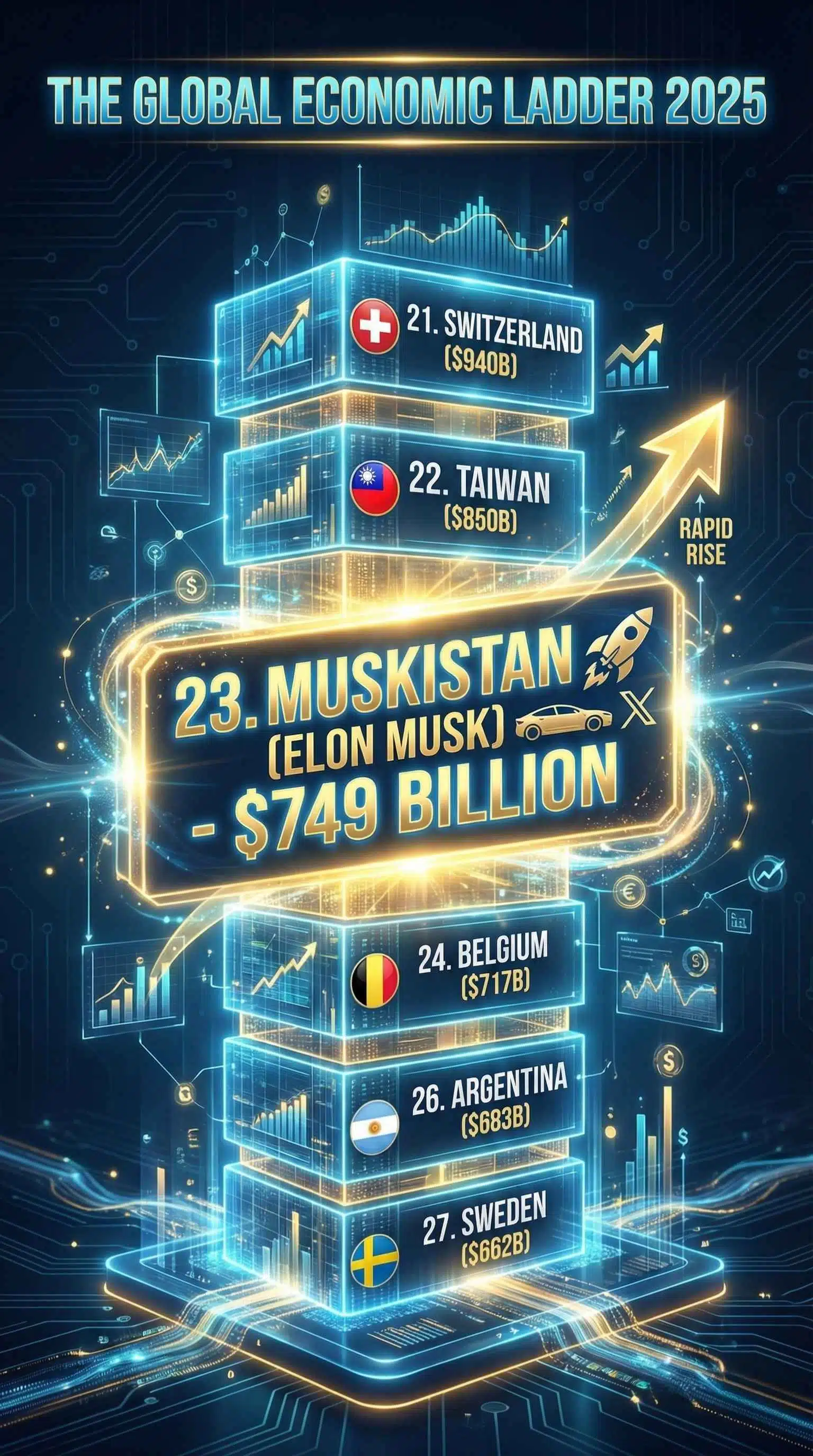
As of late 2025, “Muskistan” has officially surpassed the economic output of several of Europe’s oldest and most stable democracies. Based on the latest IMF and World Bank data, here is where Elon Musk slots into the global economy:
| Rank | “Country” | GDP / Net Worth (USD) | Status |
| 21 | Switzerland | ~$940 Billion | Sovereign State |
| 22 | Taiwan | ~$850 Billion | Sovereign State |
| 23 | ELON MUSK | $749 Billion | Private Citizen |
| 24 | Belgium | $717 Billion | EU Member State |
| 25 | Ireland | $709 Billion | EU Member State |
| 26 | Argentina | $683 Billion | G20 Member |
| 27 | Sweden | $662 Billion | EU Member State |
Table: The Nations Where Musk Leaves Behind
The most shocking realization isn’t that Musk is rich; it’s who he is richer than.
-
The European Pillars: Musk’s wealth now exceeds the entire annual economic output of Belgium and Sweden. These are industrial powerhouses, yet the market value of Musk’s holdings exceeds the value of every good and service produced within their borders over a full year.
-
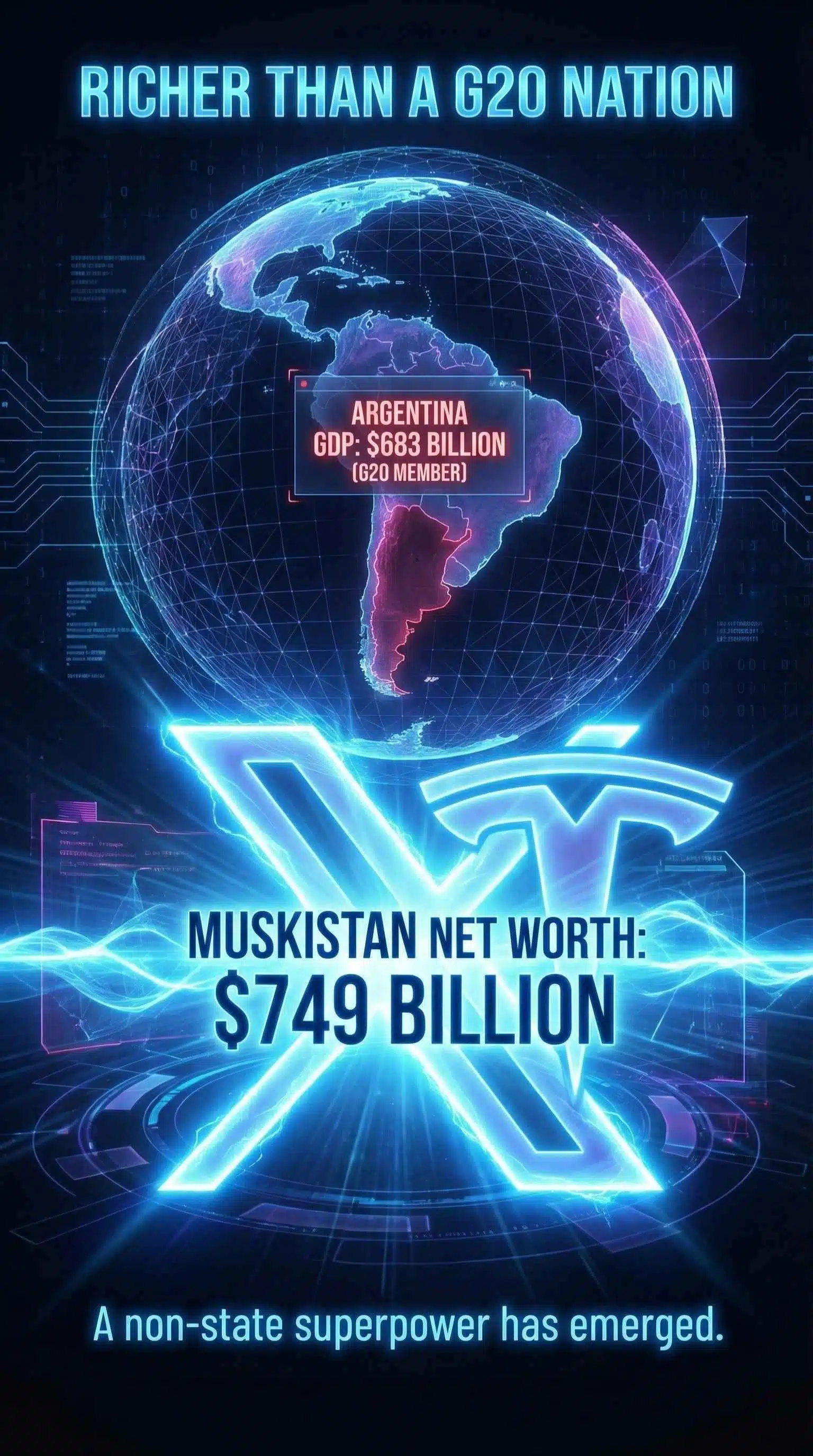
The G20 Anomaly: Perhaps the most significant “conquest” is Argentina. By surpassing Argentina ($683B), Musk has effectively established an economic footprint larger than a sitting G20 member state. While he doesn’t have a seat at the summit table, his wallet suggests he should.
Demographics: The Citizens of Muskistan
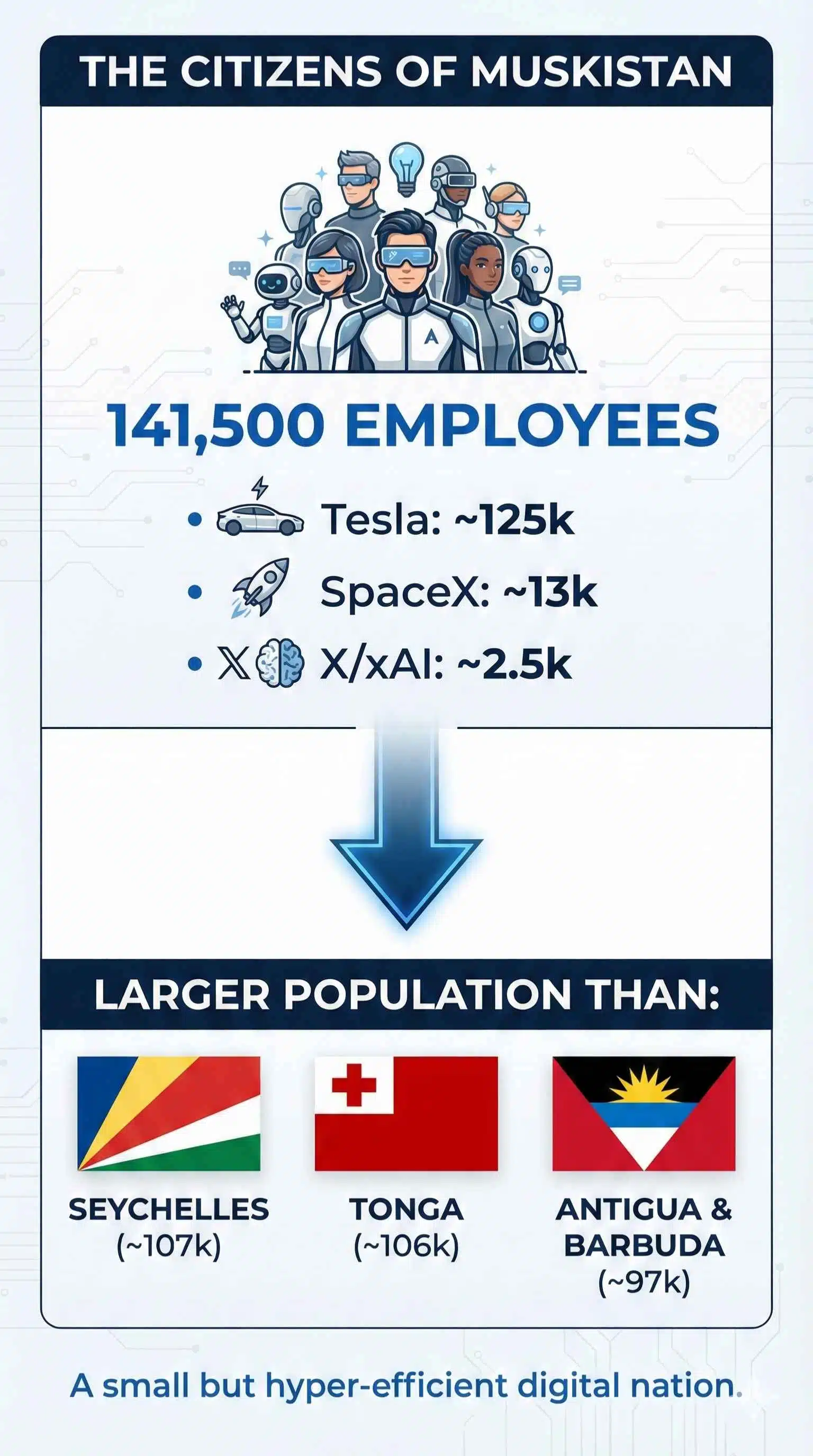
Every country needs a population. If we look at the direct employees under Musk’s command, “Muskistan” is a small but hyper-efficient nation-state.
-
Tesla: ~125,000 employees
-
SpaceX: ~13,000 employees
-
xAI & X Corp: ~2,500 employees (rapidly expanding in late 2025)
-
Neuralink & Boring Co: ~1,000 employees
Total Population: 141,500 “Citizens”
While this population is small compared to the US, it is larger than the sovereign populations of Seychelles, Antigua and Barbuda, or Tonga.
However, the culture of this citizenry is unique. Unlike a democracy, Muskistan operates on “hardcore” mode—a meritocratic autocracy where loyalty and extreme output are the only currencies. With the 2025 “Efficiency” drive (mirrored by his work with the US Department of Government Efficiency, or DOGE), the per capita productivity of a “Muskistan” citizen is arguably the highest in the world.
The “Exports” of Muskistan: Analyzing the Ministries
If Muskistan were a country, it wouldn’t just be rich—it would be strategically critical. Like Saudi Arabia relies on oil, Muskistan relies on a few high-tech “exports” that the rest of the world cannot easily duplicate.
The Ministry of Energy & Transport (Tesla)
This is the backbone of the economy. In 2025, the North American Charging Standard (NACS) effectively became the only standard that mattered. By controlling the fuel (the Supercharger network) and the vehicle (the Model Y and Cybertruck), Muskistan has achieved energy independence. Unlike a traditional petro-state, however, its main export is deflationary technology—batteries and autonomy that get cheaper over time.
The Ministry of Defense & Aerospace (SpaceX)
This is where Muskistan transitions from an economic power to a military one. As of December 2025, SpaceX controls over 9,000 active Starlink satellites. This isn’t just an internet service; it is the central nervous system of modern warfare.
-
The Monopoly: No other nation—not the US, China, or Russia—possesses a reusable bridge to orbit. If NASA wants to send astronauts to the Moon or the ISS, they must book a ticket on Muskistan’s rockets.
The Ministry of Information (X)
While not a massive profit center, X (formerly Twitter) functions as Muskistan’s state media. Similar to how Qatar leverages Al Jazeera or the UK leverages the BBC, Musk uses X to exert “soft power,” shaping narratives and bypassing traditional diplomatic channels to speak directly to the global populace.
The Central Bank: X Payments and Crypto
A true superpower controls its own currency. In late 2025, Muskistan made its move to financialize its ecosystem.
The “Western WeChat” Strategy
With money transmitter licenses now secured in over 35 US states, the launch of X Payments aims to turn the social platform into a global bank. The goal is to create a closed-loop economy where users earn money, spend money, and save money without ever leaving the “Muskistan” digital borders.
The Crypto Reserve
Unlike traditional nations that hoard gold or US Treasuries, Muskistan’s central bank is heavily leveraged into cryptocurrency. Musk’s consistent backing of Dogecoin and Bitcoin suggests that as X Payments goes global, it will likely be the first “nation” to fully integrate crypto rails into its national banking system, bypassing the SWIFT network entirely.
Foreign Policy: The Diplomacy of a Non-State Superpower
In 2025, we witnessed the strange reality of a CEO conducting foreign policy. Musk’s role as the face of the “Department of Government Efficiency” (DOGE) in the US effectively merged his private interests with American public administration.
But his influence extends far beyond Washington.
-
Starlink Diplomacy: In conflicts from Ukraine to new flashpoints, the decision to enable or disable Starlink coverage is made not by the UN Security Council, but by a boardroom in Texas. Muskistan can unilaterally decide which armies can communicate.
-
The Summit Circuit: Musk is now received by world leaders as a visiting dignitary. His meetings in 2025 with leaders like Argentina’s Javier Milei and his dialogue with India’s Narendra Modi regarding Tesla’s market entry resemble state visits. He negotiates tariffs, land rights, and spectrum allocation directly with heads of state, bypassing ambassadors entirely.
National Security Threats: The Vulnerability of a One-Man State
Every empire has weaknesses, and Muskistan is no exception.
The “Key Man” Risk
The greatest threat to Muskistan is biology. The entire $749 billion economy is centralized around the brain of one 54-year-old human male. Unlike Apple (post-Jobs) or Microsoft (post-Gates), there is no clear successor. If the “Supreme Leader” were to be incapacitated, the GDP of Muskistan would likely collapse by 50% overnight—a level of volatility no G20 nation faces.
Regulatory Warfare
The EU and Brazil have already fired warning shots. As Muskistan’s power grows, sovereign nations are fighting back with fines and bans. The $140 million fine from the EU in late 2025 was a signal: Old World governments will not cede power to Cloud Nations without a fight.
The “Glitch” in the Matrix: Why Net Worth ≠ GDP
Before we declare Musk the King of the World, we must acknowledge the economic flaw in this comparison.
Stock vs. Flow
GDP is a flow metric—it measures the velocity of money (transactions) over a year. Net worth is a stock metric—it measures the accumulated value of assets.
-
The Liquidity Problem: If Sweden needs $10 billion, it raises taxes. If Elon Musk tried to liquidate $100 billion of Tesla stock tomorrow to buy a country, the stock price would crash, and his “GDP” would evaporate.
However, the comparison remains valid for one reason: borrowing power.
Just as the US government borrows against its future tax revenue, Musk borrows against his stock. This allows him to deploy cash with the speed and scale of a nation-state, funding multi-billion dollar projects (like a Mars colony or a social media acquisition) without needing congressional approval.
Final Words
“Muskistan” is a volatile, high-tech autocracy with no borders, a space program that dwarfs the European Space Agency, and a leader who answers to no parliament.
As we move toward 2026, the lines between corporate titans and sovereign states are blurring. We are entering an era of “Cloud Nations,” where power is determined not by land mass or population, but by control over digital infrastructure and orbit. Elon Musk is simply the first president of this new world order—and right now, his economy is booming.