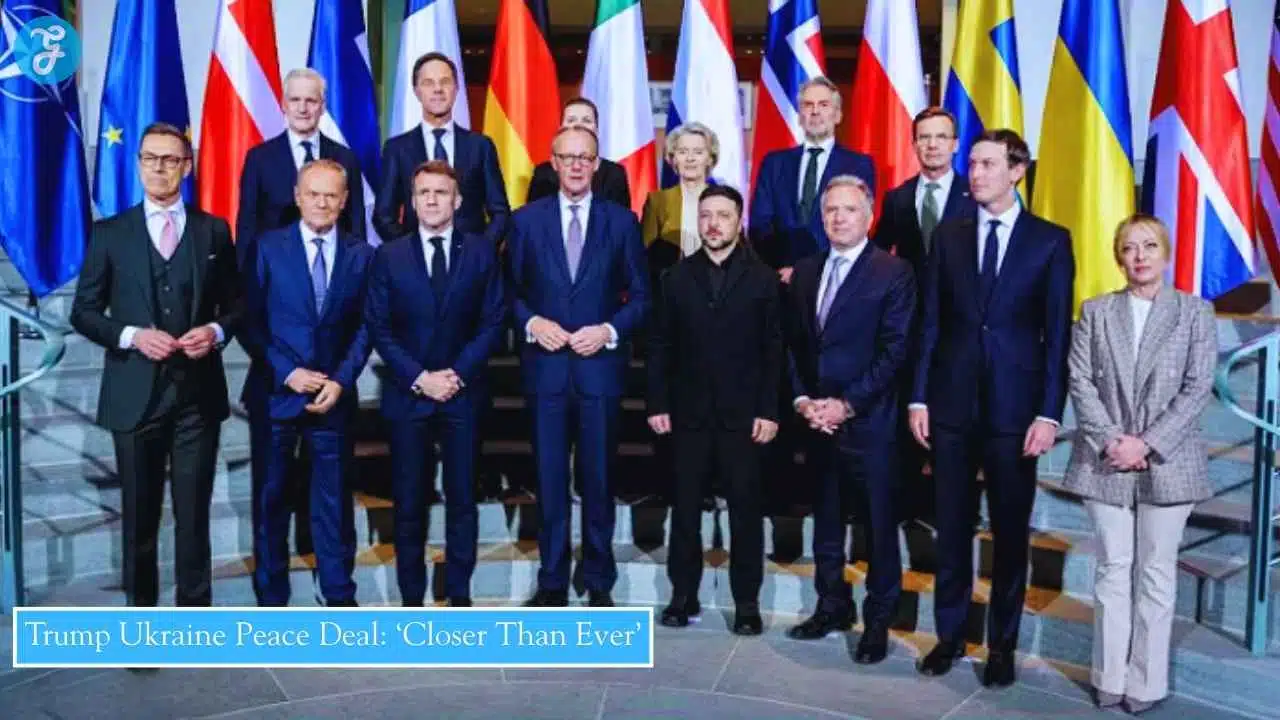
U.S. President Donald Trump said a Trump Ukraine peace deal is “closer than ever” after two days of talks in Berlin involving U.S., Ukrainian, and European officials, with major gaps still open on territory and enforcement.
What Trump said and what changed in Berlin?
Trump’s latest comments followed a high-level negotiating round in Berlin on December 14–15, 2025, where U.S. envoys met with Ukrainian and European counterparts to narrow differences on a draft framework aimed at stopping the war. Multiple officials involved in the discussions described substantial progress, with one senior official saying negotiators believe most issues are resolved, while a smaller set of core disputes could still derail an agreement.
Berlin matters because the talks appear to be moving beyond general statements and into detailed bargaining over enforcement—particularly the idea of “NATO Article 5-like” security guarantees for Ukraine without formal NATO membership. That concept is being discussed as a centerpiece designed to reassure Kyiv while addressing Moscow’s long-standing objections to Ukraine joining the alliance.
Who is involved?
The negotiating track described by officials includes:
- The United States, led by Trump’s team and envoys participating in the Berlin round.
- Ukraine, represented by President Volodymyr Zelenskyy and senior officials focused on security guarantees and sovereignty.
- European leaders and EU institutions, coordinating security elements and potential post-war support structures.
- Russia, not publicly present at Berlin but central to the terms under discussion and any final acceptance.
What’s reportedly on the table
“Article 5-like” guarantees without NATO membership
A key proposal under discussion would provide Ukraine security commitments modeled on NATO’s Article 5—the clause that treats an attack on one member as an attack on all—without bringing Ukraine into NATO. Details described by officials include monitoring and response mechanisms meant to deter renewed attacks after a ceasefire.
A European-led multinational force and U.S.-led monitoring
European leaders have backed the concept of a European-led multinational force as part of broader guarantees, alongside a U.S.-led ceasefire monitoring mechanism. The stated logic is to combine European presence and capabilities with American-backed oversight to increase credibility and speed of response.
Military capacity targets for Ukraine
One proposal discussed by European leaders includes sustaining Ukraine’s military strength at around 800,000 troops as part of the security architecture meant to prevent future aggression.
The hardest issues: territory and enforcement
Territorial concessions and withdrawal demands
The largest unresolved issue remains land—especially eastern regions under dispute. U.S. negotiators have been signaling that a viable deal may require difficult territorial decisions, while Ukrainian officials have maintained that sovereignty cannot be traded away under pressure and that security terms must be clear and binding before any territorial discussions move forward.
What “guarantees” actually mean in practice?
Even if negotiators agree on language, the practical questions are politically heavy:
- Would there be automatic military support if Russia attacks again?
- Would commitments require U.S. congressional approval or separate treaties?
- How quickly would monitoring detect violations, and what happens next?
Some reporting indicates the U.S. concept may not involve American troops on the ground, raising questions about how deterrence would function and what “Article 5-like” means operationally.
How the talks reached this point?
| Date | Development | Why it mattered |
| Nov 22, 2025 | Trump said the U.S. peace plan was not his “final offer.” | Signaled flexibility after pushback and a moving negotiating draft. |
| Dec 14, 2025 | U.S. envoys arrived for another Berlin round; Zelenskyy emphasized firm guarantees. | Set up Berlin as a make-or-break negotiating session. |
| Dec 15, 2025 | Officials described major progress; Trump said a deal is “closer than ever.” | Put public momentum behind a framework while exposing unresolved issues. |
| Dec 15, 2025 | European leaders endorsed security guarantees and a European-led force concept. | Indicated Europe is preparing to carry a large share of enforcement. |
Key elements under discussion: quick comparison table
| Issue | What Ukraine is signaling it needs | What the U.S./Europe are signaling they can offer | Core risk |
| Security guarantees | Binding, credible deterrence comparable to NATO-level protection | “Article 5-like” model + monitoring + European multinational force | If guarantees look weak, Kyiv may reject; if too strong, Moscow may refuse. |
| Territory | No forced concessions; security first | Tough decisions implied, especially in the east | Land becomes the political deal-breaker on both sides. |
| Enforcement | Fast consequences for violations | U.S.-led monitoring and European operational role | Monitoring without credible penalties may not deter renewed attacks. |
| Reconstruction | Long-term recovery support | “Prosperity package” discussions involving major financial institutions | Funding sources and governance could become contentious. |
Why Trump’s claim matters politically?
Donald Trump has long argued he could bring the war to an end quickly, but the process has stretched across months of diplomacy, revisions, and competing demands. The current moment is being framed by his team as the closest point yet to a negotiated endgame, with officials suggesting there is limited time before political and battlefield realities shift again.
At the same time, optimism in public statements does not automatically translate into a signed agreement. In past rounds, progress has repeatedly run into the same structural problem: Ukraine prioritizes guarantees and sovereignty, while Russia’s demands and red lines focus on territory, alignment, and constraints on Ukraine’s future security posture.
The next phase is likely to hinge on whether negotiators can lock down enforceable security guarantees and define a territorial pathway that Ukraine can accept without appearing to legitimize conquest. Watch for:
- A written outline of what “Article 5-like” guarantees require legally and militarily.
- Whether Europe formally commits to a multinational presence and under what mandate.
- Any signal that Russia is prepared to accept constraints and monitoring mechanisms.
- Deadlines—explicit or implied—set by the U.S. side for accepting the framework.