

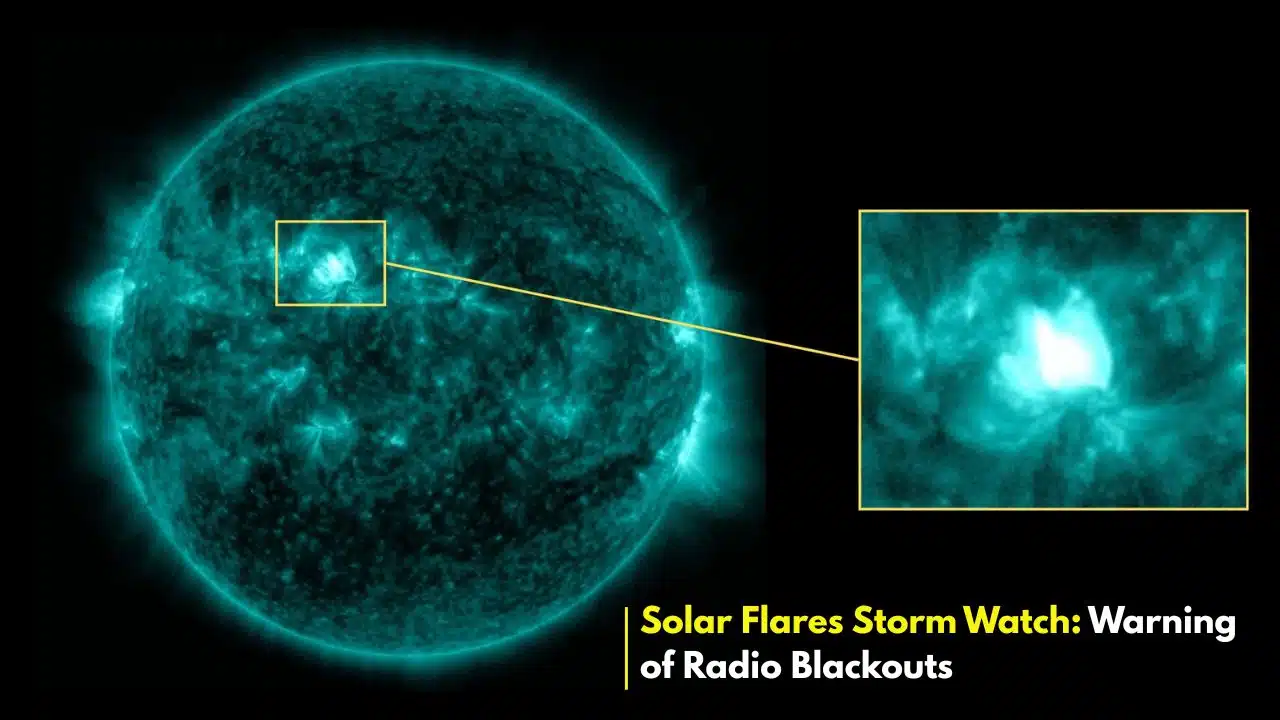
Powerful solar flares have erupted from the Sun this week, triggering a storm watch and causing radio blackouts across multiple regions of the globe. The most recent flare, classified as an X1.1 event, erupted early on December 8, 2025, and has led to a cascade of effects on Earth’s technological infrastructure, with scientists warning of further disruptions and even visible auroras in higher latitudes.
Solar Flare Details
The X1.1-class solar flare peaked at 12:01 a.m. EST on December 8, originating from sunspot region AR4298 as it rotated toward the Sun’s western limb. This flare is part of a series of intense solar events this month, including an earlier M8.1 flare on December 6, which was associated with a full-halo coronal mass ejection (CME) expected to impact Earth on December 9. Solar flares are powerful bursts of electromagnetic radiation, with X-class flares being the most intense, capable of releasing energy equivalent to billions of nuclear bombs.
The December 8 flare caused brief but significant radio blackouts, particularly affecting high-frequency (HF) communications in Australia and parts of Southeast Asia. Such blackouts occur when the intense burst of X-rays and ultraviolet radiation from the flare ionizes the upper atmosphere, disrupting radio waves that rely on reflection from the ionosphere.
Storm Watch and Geomagnetic Impact
NOAA’s Space Weather Prediction Center has issued a strong (G3) geomagnetic storm watch for December 9, as the Earth-directed CME from the M8.1 flare is expected to arrive and interact with Earth’s magnetosphere. This interaction could lead to periods of strong geomagnetic storming, potentially disrupting power grids, satellite operations, GPS signals, and navigation systems. The geomagnetic storm watch is valid for December 9, with possible auroral displays visible at high to mid-latitudes if the storm intensity is sustained.
Auroras, or the northern and southern lights, occur when charged particles from the Sun collide with gases in Earth’s atmosphere, producing vibrant light displays. With a G3 storm, these displays may be visible farther south than usual, offering a rare spectacle for many regions.
Radio Blackouts and Technological Risks
The X1.1 flare caused an R3-level radio blackout, the strongest category for such events, which can severely disrupt aviation, maritime, and emergency communication systems. HF radio signals, which are used for long-distance communication, are particularly vulnerable, as they rely on the ionosphere to bounce signals over the horizon.
Additionally, the risk to satellites and astronauts in low Earth orbit increases during such solar events. The intense radiation can damage sensitive electronics and pose health risks to humans exposed outside Earth’s protective atmosphere. Space agencies and satellite operators are closely monitoring the situation and may implement protective measures to safeguard critical infrastructure.
Solar Activity and Forecast
Solar activity has been particularly high this month, with several sunspot regions producing multiple M-class and X-class flares. Sunspot AR4294, a large and complex region, has been a prolific source of solar activity, and forecasters expect continued flare activity in the coming days. The Sun is currently approaching its solar maximum, a period of heightened solar activity that typically occurs every 11 years, leading to more frequent and intense solar flares and CMEs.
Forecasters predict that while the immediate threat from the December 8 flare has passed, the Earth-directed CME from December 6 may cause prolonged geomagnetic storming and additional radio disruptions on December 9. The chances of further M-class and X-class flares remain elevated, with a slight possibility of even stronger events as new sunspot regions rotate into view.
Historical Context and Preparedness
Solar flares and geomagnetic storms are not new phenomena. The most powerful flare recorded in recent years was an X5.1-class event in November 2025, which caused widespread radio blackouts across Europe and Africa. Such events serve as a reminder of the Sun’s potential to disrupt modern technology and the importance of space weather monitoring and preparedness.
Governments and space agencies have developed protocols to mitigate the impact of solar storms, including early warning systems, satellite shielding, and backup communication networks. However, the rapid onset and unpredictable nature of solar flares mean that ongoing vigilance is essential to protect critical infrastructure and ensure public safety.
Global Impact and Observations
The effects of the December 8 solar flare and the associated geomagnetic storm are being felt worldwide. In addition to radio blackouts and potential disruptions to power grids, there are reports of increased auroral activity in northern regions, with sightings expected to continue into December 9. Observatories and amateur astronomers are closely tracking the event, providing real-time updates and imagery of the auroras and solar activity.
For regions directly affected by radio blackouts, alternative communication methods such as satellite phones and landline networks are recommended until normal HF radio operations resume. Aviation and maritime authorities are also advised to monitor space weather forecasts and adjust operations as needed to ensure safety.
What’s Next?
As the Sun continues its approach to solar maximum, the likelihood of further powerful solar flares and geomagnetic storms remains high. Forecasters expect increased solar activity through the remainder of 2025 and into 2026, with the potential for additional radio blackouts, auroral displays, and technological disruptions.
Staying informed through official space weather sources and being prepared for potential disruptions are key steps for individuals and organizations affected by these solar events. Ongoing research and monitoring efforts will help improve our understanding of solar activity and enhance our ability to predict and respond to future solar storms.





















