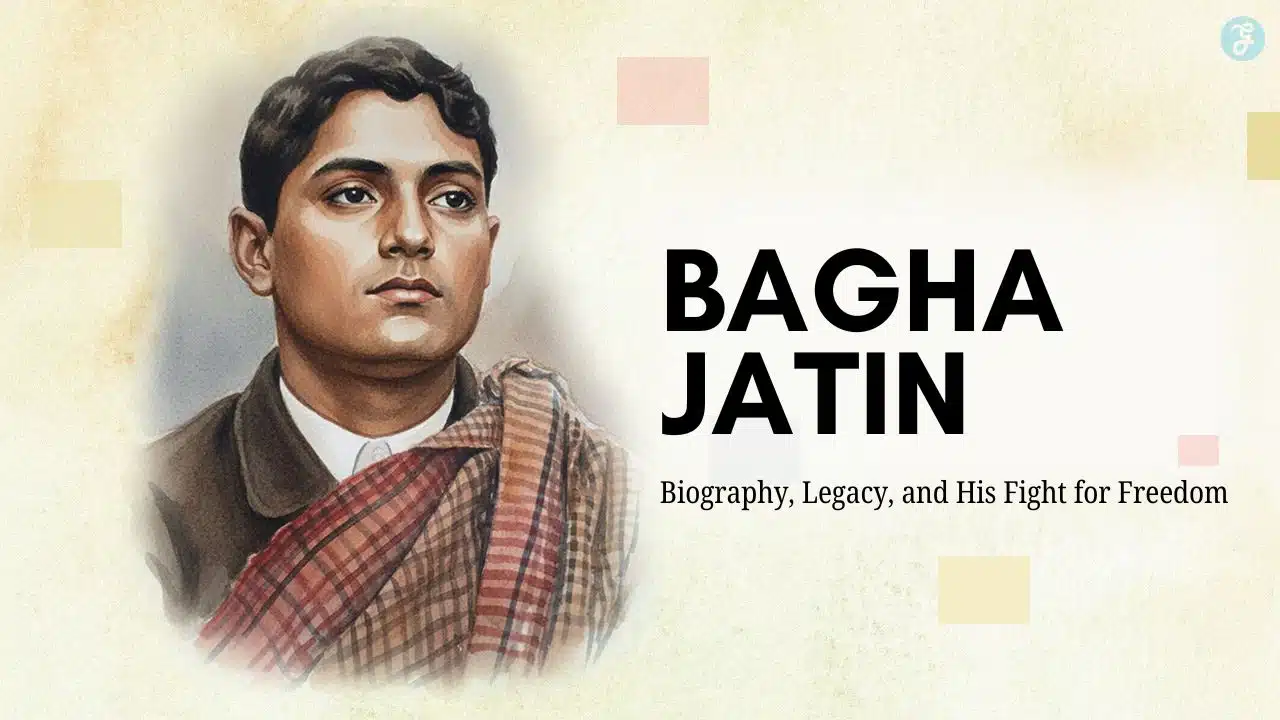
As India commemorates the 146th birth anniversary of Bagha Jatin, we remember not just a revolutionary but a symbol of unyielding courage whose life story has influenced future generations.
Known for his legendary bravery and fierce patriotism, Bagha Jatin—born Jatindranath Mukherjee—stood at the forefront of the early armed resistance against British rule. His extraordinary feats, from confronting a Royal Bengal tiger with his bare hands to orchestrating bold plans for India’s liberation, transformed him into a national icon.
Today, as we revisit his journey of sacrifice and strength, we honor a hero whose vision of freedom still echoes in the heart of the nation. If you have ever wondered who Bagha Jatin was and why he matters even today, this article explores his biography, his revolutionary work, and the powerful legacy he left behind.
Early Life of Bagha Jatin
Jatindranath Mukherjee was born on 7 December 1879 in Kayagram (also written as Koya Gram or Kaya Gram) in Kushtia, then part of the Nadia district of Bengal Presidency, in British India. He grew up in a middle-class Bengali family that valued education, culture, and patriotism. His father died when he was very young, and his mother, Sharat Shashi, played a major role in shaping his character.
From an early age, Jatin showed strong physical courage, leadership, and a sense of justice. He was deeply influenced by Swami Vivekananda’s call to build strong, fearless youth who would serve the motherland. He later moved to Calcutta (now Kolkata) for higher studies and gradually entered the circle of nationalist politics and secret revolutionary societies.
Key Facts About His Early Life
| Aspect | Detail |
| Birth name | Jatindranath Mukherjee |
| Popular name | Bagha Jatin (Jatin of the Tiger) |
| Date of birth | 7 December 1879 |
| Birthplace | Kayagram, Kushtia, Bengal Presidency |
| Parents | Father: Umeshchandra Mukherjee, Mother: Sharat Shashi |
| Early influence | Swami Vivekananda’s ideals of strength and service |
Why Was Jatindranath Mukherjee Called “Bagha” Jatin?
The name “Bagha Jatin” literally means “Jatin of the Tiger.” This title was not a poetic nickname. It came from a real incident that captured the public imagination and symbolized his raw courage.
According to accounts, Jatin once fought a fully grown Royal Bengal tiger with nothing but a dagger after the animal attacked his companion near a forested area in Odisha. He killed the tiger, but the encounter left him seriously injured and permanently scarred. The British doctor who treated him is said to have remarked on his extraordinary bravery. From that day on, people began calling him “Bagha” Jatin.
The Tiger Incident At a Glance
| Aspect | Detail |
| Location | Near a forested area in Odisha (then Orissa) |
| Opponent | A Royal Bengal tiger |
| Weapon | Dagger |
| Outcome | Tiger killed, Jatin badly injured |
| Resulting title | Known as “Bagha Jatin” by the public |
Entry Into Revolutionary Politics
To understand who Bagha Jatin was in the context of Indian politics, we must look at the secret networks he helped build. In Calcutta, Jatin came into contact with leaders of the Anushilan Samiti, a revolutionary organization that believed armed struggle was necessary to uproot British rule. He later became one of the most important leaders of the Jugantar group, a more militant offshoot.
While many leaders worked in the open through petitions and protests, Jatin operated underground. He focused on building a disciplined, countrywide revolutionary network capable of coordinated action. He helped inspire and organize young men in Bengal and other regions, arranging arms, training, and communication channels.
Major Revolutionary Associations
| Organization | Role of Bagha Jatin |
| Anushilan Samiti | Early association, contact with key revolutionaries |
| Jugantar | Senior leader, strategist, organizer |
| Underground cells | Helped coordinate secret groups in Bengal and beyond |
The 1915 Plan: Germany, World War I, and Armed Uprising
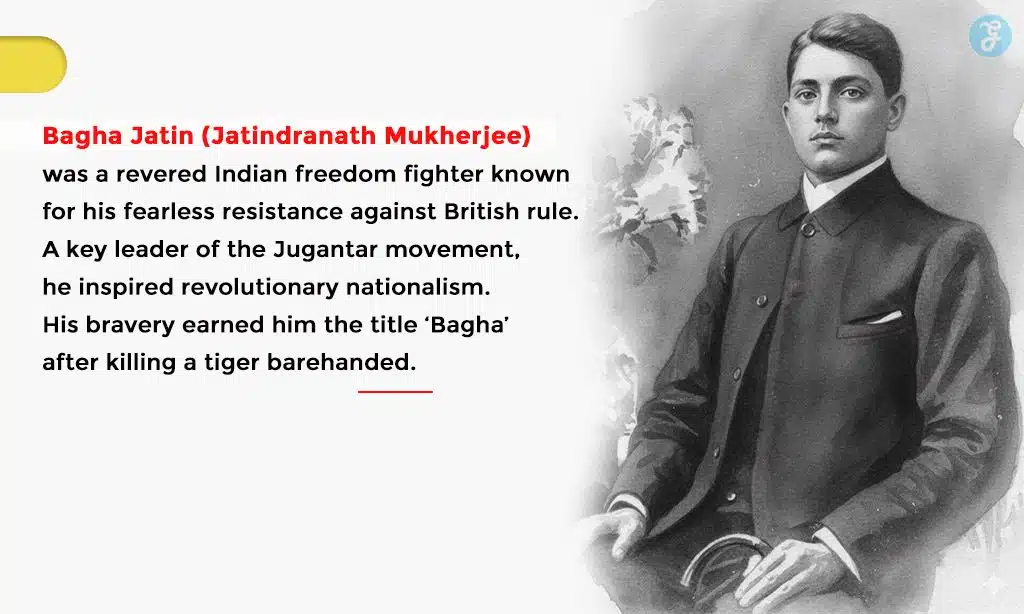
Perhaps the most dramatic chapter in Bagha Jatin’s life came during World War I. He understood that Britain was stretched thin and believed that global conflict created an opportunity for an armed uprising in India. To execute this vision, he and other revolutionaries planned to bring in arms with the support of Germany, which was then at war with Britain.
This plan is often referred to as part of the “German Plot” or “Hindu–German Conspiracy” in historical records. German agents and Indian revolutionaries abroad worked to arrange ships loaded with arms that would land on the Indian coast. Jatin and his associates planned to distribute these weapons to revolutionary groups across the country and launch a coordinated revolt.
However, British intelligence, already tracking revolutionary networks, managed to intercept much of the communication. The plan did not materialize fully, and the British began a harsh crackdown on suspected revolutionaries. Jatin and his comrades were forced to go into hiding.
Summary Of The 1915 Plan
| Aspect | Detail |
| Context | World War I: Britain engaged in a global war |
| International link | German support for Indian revolutionaries |
| Goal | Large-scale armed uprising in India |
| Method | Secret arms shipments by sea to the Indian coastline |
| Outcome | The plan was compromised by British intelligence |
The Final Stand At Balasore: Battle Of Chashakhand
To truly answer who Bagha Jatin was, history often points to his last stand. After the German-linked plan collapsed, Jatin and a small group of revolutionaries moved towards the Odisha coast near Balasore, hoping to stay ahead of the British and reconnect with possible arms landings.
The British police and army, however, were closing in. On 9 September 1915, Jatin and his associates were surrounded near Chashakhand by a heavily armed force. Despite being outnumbered and poorly armed compared to the British, Jatin decided to fight rather than surrender.
The battle that followed was intense and lasted for hours. Jatin fought bravely, was severely wounded, and was eventually captured. He succumbed to his injuries the next day, on 10 September 1915. His comrades either died in the gunfight or were arrested and later tried.
Key Facts About His Last Battle
| Aspect | Detail |
| Location | Near Chashakhand, Balasore (Odisha) |
| Date of battle | 9 September 1915 |
| Opponents | British police and military forces |
| Jatin’s status | Severely wounded, captured |
| Date of death | 10 September 1915 |
Ideology: What Did Bagha Jatin Stand For?
Bagha Jatin was not just a fighter. He was a strategist and thinker who believed in organized, disciplined action. He admired Swami Vivekananda’s call to build fearless youth and saw physical strength and moral courage as two sides of the same coin. He believed that freedom could not be begged for. It had to be seized through sacrifice and coordinated effort.
He also believed in building a united front, cutting across regions and religions. For him, the fight was not just for Bengal but for the whole of India. He worked with revolutionaries from Punjab, Maharashtra, and other parts of the country, anticipating a more integrated national movement.
Core Ideals Of Bagha Jatin
| Principle | Explanation |
| Courage and sacrifice | Willingness to give life for freedom |
| Organization and discipline | Focus on trained, coordinated revolutionary cells |
| National unity | India above region, religion, or community |
| Active resistance | Belief that armed struggle had a role to play |
Legacy: How Is Bagha Jatin Remembered Today?
For years, Bagha Jatin did not get the same mainstream recognition as some other leaders of the freedom movement. Much of his work was secret, and many records were suppressed or scattered. However, over time, historians and regional memory have kept his story alive.
In Bengal and Odisha, he is widely celebrated as a heroic symbol of resistance. Statues, roads, educational institutions, and local commemorations carry his name. His life has inspired books, research works, and films. In recent years, there has been renewed interest in telling his story to a wider, national, and even global audience that is curious about lesser-known revolutionaries.
Forms Of His Legacy
| Area | Example |
| Public memory | Statues, portraits, local holidays, and events |
| Education | Chapters in regional history and academic research |
| Culture | Biographies, novels, and documentaries |
| Symbolism | Model of fearless, organized resistance |
Why Does Bagha Jatin Matter in Today’s India?
Understanding who Bagha Jatin was is not just about learning a name from the past. It is about understanding a particular vision of freedom and responsibility. His life raises important questions that remain relevant.
He stood for courage, but not for mindless violence. He believed in sacrifice, but also in careful planning. He promoted unity across identities at a time when India was divided by region, religion, and caste. In a modern world facing new forms of injustice, corruption, and external pressures, his example still speaks about integrity, discipline, and the cost of real independence.
Modern Relevance
| Theme | Contemporary Connection |
| Youth and strength | Inspires youth movements toward discipline |
| National unity | Stands against divisive politics |
| Sacrifice for ideals | Reminds us that freedom and justice have a cost |
| Remembering history | Encourages deeper study beyond textbook heroes |
Who Was Bagha Jatin, Really?
So, who was Bagha Jatin? He was more than a man who killed a tiger with a dagger and earned a legendary nickname. He was a quiet architect of armed resistance, a builder of networks, and a leader who believed that India must stand on its own feet through courage and unity.
His life story connects physical bravery, spiritual inspiration, and political strategy. He did not live to see independence, but his work helped lay the foundation for later movements and shaped the revolutionary tradition in India. Remembering Bagha Jatin today means remembering that freedom was won not only in assemblies and ashrams, but also in forests, safe houses, and battlefields where people like him gave their lives for a free future.
Frequently Asked Questions About Bagha Jatin
Who was Bagha Jatin in Indian history?
Bagha Jatin, born Jatindranath Mukherjee, was a prominent Bengali revolutionary who played a key role in the early twentieth-century freedom movement. He was a leader in organizations like Jugantar and worked to build a nationwide network for armed resistance against British rule.
Why was Jatindranath Mukherjee called Bagha Jatin?
He earned the title “Bagha” Jatin after fighting and killing a Royal Bengal tiger with a dagger to protect his companion. This incident made him famous for his physical bravery, and the name stayed with him for life.
What was Bagha Jatin’s role in the German Plot during World War I?
During World War I, Bagha Jatin helped plan an armed uprising in India supported by German arms shipments. The idea was to use the global conflict to weaken British control. However, British intelligence intercepted the plan, and it was never fully realized.
How did Bagha Jatin die?
Bagha Jatin died after a gun battle with British forces near Balasore in present-day Odisha on 9 September 1915. Severely wounded, he was captured and succumbed to his injuries on 10 September 1915.
How is Bagha Jatin remembered today?
He is remembered as a fearless revolutionary and a symbol of armed resistance in Bengal and India. Many local institutions, roads, and memorials bear his name, and his life is studied by historians and celebrated in regional culture.