

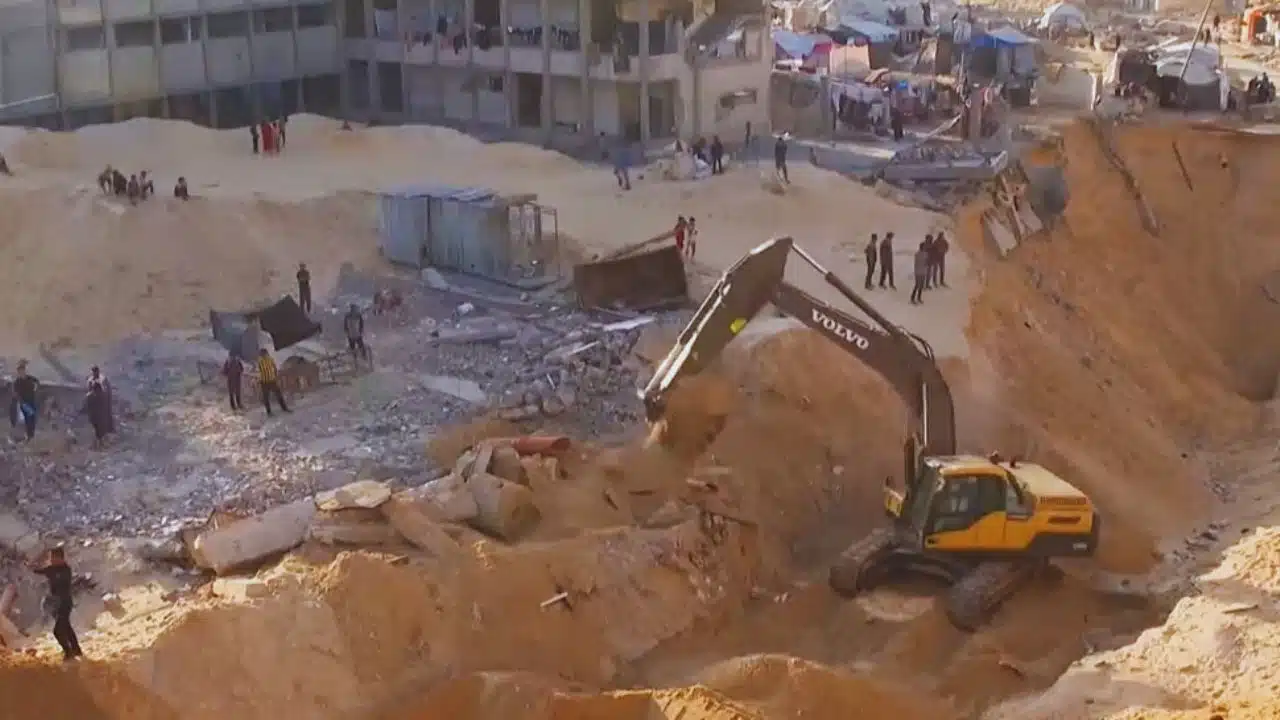
In an unprecedented and fragile operation, Egyptian technical teams and the International Committee of the Red Cross (ICRC) have entered Israeli-controlled areas of the Gaza Strip to assist in the search for the remaining hostage bodies in Gaza, Israeli officials confirmed Sunday.
The move, a significant new phase in the U.S.-brokered ceasefire that began on October 10, 2025, aims to break a five-day impasse that has threatened the stability of the truce. In a highly unusual development, Israeli authorities also permitted Hamas representatives to accompany the search teams to help pinpoint the locations of the deceased.
This complex, multi-party effort underscores the intense diplomatic pressure—chiefly from the United States—to bring closure to the families of 13 deceased hostages still missing within the war-torn enclave, more than two years after the conflict began.
The State of the Recovery Operation
- 13 Deceased Hostages: The remains of 13 Israeli hostages are still believed to be in Gaza.
- 28 Total Deceased: At the start of the October 10 ceasefire, Hamas was holding the remains of 28 hostages who died or were killed in captivity.
- 15 Bodies Returned: In the initial days of the truce, Hamas returned the remains of 15 hostages, in exchange for which Israel transferred the bodies of approximately 165-195 Palestinians.
- Egyptian Involvement: An Egyptian technical team, including heavy engineering vehicles like excavators and trucks, entered Gaza on Saturday to assist in the physical search.
- ICRC Role: The ICRC is acting as a “neutral intermediary” to facilitate the operation and the transfer of any recovered remains, at the request of both parties.
- Hamas Participation: In a rare move, Israel authorized Hamas representatives to enter IDF-controlled territory, under supervision, to help identify burial sites.
A Fragile Truce Tested by the Dead
The current ceasefire, brokered by the United States and mediated by Egypt and Qatar, successfully saw the release of all 20 remaining living Israeli hostages around October 13-15. This was part of a larger agreement that included the release of nearly 2,000 Palestinian prisoners from Israeli jails.
A critical second phase of that deal stipulated the “as soon as possible” return of all 28 deceased hostages Hamas was holding. After an initial handover of 15 bodies, the process stalled for five days.
Hamas repeatedly claimed that it was unable to locate or retrieve the remaining 13 bodies, alleging they were buried deep under thousands of tons of rubble from Israeli airstrikes and would require specialist recovery equipment.
This delay drew sharp criticism from Israeli officials, who insisted that Hamas knew the locations of most of the bodies and was deliberately holding them back as a bargaining chip. The impasse prompted a public 48-hour warning from U.S. President Donald Trump, who stated he was “watching very closely” and that Hamas would be held responsible for a collapse of the truce.
Faced with the potential collapse of the ceasefire, the new, coordinated search operation was approved by Israeli Prime Minister Benjamin Netanyahu.
A Complex Web: The Roles of Each Party
The operation to find the hostage bodies in Gaza is not a single search but a complex, multi-layered mission with each party playing a distinct and critical role.
Egypt: The Mediator with Boots on the Ground
Egypt, which has been a central mediator throughout the two-year conflict, has now taken on a direct, technical role. On Saturday, an Egyptian team with excavators, bulldozers, and trucks crossed the Rafah border into Gaza.
This team is not acting independently but is working to provide the heavy-lifting capability that Hamas claimed it lacked. An Israeli official, speaking to Source, clarified the mission: “It is a technical team. They are going in only to locate the slain hostages.”
The Egyptian machinery was seen operating near Khan Younis in southern Gaza, clawing through sand and rubble near heavily damaged buildings.
ICRC: The Neutral Intermediary
The International Committee of the Red Cross (ICRC), whose vehicles were seen with the Egyptian convoy, has been clear about its specific mandate. The organization is not leading the search but facilitating it as a trusted neutral party.
In a statement responding to reports, the ICRC clarified its position:
The International Committee of the Red Cross is currently operating in Gaza as a neutral intermediary, at the request of the parties, to facilitate the return of the remains of hostages who are no longer alive… To ensure the safety of those involved, we will not comment further on the different reports at this stage.”
The ICRC’s role is essential for any transfer, ensuring that any remains are handled with dignity and providing a trusted channel between the IDF and Hamas.
Hamas and the IDF: A Tense Cooperation
The most extraordinary component of the new operation is the supervised participation of Hamas. Israeli officials confirmed to Hebrew-language media that Israel authorized “a representative of Hamas to enter the ‘Yellow Line [IDF-controlled territory] together with the Red Cross to help locate fallen hostages.”
This pragmatic, if tense, arrangement concedes Hamas’s point that it is the only party with the intelligence on the burial locations, while keeping the operation under firm Israeli security control. The IDF, meanwhile, continues its own intelligence-based operations to locate bodies.
This “cooperation” is born of sheer necessity, with the U.S. applying immense pressure on all sides to produce results and uphold the fragile ceasefire.
The Human Toll: Families Await Closure
For the 13 families still in limbo, the new search is a source of both renewed hope and profound anxiety. After the initial joy of the living hostages’ return, the focus has shifted to what the Hostage and Missing Families Forum has called a “sacred duty” to return the dead for proper burial.
The families’ plight has been a central political and social issue in Israel, with constant protests and lobbying efforts. Following a recent visit by U.S. Secretary of State Marco Rubio, the Forum issued a plea on X (formerly Twitter):
Thirteen hostages need to come home. Thirteen families need closure. Please don’t stop – until the last hostage is released.”
The agonizing wait continues. The recovery of the body of Eliyahu “Churchill” Margalit, 75, on October 17, was a grim reminder of the stakes. His family, after more than two years of uncertainty, could finally begin the process of mourning. Thirteen other families are now waiting for that same, heartbreaking closure.
The success or failure of this joint operation will likely determine the fate of the entire ceasefire.
- Speed of Recovery: The pressure is on to recover the 13 bodies quickly. Any further delays, perceived obstruction by Hamas, or security incidents could cause Israel to halt the operation and potentially resume military action.
- Stability of the Truce: The truce remains on a knife’s edge. Hamas has already accused Israel of a “clear violation” for strikes targeting Palestinian Islamic Jihad (PIJ) militants elsewhere in Gaza, which the IDF defended as a necessary counter-terror action.
- The “Day After”: This operation is a microcosm of the larger challenge of post-war Gaza. It involves international bodies (ICRC), regional powers (Egypt), and an ongoing, tense relationship between Israeli security and Hamas’s de-facto presence. This complex interaction is a preview of the difficulties facing a proposed UN-backed multinational stabilization force.
The search for the hostage bodies in Gaza has evolved from a solely military mission into a complex diplomatic and humanitarian endeavor. The ground-breaking, if precarious, cooperation between Egypt, the ICRC, the IDF, and Hamas demonstrates the desperate lengths being taken to honor the dead and preserve a fragile peace.
The Information is Collected from BBC and WION.





















