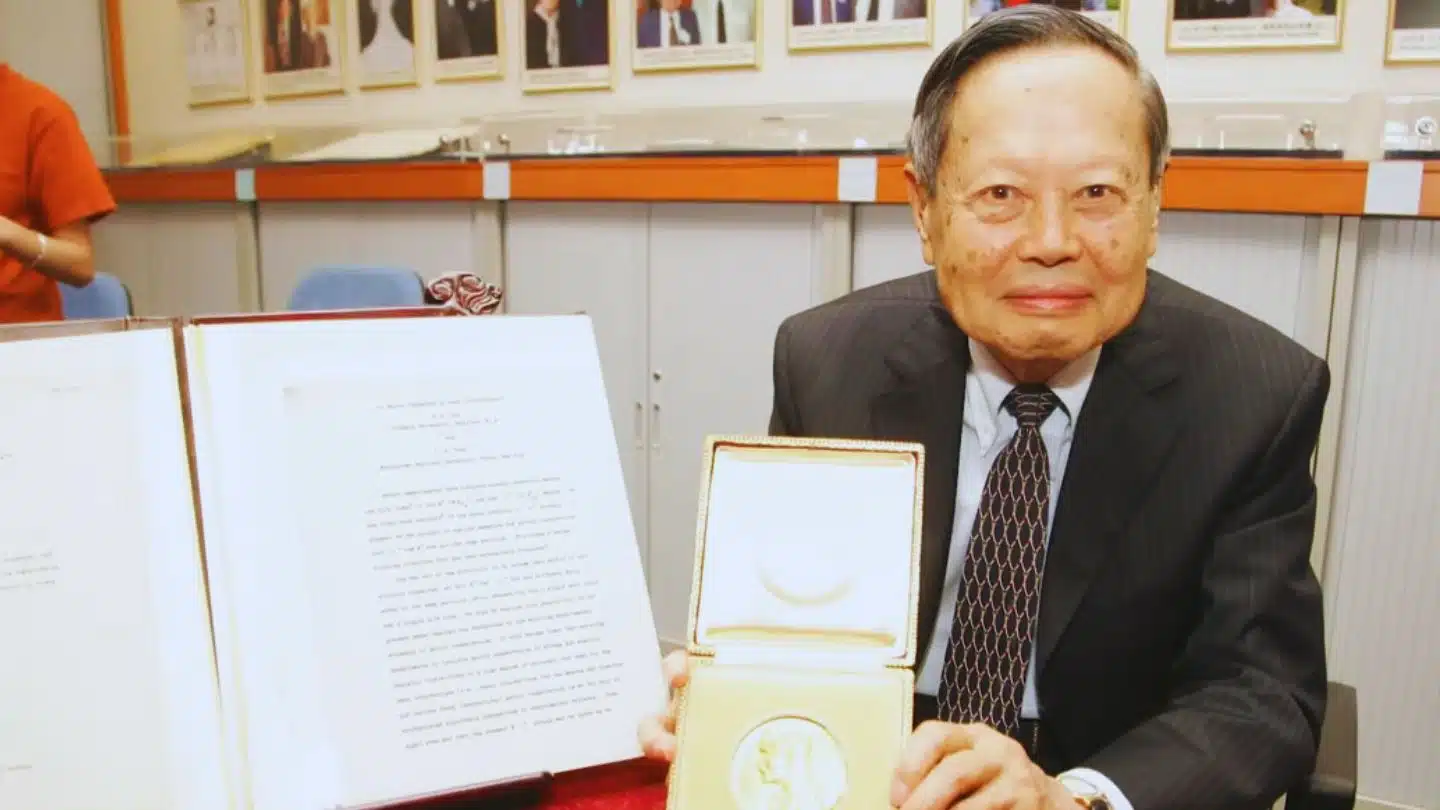
Chen Ning Yang, a towering figure in theoretical physics whose work fundamentally reshaped our understanding of the universe’s basic forces and who became a pivotal force in China’s scientific re-emergence, died on Saturday in Beijing. He was 103.
His death was announced by Tsinghua University, where he was an honorary director and professor, which stated he passed away from an illness. Yang’s passing marks the end of an era for a generation of physicists who redefined their field in the 20th century.
A Nobel laureate at the age of 35, Yang’s intellectual legacy is anchored by two monumental contributions: the theory of parity non-conservation in weak interactions, for which he won the 1957 Nobel Prize in Physics, and the universally influential Yang-Mills theory, a cornerstone of the Standard Model of particle physics. His later life was dedicated to rebuilding China’s scientific prowess, bridging the gap between his adopted home in the United States and his country of birth.
- Death: October 18, 2025, in Beijing, at age 103.
- Nobel Prize (1957): Awarded jointly with Tsung-Dao Lee for theoretically showing that the principle of parity conservation—a long-held belief in left-right symmetry—is violated in the weak nuclear force.
- Yang-Mills Theory (1954): Co-developed with Robert Mills, this theory provided the mathematical framework for describing the strong, weak, and electromagnetic forces, becoming a foundation of the Standard Model.
- Return to China: After a distinguished career in the U.S., he returned to China in his later years, teaching at Tsinghua University and advocating for science education and basic research.
- Citizenship: Renounced his U.S. citizenship in 2015 and became a citizen of the People’s Republic of China, a move he described as fulfilling a cultural and familial connection.
A Life Across Two Worlds
Born in Hefei, Anhui province, on October 1, 1922, Yang’s early life was steeped in academia. His father was a mathematician at Tsinghua University. The Sino-Japanese War displaced his family, but he completed his education at the National Southwest Associated University in Kunming, a wartime amalgamation of China’s top universities.
In 1945, on a fellowship, he traveled to the United States to study at the University of Chicago, earning his Ph.D. under the guidance of Edward Teller. It was in the U.S. that he would conduct his most revolutionary work, first at the Institute for Advanced Study in Princeton, a contemporary of Albert Einstein, and later at the State University of New York at Stony Brook.
The Overthrow of Parity
In the mid-1950s, physics was confronted with the “tau-theta puzzle,” where two subatomic particles appeared identical in every respect except for their decay patterns, which suggested opposite parities. At the time, the conservation of parity—the idea that the laws of physics are indifferent to mirror reflections—was considered a fundamental law.
In a groundbreaking 1956 paper, Yang and his collaborator Tsung-Dao Lee of Columbia University boldly proposed that parity was not conserved in the weak nuclear force, the interaction responsible for radioactive decay.
The confirmation came swiftly and dramatically. In 1957, experimental physicist Chien-Shiung Wu, a colleague of Lee’s at Columbia, conducted what is now known as the “Wu experiment.” By observing the beta decay of Cobalt-60 nuclei at extremely low temperatures, she demonstrated conclusively that the emitted electrons showed a preferential direction, shattering the illusion of mirror symmetry in the weak force. For their theoretical insight, Yang and Lee were awarded the Nobel Prize in Physics that same year.
Yang-Mills Theory: The Architecture of Modern Physics
Before his Nobel-winning work, Yang, along with Robert Mills, a fellow physicist at Brookhaven National Laboratory, developed another, perhaps even more profound, concept. In 1954, they published a paper on a new type of gauge theory, a generalization of the theory of electromagnetism. This “Yang-Mills theory” introduced a complex and elegant mathematical framework to describe the interactions between elementary particles.
Initially, the theory seemed to have a fatal flaw—it predicted massless particles that were not observed in nature. However, with the development of the concept of spontaneous symmetry breaking in the 1960s, the Yang-Mills theory was resurrected. It became the mathematical foundation for:
- The Electroweak Theory: Unifying electromagnetism and the weak force.
- Quantum Chromodynamics (QCD): The theory of the strong nuclear force that binds quarks together inside protons and neutrons.
Together, these form the bedrock of the Standard Model of particle physics, our most successful description of the fundamental particles and forces of nature.
A Bridge Back to China
Yang’s first visit to the People’s Republic of China in 1971, as U.S.-China relations began to thaw, marked a turning point. He was among the first prominent overseas Chinese scholars to return and was instrumental in re-establishing scientific exchange after the disruptions of the Cultural Revolution.
He met with top leaders and tirelessly advocated for rebuilding the country’s scientific infrastructure. In a 2019 interview, he reflected on this role, stating his belief that his most significant contribution may have been “helping the Chinese people to regain their self-confidence in science.”
In 2003, he moved back to China permanently, taking up a professorship at Tsinghua University. He founded the Institute for Advanced Study and, even in his 80s, taught freshman physics, inspiring a new generation.
In an official tribute, Tsinghua University praised his immense impact:
“Professor Yang is one of the greatest physicists of the 20th century, having made revolutionary contributions to the development of modern physics… He poured immense effort into advancing fundamental disciplines like physics and cultivating talents at Tsinghua, making tremendous contributions that greatly impacted the reform and development of Chinese higher education.”
Chen Ning Yang’s legacy is twofold: as a physicist who provided the language to describe the universe, and as a patriot who dedicated his final decades to nurturing scientific talent in his homeland. His work on gauge theories continues to drive the search for a “Theory of Everything” that would unite the Standard Model with gravity.
His passing leaves a void in the global physics community and in China, where he was a revered national icon. The question now is how the institutions he built and the generations he inspired will carry the torch forward. His life serves as a testament to the power of pure intellectual inquiry and the enduring pull of cultural identity.
As China invests heavily in fundamental research, with massive projects like new particle accelerators under discussion, Yang’s influence will undoubtedly shape the direction of the nation’s scientific ambitions for decades to come. His story—a journey from a war-torn nation to the pinnacle of global science and back again—will remain a powerful symbol of China’s own century-long transformation.
The Information is Collected from ABC News and NBC News.