Hi readers! I hope you are doing well. Have you ever wondered how Netflix recommends your next series, and Amazon shows you a perfect product? This actually happens with an AI-based recommendation system. Today, we will discuss an AI-based recommendation system, a powerful application of AI transforming personalization.
Introduction of AI-based recommendation systems has emerged as a part of the digital business strategy. They make customer experiences personal, enhance interactions, and generate more revenue. To e-commerce websites, to streaming services, these systems use user preferences, preferences, and data to provide recommendations to users based on their specific needs.
Recommendation engines have evolved to be extremely advanced with the development of machine learning, deep learning, and natural language processing. AI recommendation engine development services are becoming a vital aspect of digital transformation strategies today as businesses invest in achieving higher customer satisfaction levels, reduced churn, and higher conversion rates.
In this article, you will find types, development process, implementation strategies, and use cases of AI-powered recommendation systems. Let’s unlock!
Types of AI-Based Recommendation Systems
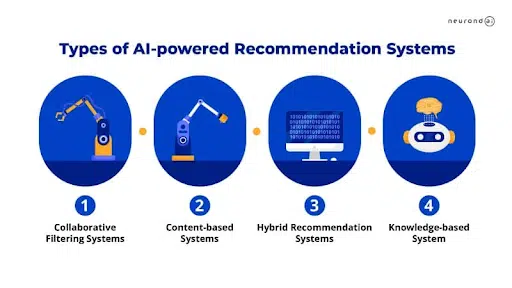
1. Content-Based Filtering
This type takes item characteristics (e.g., product description, genre, or keywords) and compares them to user preferences. As an illustration, say you were watching a lot of action movies, Netflix will recommend similar action movies.
- Strengths: Ideally suited to niche interests without a large user base.
- Cons: Narrow in terms of scope – it might not expose users to different items.
2. Collaborative Filtering
Collaborative filtering is based on user behavior data. It finds similarities among the users and suggests what like-minded individuals liked. A good example is an Amazon Customer who bought this also bought.
- Pros: Can find surprising, non-obvious recommendations.
- Cons: Requires huge datasets, does not work with new users or items (cold start problem).
3. Hybrid Recommendation Systems
Hybrid models combine the drawbacks of both content and collaborative approaches to maximize their benefits. They make more precise and varied recommendations based on the use of various data sources. Good examples of hybrid recommendation systems are Spotify and YouTube.
- Advantages: More precise, minimizes cold start problems.
- Disadvantages: Not simple to construct and fix.
4. Context-based Recommendation Systems
These systems apply the contextual data, like time and location, or the type of device. As an example, Uber Eats can suggest foods to order in the morning or at local restaurants when you are on the road.
- Advantages: very personalized, changes depending on the situation of the user.
- Disadvantages: It needs real-time measurements and sophisticated infrastructure.
Development of an AI Recommendation System
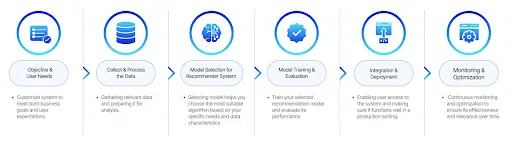
The Artificial Intelligence based recommendation engine development process includes multiple stages. It requires careful planning, continuous optimization, and the right technology stack. Key strategies are mentioned below.
1. Data Collection
Data is the foundation of any recommendation system. This includes interactions of the user, like clicks, browsing history, purchases, and history. The recommendations can be better with more diverse and high-quality data.
2. Data Preprocessing
The data in its raw form is chaotic. It’s early processing, including clearing, handling missing values, removing inconsistencies, and structuring datasheets. This ensures accuracy and efficiency during model training.
3. Algorithm Selection
Selection of the right algorithm is a critical task. There are many options, which include content-based filtering, collaborative filtering, hybrid approaches, and advanced deep learning models. You can choose your model based on your business goals, dataset size, and desired accuracy.
4. Model Training
After the selection of the algorithm, models are trained on a large dataset by applying machine learning techniques. This process ensures the engine learns patterns and user preferences effectively.
5. Evaluation and Testing
There are metrics like precision, recall, and F1 score to measure accuracy. With the use of these metrics, the model provides relevant and meaningful recommendations to users.
6. Deployment
The trained model provides real-time recommendations when integrated into websites, applications, or different platforms. Smooth deployment ensures a seamless user experience.
7. Updating the System
Recommendation systems are not consistent. It requires regular data updates so the engine adapts to changing user behaviour and new market trends.
Implementation Strategies
Start Small
Start on small projects to test its performance. Then rolls out the system on multiple platforms.
Use Cloud Services
Services like AWS Personalize, Google AI, or Azure ML make it easier to develop and deploy faster at lower costs of infrastructure.
Prioritize Scalability
Make your system capable of handling a wider range of user data and traffic without obstruction.
Monitor Performance
Timely monitoring of your track KPIs as Click-Through Rate (CTR), conversion rate, and retention of customers, helps to measure effectiveness.
Ensure Privacy
To build customer trust, handle their sensitive data responsibly by complying with GDPR, CCPA, and other regulations.
Use Cases of AI Recommendation Systems

E-Commerce
Online platforms such as Amazon rely on recommendation engines to cross-sell and upsell products and raise the average order value.
Streaming Services
By recommending watching history and listening to history in case of Netflix, Spotify, and YouTube, the companies keep their users entertained.
Social Media
AI in Facebook and Instagram is used to suggest friends, groups, and feeds of personalized content.
Healthcare
Using AI-based systems, care plans, health advice, or drug reminders are proposed, depending on patient history.
Online Learning
Many platforms like Coursera and Udemy recommend courses matching the skills and interests of the learner.
Travel and Hospitality
Both Booking.com and Airbnb are destination, hotel, and experience recommendation platforms that rely on AI to suggest destinations, hotels, and experiences to users depending on their preferences and previous travels.
Takeaways
Artificial intelligence-powered recommendation systems have become part of the online experience as companies are using them to deliver hyper-personalized services that grow customer interest and loyalty. They can convert and earn more revenue because the personalized product and content suggestions factor into increased satisfaction, conversions, and revenue.
With each bit of user data that they learns, these systems are becoming smarter and more accurate. By relying on AI recommendation engine development services, it is possible to introduce scalable solutions that help organizations reduce churn, optimize their operations, and become more competitive.
As AI, deep learning, and natural language processing continue to progress, recommendation engines will transform into even more potent tools-making sure personalization will be at the core of digital strategies in modern times.