


Prime Minister Narendra Modi has embarked on a two-day official visit to China, marking his first trip to the country in more than seven years. The visit comes at a significant moment when India is navigating a delicate balance in its relationships with both China and the United States.
Modi is in Tianjin between August 31 and September 1, 2025, to participate in the Shanghai Cooperation Organisation (SCO) Summit. The summit brings together leaders from across Eurasia, including Chinese President Xi Jinping and Russian President Vladimir Putin, making it a crucial platform for multilateral discussions.
This visit follows a recent phase of cautious engagement between New Delhi and Beijing, as the two countries continue to manage lingering tensions from the 2020 Galwan Valley clashes. In 2025, both sides reopened several trade routes, including Lipulekh, Shipki La, and Nathu La, and also restored direct commercial flights—signaling a partial thaw in relations.
Optimism in Chinese Online Spaces
Chinese state-controlled media and social platforms such as Weibo and Douyin highlighted Modi’s arrival as a major diplomatic event. Posts circulated widely, describing the visit as a turning point in China-India relations and emphasizing its potential to reset the trajectory of bilateral ties.
Several Chinese users expressed admiration for India’s assertiveness in recent trade disputes with the United States. They viewed Modi’s handling of US tariffs, which were raised to 50 percent on Indian exports, as a bold rejection of external pressure. Videos and discussions on Douyin framed Modi’s approach as firm and uncompromising, portraying India as willing to adopt strategies similar to those that China once used to negotiate concessions from Washington.
Reports circulating online that Modi had declined several recent calls from former US President Donald Trump were also seen as an example of his tough diplomacy. Many users described this as evidence of India’s determination not to be treated as a subordinate power by the West.
Another theme gaining traction was India’s decision to continue importing discounted Russian oil despite US pressure. Commentators highlighted that this policy reinforced India’s independent approach to global issues, echoing Chinese scholarly opinion that India was pursuing its own strategic interests rather than aligning blindly with Western priorities.
Heightened Expectations From Beijing’s Perspective
While Modi’s visit was welcomed, the online discussion also revealed significant expectations. Many Chinese commentators stressed that India needed to show visible gestures of goodwill if it truly wished to strengthen ties.
A recurring point of criticism was that Modi is not expected to attend the September 3 commemoration in Beijing, marking the 80th anniversary of the end of World War II and Japan’s formal surrender. In Chinese public opinion, the presence of global leaders at this event is seen as an act of solidarity with China’s wartime legacy. Observers noted that while leaders from most SCO countries were expected to attend, Modi’s absence stood out and was interpreted as hesitation on India’s part to fully embrace friendship with Beijing.
Prominent Chinese commentators, such as journalist Hu Xijin, suggested that if Modi had extended his stay for the Tiananmen Square parade, it might have been perceived as an excessively large gesture that would complicate India’s balancing act with the United States and its allies. Still, for many online users, Modi’s absence at this event represented a missed opportunity to signal deeper alignment.
Criticism of India’s Strategic Ambiguity
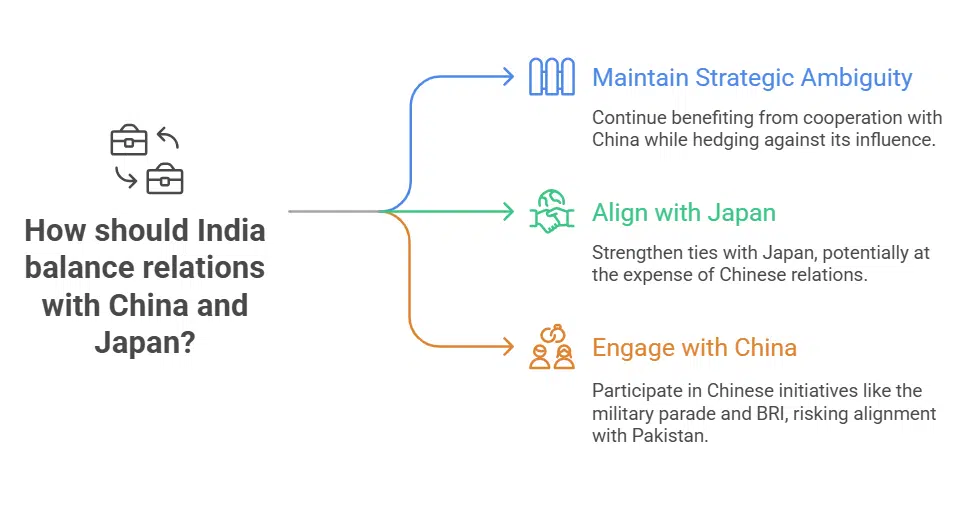
Some Chinese users accused India of following a “sitting on the fence” strategy. They pointed out that Modi had just visited Japan days before traveling to China, which was viewed as contradictory given Tokyo’s close alignment with Washington.
Additionally, India’s recent domestic moves to reduce industrial dependence on Chinese imports were mentioned as examples of policies that undercut claims of warming ties. Critics argued that India wanted to reap the benefits of cooperation with China while simultaneously hedging against Beijing’s growing economic influence.
Scholars like Professor Jin Canrong, a well-known Chinese international relations expert, emphasized that the future of bilateral relations hinged on two critical factors:
-
Whether Modi would reconsider his decision and join the September 3 military parade in Beijing.
-
Whether India would shift its long-standing opposition to the Belt and Road Initiative (BRI), a project that New Delhi has rejected because one of its major corridors passes through Pakistan-occupied Kashmir (PoK), territory claimed by India.
Strategic Balancing Between Powers
For New Delhi, the visit is as much about optics as it is about diplomacy. India has positioned itself as a central player in the Indo-Pacific strategy of the United States, while also acknowledging the practical need to maintain a working relationship with China—Asia’s largest economy.
From Beijing’s perspective, welcoming Modi at the SCO summit serves to highlight its role as a convener of major regional powers, especially at a time when global politics are increasingly defined by rivalry with Washington. The simultaneous presence of Modi, Xi, and Putin underscores the multipolar framework that China seeks to project to the world.
Although few analysts expect major breakthroughs during this visit, the symbolism of India re-engaging at the highest level with China is significant. Both sides are carefully testing the waters to determine whether limited cooperation on trade and multilateral platforms can open the door to more substantive dialogue in the future.
Hope and Hesitation
Modi’s return to China after seven years has triggered a wave of commentary within Chinese social media—ranging from admiration for his bold resistance to US trade pressure, to skepticism about India’s true intentions.
The enthusiasm reflects recognition of India’s growing importance in global politics, while the doubts reveal the complexity of China’s expectations. The mixed response highlights the challenge facing India: striking a balance between its partnerships with the United States and its difficult but unavoidable relationship with China.
For now, Modi’s trip remains an exercise in symbolism and diplomacy rather than immediate policy change. Whether India chooses to deepen engagement with Beijing or continue to tread a cautious, middle path will shape not only bilateral ties but also the wider strategic dynamics of Asia.






















