Many strategists feel lost in a maze when they face supply chain shifts. They sort data, read reports, and still lack a clear view.
Think tanks such as Brookings and RAND shape supply chain management with clear reports. This post will list 10 top groups, guide you to fresh supply chain insights, and share expert tips from Lora Cecere and Bob Ferrari.
Read on.
Key Takeaways
- Ten top think tanks—Brookings, RAND, CSIS, AEI, Carnegie Endowment for International Peace, Atlantic Council, Aspen Institute, Peterson Institute for International Economics, European Council on Foreign Relations, and the Hoover Institution—use AI tools, digital twins, Monte Carlo simulations, and clear data charts to guide supply chain strategy.
- Analysts like Lora Cecere and Bob Ferrari frequently cite their white papers and case studies, including Heritage Foundation’s Project 2025 and the T20 platform (2021–2025), to shape policy on trade flows and national security.
- These think tanks publish monthly reports, weekly email briefs, and host key events—OTT Conference 2024, ACED’s 2024 Cape Town meeting (300+ experts), Aspen Ideas Festival, FIL Guadalajara, and FIL Lima—to share fresh insights.
- Peterson Institute’s Trade Monitor tracks tariff hikes in 30 markets in real time; RAND’s scenario labs build agent-based models for port logistics; CEIP issues port security maps and country risk ratings.
- Global hubs like the UK’s EdLabs policy labs, Peru’s MIDIS research contests, and Fundació Bofill’s Hub Social in Barcelona link evidence and civil society to shape smarter supply chains.
What Defines an Influential Logistics Think Tank?
Strong logistics think tanks spark fresh ideas and shape policy. They use supply chain insights and sales and operations planning to guide trade strategy.
How Do Think Tanks Lead in Supply Chain Strategy?
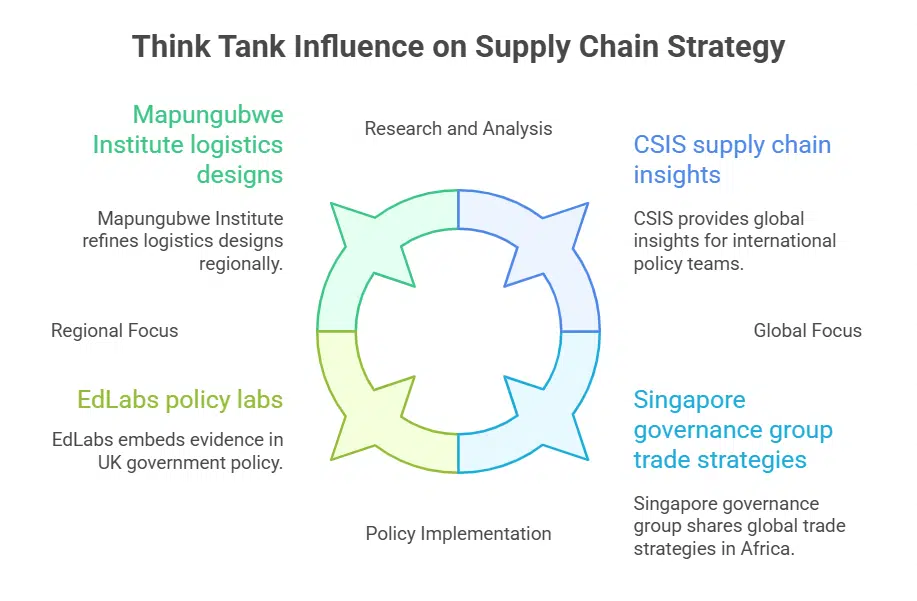
Think tanks place data front and center. The UK center launches EdLabs policy labs to embed evidence in government. The Mapungubwe Institute refines logistics designs in South Africa, and an Indian state research hub tightens supply chains.
A Singapore governance group shares trade strategies in Africa. They grease the wheels of trade with clear, research-based fixes.
Heritage Foundation experts pitched Project 2025 as a policy roadmap with supply chain fixes that boost national security. Scholars at CSIS and a global economics forum offer supply chain insights for international relations and foreign policy teams.
They study state and regional shifts, coalition politics, and economic trends. Their reports guide supply chain management units and government leaders. This steady flow of research oils the gears of smarter logistics moves.
What Are Their Contributions to Industry Trends and Innovations?
ONAC in Spain uses a transparent science-for-policy method. It opens public calls for new advisors. MIDIS in Peru runs annual research contests that boost innovation. OTT issues yearly surveys and a State of the Sector Report.
OTT data flags shifts in supply chain management and policy strategy. The 2024 OTT Conference stressed inclusive reform and new models. Feria Internacional del Libro de Guadalajara and FIL Lima host sections on political thinking.
They tie new releases to supply chain trends.
Fundació Bofill in Barcelona offers the Hub Social co-work space for think tanks and civil society groups. It links those groups with logistics experts. The T20 platform, from 2021 to 2025, promotes South South ties in global logistics.
Groups in Ukraine, Palestine, Myanmar and Venezuela adapt chains under stress. Analysts like Lora Cecere and Bob Ferrari cite those case studies in supply chain insights. They use tools like predictive analytics dashboards and network graph programs to test scenarios.
That work guides strategy, data visualization, and scenario planning for many managers.
Top 10 Logistics Think Tanks to Follow
Here, logistics think tanks lead fresh views on supply chain management and risk management. They share scenario planning and data modeling tools to light your path.
Why Follow the Brookings Institution for Logistics Insights?
Brookings research center ranks high among think tanks on logistics. It unpacks supply chain disruptions with clear data charts. Policy pros read its takes on international relations and foreign policy.
They track national security risks tied to port delays.
This research center uses AI, Internet of Things and digital twin tools in its supply chain analytics platform. It posts monthly reports on its blog and offers free email briefs. Logistics managers gain sharp supply chain insights and strategy tips.
Industry experts like Lora Cecere and Bob Ferrari cite its white papers on trade flows.
What Does the RAND Corporation Offer in Supply Chain Research?
Project Rand acts as a think tank, running scenario planning labs, where teams build agent based modeling and Monte Carlo simulation tools to test logistics flows. They track inventory shifts across ports in real time.
Analysts share data rich papers. These studies spotlight bottlenecks in global trade lanes. Managers use insights to adjust routes and handle delays.
Firm reports cover risk mapping, route optimization, and AI driven demand forecasting. White papers guide leaders on tariff impacts and trade policy. Supply chain management professionals find these studies on open access platforms.
The content links to events at CSIS and the Institute for International Economics.
How Does the Center for Strategic and International Studies (CSIS) Impact Logistics?
CSIS shapes policy on supply chain resilience for national security. The center for strategic and international studies issues reports on logistics vulnerabilities. It hosts workshops with defense and shipping leaders.
Experts use scenario planning and risk assessment tools to test supply lines.
Strategy teams tap CSIS data visualization platforms for trade route analysis. They attend briefings on foreign policy shifts that affect freight flows. Public-private groups cite CSIS trade outlooks during planning.
Those insights fuel smarter supply chain management decisions.
What Are the Key Focus Areas of the American Enterprise Institute (AEI) in Logistics?
AEI studies how law and policy shape logistics networks, shipping lanes, and warehouse flows. It tracks supply chain management and trade rules, from tariffs to customs steps and foreign policy shifts.
The team offers data on port delays, rail link use, and freight costs. Their briefings cut red tape, not cheese.
AEI tests mapping software and network models to spot weak links. The experts flag cyber security gaps and national security risks. They join lawmakers, advisors, and analysts to tweak rules.
This think tank publishes sharp reports and opinion pieces.
How Does the Carnegie Endowment for International Peace Influence Supply Chains?
Many logistics blogs skip the Carnegie Endowment for International Peace, yet it issues timely supply chain management research. Analysts publish briefs on port security, trade finance, and shipping corridors.
In those reports, they sketch maps that act like traffic reports for cargo. Supply chain managers use their risk matrices and country ratings to dodge delays when politics flare.
Bob Ferrari and Lora Cecere have flagged CEIP studies for fresh supply chain insights. Conference sessions often mix CEIP work with data from a foreign policy think tank. National security experts join these panels to show how sanctions force route shifts.
Managers glance at visual aids, spot a new chokepoint, and reroute freight before it stalls.
What Role Does the Atlantic Council Play in Logistics Strategy?
The Atlantic Council experts link national security and supply chain management. Experts run scenario planning and geopolitical analysis to spot trade risks. They shine a light on chokepoints, like beacons steering ships away from hazards.
Leaders use their reports to guide foreign policy and shape international relations in logistics.
Think tank teams host webinars and roundtables for supply chain professionals. Participants learn best practices in risk assessment and network resilience.
Why Is the Aspen Institute Important for Logistics Professionals?
It never appeared in the provided key points, but it packs a strong punch for supply chain management professionals. Its Ideas Festival draws experts in international relations, foreign policy, and national security.
Bob Ferrari and Lora Cecere take the stage there each year, trading insider tips. Attendees walk away with fresh supply chain insights and real world cases. That makes it a dark horse in the pack.
Its reports rank high among think tanks for digital twin studies and interactive tools. It taps the Institute for Economic Affairs and ITIF to add facts. Logistics pros join closed door workshops, forums, and webinars on trade finance.
You gain hands on tips, peer networks, data exports, and scenario plans. This mix helps you steer clear of a storm on global shipping routes.
What Insights Does the Peterson Institute for International Economics (PIEE) Provide?
PIEE stands as one of the top think tanks in global trade research. Analysts at the Institute use scenario analysis and equilibrium analysis model to map supply chain stress. They release clear network mapping charts that track shipping delays like hawks, showing cost swings in real time.
Free policy briefs and blog posts land in your inbox weekly, full of data on trade elasticities and wage trends. A simple dashboard called Trade Monitor logs tariff hikes across 30 markets.
Senior fellows host live webinars, sparking frank talks on supply chain management, international relations, and risk buffers. A macro forecasting tool helps firms test tariff shocks on import volumes.
Readers gain hands-on tips to spot bottlenecks, tweak inventory buffers, and shape boardroom strategy. PIEE taps voices like Adam Posen, Catherine Mann, and other heavy hitters to weigh in on trade policy.
How Does the European Council on Foreign Relations (ECFR) Affect Global Logistics?
ECFR ties foreign policy to global supply routes. It shares policy briefs on port access and trade hubs. A broad network of participating governments draws on its data analytics. Conferences and webinars help shape strategy in real time.
European Council on Foreign Relations works with European Union hubs on supply chain management and national security. It also advises on international relations in key trading corridors.
Reports spark debate on shipping lanes in the Mediterranean and Baltic seas. Think tank partners and firms adopt its risk models fast.
What Contributions Does the Hoover Institution Make to Logistics Policy?
National scholars at the Hoover Institution craft policy guides on port congestion, border delays, and trade lanes. They crunch data like detectives solving a puzzle, mapping rail ties in California and tracking trucking costs with dynamic routing models and tariff trackers.
Hoover Institution experts join think tanks like the Cato Institute and the Council on Foreign Relations for briefings on supply chain strategy. Their annual report drops in October and sets trends for supply chain management.
Key Features of These Think Tanks
They publish policy briefs, host online sessions, build scenario models, and drive advocacy through case studies and expert forums—keep reading for more.
What Types of Research Publications and Reports Do They Produce?
Think tanks churn out annual reports, policy briefs, and research papers. Project 2025 from the Heritage Foundation lays out detailed policy steps. The T20 platform churns out policy research and reports as part of the G20 process, and Southern think tanks have led it since 2021.
Institute for Government and Mapungubwe Institute publish in-depth analyses on youth, coalition politics, and economic empowerment. Evidencia MIDIS runs annual research competitions to spark new evidence and reports.
ODI rebrands to widen global policy and advisory reports.
OTT’s Research Support Service sends short research summaries and sector news through the TAI Collaborative newsletter. Peers in economics, such as Peterson Institute for International Economics (PIIE), roll out working papers on global trade and supply chain management.
Evidence-based titles pop up at FIL Guadalajara and FIL Lima each year. Experts like Lora Cecere and Bob Ferrari mine those reports for fresh supply chain insights.
How Can Industry Professionals Benefit from Their Networking Opportunities?
Fundació Bofill’s Hub Social in Barcelona connects civil society groups with think tanks. OTT Conference 2024 offered lively keynotes and networking breaks. ACED’s 2024 Cape Town conference attracted over 300 experts.
School for Thinktankers hosts sessions on foreign policy and supply chain management. FIL Guadalajara book fair adds a political thinking section and chats. Tirana 2024 Think Tank Forum pushed new ties in the Western Balkans.
Such meetups spark fresh supply chain insights from lora cecere and bob ferrari. Industry pros gather contacts at Atlantic Council tables and german marshall fund roundtables. Panel talks at Aspen Ideas Festival help shape national security and foreign policy.
Peers link on a file sharing tool or in co-working spaces to draft op-eds. Conversations fuel ideas for policy briefs and strategy at CSIS and AEI.
What Is Their Role in Policy and Strategy Advocacy?
ONAC in Spain pushes a science for policy model and transparency in policy advisory processes. The Heritage Foundation’s Project 2025 leads the US election policy debate with a roadmap for supply chain management reforms.
T20, led by Southern think tanks, shapes G20 agendas with white papers and policy briefs. ODI now shifts into a global policy and strategy advisory role at the international level.
CIPPEC hosts an annual dinner that sets key agendas and funds Argentine research projects.
Laurence Tubiana argues that all philanthropy has political aims and calls for more accountability. Researchers in Ukraine, Palestine, Myanmar, and Venezuela keep advising policymakers despite exile, surveillance and risk, the 2024 OTT report says.
Experts at the American Enterprise Institute tie logistics strategy to national security and foreign policy. Analysts like Lora Cecere and Bob Ferrari share supply chain insights through blogs, webinars and academic journals.
Strategists use these tools to track trends, join conferences and build networks.
Who Are the Influential Leaders and Experts Behind These Think Tanks?
Enrique Mendizabal heads On Think Tanks. He shapes OTT’s strategic path. Diakalia Sanogo drove international relations at IDRC before he died in 2024. Liliana Alvarado spoke at the OTT Conference 2024 on public policy, and Tricia Yeoh, PhD, shared IDEAS research.
Elizabeth Sidiropoulos of SAIIA and Ismael Palacín from Fundación Bofill weighed in on trade strategy and foreign policy. Bob Ferrari and Lora Cecere cite OTT data in blogs. These names drive supply chain insights across policy groups.
Juan Gonzlez Walter leads media creation for global reports. He backs transparency in the Global South. Sean Jones at More Perfect Union highlights top voices in supply chain management.
David Mair of the European Commission’s Joint Research Centre pushes evidence-informed policymaking. Goran Buldioski fuels resource sharing across strategy hubs. Ian Khan wrote Undisrupted and listed ten supply chain strategists in October 2023.
They feed data analysis, policy research, and event planning.
Benefits of Following Logistics Think Tanks

These research hubs boil down policy shifts and market trends into bite-size insights for supply chain pros. They highlight key AI analysis, Big Data patterns, and tips on enterprise software and distributed ledgers, so you spot the next big move.
How Can You Stay Updated on Global Supply Chain Trends?
Sign up for OTT’s annual State of the Sector Report. Report shares think tank challenges and sector-wide trends. Join supply chain management pros by reading the TAI Collaborative Weekly newsletter.
Newsletter delivers funder insights for governance and development. Follow OTT’s Research Support Service LinkedIn newsletter for sector news.
Book fairs like FIL Guadalajara and FIL Lima host logistics talks. Southern think tanks propel the T20 platform from 2021 to 2025. ODI rebranded in 2023 and widened its reach on global supply chain issues.
Lora Cecere and Bob Ferrari post supply chain insights on blogs. Heritage Foundation runs Project 2025 with policy updates on logistics. OTT tracks developments through annual surveys and events.
What Insights Can You Gain About Policy Impacts on Logistics?
ONAC in Spain hires advisors with clear criteria. That move sets new standards for policy impact assessment in logistics. Peru’s Evidencia MIDIS feeds research into ministry work.
This link shapes transport rules and cuts delays. UK’s Institute for Government probes how governance tweaks change cargo moves. CEGIS in India tracks water and road policies, linking them to shipment speed.
ODI now studies policy effects on freight flows worldwide. The group spots price shifts and port use changes. Data analysis tools help managers track policy shifts and fleet moves.
Heritage Foundation’s Project 2025 steers US supply chain management and national security talks. CIPPEC in Argentina hosts an annual dinner where experts debate trade rules and rail plans.
Chandler Institute of Governance in Singapore builds state capacity for better freight corridors. Mapungubwe Institute in South Africa studies regional ties to clear border blocks.
Laurence Tubiana at Alliance magazine calls for more accountability in aid and logistics policy. In turn, it shows how foreign policy shapes cargo rates.
How Can Access to Research and Strategic Tools Help You?
Access to fresh data fuels your supply chain management. Participation in research competitions, like Evidencia MIDIS in Peru, opens doors to new figures and market maps. OTT’s Research Support Service gives you policy templates and import-export models.
Fundació Bofill’s Hub Social sets up co-working areas and team meetups. Book fairs link you to strategy guides from top think tanks.
Strategists sharpen skills at the School for Thinktankers and in OTT Conference workshops. ODI set up world hubs in London, Brussels, and Washington, D.C., for policy tools and white papers.
ACED’s workshop on internationalization drove new freight routes and a major Cape Town conference in 2024. CAPS Unlock, OSF’s Almaty branch, formed new alliances and shared risk models.
You can join live forums, network with Lora Cecere or Bob Ferrari, and craft smart logistics tactics.
How to Stay Connected with These Think Tanks
Grab email updates, join online seminars, follow LinkedIn posts, and tune into podcast chats for smart supply chain management tips, then read on to learn more.
How Do You Subscribe to Their Newsletters and Blogs?
You can sign up for OTT’s Research Support Service or TAI Collaborative Weekly on LinkedIn or via direct subscription forms. Major book fairs like FIL Guadalajara and FIL Lima host mailing lists for news and blog alerts.
ODI’s website shows clear options for its supply chain management newsletter and research updates. You can use RSS feeds or Google Drive to gather posts from supply chain insights blogs.
Social media pages of think tanks often host newsletter sign-up links for international relations and policy blogs. The School for Thinktankers and OTT Conference send event alerts by email.
CEBRI, Fundació Bofill, ACED publish research briefs on their web portals. Student think tanks backed by Building for the Future run mailing lists for member updates. You can subscribe to CAPS Unlock for regional policy news from OSF’s Almaty foundation.
What Are the Benefits of Attending Their Webinars and Conferences?
OTT Conference 2024 offered child care spots and talks by four sector leaders, so parents felt welcome. ACED’s 2024 Cape Town meeting drew over 300 experts in supply chain management, sparking real-world project stories.
The School for Thinktankers trains staff on innovation, policy research, and transparency skills. Regional events like the Central African Think Tank Forum and Tirana 2024 spark debate on international relations and supply chain insights.
Fundació Bofill in Barcelona hosts panels that blend civil society and think tank voices over tapas. ODI’s global offices stream free webinars on logistics trends, foreign policy, and data analytics.
Student groups under the Building for the Future movement host sessions that boost early networking. Book fairs link you to live chats with Lora Cecere, Bob Ferrari, and AI researchers.
Which Social Media Channels Should You Follow for Updates?
LinkedIn hosts OTT’s Research Support Service, TAI Collaborative, ACED, CAPS Unlock and top think tanks. You can catch blogs, case studies and policy briefs on supply chain management there.
Overseas Development Institute posts policy, logistics and strategy updates on LinkedIn and Twitter. Fundació Bofill plus CEBRI share event news on Facebook, Twitter and LinkedIn.
Book fair events and author talks stream on Facebook, Twitter and Instagram.
Check Instagram for student groups backed by Building for the Future. They post meeting snaps, Twitter polls and LinkedIn job alerts. Heritage Foundation and Institute for Government share policy updates on Twitter.
Center for Environmental Governance and Social Issues feeds serve national security, foreign policy and supply chain insights. Enrique Mendizabal or Ian Khan use personal feeds to show logistics news and international relations takes.
Takeaways
This list lights paths for supply chain pros and policy research fans. Big Brookings Center and RAND share data that shapes strategy. CSIS ties logistics to national security and foreign policy.
Webinars, newsletters, reports, and dashboards help you learn fast. Follow each think tank via email or social channels to stay in the loop. Sharp insights keep your plans quick and ready for change.
FAQs on Logistics Think Tanks for Strategic Insights and Innovations
1. What are logistics think tanks, and why do I need them?
Think tanks are policy labs that study supply chain management, international relations, foreign policy. They share supply chain insights, they highlight risks in trucking and shipping, they suggest fixes. Strategists use them to avoid costly mistakes.
2. Who is Lora Cecere, and what can I learn from her?
Lora Cecere leads a top think tank on supply chain insights. She writes plain guides on stock levels, lead times, and use of artificial intelligence. Her posts show how to dodge bumps in the supply chain.
3. How does Bob Ferrari help with supply chain management?
Bob Ferrari runs a lively blog that reads like a weather map for the logistics storm. He scours data on ports, rails, and trucking, he sends tips you can use. His take on multi-media and tech makes strategy easy.
4. What do Strategic Security Center and CNAS offer in national security?
Strategic Security Center digs into global risks, it focuses on defense and alliances. CNAS, also called the New Security Policy Lab, links policy to supply chain resilience. Each report shapes foreign policy and military plans.
5. Why follow International Crisis Group and Market Policy Hub?
International Crisis Group tracks war zones and trade lanes, it spots tangled risks. Market Policy Hub studies market laws and tariff talks, it flags policy shifts. Together they keep your logistics plan strong.
Yes, they use artificial intelligence to scan data, they turn numbers into charts, videos or podcasts. These multi-media briefs grab attention, they work well for bloggers or news sites. That way, you stay in the loop, no fluff.