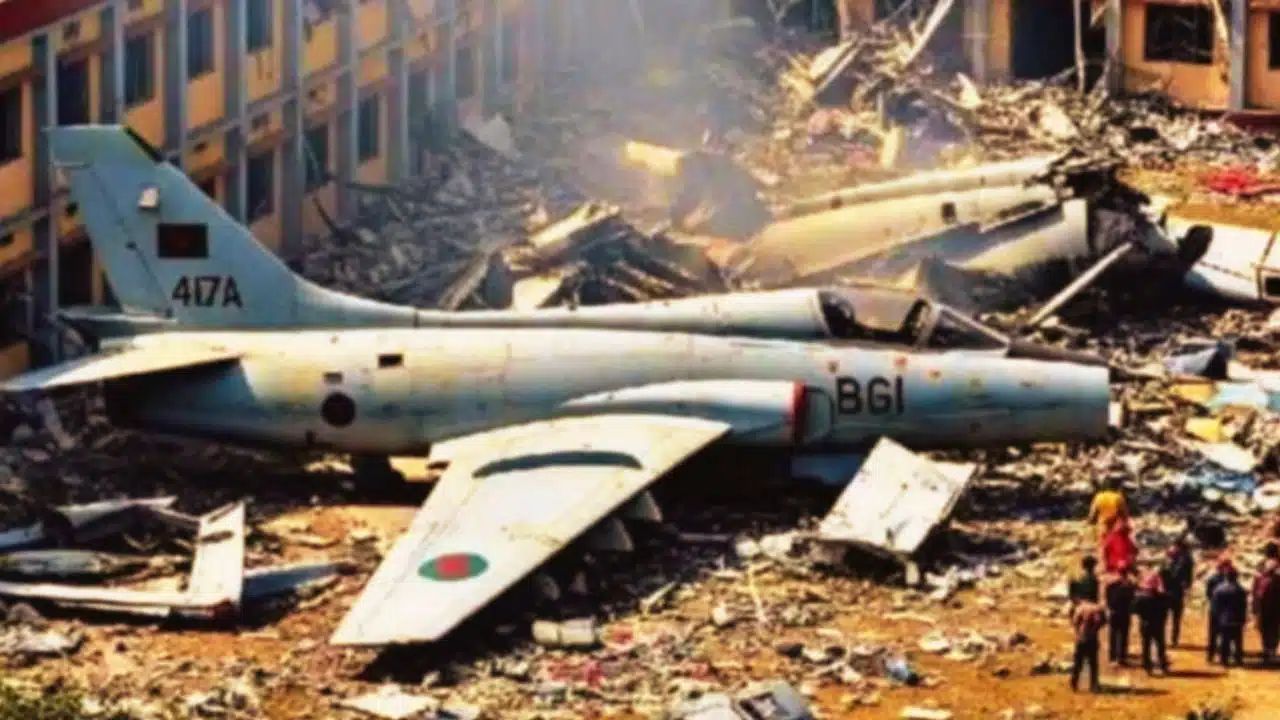
A devastating military jet crash into a school building in Dhaka has shocked Bangladesh and triggered widespread protests. The accident, which occurred on Monday, July 21, 2025, resulted in 32 confirmed deaths, including 29 schoolchildren, two teachers, and the pilot of the aircraft. Additionally, 171 individuals have been injured, many of them critically burned. The event is being called one of the deadliest aviation tragedies in the country’s recent history, especially involving civilians and children.
Tragedy Strikes a School in the Heart of Dhaka
The incident unfolded when a Chinese-manufactured F-7BGI fighter jet, operated by the Bangladesh Air Force, crashed directly into Milestone School and College, a private institution located in the Uttara Model Town area of northern Dhaka. The aircraft had taken off from Kurmitola Air Base for a routine training mission and lost control shortly afterward due to what military officials later described as a mechanical failure.
The jet struck the second floor of the school building, causing a massive explosion and fire. The targeted section of the building was designated for primary-level students, most of whom were in classrooms when the impact occurred. The school building, constructed with standard brick and concrete, quickly caught fire, trapping many inside. Emergency responders rushed to the scene, but the heat and smoke hindered immediate rescue operations.
Among the dead were at least 29 young students, aged between 6 and 12, who were attending classes when the aircraft hit. Two teachers also lost their lives, one of whom sustained fatal burns while trying to help students escape. The pilot, on his first solo training mission, was confirmed dead after the wreckage was cleared.
Hospitals Overwhelmed as Burn Victims Battle for Life
Medical teams across Dhaka were overwhelmed with casualties. Around 171 individuals, mostly children, were rushed to hospitals with severe injuries. Many of them sustained burns exceeding 60% of their body surface, a critical threshold in survival rate according to Bangladesh’s healthcare statistics.
Burn units at Dhaka Medical College Hospital (DMCH), Kurmitola General Hospital, and Sheikh Hasina National Burn and Plastic Surgery Institute were filled beyond capacity. A majority of the victims required urgent surgical intervention, ventilation support, and long-term intensive care.
Indian authorities, responding to an urgent request for support, dispatched a team of burn specialists and nurses to assist local hospitals in managing the large number of patients.
Despite the best efforts of the medical staff, the death toll rose to 32 by Tuesday morning, and doctors fear it may rise further as more patients remain in critical condition.
Protest Erupts: Students Demand Justice and Accountability
In the aftermath of the crash, grief quickly turned to public outrage. On Tuesday, hundreds of students and parents gathered near the crash site and in front of government buildings across Dhaka. Many held placards demanding accountability, transparency, and an immediate suspension of air force training flights over residential areas.
Protesters called for the government to publish the full list of victims and provide adequate compensation to the families affected. The use of obsolete and unsafe aircraft—specifically the aging F-7BGI jets—became a central point of contention. Students and civil society groups questioned why military flight drills were still being conducted in densely populated urban areas where schools, hospitals, and homes stand in close proximity.
As emotions flared, there were reports of clashes between protesters and security forces. Several students alleged physical assault by police and accused them of manhandling teachers. The situation became tense when two senior government officials visited the crash site. Angry crowds confronted them, forcing the officials to seek protection from security personnel and hastily retreat from the area.
Spotlight on the Aircraft: Is the F-7BGI Still Safe?
The fighter jet involved in the crash was a Chinese-made F-7BGI, part of a fleet procured by Bangladesh between 2011 and 2013. This variant is based on the Chinese Chengdu J-7, which itself is an upgraded version of the Soviet-era MiG-21.
Despite multiple modernizations, the F-7 series has a long history of safety concerns, especially in training operations. The Bangladesh Air Force operates several of these jets for pilot training missions. Over the years, there have been several minor incidents and near-misses, prompting aviation experts to repeatedly question the aircraft’s suitability in urban airspace.
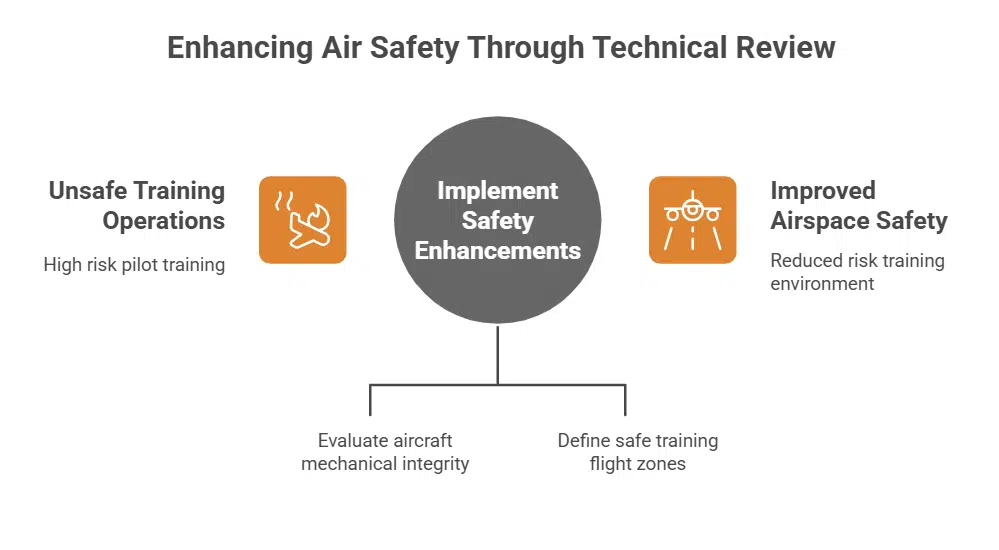
Military sources later attributed Monday’s crash to a mechanical failure, though specifics have yet to be released. Independent defense analysts are calling for a full technical review of the fleet and stricter guidelines on where such training flights can take place.
Emotional Toll and Difficult Recovery
Rescue workers, police, and military teams spent hours combing through the debris for survivors, charred schoolbags, scorched identity cards, and other personal belongings. The sight of rows of children’s shoes, strewn across the schoolyard, painted a haunting picture of the tragedy.
Grieving families continued to search hospitals and morgues for their missing children. Many bodies were burned beyond recognition, prompting authorities to initiate DNA testing for proper identification. Emotional scenes played out at hospitals where parents clung to hope, waiting for news about their children—some of whom are still unaccounted for.
Public anger has intensified due to lack of timely updates, chaotic communication from authorities, and inconsistent reports about the number of dead and missing.
Day of National Mourning Declared Across Bangladesh
In response to the scale of the tragedy, the Bangladesh government declared July 22 as a day of national mourning. Flags were flown at half-mast at all public institutions. Special prayers were held in mosques, temples, and churches across the country in memory of the victims.
Educational institutions in the capital were temporarily closed, and counseling services were activated to help survivors and family members cope with the trauma. Government officials promised compensation packages, though no details have yet been announced publicly.
Investigations and Demands for Reform
The Bangladesh Air Force has launched a high-level investigation to determine the exact cause of the crash. A separate judicial inquiry is also being considered by the Ministry of Defense to examine whether negligence, technical lapses, or procedural violations were involved.
Meanwhile, the High Court of Bangladesh called for the formation of a technical oversight committee to assess the safety standards of all military aircraft and their flight paths over urban areas. Public interest groups and aviation experts are pushing for comprehensive airspace zoning laws to prevent such disasters in the future.
There are also calls for independent civilian oversight of military flight training programs and for phasing out high-risk aircraft models from Bangladesh’s military inventory.
Questions That Demand Answers
The Milestone School tragedy has raised profound concerns about public safety, military accountability, and emergency preparedness in Bangladesh.
Key issues still unanswered include:
-
Why are aging fighter jets still used for training over schools and housing zones?
-
Was the aircraft’s mechanical issue known or preventable?
-
Were flight plans adequately reviewed before takeoff?
-
What immediate actions will the government take to prevent future tragedies?
As the nation mourns its children, the demand for answers, reforms, and justice continues to grow louder.
The crash of the Bangladesh Air Force jet into Milestone School has become a national tragedy and turning point in the country’s conversation about aviation safety and public accountability. With the death toll at 32 and over 170 injured, this disaster underscores the urgent need to reconsider how military operations intersect with civilian life in Bangladesh’s rapidly growing cities.
As investigations begin and public pressure mounts, the coming days will be crucial in determining how the government and armed forces respond—not just with compensation, but with meaningful reform.