
What happens when siblings inherit a house but can’t agree on what to do with it? One wants to keep it as a family legacy. Others need money urgently. This disagreement turns to dispute. That’s the reason, we have partition action law.
When co-owners of a property can’t find common ground, a partition action becomes the legal way to settle things. It’s not a simple process, though. You may go through long legal battles, financial losses, and broken relationships.
Let’s understand how it works so that you can navigate the situation.
Partition actions in property disputes
A partition action is a legal process that forces the division of co-owned property. It applies when multiple people share ownership but disagree on its use or sale. Inherited property disputes are among the most common reasons for partition cases.
People inherit their property generally at a later stage in their life when they are married and may have kids. In those cases, they have their own priorities. It’s rare to see people on the same page at this stage. When no agreement is reached, legal intervention becomes necessary.
Legal grounds for filing a partition action
Property laws protect the rights of co-owners. Anyone with ownership interest has the legal right to file a partition action. The court steps in when there’s no voluntary resolution.
Common reasons for filing include:
- One or more owners refusing to sell or buy out others.
- The financial burden of maintaining the property.
- Unequal contributions to property expenses.
- Family disputes making co-ownership impossible.
But before taking legal steps, speak with a property lawyer San Diego to clarify available options. Sometimes, a lawsuit is not the only option, or the best option. Legal guidance helps find out the right course of action.
Types of partition in inherited property
Courts decide the best way to divide the property based on its nature and the interests of all owners. One can’t expect an outright sale.
-
Partition by sale
This is the most common type. The court orders the sale of the property, and proceeds are divided among owners. This happens when the property can’t be physically divided, like a single-family home.
-
Partition by kind
This type of partition is common with lands and farms. Rare in residential cases. Each owner receives a portion based on their ownership percentage.
-
Hybrid solutions
Sometimes, courts order buyouts instead of forcing a sale. One or more owners purchase the shares of those who wish to exit. This avoids selling to outsiders and keeps the property within the family.
Challenges in partition litigation
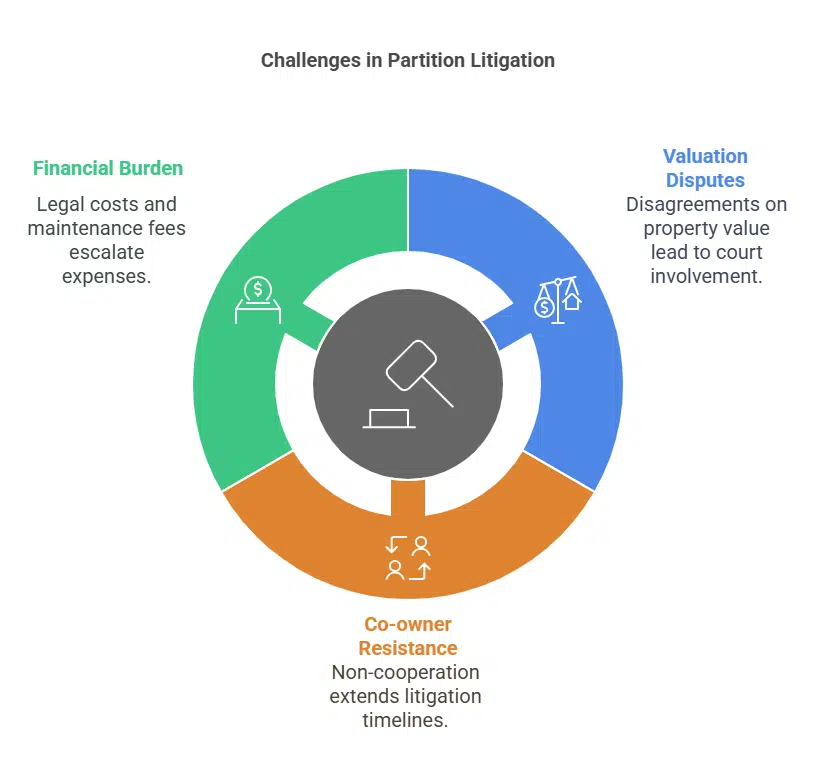
Partition cases can be challenging. Legal and emotional hurdles make them complicated. Some of the biggest challenges are:
- Valuation disputes – Owners may disagree on the property’s market value. One wants a higher price, while another is ready to sell fast. Courts rely on appraisers to settle the matter.
- Resistance from co-owners – Some refuse to cooperate, dragging the case for months or even years.
- Financial burden – Legal fees, court costs, and property maintenance add up. Litigation becomes expensive.
Alternatives to litigation in partition disputes
Many cases can be settled before reaching litigation. Talk to an expert and explore alternative solutions to save your money and time.
You can negotiate a buyout or make a property management agreement. If some owners want to keep the property, they can buy out others. A fair valuation is necessary to avoid further disputes here. Or, if selling is not an option for you, a formal agreement can help. It outlines responsibilities for maintenance, rental income distribution, and expense sharing.
Protecting your interest before and during a partition case
Before filing a lawsuit, it’s important to take a few steps. These steps strengthen the case and minimize complications.
- Gather ownership documents – Proof of ownership is necessary. This includes wills, deeds, and any agreements among co-owners.
- Assess the property’s value – An independent appraisal helps understand the fair market price.
- Consult a lawyer – A legal expert can suggest the best course of action. This is especially important when family emotions are involved.
During the legal process, stay organized and cooperate to speed things up. Prolonged disputes only increase costs and stress.
Conclusion
Inherited property disputes can put a strain on relationships. And even if the co-owners don’t agree, a partition action becomes the last resort.
While it resolves ownership conflicts, it also comes with legal and financial challenges. Therefore, explore alternative solutions like mediation or buyouts to prevent costly litigation.