Gaming has often been perceived as mere entertainment, but modern research reveals that playing video games can significantly boost cognitive skills.
From improving problem-solving abilities to enhancing memory and focus, gaming engages the brain in ways that traditional activities often do not.
As technology evolves, scientists continue to uncover the profound effects of gaming on mental performance, proving that video games can be a valuable tool for cognitive growth. Moreover, gaming fosters skills such as multitasking, adaptability, and strategic thinking, which are crucial in both academic and professional settings.
By understanding the cognitive science behind gaming, individuals can leverage its benefits for brain training and mental agility.
The Neuroscience of Gaming: How the Brain Responds
The intersection of gaming and neuroscience has gained immense attention in recent years, as researchers delve deeper into how interactive experiences reshape brain function. Video games are no longer seen as mere distractions; they actively stimulate cognitive growth by engaging multiple neural pathways.
This engagement fosters improved memory, problem-solving, and even motor coordination. As we explore the science behind gaming’s impact, it becomes evident that this form of entertainment holds untapped potential for cognitive enhancement.
Brain Regions Activated by Gaming
Gaming engages the brain in unique and powerful ways, reshaping neural pathways and improving cognitive function. The stimulation from gaming leads to increased connectivity between different brain regions, which enhances learning, problem-solving, and motor skills. Understanding how various parts of the brain respond to gaming can provide deeper insights into the cognitive benefits it offers.
Video games engage multiple areas of the brain, leading to cognitive improvements:
| Brain Region | Function | Effect of Gaming |
| Prefrontal Cortex | Decision-making, planning, and problem-solving | Enhances strategic thinking and logical reasoning |
| Hippocampus | Memory formation and spatial navigation | Strengthens memory retention and learning adaptability |
| Cerebellum | Motor skills and coordination | Improves reflexes and fine motor control |
The Role of Neuroplasticity in Skill Development
Neuroplasticity is the brain’s ability to reorganize itself by forming new neural connections. Gaming promotes neuroplasticity by constantly challenging players with new tasks, environments, and decision-making scenarios.
Studies have shown that individuals who play video games regularly exhibit increased gray matter density, particularly in regions linked to learning and memory. This structural adaptation can contribute to faster problem-solving skills and a greater ability to adapt to new challenges.
Key Cognitive Skills Enhanced by Gaming

Gaming has become more than just a recreational activity; it is a tool for cognitive enhancement. Studies show that engaging in video games can significantly improve brain function, helping players develop essential skills such as critical thinking, problem-solving, memory, and multitasking.
By understanding these cognitive benefits, gamers can make more informed choices about the types of games they play and how to incorporate gaming into their daily lives for intellectual growth.
Problem-Solving and Critical Thinking
Games often present players with complex problems that require logical reasoning and quick decision-making. Strategy and puzzle games, such as “Portal” and “The Legend of Zelda,” demand creative solutions, reinforcing cognitive flexibility and critical thinking.
Players must analyze situations, anticipate outcomes, and execute strategies, enhancing their decision-making capabilities.
Examples of Games That Enhance Problem-Solving Skills:
| Game | Cognitive Benefit |
| Portal | Encourages spatial reasoning and creative problem-solving |
| The Legend of Zelda | Requires logical thinking and puzzle-solving skills |
| Civilization VI | Strengthens strategic planning and decision-making |
Memory and Learning Retention
Memory-based games, such as “Lumosity” and “Brain Age,” are designed to strengthen short-term and long-term memory. Role-playing games (RPGs) also enhance memory by requiring players to remember storylines, character relationships, and strategic gameplay elements.
This improves recall abilities and enhances cognitive flexibility, allowing players to learn and retain information more efficiently.
Attention Span and Focus Improvement
Fast-paced games, like first-person shooters and racing games, require sustained attention and rapid reactions. Research suggests that playing action games improves selective attention and enhances the brain’s ability to filter out distractions, leading to better concentration in real-life tasks.
This has practical applications for students and professionals who require high levels of focus.
| Type of Game | Cognitive Benefit |
| Action Games | Increases focus and reaction speed |
| Strategy Games | Improves sustained attention and planning |
| Puzzle Games | Enhances logical reasoning and concentration |
Multitasking and Decision-Making Speed
Many video games demand multitasking, such as managing resources while navigating an environment or responding to multiple stimuli simultaneously. Studies have found that gamers tend to process information faster and make quicker decisions than non-gamers, a skill that translates into professional and personal efficiency.
These improvements can be particularly beneficial in high-pressure environments, such as healthcare, finance, and emergency response roles.
Comparing Different Game Genres and Their Cognitive Benefits
Gaming offers a diverse range of experiences, each providing unique cognitive benefits. Different genres train different aspects of the brain, from improving reflexes to enhancing strategic thinking. Understanding how these genres impact cognitive skills can help players choose games that align with their personal development goals.
| Game Genre | Cognitive Benefits |
| Action/FPS Games | Improves reflexes, spatial awareness, and hand-eye coordination. |
| Puzzle & Strategy Games | Enhances logical reasoning, problem-solving, and strategic thinking. |
| RPGs | Boosts creativity, problem-solving, and emotional intelligence. |
| Simulation Games | Develops planning, resource management, and real-world decision-making skills. |
| Multiplayer Online Games | Improves communication, teamwork, and social intelligence. |
Scientific Studies and Real-World Evidence
Gaming has long been associated with entertainment, but recent research has illuminated its powerful impact on cognitive function. Scientists have explored how gaming influences brain activity, learning patterns, and decision-making skills.
By analyzing the data, they have found that gaming can serve as an effective tool for mental stimulation and growth, challenging the outdated belief that video games are merely a source of distraction.
Research on Gaming and Cognitive Enhancement
Several studies highlight the cognitive benefits of gaming:
- A study published in Nature found that playing 3D video games improved memory formation and recall.
- Research from the University of Rochester concluded that action gamers made decisions 25% faster without compromising accuracy.
- A Frontiers in Human Neuroscience study showed that gamers exhibited higher levels of cognitive flexibility than non-gamers.
Real-Life Examples of Gamers with Enhanced Cognitive Abilities
- Professional Gamers: esports players develop exceptional hand-eye coordination and reaction times, crucial for competitive gaming and real-world applications like surgery and sports.
- Gamers in Education & Careers: Many individuals credit gaming for enhancing their ability to think critically, multitask efficiently, and adapt to new challenges in their professional lives.
Addressing Concerns: Gaming Addiction vs. Cognitive Benefits
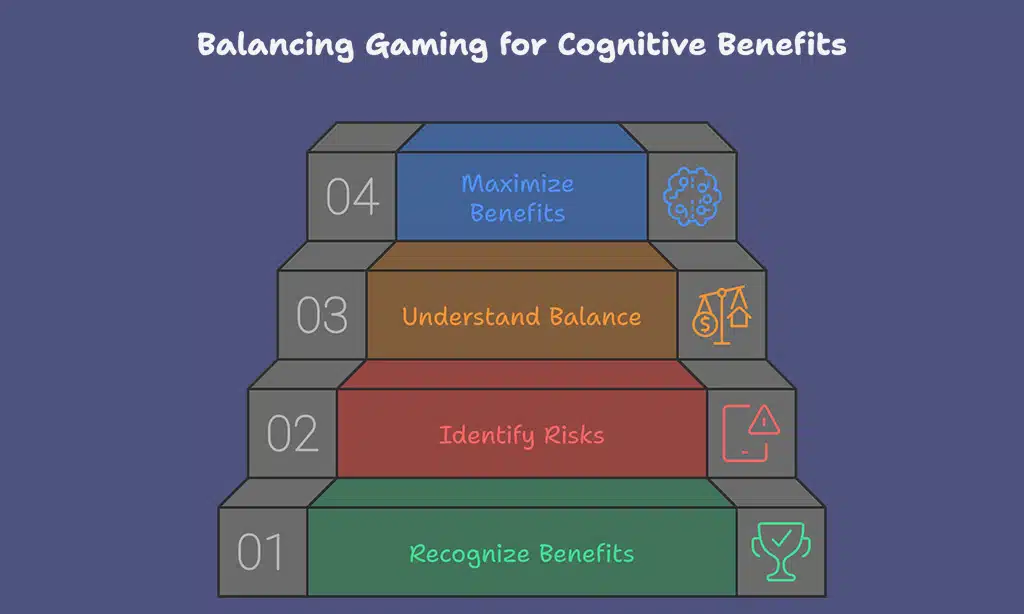
While video games provide significant cognitive benefits, there is ongoing debate about their potential risks, particularly regarding addiction. Understanding the balance between gaming for cognitive enhancement and excessive gaming is crucial.
Researchers suggest that moderate and purposeful gaming can improve brain function, whereas excessive play may lead to negative psychological and physical consequences. Recognizing the difference between productive and problematic gaming behaviors is key to maximizing benefits while mitigating risks.
Finding the Right Balance
While gaming offers cognitive advantages, excessive gaming can lead to negative effects like addiction, sleep disruption, and social withdrawal. Experts recommend moderation, ensuring that gaming remains a productive and enjoyable activity.
Healthy Gaming Habits for Cognitive Growth
- Set time limits to avoid overindulgence.
- Choose games that challenge cognitive abilities rather than passive entertainment.
- Incorporate educational and brain-training games into regular gaming sessions.
- Balance gaming with physical activity and social interactions.
Wrap-Up: Harnessing the Power of Gaming for Cognitive Growth
Gaming is no longer just a pastime; it is a powerful cognitive development tool. By engaging the brain in dynamic ways, video games enhance problem-solving, memory, attention, and decision-making skills.
With the right balance and game selection, players can unlock the full potential of their minds while enjoying an immersive experience. The future of gaming holds even greater promise, blending entertainment with mental enrichment in innovative ways.