

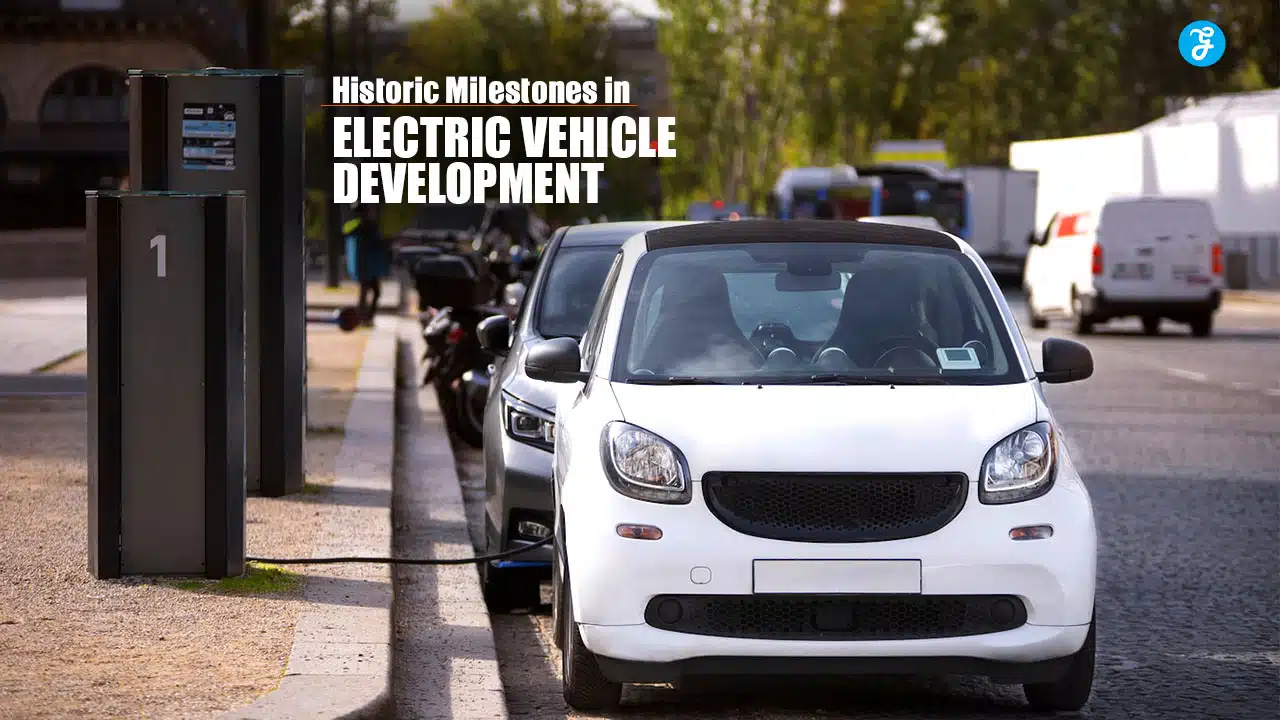
Electric vehicles (EVs) have come a long way, evolving from early experiments in the 19th century to becoming a key component of the future of transportation.
As we move towards a more sustainable future, it’s essential to understand the history of electric vehicle development and the technological breakthroughs that made modern EVs possible.
This article will explore eight historic milestones that have significantly shaped the evolution of electric vehicles.
1. The Invention of the First Electric Vehicle (1828-1835)
The concept of electric vehicles dates back to the early 19th century, when several inventors across Europe and North America began experimenting with electric motors and batteries.
The first rudimentary electric vehicles were created between 1828 and 1835, predating gasoline-powered cars by several decades.
Key Developments:
- Anyos Jedlik
(Hungary, 1828): Jedlik built a small-scale model of a vehicle powered by an electric motor, marking one of the earliest recorded uses of electricity for transportation.
- Thomas Davenport
One of the earliest practical uses of an electric vehicle was a small, circular electric locomotive that American inventor Davenport built in 1835 and powered by a non-rechargeable battery.
Impact:
These early inventions laid the foundation for future developments in electric mobility, sparking curiosity and innovation in the use of electric power for vehicles.
Although these prototypes were limited in range and practicality, they demonstrated the potential of electricity as a power source for transportation.
2. The First Practical Electric Car (1889-1891)

By the late 19th century, advancements in battery technology and electric motors led to the development of the first practical electric cars.
William Morrison constructed the most notable example in 1891. Morrison, an American chemist from Iowa, is credited with creating the first electric car capable of carrying passengers.
Key Features:
- Morrison’s electric car had a top speed of 14 mph and could carry six passengers, making it more than just a novelty. A number of nonrechargeable batteries powered it.
- The vehicle had a range of approximately 50 miles per charge, making it a viable option for short-distance travel within cities.
Impact:
Morrison’s electric car captured public interest and led to a surge of interest in electric vehicles in the United States and Europe.
By the early 20th century, electric cars were seen as a more reliable and quieter alternative to steam and gasoline-powered vehicles, especially in urban areas.
3. The Golden Age of Electric Cars (1890s-1920s)
Between the 1890s and the 1920s, electric cars enjoyed a period of relative popularity, particularly in the United States.
During this time, electric vehicles (EVs) were competing with steam-powered and gasoline-powered vehicles, and they became the vehicle of choice for many urban drivers.
Key Factors for Popularity:
- Ease of Use:
Electric cars didn’t require a hand crank to start, unlike gasoline cars, which made them more user-friendly, especially for women.
- Clean and Quiet:
Unlike steam and gasoline cars, electric cars produced no exhaust and were much quieter, making them ideal for city driving.
- Popularity in Cities:
Electric vehicles were primarily used in urban areas, where short trips made range limitations less of an issue.
Impact:
During this period, companies like Detroit Electric and Baker Electric produced thousands of electric cars.
However, this golden age came to an end in the 1920s, as improvements in internal combustion engines and the discovery of abundant oil reserves made gasoline-powered cars cheaper and more convenient for long-distance travel.
4. Decline and Near Disappearance of Electric Vehicles (1930s-1960s)
The rise of the internal combustion engine and the mass production of gasoline-powered cars by companies like Ford marked the decline of electric vehicles.
By the 1930s, electric cars had largely disappeared from the market due to their limited range, high costs, and the growing availability of gasoline.
Key Challenges:
- Lower Cost of Gasoline Cars:
Henry Ford’s introduction of the assembly line drastically reduced the cost of producing gasoline-powered cars, making them more affordable than electric vehicles.
- Range Limitations:
Electric cars of the time had limited battery life, and with the expansion of road networks, their range became an issue.
- Lack of Charging Infrastructure:
The infrastructure to support long-distance electric travel was virtually nonexistent, while gasoline stations were becoming widespread.
Impact:
Electric vehicles became a niche market, used mainly for specific industrial purposes (such as milk delivery trucks) or in enclosed environments like warehouses, where gasoline fumes would be problematic.
5. The Oil Crisis and EV Revival (1970s)
The 1970s oil crisis reignited interest in alternative energy vehicles, including electric cars.
With gasoline prices soaring and concerns about oil dependency growing, car manufacturers and governments began to reconsider the viability of electric vehicles.
Key Developments:
- The U.S. government and other nations began funding research into electric vehicles and battery technologies as a means of reducing dependence on oil.
- Companies like Sebring-Vanguard introduced small, limited-production electric cars, such as the CitiCar, which became one of the best-selling EVs during this period, although it had a limited range and performance.
Impact:
Although the technology of the time was not advanced enough to produce electric vehicles that could compete with gasoline-powered cars in terms of performance or range, the oil crisis marked the beginning of modern interest in alternative fuels and spurred research into battery technology that would later benefit EVs.
6. The Launch of General Motors EV1 (1996)

In the mid-1990s, General Motors (GM) released the EV1, the first mass-produced, purpose-built electric vehicle from a major automaker.
The EV1 was part of GM’s response to California’s Zero Emission Vehicle (ZEV) mandate, which required automakers to produce a percentage of emission-free vehicles if they wanted to sell cars in the state.
Key Features:
- Range:
The first-generation EV1 had a range of around 70-100 miles per charge, using lead-acid batteries.
A second-generation model with nickel-metal hydride (NiMH) batteries increased the range to approximately 160 miles.
- Performance:
The EV1 could accelerate from 0 to 60 mph in about 8 seconds, making it competitive with many gasoline-powered cars of the time.
Impact:
Although the EV1 garnered a loyal following among drivers, GM ultimately discontinued the program in 2003 and controversially recalled and destroyed most of the vehicles.
However, the EV1 represented a major milestone in EV history as a fully electric car produced by a major automaker, signaling that EVs could be more than just niche products.
7. The Tesla Roadster and the Beginning of the Modern EV Era (2008)
The release of the Tesla Roadster in 2008 marked the beginning of the modern era of electric vehicles.
Tesla, founded by Elon Musk and a team of engineers, aimed to create a high-performance electric car that could compete with gasoline-powered sports cars.
Key Features:
- Range:
The Roadster could travel up to 245 miles on a single charge, making it the first production EV to use lithium-ion batteries and achieve such a range.
- Performance:
The Roadster had impressive acceleration, with a 0-60 mph time of around 3.7 seconds, comparable to some high-end sports cars.
- Lithium-Ion Batteries:
Tesla’s use of lithium-ion batteries, a technology that was previously reserved for electronics like laptops, revolutionized the EV industry by offering significantly better range and energy density than previous battery technologies.
Impact:
The success of the Tesla Roadster demonstrated that electric cars could be fast, desirable, and capable of long-range travel.
Tesla’s innovations in battery technology and electric drivetrain design paved the way for future electric vehicles and helped change public perception of EVs from slow, utilitarian vehicles to high-performance machines.
8. The Global Shift Toward EVs and Mass Adoption (2020s-Present)
The 2020s mark a turning point in the history of electric vehicles, as global automakers and governments commit to transitioning away from internal combustion engines.
Advances in battery technology, decreasing costs, and growing environmental awareness have accelerated the adoption of electric vehicles worldwide.
Key Developments:
- Government Policies:
Several countries and regions, including the European Union, the UK, and California, have announced bans on the sale of new gasoline and diesel vehicles by 2030-2040.
This has spurred automakers to accelerate their EV production plans.
- New EV Models:
Major automakers, including Ford, Volkswagen, GM, and Nissan, are producing a range of electric vehicles for the mass market, with models like the Ford Mustang Mach-E, Volkswagen ID.4, and Chevrolet Bolt.
- Battery Technology:
The cost of lithium-ion batteries has decreased by about 89% since 2010, making EVs more affordable.
New developments in solid-state batteries promise even greater energy density, faster charging times, and longer lifespans.
Impact:
The global push toward electric vehicles has reached a tipping point, with EVs expected to account for a significant percentage of new car sales within the next decade.
This shift is helping reduce carbon emissions, improve air quality, and drive further innovations in renewable energy and charging infrastructure.
Final Thoughts
The development of electric vehicles has been a journey filled with innovation, setbacks, and breakthroughs.
From the earliest experiments with electric motors to the mass production of modern EVs, each milestone has contributed to the growing viability and appeal of electric vehicles.
As we move further into the 21st century, the future of transportation is increasingly electric, promising cleaner, more efficient mobility for generations to come.






















