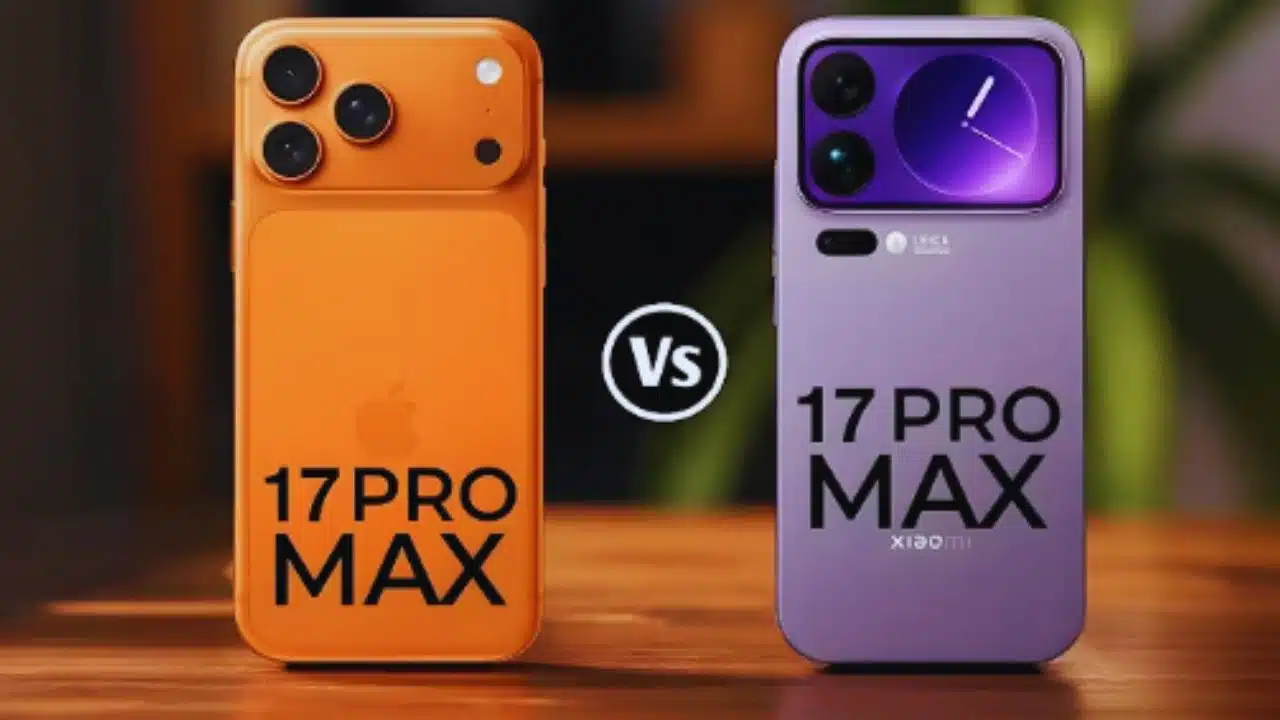
The smartphone world thrives on rivalries, and 2025 has already brought one of the most heated yet — the battle between Xiaomi’s 17 Pro Max and Apple’s iPhone 17 Pro Max. Both brands have pushed the envelope, offering top-of-the-line specs, futuristic designs, and advanced features aimed at winning over users who demand the very best.
But the real question remains: Can Xiaomi’s latest flagship, armed with cutting-edge hardware and bold innovations, stand toe-to-toe with Apple’s most powerful iPhone to date? Let’s break it down in detail.
Design and Build: Premium Choices with Different Philosophies

iPhone 17 Pro Max
Apple continues its tradition of elegant simplicity but with a few engineering upgrades. The phone features a polished aluminum frame, chosen specifically for better heat dissipation — an area Apple is finally taking seriously after years of criticism over thermal throttling.
For the first time, Apple has integrated a vapor chamber cooling system into its Pro Max model. This technique, already popular among gaming smartphones and premium Androids, uses a small sealed chamber with liquid that evaporates and condenses to pull heat away from the chipset. In real-world terms, this should help the A19 Pro chip sustain performance for longer without overheating.
On durability, Apple’s Ceramic Shield 2 front glass promises 3× better scratch resistance compared to the first-generation version. The back glass continues to use Ceramic Shield, offering 4× stronger crack resistance. Early reviews, however, suggest that the aluminum body — while cooler — might still be more prone to visible scratches compared to Apple’s previous titanium models.
Xiaomi 17 Pro Max
Xiaomi has taken a bold step in design by introducing a dual-display system. The front houses a large 6.9-inch panel, while the rear sports a smaller 2.9-inch AMOLED screen integrated into the camera module. This secondary display isn’t just for show — it serves as a quick viewfinder for selfies with the main camera, a widget screen for notifications, and even a space for custom animations.
The main body is crafted with a combination of aluminum and Xiaomi Shield Glass, the company’s proprietary protective material. While it hasn’t been tested as extensively as Apple’s Ceramic Shield, Xiaomi claims it offers improved resistance against drops and scratches.
Overall, the design battle comes down to philosophy: Apple prioritizes refinement and practicality, while Xiaomi emphasizes innovation and flair.
Display: Two 6.9-Inch Powerhouses, but One Brighter
iPhone 17 Pro Max
Apple has equipped the iPhone 17 Pro Max with a 6.9-inch OLED Super Retina XDR display. It runs at a 120Hz adaptive refresh rate (ProMotion), ensuring smooth scrolling, responsive animations, and fluid gaming.
The resolution is 2868×1320 pixels, delivering sharp text and crisp visuals. Perhaps the biggest leap is its peak brightness of 3,000 nits — a welcome improvement for outdoor visibility, making it one of the brightest displays Apple has ever shipped. Additionally, Apple has added an anti-reflective coating, reducing glare in direct sunlight.
Xiaomi 17 Pro Max
Xiaomi isn’t holding back either. The 17 Pro Max comes with a 6.9-inch LTPO AMOLED panel offering a 1.5K resolution. While slightly lower in sharpness compared to Apple’s panel, it compensates with a blistering 3,500 nits peak brightness, currently the brightest on any mainstream phone display.
The panel supports 120Hz refresh rate, high-frequency PWM dimming for flicker-free low-brightness use, and DC dimming. These features are particularly helpful for users sensitive to eye strain.
On top of that, Xiaomi’s rear display adds versatility, allowing users to check notifications, use the main camera for selfies, or control music playback without turning the phone around.
Verdict: Xiaomi wins in sheer brightness and versatility, while Apple focuses on balanced quality and better calibration for color accuracy.
Camera Systems: Hardware Muscle vs Computational Mastery
iPhone 17 Pro Max

Apple has finally standardized all three rear cameras at 48MP each (wide, ultrawide, and telephoto). The telephoto lens now supports 8× “optical-quality” zoom, achieved with a mix of optics and smart cropping.
The front camera is 18MP with advanced Center Stage tracking, great for video calls. On the video side, Apple maintains its edge with ProRes RAW, Dual Capture, and Genlock syncing, making it the tool of choice for content creators and professionals.
Xiaomi 17 Pro Max

Xiaomi partners with Leica for its camera system. The phone features a triple 50MP setup:
- A main wide-angle sensor,
- An ultrawide lens,
- A periscope telephoto lens offering 5× optical zoom with a wide f/2.6 aperture for better low-light shots.
Thanks to the rear display, users can frame selfies with the main 50MP camera, delivering far higher quality than traditional front-facing lenses.
Verdict: iPhone leads in computational photography and video tools, while Xiaomi shines with hardware flexibility, zoom power, and creative use of its rear screen.
Performance and Software: iOS Stability vs Android Powerhouse
iPhone 17 Pro Max
Powered by the A19 Pro chip, the iPhone offers a significant leap in both CPU and GPU performance. Apple’s silicon has historically dominated single-core benchmarks, and the new vapor chamber cooling ensures sustained power for gaming and professional workloads.
The strength of iOS lies not just in performance, but in its ecosystem. Features like AirDrop, iCloud syncing, and device continuity (switching calls between iPhone, Mac, and iPad) make it hard for many users to switch away.
Xiaomi 17 Pro Max
The Xiaomi flagship is powered by the Snapdragon 8 Elite Gen 5, Qualcomm’s most advanced processor to date. Coupled with up to 16GB of RAM and 1TB storage, the device is built for heavy multitasking, gaming, and AI-driven applications.
It runs on HyperOS, Xiaomi’s own Android-based interface, with AI features integrated for image editing, live translation, and productivity. While powerful, its global rollout and long-term update guarantees may not match Apple’s track record.
Battery and Charging: Xiaomi’s Big Advantage

iPhone 17 Pro Max
Apple has packed its largest battery yet — around 5,088mAh. The company claims up to 37 hours of video playback, a slight improvement over the 16 Pro Max. Charging remains modest, with Apple supporting USB-C charging but at speeds far below Android competitors.
Xiaomi 17 Pro Max
This is where Xiaomi dominates. With a massive 7,500mAh battery, the 17 Pro Max is designed for endurance. It supports 100W wired charging and 50W wireless charging, allowing a near-full top-up in under 30 minutes. Xiaomi even claims its endurance can outlast iPhones paired with external batteries.
Ecosystem and User Experience
- Apple iPhone 17 Pro Max: Seamless ecosystem, strong resale value, guaranteed 5–6 years of software updates, and unmatched integration with Apple devices.
- Xiaomi 17 Pro Max: Bold innovations like the rear display, powerful hardware, and AI features. But software updates and global availability may not be as strong.
Takeaways
The Xiaomi 17 Pro Max is an aggressive challenger, excelling in display brightness, battery life, charging speed, and camera hardware flexibility. Its dual-screen design also gives it a unique edge.
The iPhone 17 Pro Max, however, remains unbeatable in ecosystem maturity, computational photography, software support, and long-term reliability. For many users, especially those embedded in Apple’s ecosystem, switching will be difficult.