

A legal subscription can cost less per year than two hours with an average attorney, but the plans differ sharply in what they cover and who counts as family.
The average US lawyer bills $349 an hour, according to Clio’s 2026 rate data. A simple will runs $250 to $1,000 on the open market. A full estate plan with a trust, powers of attorney, and a healthcare directive reaches $2,000 to $5,000. Legal subscription services plans exist to convert those unpredictable bills into a fixed monthly line item, and several million US households now hold one.
| Service | Monthly cost | Family covered | Standout term |
|---|---|---|---|
| LegalShield | $39.95–$59.95 | Spouse + dependents (from Advanced) | No hourly fees on unlimited questions |
| MetLife Legal Plans | $12.30–$22 | Spouse + dependents to 26 | No copays, deductibles, or claim forms |
| ARAG | $16.97–$24.45 | Spouse + dependents | Network fees paid in full on most matters |
| Rocket Lawyer | $12.41–$29.08 (annual) | Named member | Unlimited documents on every tier |
| LegalZoom | ~$16.59 (annual) | Spouse + dependents | 30-minute consultations, unlimited count |
| Nationwide LegalGuard | ~$17–$24 | Spouse + dependents to 19–25 | No deductible; Optimum skips the wait |
| US Legal Services | From $13.14–$16.90 | Family | Divorce covered at $0 out of pocket |
Buying through an employer changes the price more than picking between providers does. Employer-sponsored plans run $120 to $300 a year. Direct-purchase plans for the same category of coverage run $430 and up, because no employer is subsidising the premium. The gap exists because an employer negotiates a group rate and frequently absorbs part of the cost, so the same person buying comparable coverage alone pays close to three times as much for access to the same attorney network.
Three structural models sit behind these seven names. LegalShield runs a membership club with firms assigned by state. MetLife, ARAG, and Nationwide LegalGuard sell insurance-style products with defined benefit schedules. Rocket Lawyer and LegalZoom operate document platforms with attorney time attached. Knowing which model a plan uses tells you how it behaves once a matter turns contested. Everything below assumes a US address and a US legal matter.
LegalShield Puts a Provider Firm Behind Unlimited Questions
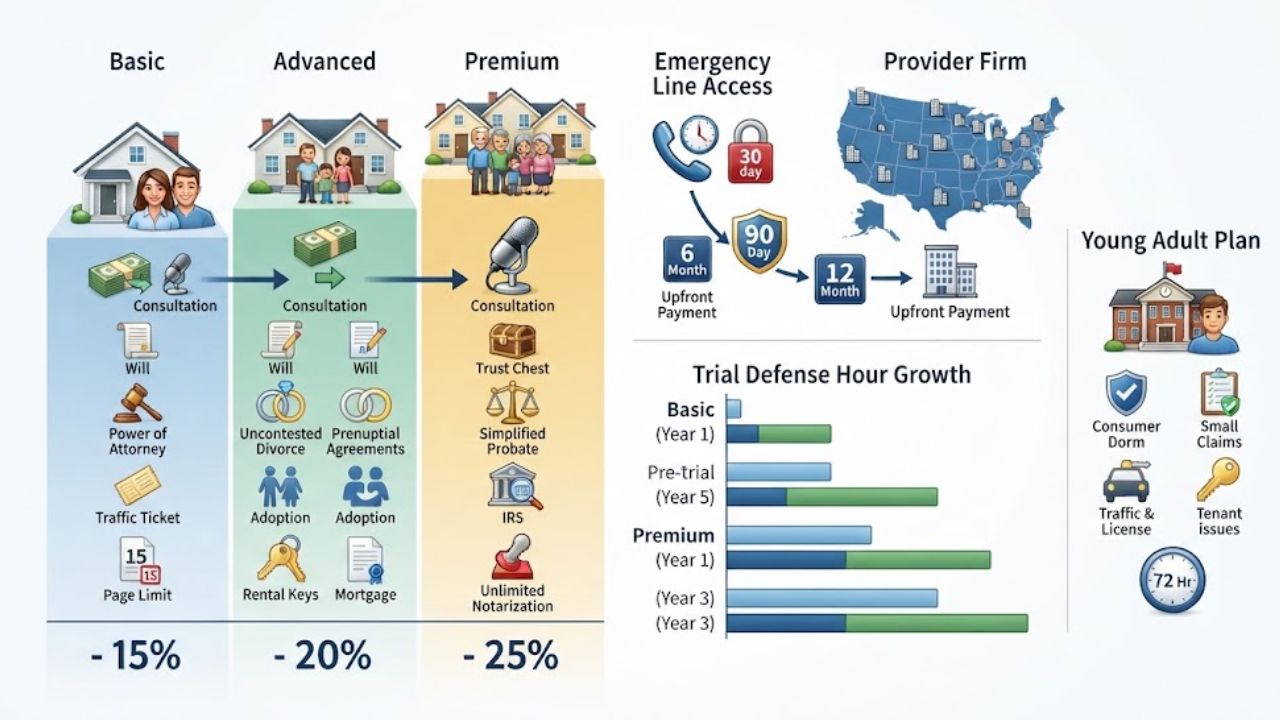
LegalShield charges $39.95 a month for Basic, $49.95 for Advanced, and $59.95 for Premium. Pay annually and each drops about 10%, to $431.46, $539.46, and $647.46. The company started in 1972 as Pre-Paid Legal Services, then rebranded in 2011. It runs the biggest direct-to-consumer plan in the country. It is also the priciest.
Family scope and document depth separate the tiers. Basic covers the member and a spouse with no hourly fee for consultations, will preparation, power of attorney, traffic ticket representation, and document review up to 15 pages. Advanced adds eligible child dependents, annual will updates, uncontested divorce navigation, prenuptial agreements, adoption, rental lease review, and mortgage document review. Premium layers on trust establishment, simplified probate help, IRS audit representation, and unlimited online notarization. Higher tiers cost more. They also cover more of the work families actually run into.
Provider law firms are assigned one per state, and calls on covered matters do not generate a bill. Work outside the covered list is discounted 15%, 20%, or 25% by tier. That discount matters more than it sounds. A contested divorce sits in the discounted bucket, not the covered one.
A Young Adult plan at $14.95 a month covers consumer protection, small claims, traffic and license help, and tenant issues. Not every state sells it. Applications take up to 72 hours to approve.
Trial defense hours start small and grow with tenure. Basic members get one hour of pre-trial help and 30 hours of trial time in year one, climbing toward five hours and 150 hours after five years. Premium members start at 100 hours of trial time and reach 300 hours after three years.
The 24/7 emergency line carries a restriction worth noting. It is limited to members of at least 90 days’ standing, or to those who pay six or twelve months upfront.
MetLife Legal Plans Sells Through Employers at Half the Price
MetLife’s legal product is built for payroll deduction, and the pricing reflects it. Federal employees pay $14 a month for the standard tier and $22 for the high tier. Employer-negotiated rates land between $12.30 and $19.25 a month, with around $19.25 for the Plus Parents tier.
MetLife pays network attorney fees in full for covered matters. No copays. No deductibles. No claim forms. Spouses and dependents up to age 26 sit inside the same premium.
Estate planning is where the arrangement earns its keep. Wills, trusts, powers of attorney, and healthcare directives are covered, which is both the cluster most families actually need and the cluster that costs the most when bought piecemeal. Litigation coverage is thinner, and criminal defense sits outside the plan entirely. Because the plan reaches most members through a payroll deduction, the cheapest way to buy it is also the easiest one to miss: check the benefits portal during open enrolment, since a mid-year hire usually gets thirty days and then no second window until the following year.
If an employer does not offer it, this route is largely closed. MetLife sells the individual product mainly through workplaces and to federal employees and retirees.
ARAG Covers More Ground and Charges for the Privilege
ARAG runs the widest coverage list of the three insurance-style providers, with more than 100 covered matters and a network the company puts at 15,000 attorneys. Employer rates land near $16.97 to $20.50 a month for UltimateAdvisor and $21.80 to $24.45 for UltimateAdvisor Plus. Family members are included at those figures.
A deductible applies on some ARAG plans, commonly $250. After it, the plan pays 100% of in-network fees for covered matters. Matters outside the covered list still get at least 25% off the network attorney’s standard hourly rate. That fallback is better than it first appears, because a plan that covers nothing on your specific matter still cuts the bill on the work you end up paying for.
ARAG added contested child custody and support modification to its 2026 coverage, capped at eight hours per event, alongside uncontested custody modification and minor traffic tickets. Divorce and child custody sit on the Plus tier rather than the base one.
Pre-existing condition exclusions can push an already-underway legal issue outside the benefit. Read that clause before enrolling. Coverage lists also differ by state, because ARAG operates as an insurance product in some states and a service product in others.
Leaving an employer does not end the plan. A conversion option keeps coverage running on direct billing, usually at a higher rate. ARAG puts its consumer conversion plan near $349 a year. Direct buying costs more. That is the pattern across this category.
Rocket Lawyer Sells Documents First and Attorney Time Second
Rocket Lawyer prices around an annual commitment, and the discount for paying upfront is steep. Standard costs $149 a year, Plus $249, and Pro $349 — $12.41, $20.75, and $29.08 a month. Monthly billing roughly doubles those figures, at $34.99, $49.99, and $64.99. A seven-day trial precedes all three.
Every tier includes unlimited documents, unlimited contract reviews, unlimited e-signatures, and AI-assisted legal questions. The tiers split on human attorney access. Standard includes one 20-minute Ask an Attorney session a month. Plus raises that to three, plus one live consultation. Pro removes the cap on both.
For a freelancer signing contracts or a family assembling routine paperwork, the document side carries most of the value. Anyone expecting a court matter should look elsewhere. Litigation support is not what this plan is built to deliver. Trustpilot holds a 4.4 rating across roughly 9,800 reviews, and the company reports more than 20 million businesses and individuals served. The trade is simple. Documents are unlimited and attorney time is metered, so a member who mostly needs contracts drafted, signed, and stored gets far more per dollar than one who wants a lawyer on the phone every month.
LegalZoom Bundles Consultations With Its Document Library
LegalZoom’s personal attorney plan runs $199 a year, about $16.59 a month. That buys unlimited 30-minute consultations on new legal matters, contract review up to 10 pages, estate planning with an annual review, and access to a template library with e-signatures. Spouses and dependents are covered. The business plan costs $469 a year.
Buying documents one at a time costs more in most scenarios. A will with attorney review runs about $328 at LegalZoom on its own. Registered agent service renews at $249 a year. That à la carte structure is why the subscription math favors anyone who needs more than a single document.
Contract review stops at 10 pages, the shortest ceiling among the seven providers here. The plan also discounts services outside its own list rather than covering them, so a contested matter still produces a bill.
For a household that needs one will and nothing else, the standalone purchase is cheaper. The subscription wins from the second document onward.
Nationwide LegalGuard Removes the Deductible and the Waiting Period
Most plans make you wait before family law benefits activate. Nationwide’s Optimum tier does not, and it includes uncontested divorce — a benefit several competitors route to a discounted rate instead. Advantage runs about $17 a month and Optimum about $24, plus an $0.85 monthly administrative fee. Neither carries a deductible.
Coverage mixes fully paid matters with fixed-rate ones, which is the part worth mapping before enrolling. Living wills come at no additional charge. Traffic tickets on Optimum run a flat $89 rather than being covered outright.
Spouses are included, and dependents up to 19, or 25 if they are full-time students. That dependent age cap is tighter than the 26 that MetLife and ARAG use. For a household with a college-age child, it matters. Age caps read like fine print until a dependent turns twenty, at which point the same plan that covered their lease review stops covering it and the household either upgrades or pays hourly.
US Legal Services Covers Divorce at Zero Out of Pocket
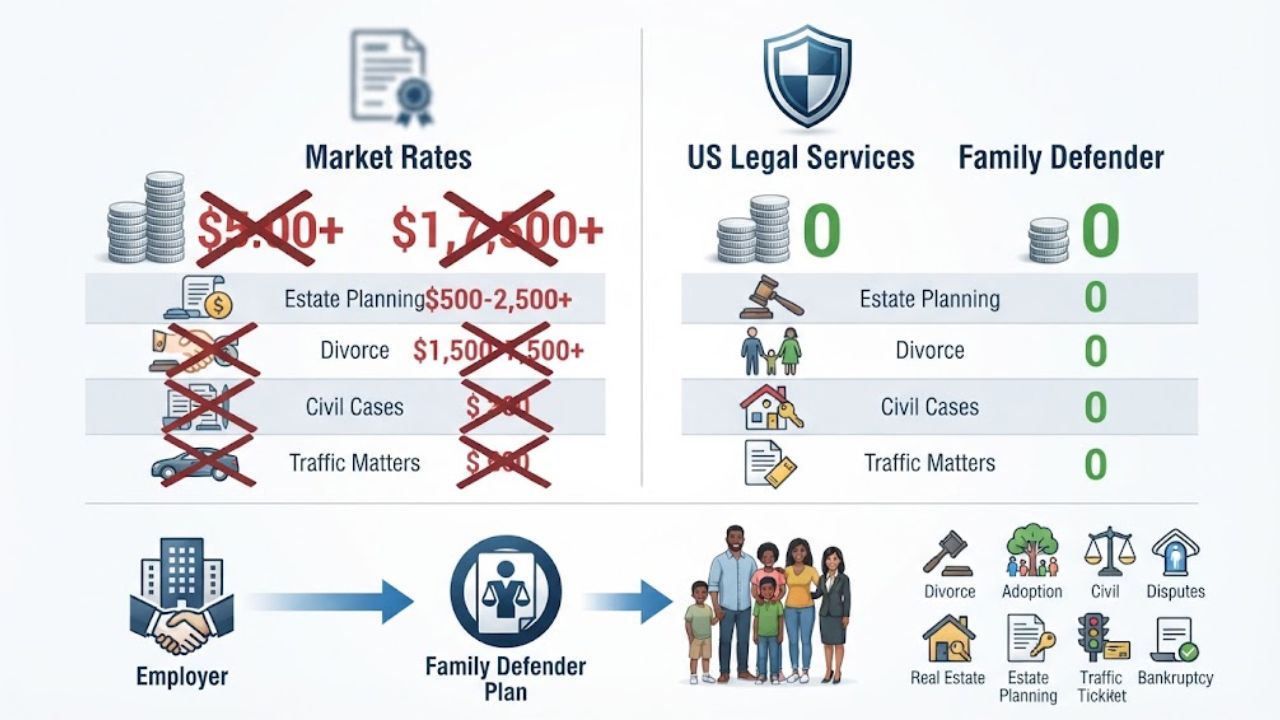
US Legal Services sells Family Defender mainly through employers, from $16.90 a month, dropping to $13.14 in California. The covered list runs long: divorce, adoption, custody and support modification, wills and trusts, real estate transactions, landlord disputes, traffic tickets, and bankruptcy.
The provider publishes a comparison against market rates. Estate planning billed at $500 to $2,500 or more comes to $0. Divorce at $1,500 to $7,500 or more comes to $0. Civil cases and traffic matters follow the same pattern.
Individual enrollment is not yet open. The plan reaches consumers through employer benefits, which puts it in the same access category as MetLife.
What Every Plan Leaves to You
No subscription in this category pays court costs. Filing fees, service of process charges, expert witness fees, and government fines come out of pocket regardless of membership status. A plan can cover the attorney’s time completely and still leave a four-figure bill once a matter reaches litigation.
Waiting periods work the same way across providers. Family law and traffic benefits commonly activate 30 to 90 days after enrollment. A plan bought after a problem starts will not help with that problem.
Immigration matters fall outside most of these plans. A contested divorce, a DUI charge, and a bankruptcy filing all sit in the discounted tier rather than the covered one on every provider listed here, which means the benefit schedule and the discounted hourly rate behave as two separate products and most members end up using the second. Ask which one applies before you enrol.
Reimbursement caps make the network restriction concrete. ARAG publishes a separate non-network attorney schedule that pays less than the network column. MetLife and LegalShield route non-network work to the discounted hourly rate instead. Either way, choosing your own lawyer costs more than using the assigned one.
Matching the Plan to the Legal Work You Actually Have
Read the certificate of coverage before enrolling, not the marketing page. The coverage list decides more than the premium does. Because the tiers are cumulative, the practical question is not which plan is cheapest but which single benefit you expect to use in the next twelve months, since one covered will or one real estate closing repays a year of premiums at any tier.
Four situations make the math obvious. A home purchase with attorney coverage recoups a full year of premiums in one transaction. New parents need wills, guardianship designations, and powers of attorney — a cluster that costs $750 for one person and $1,200 for a couple without a plan. Households approaching retirement need trusts and advance directives updated. Renters facing deposit disputes or eviction defense draw on benefits that would otherwise bill hourly.
Enrollment timing differs enough to change the answer. Employer plans open during annual enrollment or within 30 days of a new hire, so a mid-year decision can mean waiting months. Direct plans activate within days, subject to the waiting periods already described. A plan bought in the middle of a dispute rarely helps with that dispute.
For everyone else, a legal subscription works as insurance against a bill you have not received yet. Buy it before the matter starts. Check that your specific need sits on the covered list. Confirm an in-network attorney practices near you. Then stop. More research will not change the answer.
One final comparison. At $349 an hour, a single three-hour matter costs $1,047. Twelve months of an employer-sponsored plan at $14 a month costs $168. The plan wins on price whenever you use it, and loses whenever you do not.