

A payment can move between accounts before a person has time to review it. Real-time AI fraud detection helps financial institutions assess transactions as they arrive, using patterns in payment data and account activity to decide which ones need a closer look.
The system may flag a purchase that differs from an account’s usual activity, a sudden run of transfers, or a recipient account connected to suspicious payments. A flag is a risk signal, not proof of fraud. The response depends on the payment channel, the institution’s rules, and any further checks it can make.
What Real-time AI Fraud Detection Means
A financial institution may use artificial intelligence (AI) and machine learning (ML) to estimate how suspicious a transaction appears. A model can assess signals such as amount, timing, account history, and payment behavior. Which signals are available varies by provider and payment system.
A real-time AI fraud detection system is rarely one model making every decision. Providers may combine machine learning with fixed rules, identity checks, transaction limits, and staff review. A payment could be approved, challenged, paused, or referred for investigation based on that combined assessment.
“Real time” also varies by task. A card authorization may need a quick response; tracing connections among several accounts can take longer. These systems help institutions act while a payment is being processed or investigated. They cannot guarantee that every fraudulent payment will be stopped.
10 Ways AI Helps Detect Financial Fraud
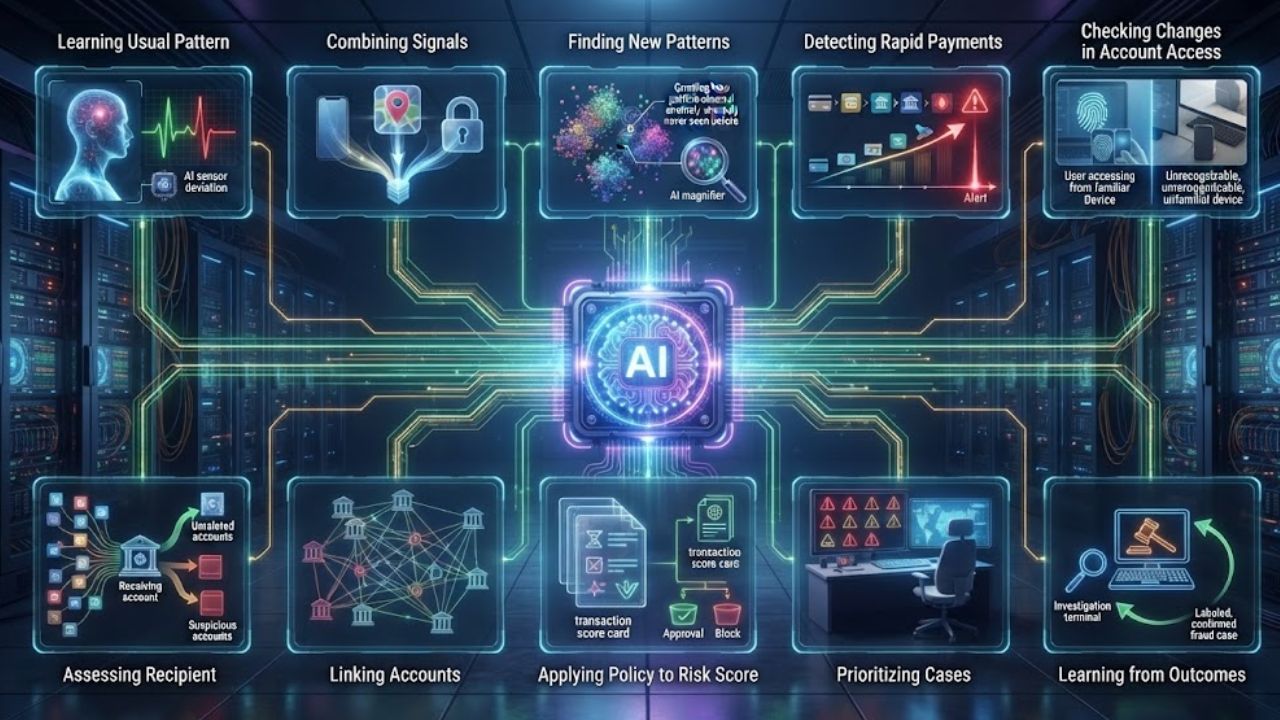
These methods can work together. A payment may be assessed against account history, access signals, and information about the recipient.
1. Learning an Account’s Usual Pattern
Real-time AI fraud detection can compare a new payment with earlier activity linked to an account. The system might consider its amount, timing, frequency, or merchant type, depending on the information available.
A purchase outside a person’s routine is not automatically fraud. Travel or a large one-off expense may explain the change. The model can flag the deviation for further assessment.
2. Combining Several Signals
One signal may be harmless on its own. A new device, for example, could reflect a recent phone upgrade. Several rapid transfers might be normal for a business. But a new device, an unfamiliar recipient, and a recently changed password may together justify another check.
Machine-learning tools can analyze large sets of structured and unstructured data to identify patterns quickly. Their usefulness depends on data quality and system design.
3. Finding New Patterns
Some models learn from transactions already labelled as legitimate or fraudulent. Others look for activity that differs from typical behavior, including patterns that have not yet been labelled.
A Bank for International Settlements (BIS) working paper describes a layered approach to monitoring high-value payment systems: one model separated typical from unusual payments, then another assessed the unusual group. Researchers tested it using artificially manipulated transactions and Canadian payment data. The experiment does not predict how well any particular commercial system will perform.
4. Detecting Rapid or Repeated Payments
A sequence can be more telling than one transaction. Many transfers in quick succession, repeated failed attempts followed by a successful one, or an abrupt rise in activity may prompt review.
Context matters. A business may pay several suppliers at once; a person may send multiple legitimate transfers. The pattern needs to be assessed against the account’s normal activity and payment type.
5. Checking Changes in Account Access
A provider may consider whether an account is being accessed from a familiar device or session. A change can add context when other signals, such as a new recipient or unusual transfer, are also present.
A new phone or software update can explain a change too. Device signals should inform an overall assessment, not trigger an automatic block by themselves.
6. Assessing the Recipient
Real-time AI fraud detection can look beyond the person sending money. If recipient data is available, the system may flag accounts that receive funds from many unrelated sources and quickly transfer them elsewhere.
That pattern can warrant investigation, but it does not prove wrongdoing. Legitimate businesses and individuals may also receive payments from many people.
7. Linking Accounts into a Network
Fraud can involve connected accounts across multiple financial institutions. Reviewing each payment on its own may hide the wider pattern.
Network analysis maps relationships among accounts and transactions. BIS Project Hertha tested payment-system analytics using a simulated dataset of 1.8 million accounts and 308 million transactions. In that experiment, the analysis helped identify 12% more illicit accounts, with a 26% improvement for previously unseen behaviors. BIS noted that the dataset was synthetic and that real-world use would raise practical, legal, and regulatory questions.
8. Applying Policy to a Risk Score
A model may produce a score, but institutional policy determines what happens next. Depending on the transaction and provider, that score might lead to approval, extra authentication, a pause, or manual review.
A suspicious card payment and a high-risk transfer may call for different responses. The institution needs procedures suited to the payment type and applicable requirements.
9. Prioritizing Cases for Staff
A review team cannot investigate every alert with the same urgency. Real-time AI fraud detection can help sort cases by risk signals or possible links to other activity, so investigators can focus on those needing attention.
The alert must include useful context. If staff cannot see why a transaction was flagged, they may struggle to assess it consistently. Human review matters most when a decision could restrict access to someone’s funds.
10. Learning from Investigation Outcomes
Confirmed cases, customer reports, and investigation results can help institutions assess whether their models are identifying useful signals. Feedback may arrive late or be incomplete, though, and incorrect labels can mislead a model.
BIS Project Hertha identified labelled training data, feedback loops, and explainability as important to the approach it studied.
What Happens After a Transaction is Flagged?
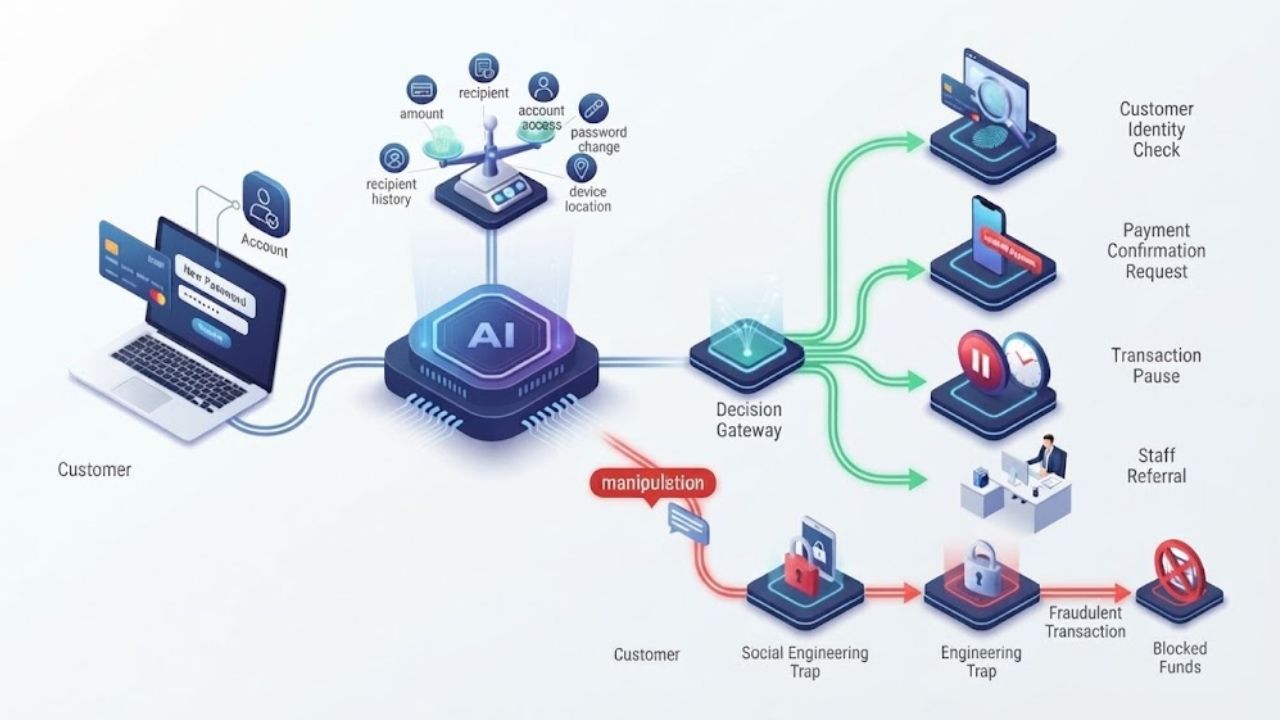
A flag does not have to mean an automatic rejection. A provider may ask the customer to confirm a payment, request another identity check, pause the transaction, or refer it to staff. The available options depend on the payment system and the institution’s procedures.
Imagine a customer initiating a large transfer to a new recipient shortly after changing a password. The amount alone does not prove fraud. The institution may consider the transfer alongside recent account activity and access signals before choosing a response.
There is another important limit: a customer can be manipulated into authorizing a payment themselves. The European Banking Authority has warned that social engineering can lead customers to authenticate fraudulent payments. Authentication can show that a customer approved an action; it cannot establish that the customer was acting freely or understood the scam.
Why Fraud Screening Produces False Alarms
A fraud model can miss suspicious activity or flag a legitimate payment. The second problem can disrupt everyday life if a customer loses access to a card or account while trying to resolve the alert.
In a 2022 enforcement action, the U.S. Consumer Financial Protection Bureau said Bank of America relied on a flawed automated fraud filter that incorrectly froze or blocked some prepaid benefit accounts. The agency’s case shows why screening needs a workable review and customer-support process.
Real-time AI fraud detection must balance missed fraud against the cost of false alarms. A lower alert threshold may catch more suspicious activity, but it can also create more interruptions for customers and more cases for investigators.
Limits of AI Fraud Detection
AI can process data quickly, but it cannot make incomplete information reliable. A model based on older patterns may miss a new scheme or treat a change in ordinary behavior as suspicious. Fraudsters may also adapt to the signals institutions use.
Privacy deserves equal attention. More data does not automatically mean better decisions. Institutions need to consider what information they collect, how they use it, and whether sharing it is permitted and secure. Project Hertha explored identifying patterns with a limited set of data points, but its report also noted unresolved questions about real-world implementation.
What Financial Institutions Should Get Right
The key question for a bank or payment provider is not simply whether it uses AI. It is whether the entire fraud process works for customers and investigators. Institutions should:
- Test models against changing fraud patterns.
- Monitor missed fraud as well as false alarms.
- Give reviewers enough information to understand why an alert was raised.
- Provide customers with a clear way to report and resolve incorrect blocks.
- Limit data collection to what is necessary and permitted.
- Reassess performance when payment behavior or products change.
The BIS Project Hertha results came from a research experiment using synthetic data. They show potential for payment-system analytics, not a result every institution should expect in production.
Final Thoughts
Real-time AI fraud detection can help financial institutions assess payment patterns, spot anomalies, and connect activity across accounts. Its value depends on what happens after an alert: proportionate checks, timely review, and a clear route for customers to resolve mistakes.
For institutions, a risk score is a starting point for a decision, not a substitute for one. For customers, an extra verification step may be inconvenient; being locked out of needed funds without an effective way to appeal is a much more serious failure.
Frequently Asked Questions (FAQs) About Real-Time AI Fraud Detection
Can AI stop every fraudulent transaction?
No. A system may miss a new pattern or lack useful data. It can also flag a legitimate payment, so institutions still need review and dispute processes.
Does an alert mean a payment is confirmed fraud?
No. It means the activity needs another check or has met a risk threshold. It is not proof that the customer or recipient committed fraud.
Sometimes a model may detect unusual recipient or account behavior, but an authorized payment can resemble a legitimate one. When a customer is manipulated into approving it, transaction data alone may not reveal the deception.