

The fraud detection technologies used in insurance claims today center on AI-driven pattern scoring, multimodal AI for images and documents, network and social-graph analysis, natural language processing, predictive analytics, end-to-end platforms like Shift Technology and FRISS, behavioral analytics, and biometric verification.
Most carriers now combine several of these tools instead of relying on one system, because fraud schemes have become more layered and harder to catch with a single method.
What Is Insurance Claims Fraud Detection and How Does It Work?
Insurance claims fraud detection is the process of identifying claims that contain false, exaggerated, or staged information before a payout is approved. It works by combining data checks, pattern analysis, and human investigation to separate legitimate claims from suspicious ones.
Most carriers run claims through several layers of review:
- Intake screening, software scores a claim the moment it’s filed, often within seconds.
- Pattern matching, the system compares the claim against known fraud indicators and historical data.
- Risk scoring, claims above a certain risk threshold get flagged for a Special Investigations Unit.
- Human investigation, trained investigators review flagged claims, request documentation, and sometimes conduct interviews.
A quick example: a water damage claim filed two days after a policy’s effective date, paired with a repair estimate that matches a known inflated-pricing contractor, would likely trigger an automatic flag before a human ever sees the file.
What Are the Main Types of Fraud in Insurance Claims?
Insurance claims fraud generally falls into three categories: opportunistic fraud, organized fraud, and internal fraud. Each type requires a different detection approach, which is why most carriers use layered technology rather than one tool.
| Fraud type | Description | Common examples |
|---|---|---|
| Opportunistic (soft) fraud | Exaggerating a real, legitimate claim | Inflating repair costs, padding injury claims |
| Organized (hard) fraud | Staged or fabricated events by coordinated groups | Staged car accidents, fake slip-and-fall claims, arson rings |
| Internal fraud | Fraud involving agents, adjusters, or employees | Falsifying claim approvals, fake policies, premium diversion |
Soft fraud is the most common and the hardest to prosecute because the underlying event is real. Hard fraud involves deliberate staging and is usually the target of network analysis and SIU investigations. Internal fraud is less frequent but can be more costly per incident, since it often involves access to multiple claim files.
The 8 Fraud Detection Technologies Used in Insurance Claims
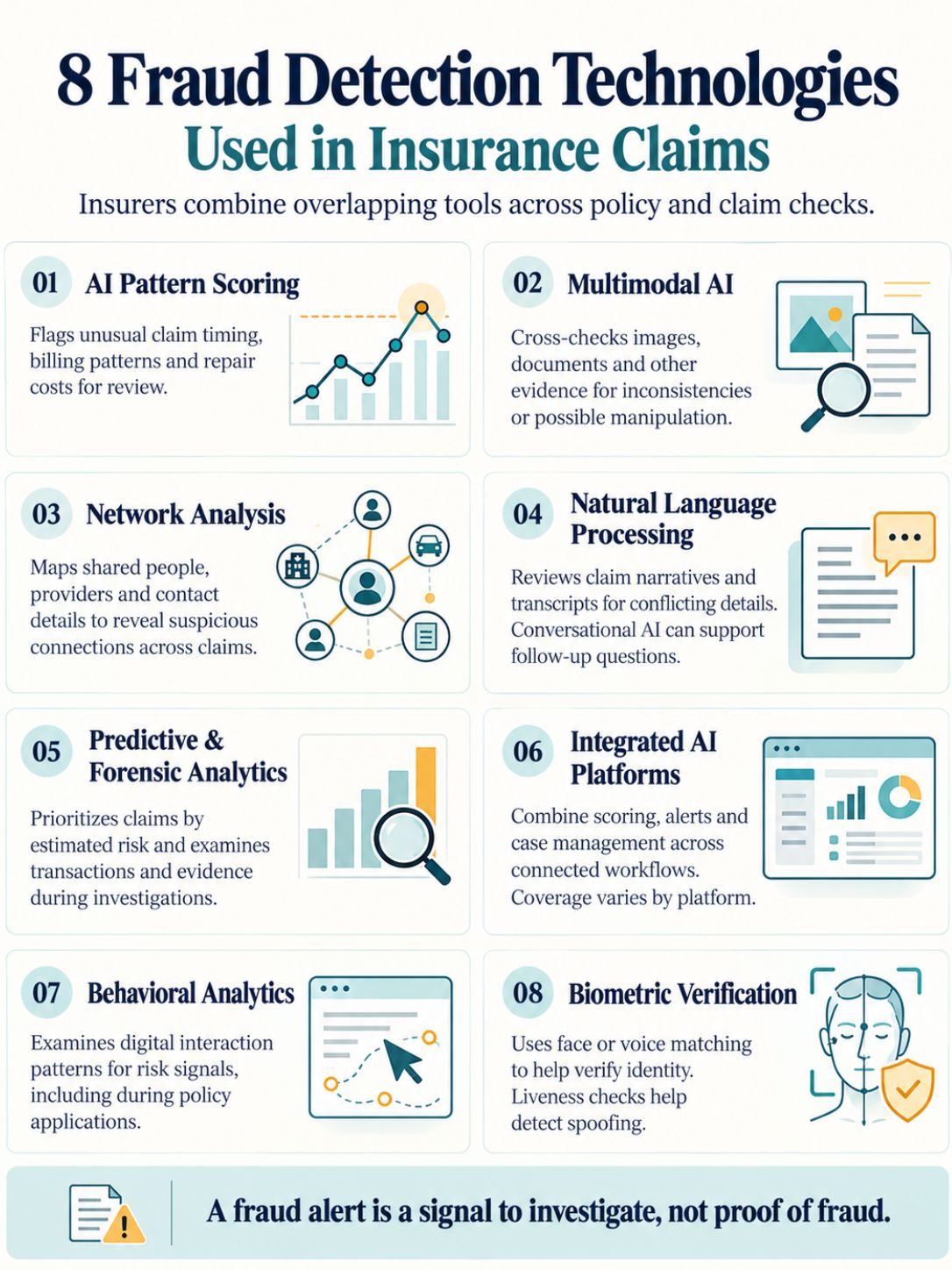
The core fraud detection technologies used in insurance claims today are AI pattern scoring, multimodal AI, network and social-graph analysis, natural language processing, predictive and forensic analytics, end-to-end AI platforms, behavioral analytics, and biometric verification. Carriers typically layer two or more of these tools across the claim lifecycle rather than depending on a single system.
1. AI-Driven Pattern Scoring and Anomaly Detection
AI pattern scoring is now the backbone of fraud detection across most claims platforms. Machine learning models review thousands of data points per claim and flag anything that deviates from normal patterns, such as unusual claim timing, mismatched billing codes, or repair estimates that don’t fit the reported damage.
2. Multimodal AI for Images, Video, and Documents
Multimodal AI analyzes photos, video, audio, and text together instead of separately. This matters because digitally altered or AI-generated damage photos have become more common, and a system that only checks text descriptions can miss a manipulated image entirely.
3. Network and Social-Graph Analysis
Network analysis maps relationships between claimants, witnesses, repair shops, medical providers, and attorneys to expose organized fraud rings. If the same clinic, tow truck company, or phone number appears across dozens of unrelated claims, the system surfaces that connection automatically.
4. Natural Language Processing (NLP) and Conversational AI
NLP tools analyze written claim narratives and recorded interview transcripts for inconsistencies, hesitation patterns, or language that doesn’t match the claimed event. Conversational AI is also being used in claim interviews to ask structured follow-up questions and flag contradictory answers in real time.
5. Predictive and Forensic Data Analytics
Predictive analytics scores the probability that a claim is fraudulent based on patterns learned from historical data, while forensic analytics digs into specific transactions once a claim is already flagged. These tools are now embedded directly inside carrier SIUs so fraud signals surface early, not after payment.
6. End-to-End AI Fraud Platforms
Vendors such as Shift Technology, FRISS, and SAS offer platforms that score policies and claims across the entire lifecycle, underwriting, first notice of loss, and claims payout, rather than at just one checkpoint. This reduces blind spots between departments that used to operate independently.
7. Behavioral Analytics and Application-Journey Monitoring
Behavioral analytics tracks how a person interacts with an online application or claims portal, such as typing speed, copy-paste behavior, or device switching. It’s designed to catch fraud signals before a claim is even filed, during the policy application stage.
8. Biometric Verification
Biometric technology uses voice, face, or fingerprint verification to confirm a claimant’s identity and detect synthetic identities or impersonation attempts. It is increasingly paired with liveness checks to confirm a real person, not a photo or recording, is submitting the claim.
Rule-Based vs. Predictive Fraud Detection: What’s the Difference?
Rule-based fraud detection flags claims that match specific, predefined conditions, while predictive fraud detection uses machine learning to score claims based on patterns learned from historical data. Rule-based systems are easier to explain and audit; predictive systems catch new fraud patterns that rules haven’t been written for yet.
| Feature | Rule-based detection | Predictive detection |
|---|---|---|
| How it works | If-then logic based on fixed conditions | Machine learning scores based on historical patterns |
| Best for | Known, well-documented fraud schemes | New or evolving fraud patterns |
| Transparency | High, easy to explain a flag | Lower, requires model interpretability tools |
| Maintenance | Rules need manual updates | Models retrain on new data automatically |
| Weakness | Misses novel fraud types | Can be harder to justify to regulators |
How Do Insurance Companies Use Data Analytics to Prevent Claims Fraud?
Insurance companies use data analytics to prevent claims fraud by scoring risk before a claim is even filed, not just after. Analytics teams pull from policy history, third-party databases, public records, and claim-filing behavior to spot risk signals early in the underwriting and application stage.
Common applications include:
- Cross-referencing new claims against industry-wide databases to catch repeat claimants across multiple carriers.
- Monitoring claim-filing velocity (how soon after a policy starts a claim is filed).
- Comparing provider billing patterns against regional and national averages.
- Flagging policy changes made shortly before a loss event, such as a sudden coverage increase.
A common mistake carriers make is treating analytics as a one-time underwriting check instead of a continuous process. Fraud patterns evolve, so static rules built in 2022 may miss schemes common in 2026.
How Much Does Fraud Detection Software Cost for Insurance Companies?
Fraud detection software costs vary widely based on claim volume and whether a carrier builds custom tools or buys a vendor platform. Smaller insurers typically pay a few thousand dollars per month for basic analytics modules, while large national carriers often sign multi-year contracts worth seven figures annually for end-to-end AI platforms.
| Carrier size | Typical approach | Rough cost range |
|---|---|---|
| Small regional insurer | Shared SaaS fraud-scoring module | $2,000,$15,000/month |
| Mid-sized carrier | Vendor platform with custom rules | $50,000,$500,000/year |
| Large national carrier | Full lifecycle AI platform (underwriting + claims) | $1M+/year |
Pricing usually depends on claim volume, number of integrations (policy admin, claims systems, third-party data), and whether the carrier needs real-time scoring versus batch processing.
Can Small Insurance Companies Afford Advanced Fraud Detection Technology?
Yes, small insurance companies can afford advanced fraud detection technology, mainly because many vendors now offer modular, cloud-based pricing instead of large upfront licensing deals. This has made AI-based fraud scoring accessible to regional and specialty insurers that could not previously justify the cost.
Smaller carriers typically start with:
- A single fraud-scoring module focused on their highest-risk line of business (often auto or property).
- Shared industry databases instead of building proprietary data sets.
- Outsourced SIU support combined with software, rather than hiring a full in-house team.
Can Fraud Detection Systems Make Mistakes and Deny Legitimate Claims?
Yes, fraud detection systems can make mistakes, and false positives remain one of the biggest criticisms of AI-based claims scoring. A legitimate claim can get flagged simply because it shares surface-level similarities with known fraud patterns, such as filing timing or provider location.
Common causes of false positives include:
- A claimant using the same contractor or clinic that also handled fraudulent claims unrelated to them.
- Policy changes made for legitimate reasons shortly before a loss (moving, adding a driver, refinancing).
- Data entry errors that create inconsistencies between the claim form and supporting documents.
How accurate are current insurance fraud detection systems?
Accuracy varies by vendor and model, and carriers generally don’t publish exact false-positive rates publicly. Most systems are tuned to flag a percentage of claims for human review rather than auto-deny them, specifically to reduce the risk of denying a legitimate claim without a person ever looking at it. Carriers that skip the human review step and rely on automated denials face higher complaint and appeal rates.
What Are the Best Fraud Detection Tools for Insurance Claims Processing?
The best fraud detection tools for insurance claims processing combine AI scoring, network analysis, and case management in one platform rather than requiring separate systems for each function. Shift Technology, FRISS, and SAS are among the most widely used end-to-end platforms in the industry as of 2026.
When evaluating tools, claims and risk teams should look for:
- Real-time scoring at first notice of loss, not just after a claim is already in process.
- Explainable AI outputs that investigators can defend in court or to regulators.
- Integration with existing claims management and policy admin systems.
- Built-in network analysis for identifying organized fraud rings, not just individual claim flags.
- Regular model retraining to adapt to new fraud patterns.
How Do Insurance Companies Investigate Suspected Fraud?
Insurance companies investigate suspected fraud by routing flagged claims to a Special Investigations Unit, where trained investigators verify documentation, interview claimants, and sometimes coordinate with law enforcement. The process is designed to confirm or clear a fraud flag before any payout decision is finalized.
A typical SIU investigation includes:
- Reviewing the AI-generated fraud score and the specific triggers behind it.
- Pulling supporting documents, police reports, medical records, repair invoices.
- Interviewing the claimant and any witnesses, sometimes using recorded statements.
- Cross-checking the claim against industry fraud databases and prior claim history.
- Referring confirmed fraud cases to state insurance fraud bureaus or law enforcement.
Investigations can take anywhere from a few days for straightforward cases to several months for organized fraud rings involving multiple claimants and providers.
What Red Flags Trigger Fraud Investigations in Insurance Claims?
Certain claim characteristics consistently trigger fraud investigations, including timing irregularities, inconsistent documentation, and connections to known high-risk providers. No single red flag proves fraud, but multiple flags together usually push a claim into SIU review.
Common red flags include:
- A claim filed shortly after a policy starts or right before cancellation.
- Damage or injury descriptions that don’t match the physical evidence.
- Repair estimates significantly above regional averages.
- Claimant history showing multiple prior claims across different carriers.
- Reluctance to provide documentation or inconsistent statements across interviews.
- Use of a provider, repair shop, or attorney previously linked to confirmed fraud.
Is Biometric Technology Used in Insurance Fraud Detection?
Yes, biometric technology is used in insurance fraud detection, primarily to verify identity and catch synthetic identity fraud during both the application and claims stages. Voice, facial recognition, and fingerprint verification are the most common biometric tools in use as of 2026.
Biometrics are especially useful for:
- Confirming the person filing a claim is the actual policyholder, not an impersonator.
- Detecting synthetic identities created with stolen or fabricated personal data.
- Adding liveness checks during video claim submissions to confirm a real person is present.
Biometric tools work best paired with other technologies, such as document verification and behavioral analytics, rather than as a standalone fraud check.
What Happens If You Commit Insurance Fraud and Get Caught?
Getting caught committing insurance fraud can lead to felony charges, mandatory restitution, policy cancellation, and potential prison time, depending on the state and the dollar amount involved. Insurance fraud is illegal in all 50 U.S. states, though specific penalties vary by jurisdiction and whether the fraud is classified as a misdemeanor or felony.
Typical consequences include:
- Criminal charges ranging from misdemeanors for small claims to felonies for amounts often starting around $1,000,$2,500, depending on the state.
- Court-ordered restitution requiring repayment of any fraudulently obtained funds.
- Permanent policy cancellation and difficulty obtaining coverage in the future.
- Civil lawsuits from insurers seeking additional damages beyond restitution.
- A criminal record that can affect employment, licensing, and future insurance applications.
The FBI has estimated that insurance fraud (excluding health insurance) costs more than $40 billion a year in the United States, a figure that has stayed roughly consistent across multiple years of federal reporting. That cost ultimately gets passed to policyholders through higher premiums, which is part of why carriers continue investing heavily in detection technology.
Final Thoughts
Fraud detection technologies used in insurance claims have shifted from static rule checklists to layered AI systems that score risk from application through payout. Carriers that rely on a single tool, like basic rules engines, are increasingly outmatched by organized fraud rings using digitally fabricated evidence and synthetic identities. The strongest defense in 2026 combines AI pattern scoring, network analysis, NLP, biometric verification, and trained SIU investigators working together rather than in isolation.
For claims and risk teams evaluating next steps: start by auditing which fraud types hit your book of business hardest, then match technology investment to that specific risk rather than buying a full platform upfront. Small and mid-sized carriers can begin with one targeted module, such as intake scoring or biometric identity checks, and expand from there as claim volume and fraud exposure grow.
Frequently Asked Questions
What is insurance claims fraud detection and how does it work?
Insurance claims fraud detection combines AI scoring, data analysis, and human investigation to identify false or exaggerated claims before payment. Claims are scored at intake, flagged if they match known fraud patterns, and routed to investigators for final review.
What are the main types of fraud in insurance claims?
The main types are opportunistic (soft) fraud, organized (hard) fraud, and internal fraud involving employees or agents. Soft fraud involves exaggerating a real claim, while hard fraud involves staged or fabricated events.
How do insurance companies use AI and machine learning to detect fraud?
Insurance companies use AI and machine learning to score claims in real time, detect anomalies, analyze images and documents, and map connections between claimants and providers. These tools flag suspicious claims for human review rather than making final denial decisions on their own in most cases.
What’s the difference between rule-based and predictive fraud detection?
Rule-based detection flags claims matching fixed, predefined conditions, while predictive detection uses machine learning to score risk based on learned patterns. Rule-based systems are more transparent; predictive systems adapt faster to new fraud schemes.