Using a multilingual AI voice can look like the easiest way to scale global content. You prepare one script, generate versions in several languages, and suddenly a product demo, training video, audiobook, or support flow can reach audiences you could not serve before.
That sounds efficient. It is also where many teams get careless.
A voice that sounds warm and convincing in English may sound stiff in Spanish. It may handle standard French but struggle with regional accents. It may translate the words correctly while losing the tone that makes the message feel local. This is why multilingual voice work needs more than a quick demo test.
A multilingual AI voice is useful only when it respects the listener. That means clear pronunciation, natural pacing, proper accent fit, localized wording, and enough human review to catch what the software misses.
Redefining Multilingual Voices
When people talk about AI voice languages, they often treat the technology as one simple feature. In practice, it is a chain of different tasks.
At the basic level, you have foreign language TTS, where a translated script is converted into speech. That can work well for simple narration, tutorials, app instructions, and internal training.
At the more advanced level, you have AI dubbing and voice cloning. These systems try to carry a speaker’s identity, timing, and emotional tone from one language into another. That is much harder. It is not just about saying the right words. The voice also has to sound believable in the new language.
Whether you are localizing an e-learning course or building a multilingual support bot, the quality depends on how well translation, voice generation, pronunciation, and review work together.
The Core Problem: Multilingual Is Not the Same as Localized
The biggest mistake is assuming that a tool with dozens of languages is ready for dozens of markets.
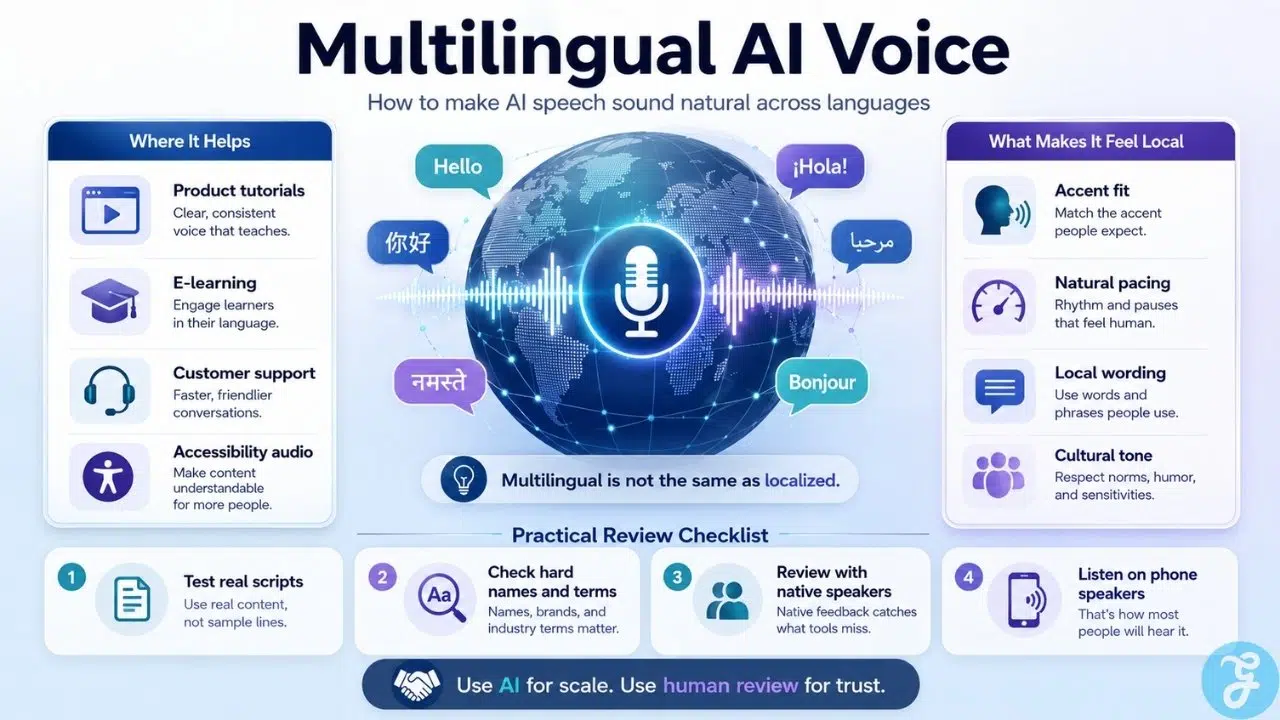
Multilingual means the system can generate speech in more than one language. Localized means the audio feels right for a specific audience.
Spanish in Mexico is not the same as Spanish in Spain. Arabic varies widely by region. English in India, the United States, the United Kingdom, and Australia carries different expectations around accent, rhythm, and tone. Even formality can change how a sentence feels.
If a multilingual AI voice ignores regional pronunciation, local vocabulary, or emotional restraint, native listeners will notice. The audio may be technically understandable, but it can still feel cold, generic, or obviously synthetic.
That gap matters most when the voice represents a brand, teacher, executive, narrator, or customer-facing assistant.
Where the Technology Works Best
Multilingual AI voice tools often work best for structured, informational content where clarity matters more than performance.
Good use cases include:
- Software walkthroughs and tutorials
- Internal HR or compliance training
- App onboarding sequences
- Product explainers
- Accessibility narration
- FAQ videos
- Draft voiceovers for market testing
For lean teams, this can be genuinely useful. A company can test whether a product tutorial performs better in three languages before investing in full studio localization. A course creator can make learning material more accessible without waiting months for voice production in every market.
The technology is strongest when the message is direct, the script is clean, and the emotional demands are moderate.
It becomes weaker when the script depends on comedy, sarcasm, character performance, cultural nuance, or high emotional stakes. A machine can pronounce every vowel correctly and still miss the human meaning underneath.
Language is not a code-conversion problem. It is communication.
The Evaluation Checklist
Do not judge a multilingual AI voice from a single vendor demo. Build a short test script using real content from your own project.
Include product names, acronyms, numbers, local phrases, technical terms, questions, warnings, and a few longer paragraphs. Then generate several minutes of audio and listen for the problems that usually appear after the first polished sentence.
Check these areas closely:
Pronunciation and accent match: Does the voice sound natural to a local listener, or does it feel like a generic international blend? Accent affects comfort, trust, and comprehension.
Pacing and script length: Different languages take different amounts of time to express the same idea. If the translated script is longer than the original and the voice is forced into the same timing, the delivery may sound rushed.
Prosody and consistency: Listen for natural rise, fall, stress, and pauses. Watch for sudden volume shifts, robotic emphasis, metallic artifacts, or emotional flattening across longer passages.
The best review step is still simple: ask native speakers to listen. They will catch awkward phrasing, wrong stress, and regional issues that a non-native production team may miss.
Translation Comes Before Voice Quality
Even the best foreign language TTS engine cannot rescue a clumsy translation.
If the script sounds awkward on the page, the AI voice will simply deliver awkward language with smoother audio. That is not localization. That is polished discomfort.
Before generating speech, review the script for natural phrasing, local vocabulary, formality, cultural references, and sentence length. For video dubbing, also check timing. A literal translation may not fit the scene, so the line may need to be adapted rather than copied word-for-word.
Script adaptation is editorial work, not a file format swap.
Ethics, Cloning, and AI Dubbing
Some platforms can preserve a speaker’s voice identity across different AI voice languages. This can help executives, educators, creators, and brands maintain a consistent presence across markets.
It also creates serious consent and trust issues.
If you clone a real person’s voice and make it speak a language they do not actually speak, consent is non-negotiable. The person should know where the voice will appear, which languages it will use, and whether the audio can be reused later.
For high-stakes brand campaigns, film work, children’s content, culturally sensitive topics, or emotional storytelling, human dubbing talent may still be the better choice. AI can help with scale. Human performers are often better at nuance, cultural rhythm, and emotional truth.
The smarter approach is not “AI or human.” It is knowing which parts of the workflow need speed and which parts need human care.
The Real Value of Global Audio
The real value of multilingual AI voice is not just lower cost or faster production. The real value is access.
It can help small teams offer education, support, product guidance, and digital content to people who were previously left with subtitles, weak translations, or no localized experience at all.
But access without quality can still feel like neglect. If the audio sounds foreign to the audience it is supposed to serve, the work has not truly been localized.
Use AI to handle scale. Use native review to protect meaning, tone, and trust. That is how multilingual AI voice becomes a useful global communication tool instead of another shortcut that sounds good only in a demo.