
Modern witchcraft is a broad, flexible practice that many people use to create meaning, build healthy routines, connect with nature, and explore spirituality or symbolism. Some practitioners approach it as a religious path. Others treat it as a personal, nonreligious practice built around intention, reflection, and ritual. Many land somewhere in the middle.
This guide is designed to be beginner-friendly, ethically grounded, and practical. It avoids sensationalism and focuses on what you can do safely, respectfully, and responsibly.
Important note: witchcraft is not a substitute for professional medical care, mental health support, legal advice, or financial counseling. If you’re dealing with harm, crisis, illness, or safety threats, seek qualified help first.
What Modern Witchcraft Is (And What It Isn’t)
Modern witchcraft is best understood as a practice rather than a single belief system. Think of it as a set of methods people use to focus attention, build intention, and work with symbolism, nature cycles, or spiritual frameworks.
Common elements in modern witchcraft include:
- Rituals that mark transitions, goals, and emotional shifts
- Symbolic tools such as candles, herbs, stones, water, salt, or written petitions
- Practices like grounding, cleansing, protection, and visualization
- Divination (tarot, oracle cards, runes) used for reflection and insight
- Seasonal or lunar timing for structure, not as a requirement
- A personal ethical framework centered on consent and responsibility
Modern witchcraft is not:
- A guaranteed way to control outcomes
- A replacement for real-world action
- A license to manipulate others
- A single religion that everyone follows the same way
- A personality aesthetic you must buy your way into
You do not need to identify as “a witch” to learn about witchcraft. Many people explore it quietly, selectively, or skeptically. Your practice can be as private, simple, or structured as you want.
Modern Witchcraft vs Wicca vs Paganism (Simple Distinctions)
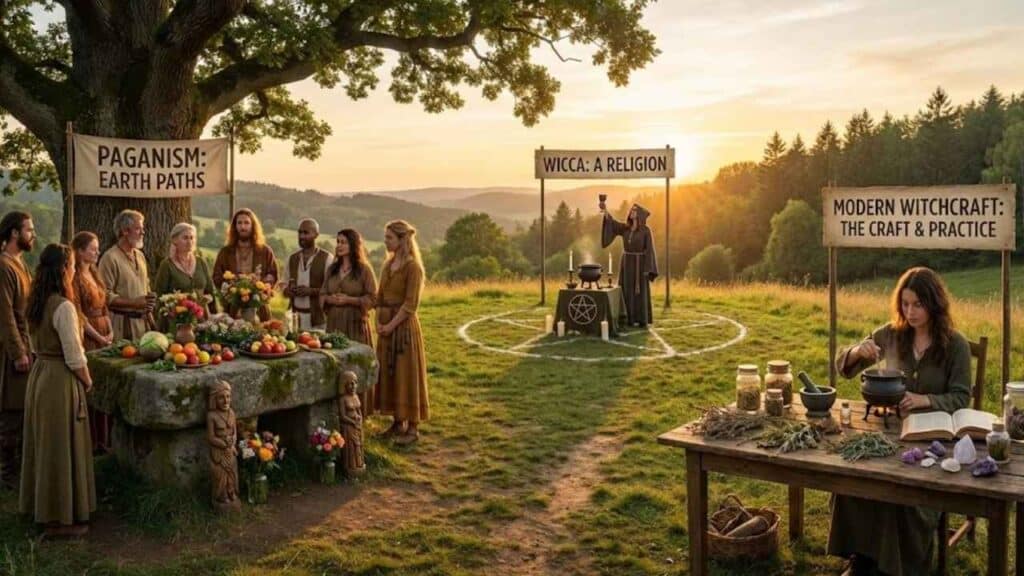
Beginners often see these terms used interchangeably online, but they describe different things and don’t always overlap. Modern witchcraft is usually practice-centered, meaning you can use rituals, symbolism, and spellwork without committing to a specific religion. Wicca is a distinct modern religion with its own structure, ethics, and seasonal celebrations, and while many Wiccans practice witchcraft, not all witches are Wiccan. Paganism is a broad umbrella for many nature-based and polytheistic spiritual paths, so some Pagans practice witchcraft and some do not. If labels feel confusing, it’s completely okay to start by learning skills and ethics first, then choose words later if you want to.
Beginners often encounter these terms together online, but they are not identical.
Witchcraft
Witchcraft is primarily a practice, meaning it focuses on what you do (rituals, symbols, intention) rather than requiring a fixed belief system. It can be spiritual or secular, and it can be practiced alone or within a group, depending on your comfort and community. Many modern approaches treat witchcraft as a way to build habits, boundaries, and self-awareness through meaningful routines and reflection. Ethical witchcraft emphasizes consent, responsibility, and cultural respect, keeping the focus on personal growth and non-coercive intentions.
Wicca
Wicca is a modern Pagan religion that emerged in the mid-20th century and is often associated with nature reverence, seasonal festivals, and ritual practice. Many Wiccans identify as witches, but not all witches are Wiccan, and not all Wiccans practice witchcraft the same way. Wicca commonly emphasizes personal responsibility, ethical intention, and balance in spiritual work rather than fear-based practice. It is a diverse path with multiple traditions, so beliefs, rituals, and deity concepts can vary widely from one practitioner to another.
Paganism
Paganism is an umbrella term for a wide range of modern and historical nature-centered spiritual paths, rather than one single religion. Many forms of modern Paganism draw inspiration from pre-Christian traditions, seasonal cycles, mythology, and earth-based reverence. Some Pagans practice witchcraft, but Paganism and witchcraft are not automatically the same thing—one can exist without the other. Because Pagan paths vary widely, beliefs and rituals can look very different from person to person, tradition to tradition, and region to region.
Paganism is a broad umbrella that includes many modern nature-based or polytheistic spiritual paths. Some witches are Pagan, and some are not. If labels feel confusing, skip them for now. Starting with ethics, safety, and foundational skills is more useful than picking an identity early.
Why Ethics Matter in Witchcraft
Because witchcraft often deals with intention, influence, and personal power, it can easily slide into harmful territory if someone treats other people like objects rather than humans with autonomy.
Ethical witchcraft is not about being perfect. It’s about practicing with care.
A practical ethical approach usually includes:
- Consent: respecting other people’s autonomy and boundaries
- Responsibility: pairing intention with real-world action and accountability
- Harm reduction: avoiding practices that cause damage, panic, or coercion
- Cultural respect: learning origins and avoiding taking what isn’t yours to take
Ethics are also what protect beginners from fear-based content and predatory services. If a practice increases anxiety, obsession, or paranoia, that’s a sign to pause and return to basics.
Consent: The Foundation of Ethical Practice
Consent is the clearest ethical guide in modern witchcraft because it centers human autonomy and personal boundaries. It helps you decide what kinds of workings feel responsible, respectful, and emotionally healthy. A consent-first approach shifts your practice toward self-growth and mutual wellbeing rather than control or coercion. When you treat consent as non-negotiable, your craft becomes safer, more grounded, and less driven by fear or obsession.
Consent is a clear line that helps beginners decide what to practice and what to avoid.
Consent-based witchcraft focuses on:
- Your choices, healing, habits, and boundaries
- Your emotional clarity and self-understanding
- Your protection and wellbeing
- Mutual relationships and healthy communication
Consent problems typically arise in spells meant to:
- Make someone love you
- Make someone return to you
- Make someone do what you want
- Punish someone instead of setting boundaries or seeking help
A simple consent test:
- Would I be okay if someone tried this on me without my permission?
If the answer is no, stop and choose a different goal.
Ethical alternatives to coercive spells:
- Confidence and communication work for yourself
- Boundary work to reduce contact with harmful people
- Clarity work to decide what you want next
- Grief or closure rituals to help you move forward
Cultural Respect and Closed Practices
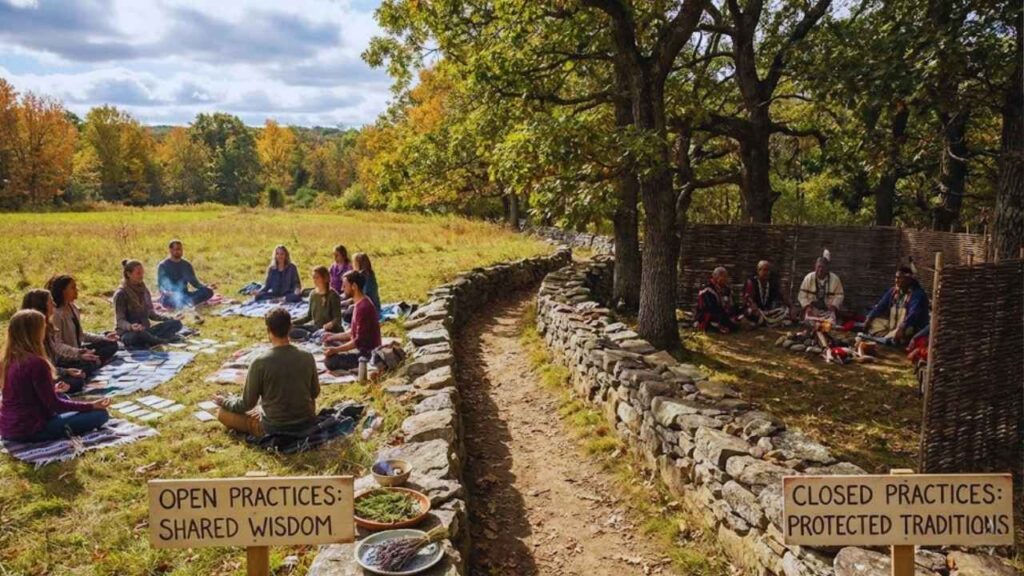
Modern witchcraft is often explored through books, social media, and mixed online communities, which can blur the lines between personal practice and cultural borrowing. Cultural respect means recognizing that some spiritual traditions are living, sacred, and community-protected, not just “inspiration” for aesthetic or trend-based spirituality. Closed practices are traditions that require initiation, lineage, cultural belonging, or explicit permission from the community to practice them responsibly. Approaching these topics with humility protects both you and others: it helps you learn more accurately, avoid harm, and build a practice rooted in integrity rather than imitation.
Modern witchcraft often borrows ideas from different cultures, but that doesn’t mean everything is open to everyone.
A respectful approach includes:
- Learning where a practice comes from
- Understanding whether it is part of a living tradition
- Avoiding sacred elements that require initiation, community permission, or cultural belonging
- Not claiming a tradition as your own if you’re not part of it
- Supporting teachers, authors, and artisans who come from the culture
A helpful guideline:
- If you don’t know the origin of a practice, pause and research before using it.
This reduces harm and also improves your learning quality.
A Balanced Note on History and Context
The word “witch” carries historical weight. In many periods and places, accusations of witchcraft were tied to fear, social control, religious conflict, misogyny, and scapegoating. Many people suffered under witch trials and persecution. At the same time, many cultures have their own folk practices, healing traditions, and spiritual systems that are not the same thing as “witchcraft” in the European trial sense.
A respectful modern approach:
- Acknowledge historical persecution without romanticizing it
- Avoid claiming direct lineage unless you have real evidence
- Remember that modern witchcraft is a contemporary practice influenced by many streams, not a single unbroken tradition
The Core Building Blocks of Modern Witchcraft
If you want a practice that is stable, safe, and meaningful, focus on foundations before spellwork.
Intention
Intention is a clear statement of what you want to cultivate or change. It works best when it is:
- Specific
- Realistic
- Focused on your agency
Examples:
- I choose calm and clarity in stressful conversations.
- I build discipline for my health routine.
- I protect my time and energy with healthy boundaries.
Attention
Many rituals work because they train attention. When you repeatedly focus on a value (calm, courage, patience), your mind learns to notice opportunities to act on it.
Symbolism
Symbols help your brain and emotions engage with a goal. Candles, water, written words, or a simple stone can become a reminder of your intention.
Action
Ethical witchcraft links intention to practical steps. If you do a confidence ritual, you also practice the behavior that confidence requires.
Reflection
Tracking what you do helps prevent magical thinking spirals and helps you improve your craft with time.
How to Start Practicing Modern Witchcraft Ethically (Beginner Path)
Here is a straightforward beginner process that keeps you grounded.
Step 1: Write your ethical code
Keep it short. Examples:
- I prioritize consent and do not practice coercive spellwork.
- I do not promise guaranteed outcomes to myself or others.
- I research origins before adopting cultural practices.
- I practice safely and stop if anxiety spikes.
- I pair ritual work with real-world action.
Step 2: Build a basic weekly routine
A realistic beginner plan:
- Daily (5–10 minutes): grounding or breathwork
- Weekly (20–40 minutes): a simple ritual for clarity, gratitude, or motivation
- Weekly (10–20 minutes): journaling what changed and what you learned
Step 3: Start a witchcraft journal
Your journal is your best tool. Use a simple template:
- Date and time
- Mood before
- Intention (one sentence)
- What I did (steps and tools)
- Mood after
- What I will do in real life this week
- Results to watch for (next 7–14 days)
- Notes and reflections
Step 4: Learn one technique at a time
- Beginner mistake: trying everything at once.
- Better approach: pick one focus for two weeks (grounding, cleansing, tarot basics, candle work) and learn it well.
Tools of the Craft (Minimal, Budget-Friendly, and Practical)
Tools are optional. They help some people focus, but they are not a requirement for effective practice.
Common tools and what they represent
- Candle: focus, transformation, timing, commitment
- Bowl of water: emotion, cleansing, reflection
- Salt: purification symbolism, boundaries
- Paper and pen: clarity, intention, commitment
- Stone or crystal: grounding, tactile reminder
- Herbs or tea: sensory cue, tradition, comfort
- Incense: scent-based focus cue
- Small cloth or tray: creates a dedicated space
Beginner starter kit (low cost)
- A candle (or a small LED candle if fire safety is a concern)
- A notebook and pen
- A bowl or cup of water
- A pinch of salt
- A small object that feels meaningful (stone, charm, key, coin)
Ethical sourcing and safety
- Don’t buy what you can’t afford
- Avoid risky practices like ingesting unknown herbs
- If you have pets, allergies, or asthma, be cautious with smoke and oils
- If a tool triggers anxiety or obsession, remove it from your practice
Creating an Altar (Optional, Not Required)
An altar is a space that helps you enter a focused mindset. It can be:
- A shelf
- A corner of a desk
- A box you keep private
- A travel pouch
- A single candle beside your journal
Simple altar setup
- Center: candle or a small object representing your intention
- Left side: something connected to calm or cleansing (water, salt, a shell)
- Right side: something connected to action or strength (a key, a coin, a small stone)
- Optional: a note with your ethical code
Your altar should feel safe and calming, not cluttered or stressful.
Ritual Basics: A Structure You Can Use Every Time
Many beginners feel lost because online rituals look complicated. You can keep rituals simple and still make them meaningful.
A basic ritual structure
- Prepare your space (tidy a little, silence phone)
- Ground (slow breathing, feel your feet, unclench shoulders)
- State your intention (one sentence)
- Do the main action (candle, petition, visualization, water ritual)
- Close (gratitude, release, blow out candle safely)
- Journal (two minutes)
How to ground (simple method)
- Sit comfortably
- Inhale slowly, exhale longer than you inhale
- Name five things you can see
- Name four things you can feel
- Name three things you can hear
- Name two things you can smell
- Name one thing you can taste
- Then rest your attention on the breath for one minute
Grounding is also what you do after intense emotional ritual work.
Cleansing: What It Means and How to Do It Without Fear
Cleansing is often misunderstood. In ethical practice, cleansing is a reset, not a panic response.
Healthy reasons to cleanse:
- You had a stressful day and want to reset your mood
- You are starting a new routine and want a clear mental cue
- You want a symbolic “fresh start” after conflict
Unhealthy cleansing patterns:
- Compulsively cleansing multiple times a day
- Believing every bad mood is a curse
- Letting fear-based content control your behavior
Beginner cleansing ritual (no smoke)
- Wash your hands slowly
- Put a pinch of salt into a bowl of water
- Stir clockwise while saying your intention in plain language
- Dab a little water on your forehead or wrists
- Pour the rest down the sink and rinse the bowl
- Journal one sentence: what you’re releasing and what you’re keeping
Protection: Boundaries Disguised as Magic (And That’s Okay)
Protection work is often most effective when it strengthens your real boundaries.
Protection ideas that stay ethical
- A morning intention: “My time and energy are mine to guide.”
- A visual boundary: imagine a calm light around you
- A physical boundary: tidy your space, lock doors, block abusive contacts
- A “closing” habit after emotional conversations: wash hands, drink water, write one sentence
Beginner protection jar (safe, symbolic)
You can use any small jar or container.
- Put in salt (boundary)
- Add paper with a clear boundary statement
- Add a small stone (stability)
- Close it and keep it where you work or rest
This is not about paranoia. It’s about reminding yourself you are allowed to protect your wellbeing.
Spellwork: An Ethics-First Approach
Spellwork is where modern witchcraft can become most controversial, so an ethical approach matters.
What spellwork is
Spellwork is a structured way to focus intention using symbols, words, and repeated action. Many people treat it as:
- spiritual influence
- psychological reinforcement
- a ritualized form of goal-setting
- a blend of spirituality and self-development
You don’t have to decide which interpretation is “true” to practice responsibly. What matters is that you stay realistic and respectful.
What spellwork is not
- A guarantee
- A substitute for action
- A reason to ignore consent
- A reason to avoid professional help
Ethical spell goals for beginners
- Confidence and courage
- Motivation and discipline
- Calm and sleep hygiene support
- Focus and creativity
- Boundary strength
- Letting go and closure
Beginner Spell Examples (Simple, Practical, Ethical)
Confidence candle ritual
Goal: build courage for a real-world action you will take.
- Write a sentence: “I act with calm confidence when I speak up.”
- Light a candle safely
- Read your sentence aloud three times
- Visualize one specific moment where you act confidently
- Write your real-world step: send the email, practice the speech, set the boundary
- Blow out the candle safely
- Do the action within 48 hours
Clarity water ritual
Goal: reduce overwhelm and choose a next step.
- Fill a glass with water
- Place your hand near it and breathe slowly for one minute
- Ask: “What is the next right step I can take?”
- Write the first realistic step you think of
- Drink the water mindfully
- Do the step the same day
Release and closure petition
Goal: let go of rumination.
- Write what you are releasing on paper
- Write what you are choosing instead below it
- Tear the paper slowly while breathing out
- Dispose of it (recycle if possible) and wash your hands
- Journal one sentence about what you learned
Moon Phases and Timing (Optional Structure, Not Mandatory)
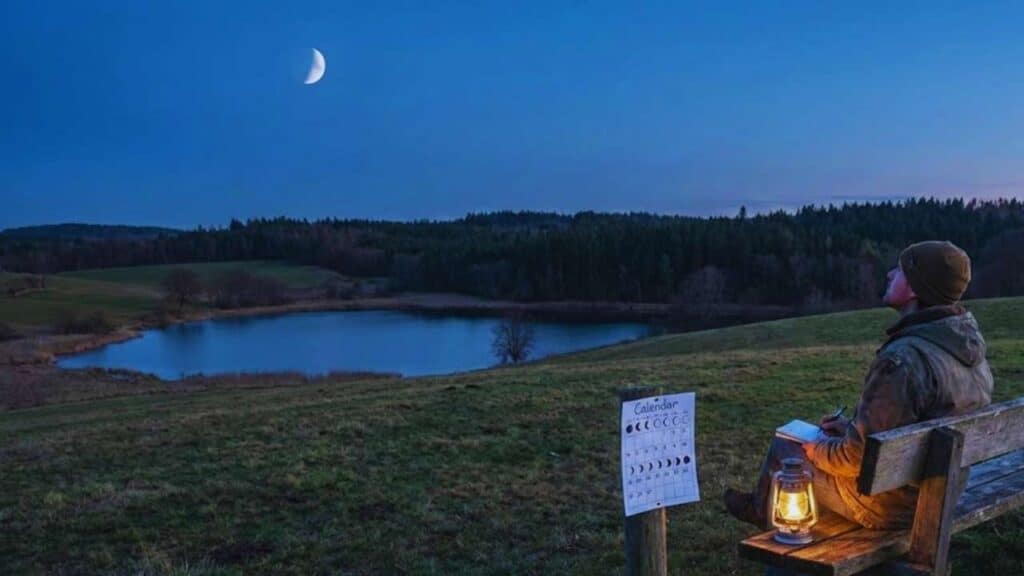
Many modern witches use the moon as a scheduling tool because it creates rhythm.
A common structure:
- New moon: set intentions, start habits
- Waxing moon: build, grow, practice
- Full moon: reflect, celebrate, release tension
- Waning moon: simplify, clean up, rest
You can use seasonal timing in the same way: as structure and symbolism rather than strict rules.
If timing adds stress, ignore it. Consistency matters more than cosmic precision.
Herbs and Crystals: How to Use Correspondences Responsibly
Correspondences are symbolic associations, not universal laws. Different traditions assign different meanings.
Beginner-friendly herbal correspondences
- Rosemary: remembrance, clarity, protection symbolism
- Lavender: calm, rest, gentle cleansing symbolism
- Cinnamon: warmth, motivation symbolism
- Mint: refreshment, focus symbolism
- Bay leaf: wishes, intentions, goal-writing symbolism
Safety note: do not ingest herbs based on online advice. Some herbs can interact with medications, irritate skin, or be unsafe for pets.
Beginner-friendly crystal correspondences
- Clear quartz: clarity, focus symbolism
- Amethyst: calm, sleep-support symbolism
- Rose quartz: self-kindness, emotional softness symbolism
- Black tourmaline: boundaries, grounding symbolism
- Citrine: motivation, optimism symbolism
You do not need crystals. A stone from your local area can be just as meaningful for grounding.
Divination (Tarot, Oracle, Runes) as Reflection
Divination can be spiritual, but it can also be used as structured self-reflection. For beginners, the most ethical approach is to treat divination as guidance, not authority.
A simple beginner tarot spread (3 cards)
- Card 1: what I’m feeling beneath the surface
- Card 2: what I need to understand
- Card 3: the most helpful next step
Ethical rules for divination
- Don’t use divination to replace medical or legal advice
- Don’t read for someone without consent
- Don’t tell people scary predictions as fact
- Be cautious reading while panicked or sleep-deprived
- Keep it practical: “What can I do?” is healthier than “What will happen?”
How to avoid confirmation bias
- Write your interpretation before checking a guidebook
- Revisit the reading a day later
- Track what actually happened
- Focus on actions you can take, not fate
Mental Health, Safety, and When to Pause
Modern witchcraft should not make your life smaller.
Consider pausing or simplifying if:
- You feel compelled to cleanse constantly
- You feel terrified of being cursed
- You use divination obsessively (multiple times a day for the same question)
- You feel pressured by online creators or paid services
- You feel isolated from friends or family due to spiritual fear
A safer reset:
- Return to grounding daily
- Reduce tool use
- Stop watching fear-based content
- Journal and sleep
- Seek professional support if anxiety or intrusive thoughts are escalating
Witchcraft can support wellbeing, but it should not become an anxiety engine.
Community, Learning, and Red Flags
Modern witchcraft communities can be supportive, but online spaces also contain misinformation and manipulation.
Green flags
- Encourages research and journaling
- Emphasizes consent and responsibility
- Avoids guarantees and fear language
- Encourages practical action and emotional regulation
Red flags
- “You’re cursed, pay me to remove it”
- “Only my method works”
- Pressure to cut off loved ones based on a reading
- Claims that you must buy expensive tools to be real
- Shaming beginners for asking questions
A healthy practice is empowering, not controlling.
Common Beginner Mistakes (And Better Alternatives)
Mistake: Doing too much too fast
Better: pick one focus for two weeks and practice it gently.
Mistake: Copying spells without understanding
Better: learn basic structure and adapt ethically to your goals.
Mistake: Confusing anxiety with intuition
Better: ground first, then decide.
Mistake: Using witchcraft to avoid action
Better: create a clear action plan alongside your ritual.
Mistake: Spending beyond your means
Better: build a practice based on time, skill, and consistency, not purchases.
A 30-Day Ethical Beginner Plan
If you want a structured start, try this.
Week 1: Foundations
- Daily grounding (5 minutes)
- Journal every other day (3 minutes)
- Choose your ethical code
Week 2: Cleansing and protection
- One cleansing ritual
- One protection ritual
- One boundary action in real life (say no, block, limit time)
Week 3: Simple spellwork
- One confidence or clarity ritual
- Complete your action step within 48 hours
Week 4: Divination and reflection
- One tarot or oracle reading weekly
- Track what actually changed
- Decide what you want to continue next month
This plan is intentionally light. Sustainable practice beats intense bursts.
Takeaways
FAQs
Is modern witchcraft a religion
Sometimes. For many people it’s a practice that can be religious, spiritual, or nonreligious depending on the person.
Can I practice witchcraft if I’m skeptical
Yes. You can treat rituals as symbolic psychology and still benefit from structure, reflection, and intention.
Do I need an altar
No. A journal and a calm routine are enough.
What is ethical witchcraft
Ethical witchcraft prioritizes consent, responsibility, harm reduction, and cultural respect.
Are love spells unethical
Many practitioners consider coercive love spells unethical because they target someone’s will without consent. A safer alternative is self-focused work for confidence, healing, and attracting mutual, healthy relationships.
Is it okay to hex
Ethics vary widely. Beginners often do better focusing on protection, boundaries, and practical action rather than retaliatory work, especially when emotions are intense.
How do I avoid cultural appropriation
Research origins, avoid closed practices unless invited, and learn from respectful sources connected to the tradition.
What are the safest beginner practices
Grounding, journaling, cleansing as a reset, protection as boundaries, and simple intention rituals with strong safety habits.
Can witchcraft replace therapy, medicine, or legal help
No. Witchcraft can support self-reflection and coping, but it should not replace professional care.
How do I know if something is a scam
Be cautious of fear-based claims, guaranteed outcomes, pressure tactics, and expensive “curse removal” offers.