
The first week of 2026 was supposed to be the “victory lap” for cryptocurrency. Bitcoin had just come off a historic run in late 2025, shattering the six-figure ceiling and touching all-time highs near $125,000. Institutional adoption was at its peak, ETF inflows were steady, and the “Digital Gold” narrative seemed unbreakable. Then came the morning of January 8th.
In a matter of hours, the euphoria evaporated. As news broke of massive Israeli airstrikes targeting Iranian military infrastructure in Aleppo, Syria, global markets shuddered. While oil spiked and traditional gold rallied, Bitcoin did the opposite. It plummeted, shedding nearly 12% of its value and dragging the entire crypto market down with it, causing the Bitcoin Crash in Syria.
“The drop from the dizzying heights of $118,000 to the grim reality of the $103,000 range has left investors asking a single, burning question: Is this the start of a genuine geopolitical crisis for crypto, or is it just a harsh but healthy correction?”
To answer this, we cannot just look at the charts. We have to look at the war room, the trading floor, and the history books.
Key Takeaways
- The Cause: Bitcoin dropped 12% triggered by Israeli airstrikes in Aleppo, Syria, amid fears of regional escalation.
- The Mechanism: The drop was exacerbated by a “long squeeze,” liquidating over $427 million in leveraged positions.
- The Debate: Bears fear energy inflation will hurt crypto; Bulls see this as a healthy correction and a “buy the dip” opportunity.
- The Irony: Syria itself is pivoting toward crypto mining to stabilize its post-war economy, even as its conflict crashes the market.
- The Outlook: The $100,000 support level is critical. If it holds, the long-term bull market likely continues.
The Geopolitical Catalyst: What Actually Happened?
To understand the market reaction, we must first dissect the trigger. This wasn’t a standard ” skirmish.” This was a significant escalation in a region that has been effectively a powder keg since the collapse of the Assad regime last year.
The Strike on Aleppo
According to reports confirmed early Wednesday, the Israeli Air Force launched a series of coordinated strikes against what they identified as “entrenched Iranian logistical hubs” in Aleppo.
Since the fall of the previous Syrian government, a power vacuum has allowed various factions to vie for control. Israel’s intelligence suggested that Iranian-backed proxies were moving advanced ballistic components into the vacuum, intending to establish a new front. Israel struck preemptively and aggressively.
Why This Spooked the Markets
Markets hate uncertainty, but they hate escalation even more.
- Direct Conflict Fears: This wasn’t a proxy skirmish; it was a direct attack on infrastructure linked to a major regional power (Iran) inside a destabilized nation (Syria). The fear is a retaliatory cycle that could drag the United States or disrupt the Persian Gulf’s oil supply.
- The “Post-Assad” Volatility: Investors had priced in a “stabilization” period for Syria. This attack shattered that illusion, reminding the world that the region remains highly volatile.
When the missiles flew, the algorithms reacted instantly.
Anatomy of the Crash: A “Long Squeeze” for the Ages
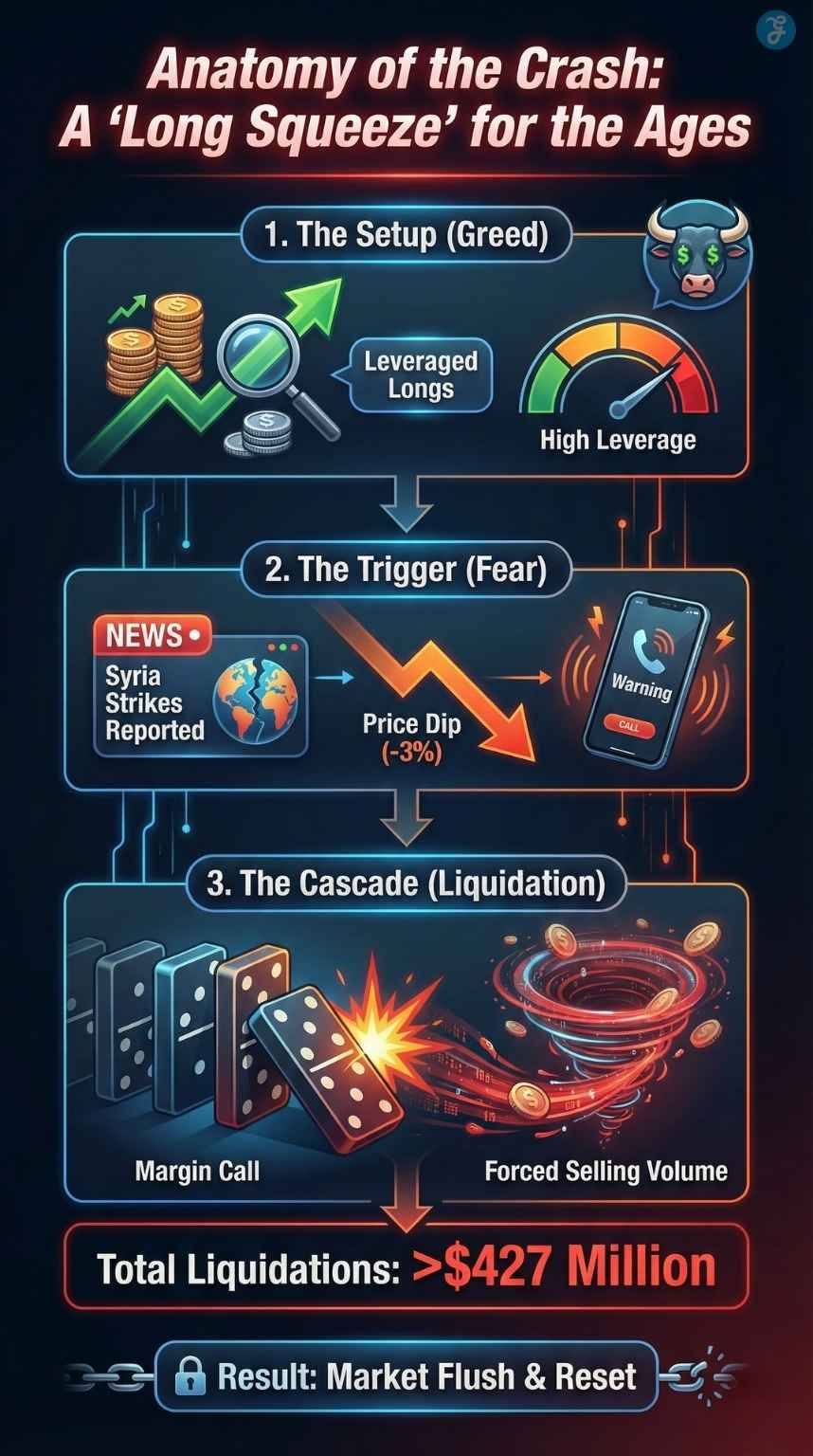
While the war was the trigger, the depth of the crash was caused by market mechanics. The 12% drop wasn’t just people selling because they were scared; it was people being forced to sell because they were greedy.
The Leverage Trap
Heading into 2026, the crypto market was heavily “over-leveraged.” Because Bitcoin had been trending up for months, traders had piled into “Long” positions—essentially borrowing money to bet that the price would go higher.
When the news from Syria hit, the price of Bitcoin dipped naturally by about 2-3%. However, this small dip hit the “stop-loss” prices of these leveraged traders.
- The Trigger: Price drops 3% on war news.
- The Cascade: Over-leveraged traders get liquidated (their Bitcoin is automatically sold by the exchange to cover debts).
- The Spiral: This automatic selling drives the price down further, triggering more liquidations.
By the Numbers
The data from that 24-hour period is staggering:
| Metric | Figure | Context |
| Total Liquidations | $427 Million | Mostly “Long” positions were wiped out. |
| Bitcoin Price Drop | -12.4% | From ~$118k to ~$103.5k. |
| Altcoin Impact | -18% to -25% | High-beta assets like Solana and ETH suffered more. |
| Open Interest | -15% | A massive amount of leverage was flushed out instantly. |
This data strongly suggests that while the reason for the sell-off was geopolitical, the severity of it was structural. The market was looking for an excuse to correct, and the Syria strikes provided it.
The “Digital Gold” Failure: Why Didn’t Bitcoin Rally?
One of the most common criticisms emerging from this event is the failure of the “Safe Haven” narrative. For years, proponents have argued that Bitcoin is “Digital Gold”—an asset that should rise when the world gets chaotic, just like physical gold does.
The Divergence
On the day of the strikes, we saw a clear divergence:
- Physical Gold: UP (+1.5%). Investors flocked to the traditional safety net.
- Oil (Brent Crude): UP (+4%). Fear of supply chain disruption drove prices up.
- Bitcoin: DOWN (-12%).
The “Risk-Asset” Reality
Why did this happen? Because in 2026, Bitcoin is still treated by Wall Street as a Risk Asset, not a Safe Haven.
When huge institutional investors (who now own a large chunk of the Bitcoin supply via ETFs) get scared, they sell their riskiest, most volatile assets first to raise cash. They don’t sell their gold; they sell their tech stocks and their crypto.
Until Bitcoin’s volatility matches that of gold (which could take decades), it will likely continue to dip initially during geopolitical shocks, even if it recovers later.
The Crisis Argument: Could This Be the Start of a Bear Market?
There is a camp of bearish analysts who believe this isn’t just a dip, but the start of a prolonged crisis. Their argument rests on the macroeconomic ripple effects of the conflict.
The Energy Inflation Threat
The biggest threat to Bitcoin isn’t the war itself, but what the war does to the global economy.
If the conflict in Syria expands and involves Iran closing the Strait of Hormuz, oil prices could skyrocket past $100/barrel.
- High Oil = High Inflation.
- High Inflation = Central Banks Raise Interest Rates.
- High Rates = Death for Crypto.
We saw this in 2022. When inflation spiked, the Federal Reserve hiked rates, and Bitcoin crashed from $69k to $15k. The “Crisis” argument fears a repeat of this cycle. If the Syria conflict reignites global inflation, the liquidity that has been fueling the 2025-2026 bull run could dry up overnight.
The Hidden Risk: Miner “Capitulation” Content
While the market focuses on the war, savvy analysts are watching the energy markets. The Syria strikes caused a temporary spike in Brent Crude oil and global natural gas futures. For Bitcoin miners, particularly those relying on grid power in deregulated markets like Texas, this is a double-edged sword.
If energy prices remain elevated due to a prolonged conflict, the “cost of production” for one Bitcoin (currently estimated at around $82,000 for average miners) rises. If the Bitcoin price drops toward that production cost while energy prices rise, miners may be forced to sell their treasury holdings to stay afloat. This “Miner Capitulation” is a historical marker of market bottoms, but it can cause short-term pain before the recovery.
The Correction Argument: The Bullish Case
Despite the fear, the majority of veteran analysts view this as a “Correction”, a healthy, necessary pullback in an otherwise strong market.
Technical Reset
Before the strikes, Bitcoin’s RSI (Relative Strength Index) was screaming “Overbought.” The price had moved up too fast, too soon.
- The “Flushing” Effect: The crash wiped out the “froth”—the greedy, over-leveraged tourists who were just gambling. Now that they are gone, the market is healthier.
- Key Support Held: Crucially, Bitcoin did not break the psychological barrier of $100,000. It bounced aggressively off $103,000. This indicates that there is massive buying demand waiting at these lower levels.
Historical Precedent: The “War Dip” Pattern
History shows us that Bitcoin often panic-sells on the outbreak of war, only to recover violently once the initial shock wears off.
- February 2022 (Russia invades Ukraine): Bitcoin dumped immediately but rallied 15% in the following days as Russians and Ukrainians turned to crypto to move wealth.
- October 2023 (Israel-Hamas): Bitcoin initially dipped, but this event actually marked the bottom of the bear market, kicking off a rally that doubled the price over the next six months.
The pattern is clear: Panic first, adoption second.
The “Dry Powder” Signal: Money Didn’t Leave, It Just Paused Content
Perhaps the most bullish signal hidden in the chaos is the flow of funds. On-chain data indicates that while Bitcoin price dropped, the total market capitalization of Stablecoins (USDT and USDC) actually increased by $2 billion during the crash.
This suggests that investors didn’t “cash out” to fiat currency to leave the market. Instead, they rotated into stablecoins, keeping their capital on exchanges. In trading terms, this is known as “Dry Powder.” There is now a record amount of cash sitting on the sidelines, ready to be deployed back into Bitcoin the moment the geopolitical situation stabilizes. This massive wall of liquidity effectively puts a “floor” under the price, making a drop below $90k increasingly unlikely.
The Irony of Syria
A fascinating and under-reported aspect of this story is Syria’s own relationship with cryptocurrency, adding a layer of irony to the crash.
Post-Assad Crypto Strategy
Since the regime change, the transitional Syrian authorities have been quietly exploring cryptocurrency as a way to bypass lingering international sanctions and stabilize their decimated currency.
There have been credible reports of the new government utilizing “stranded energy” (flared gas from oil fields) to mine Bitcoin. This creates a paradox:
- The region (Syria) is the cause of the Bitcoin crash due to war risk.
- The region is simultaneously relying on Bitcoin as an economic lifeline.
While Wall Street dumps Bitcoin because of Syria, Syrians are likely buying Bitcoin (or mining it) to survive the very instability causing the dump. This underscores Bitcoin’s true utility: it is a tool for the unbanked and the crisis-stricken, even if the price doesn’t always reflect that immediately.
What Should Investors Do? [Hypothetical Analysis]
Disclaimer: This is a financial analysis, not financial advice.
The current market sentiment is defined by “Extreme Fear,” which, according to the famous Warren Buffett adage, is often the time to be greedy.
Watch the $100k Level
The line in the sand is $100,000.
- Bullish Scenario: If BTC holds above $100k and consolidates for a few weeks while the news cycle quiets down, we will likely see a resumption of the uptrend, targeting $130k by Q2 2026.
- Bearish Scenario: If the war escalates and BTC breaks below $98,000 on high volume, the next major support isn’t until $85,000.
The Institutional Factor
Reports suggest that major ETF issuers (like BlackRock and Fidelity) saw inflows even on the day of the crash. This means that while retail traders were panic-selling, the giants were buying the discount. This is usually a strong signal that the long-term trend remains intact.
Sentiment Check: Funding Rates Flip Negative Content
A key technical indicator suggests the worst may be over: “Funding Rates” have flipped negative for the first time in three months.
In simple terms, during the rally to $118k, longs were paying shorts (optimism). Now, shorts are paying longs (pessimism). When the majority of the market is betting on the price going down (shorting), it often creates the perfect environment for a “Short Squeeze,” where a sudden price bounce forces bears to buy back, driving the price up rapidly. The market has effectively reset from “Greed” to “Fear,” which historically presents a high-risk, high-reward entry zone.
Final Thoughts: A Test of Maturity
The “Bitcoin Crash in Syria Dip” of January 2026 will likely be remembered as a maturity test for Bitcoin. It proved that the asset is not yet immune to geopolitical gravity. It is not yet the “safe haven” that maximalists dream of, at least not in the short term.
However, it also proved the market’s resilience. Despite a terrifying geopolitical headline and a $400 million liquidation cascade, the price stabilized above $100,000. A few years ago, a similar event might have crashed the market by 30% or 40%. A 12% dip, in the grand scheme of crypto volatility, is merely a scratch.
For investors, the message is clear: The fundamentals of the network haven’t changed. The block production hasn’t stopped. The supply cap is still 21 million. The only thing that changed was the sentiment. And sentiment, unlike war, is fleeting.