Choosing the right insurance API is an important step toward building a reliable, efficient, and user-friendly insurance platform. The right API can simplify policy management, automate claims processing, improve data accuracy, and connect your system with third-party services. However, not every API offers the same level of security, performance, or integration flexibility.
Before making a decision, it is essential to evaluate factors such as functionality, documentation, scalability, compliance, and pricing. In this guide, we’ll explore how to evaluate insurance APIs before integrating them so you can choose a solution that meets your business needs and supports long-term growth.
What Is an Insurance API and How Does It Work
An insurance API (Application Programming Interface) is a set of rules that lets two software systems exchange insurance data automatically, such as policy details, quotes, or claims status, without a person manually copying information between screens. In practice, an insurance agency’s website calls the API, the insurer’s system processes the request, and structured data flows back in seconds.
Here is a simple example of how this works in a real transaction:
- A customer fills out a quote form on an agency’s website.
- The website sends that information through the API to the insurer’s rating engine.
- The insurer’s system checks the data against underwriting rules.
- The API returns a quote, and the agency displays it instantly.
This exchange happens through defined endpoints, data formats (usually JSON), and authentication rules the provider documents in advance. Without a documented API, every data pull requires a phone call, an email, or a login to a separate portal, which slows down distribution and frustrates clients who expect a quote in minutes, not days.
What Features Should You Look for in an Insurance API
The strongest insurance APIs combine broad functional coverage, consistent versioning, and clear documentation, so agencies and carriers are not forced into a single rigid user interface. Before integrating, confirm the API covers the specific business functions you actually need.
Look for these core features:
- Policy and billing services that expose real-time status, not batch updates once a day.
- Claims endpoints that support submission, status checks, and document upload.
- Contact and document management so customer records stay in sync across systems.
- Configuration and workflow APIs that let you extend the platform instead of waiting on the vendor’s roadmap.
- Webhooks for event-driven alerts, such as a policy change or a claim status update, instead of constant polling.
Different Types of Insurance APIs: REST vs SOAP and More
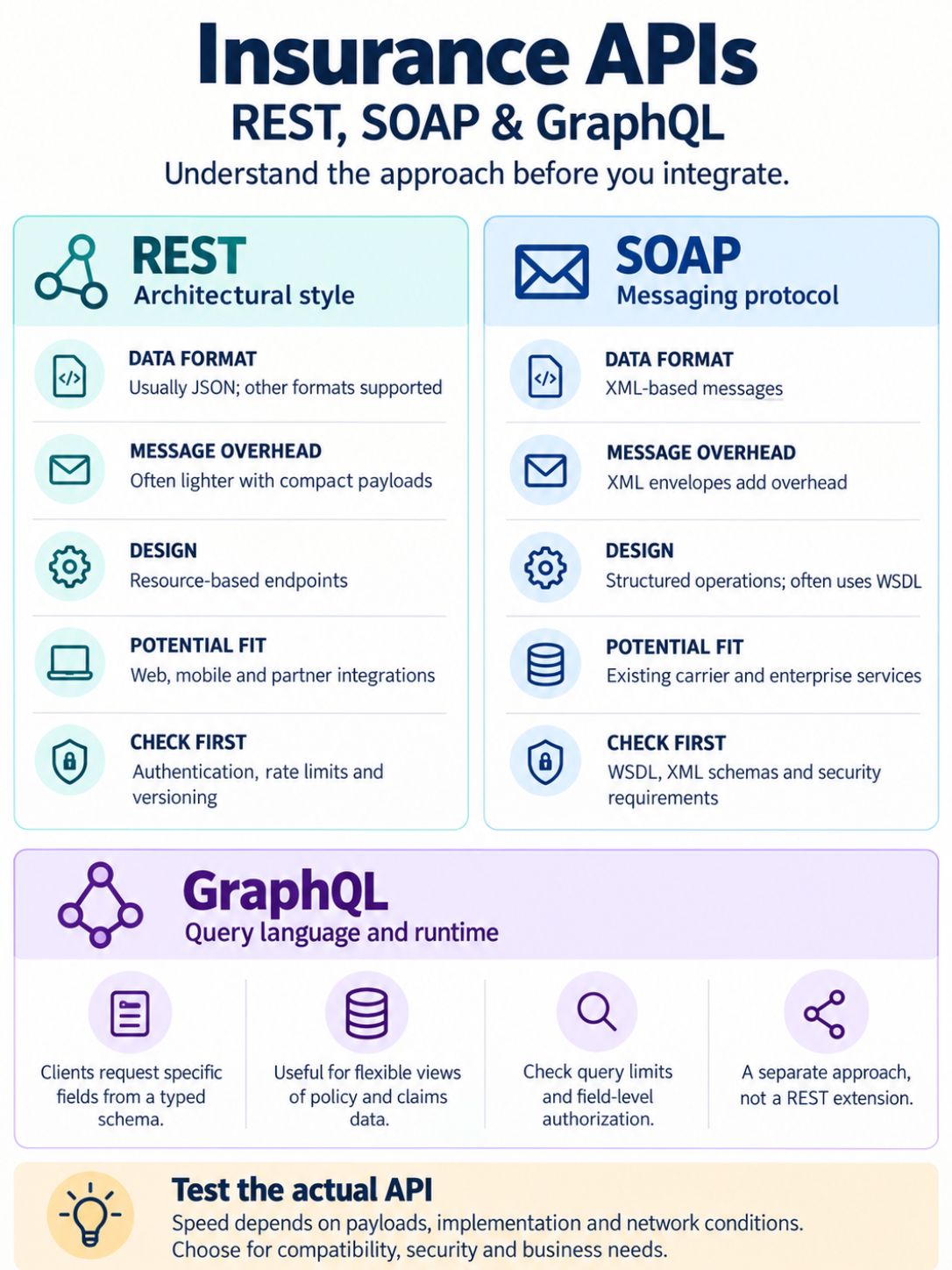
Insurance APIs generally come in two technical styles, REST and SOAP, plus newer formats like GraphQL for flexible data queries. REST is now the primary standard across the insurance industry because it is lighter, easier to test, and works well with modern web and mobile apps.
| Factor | REST API | SOAP API |
|---|---|---|
| Data format | JSON (lightweight) | XML (heavier) |
| Speed | Generally faster | Slower, more overhead |
| Common use | Modern insurance apps, mobile, partner integrations | Legacy carrier core systems, older insurers |
| Flexibility | High, supports GraphQL extensions | Lower, rigid structure |
| Best for | New integrations, embedded insurance, agencies building client tools | Carriers stuck on older policy administration systems |
How APIs Can Benefit the Insurance Industry
APIs benefit the insurance industry by cutting manual data entry, speeding up quote and bind cycles, and letting agencies plug new tools into their existing systems without rebuilding everything from scratch. The benefits insurance industry professionals report most often are faster transactions and fewer errors.
Specific advantages include:
- Faster distribution. Agencies can quote across multiple insurers in one interface instead of logging into five separate portals.
- Lower operational cost. Automated data exchange reduces the staff hours needed for re-keying policy and claims information.
- Better risk visibility. Real-time data from telematics, IoT devices, or weather feeds gives insurers more current risk signals than annual paperwork.
- Embedded insurance revenue. Retailers, lenders, and platforms can sell coverage at the point of sale by calling an embedded insurance API, creating a new distribution channel for insurers without a traditional agency relationship.
Use Cases for Insurance API Integration
Insurance APIs show up across claims, risk monitoring, and customer service, and three use cases stand out as the most common starting points for agencies and carriers. Each one solves a specific operational problem rather than being a general technology upgrade.
1. Effective Claims Management
Claims APIs let policyholders submit a claim, upload photos, and track status without calling an adjuster for every update. This cuts average claims handling time and reduces the back-and-phone-call volume that frustrates clients during an already stressful event. Carriers integrating claims APIs with internal systems also get faster, cleaner data for fraud detection and reserve setting.
2. Internet of Things (IoT) Implementation
IoT-connected devices, like telematics sensors in vehicles or water sensors in homes, feed real-time data into insurer systems through APIs. This supports usage-based pricing and faster claims triggers, since the API can automatically flag an event like a collision or a leak the moment it happens, rather than waiting for the policyholder to report it.
3. Improve Customer Experience
APIs connect customer-facing apps to policy and billing data so clients can check coverage, pay a bill, or request a certificate of insurance without waiting on hold. Agencies that integrate customer experience APIs typically see fewer inbound service calls and higher client retention, since self-service tools answer basic questions instantly.
Start With the Technical Foundation: How Do You Test an Insurance API Before Integration
Testing an insurance API before integration means running it in a sandbox environment under conditions that mirror real production traffic, not just confirming it returns a response. Skipping this step is one of the most common reasons integrations fail after launch.
A practical testing checklist:
- Review the documentation for endpoint coverage, data fields, and versioning history.
- Test authentication and authorization using the exact method the API requires, such as OAuth 2.0 tokens.
- Validate error handling by sending malformed requests and confirming the API returns clear, actionable error messages.
- Run load tests to see how the API performs under your expected transaction volume, not just a handful of test calls.
- Check response times for latency bottlenecks, especially during peak quoting periods.
- Monitor uptime over a trial period before committing to a production contract.
Check the Insurer Network and Licensing
Before integrating any insurance API, confirm which insurers are actually connected on the back end and whether the provider holds the licensing needed to distribute coverage in your states. An API that looks comprehensive on a sales call can still leave major gaps in carrier coverage once you dig into the fine print.
Ask providers directly:
- Which insurers are live in the network today, not on a future roadmap?
- Is licensing current in every state where your agency or client base operates?
- Does the API support both personal and commercial lines, or just one?
- How does the provider handle new insurer onboarding, and how long does that typically take?
Choose a provider with a verified, named insurer list if your business depends on broad market access. Choose a narrower network only if you already have strong relationships with the specific insurers it supports.
Evaluate the Claims Experience
Evaluating the claims experience means testing how an insurance API actually performs during a claim, not just during a quote. This is where many integrations reveal their real limitations, since claims workflows involve more data, more systems, and more urgency than a simple rating call.
During evaluation, check whether the API supports:
- Real-time claims status checks that update without manual refresh.
- Document and photo upload with reasonable file size limits.
- Integration with adjuster workflows and third-party administrators.
- Clear audit logging, since claims data often becomes evidence in disputes or commercial litigation risk cases.
How Do You Check if an Insurance API Is Reliable and Stable
Checking reliability means asking for actual uptime history, documented service-level agreements, and real incident response data, not marketing claims about “always on” performance. Reliable providers are transparent about past outages because they know agencies and insurers will ask.
Questions to ask any provider:
- What is the documented uptime percentage over the past 12 months?
- What happens during scheduled maintenance, and how much advance notice do clients get?
- Is there a public status page showing real-time system health?
- What is the average incident resolution time when something breaks?
What Are the Best Insurance APIs on the Market Right Now
There is no single “best” insurance API, because the right choice depends on whether you need claims automation, agency management, policy administration, or embedded distribution. Several platforms stand out for different use cases across the insurance industry.
- Curacel Grow focuses on claims automation and distribution infrastructure for insurers expanding into new markets, with API tools built around fraud detection and faster claims cycles.
- VRC Insurance Systems offers agency management system APIs built specifically for independent agencies managing business clients across commercial and personal lines.
- Zywave provides agency management, content, and analytics tools that connect through APIs into broader agency technology stacks, alongside a resource library covering risk topics agents need for client conversations.
- Duck Creek runs an open API framework used by carriers to connect banking data, vehicle and property records, and custom-built technologies into one core system.
- BriteCore launched a headless core architecture in 2026 with broad API coverage spanning policy, billing, claims, contacts, documents, and workflow services, designed so carriers can build their own interfaces instead of being locked into one vendor’s screens.
Choose embedded insurance platforms if your priority is distribution through non-insurance partners. Choose a dedicated claims or agency management API if your priority is internal operational efficiency.
Read the Commercial Terms: How Much Do Insurance APIs Cost
Insurance API costs vary widely, from free developer tiers for testing to custom enterprise contracts priced by call volume, policy count, or premium percentage, so reading the full commercial agreement matters as much as reviewing the technology. Pricing models that look simple in a sales pitch sometimes hide per-call charges or premium-based license fees buried deep in the contract.
When reading commercial terms, check for:
- Per-call or per-transaction fees that scale faster than expected as your business grows.
- Premium-based license clauses that tie API cost to the value of policies sold, not just usage volume.
- Rate limits that cap how many calls you can make per minute or per day, and what the overage penalty looks like.
- Contract lock-in terms, including how much notice is required to cancel and whether your data stays accessible after termination.
Common Mistakes When Choosing an Insurance API
The most common mistake agencies and carriers make is choosing an insurance API based on a demo alone, without testing it against their own real data and actual transaction volume. A polished presentation does not guarantee stable performance in production.
Other frequent mistakes:
- Skipping a review of the insurer network and assuming “comprehensive” means every carrier you need.
- Ignoring security documentation because the sales team assures you it’s “standard.”
- Failing to ask what happens to historical data if you switch providers later.
- Underestimating integration time and launching before staff are trained on the new workflow.
- Choosing the cheapest option without confirming it covers claims, billing, and policy data, not just quoting.
How Long Does It Take to Integrate an Insurance API
Insurance API integration typically takes anywhere from a few weeks for a simple quoting connection to several months for a full claims and policy administration integration, depending on data complexity and how many systems are involved. Most integrations follow five general stages.
- Planning and scoping, where you define which data and workflows the integration needs to support.
- Sandbox development, where developers connect to a test environment and build the core data exchange.
- Testing and validation, covering authentication, error handling, and load testing under real volume.
- Security and compliance review, confirming encryption, access controls, and regulatory requirements are met.
- Production rollout and monitoring, where the integration goes live and performance gets tracked closely for the first weeks.
A simple quoting API integration might move through all five stages in four to six weeks. A full claims and policy system integration involving multiple insurers can take three to six months, especially if legacy systems require custom workarounds.
What Support and Documentation Do Insurance API Providers Offer
Reliable insurance API providers offer detailed developer documentation, a sandbox testing environment, and a named support contact, not just a generic help desk email address. Documentation quality is often the clearest early signal of how a provider will behave once you are a paying client.
Before integrating, confirm the provider offers:
- Clear, versioned documentation with sample code and example requests.
- A sandbox environment that mirrors production behavior closely.
- Defined support response times for critical issues, ideally in writing.
- A changelog or release notes process so you know when the API changes.
How Do You Know if an Insurance API Is Right for Your Business Size
The right insurance API fits your transaction volume, technical staff capacity, and growth plans, so a solution built for large carriers can overwhelm a small agency, while a lightweight tool built for small agencies may not scale for a growing book of business. Business size should shape your evaluation checklist as much as features do.
- Small agencies generally need simpler APIs with strong documentation and lower per-call pricing, since internal developer resources are limited.
- Mid-size agencies and MGAs often need broader insurer network coverage and claims support, since client volume and complexity grow fast.
- Carriers and large enterprise clients typically need full policy, billing, and claims API coverage, plus support for custom workflow and configuration APIs.
Choose a provider with flexible pricing tiers if your transaction volume is expected to grow quickly within the next year. Choose a fixed, predictable contract if your volume is stable and you want to avoid cost surprises.
Final Thoughts
Choosing the right insurance API comes down to disciplined evaluation, not vendor promises. Start with the technical foundation, confirm the insurer network and licensing, test the claims experience directly, verify security certifications, and read every line of the commercial terms before signing anything.
Next steps: build a simple evaluation checklist using the criteria in this guide, request sandbox access from every provider under consideration, and run a real test with your own data before committing to a production contract. That one step, testing before trusting, is what separates insurance agencies and carriers with stable, scalable technology from those stuck fixing broken integrations after the fact.
Frequently Asked Questions
What are the 5 stages of API integration?
The five stages of API integration are planning and scoping, sandbox development, testing and validation, security and compliance review, and production rollout with ongoing monitoring. Each stage should be completed in order, since skipping testing or security review before launch is a common cause of integration failures in live environments.
What are the 5 C’s of insurance?
The 5 C’s of insurance commonly refer to character, capacity, capital, collateral, and conditions, criteria historically used in underwriting and credit-style risk evaluation. In modern usage, some insurance professionals apply similar principles to API vendor evaluation, assessing a provider’s reliability, financial stability, and long-term business conditions.
How do you test API integrations?
You test API integrations by running requests in a sandbox environment, validating authentication, checking error handling with malformed data, and running load tests under expected transaction volume. Monitoring uptime and response times over a trial period before going live confirms the integration will perform reliably once connected to real customer data.
What is API in insurance?
API in insurance stands for Application Programming Interface, a technical connection that lets insurance systems, like quoting engines, claims platforms, or policy databases, exchange data automatically. It replaces manual data entry and portal logins with real-time, automated data exchange between an agency, carrier, or third-party platform.