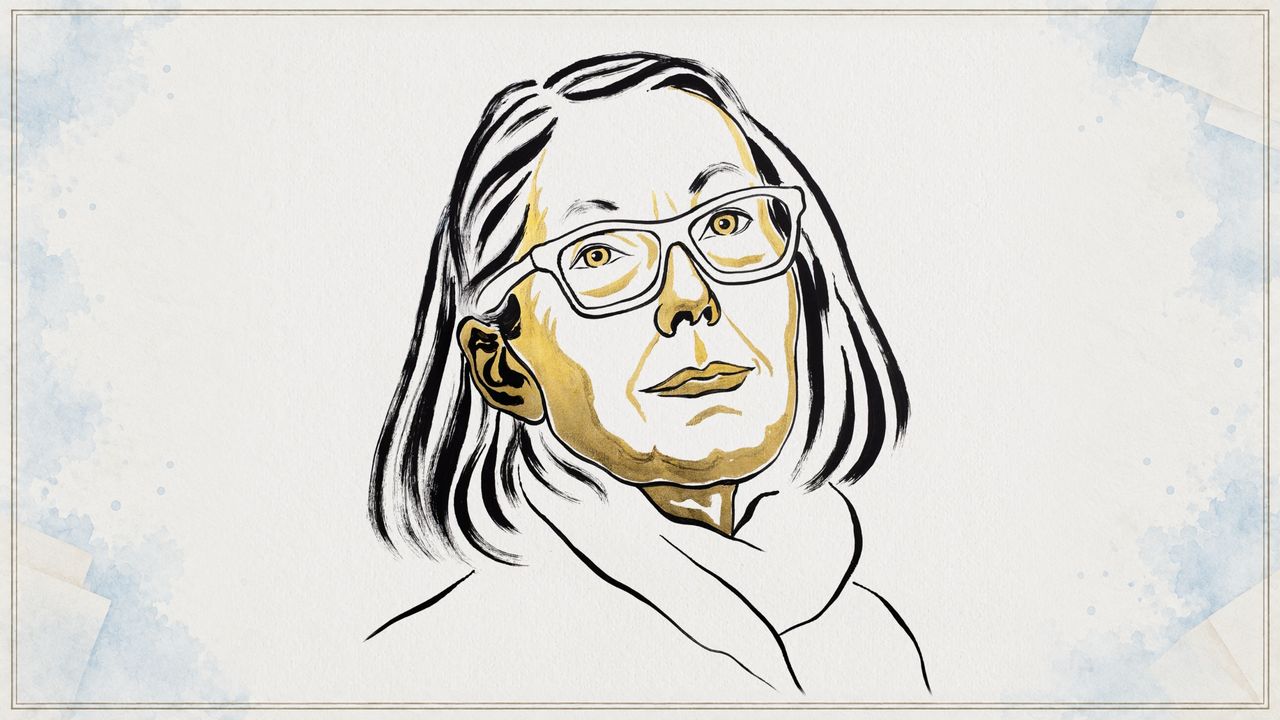
The 2026 Nobel Prize in Literature has been awarded to Anne Carson. The Swedish Academy announced its decision on October 8, honouring the Canadian poet, essayist, translator and classicist for a body of work that brings ancient literature into new forms.
Carson has made a Greek monster the central figure of a modern love story. She has built a book of mourning that unfolds from a box. She has translated poems that survive only in fragments, asking readers to attend to what remains and what has been lost.
Those examples help explain the award more clearly than a label such as genre-defying. Carson’s books take unusual shapes, but the shapes serve recognizable questions. How do we live with desire that cannot be satisfied? How do we remember someone we can no longer reach? What can an incomplete text still tell us?
Why Anne Carson won the 2026 Nobel Prize in Literature
The Swedish Academy awarded Carson the prize “for her bold and inventive oeuvre that, in playful dialogue with the classical tradition, has created new forms for contemporary literature”.
Oeuvre means a writer’s body of work. The Academy has not singled out one poem or novel as the winning achievement. It is recognizing a practice Carson has developed over decades: studying the language and stories of the past, then finding unexpected ways to bring them into the present.
Her work often crosses a border while the reader is watching. An essay begins to behave like a poem. A poem takes on the length and movement of a novel. A translation becomes a work of visual or dramatic art. Ancient Greek poets appear alongside modern writers who lived centuries later.
The question is not simply whether a work can be called poetry or prose. It is whether the form Carson chooses helps the reader see a familiar human experience differently.
A classicist who writes across boundaries
Carson was born in Toronto in 1950. She studied at the University of Toronto and completed a doctorate in classics in 1981. Alongside her writing, she has spent much of her career translating and teaching.
That background helps explain her attention to the history of individual words. But calling her a classicist should not make her sound remote from ordinary life. In Eros the Bittersweet, published in 1986, she explores desire through ancient literature. A central idea is that distance between two people, what one person wants but cannot fully possess, gives desire much of its force.
It is a scholarly starting point for a question most readers will recognize. Carson’s later books return to that distance in many forms: between lovers, between the living and the dead, and between the surviving words of an ancient poem and everything that has disappeared.
She was also widely recognized before the Nobel announcement. Men in the Off Hours won the Griffin Poetry Prize’s Canadian category in 2001, and Red Doc won it again in 2014. The Beauty of the Husband received the T. S. Eliot Prize. This Nobel honours an established career, even if it introduces her to many readers for the first time.
Autobiography of Red: The monster gets a life of his own
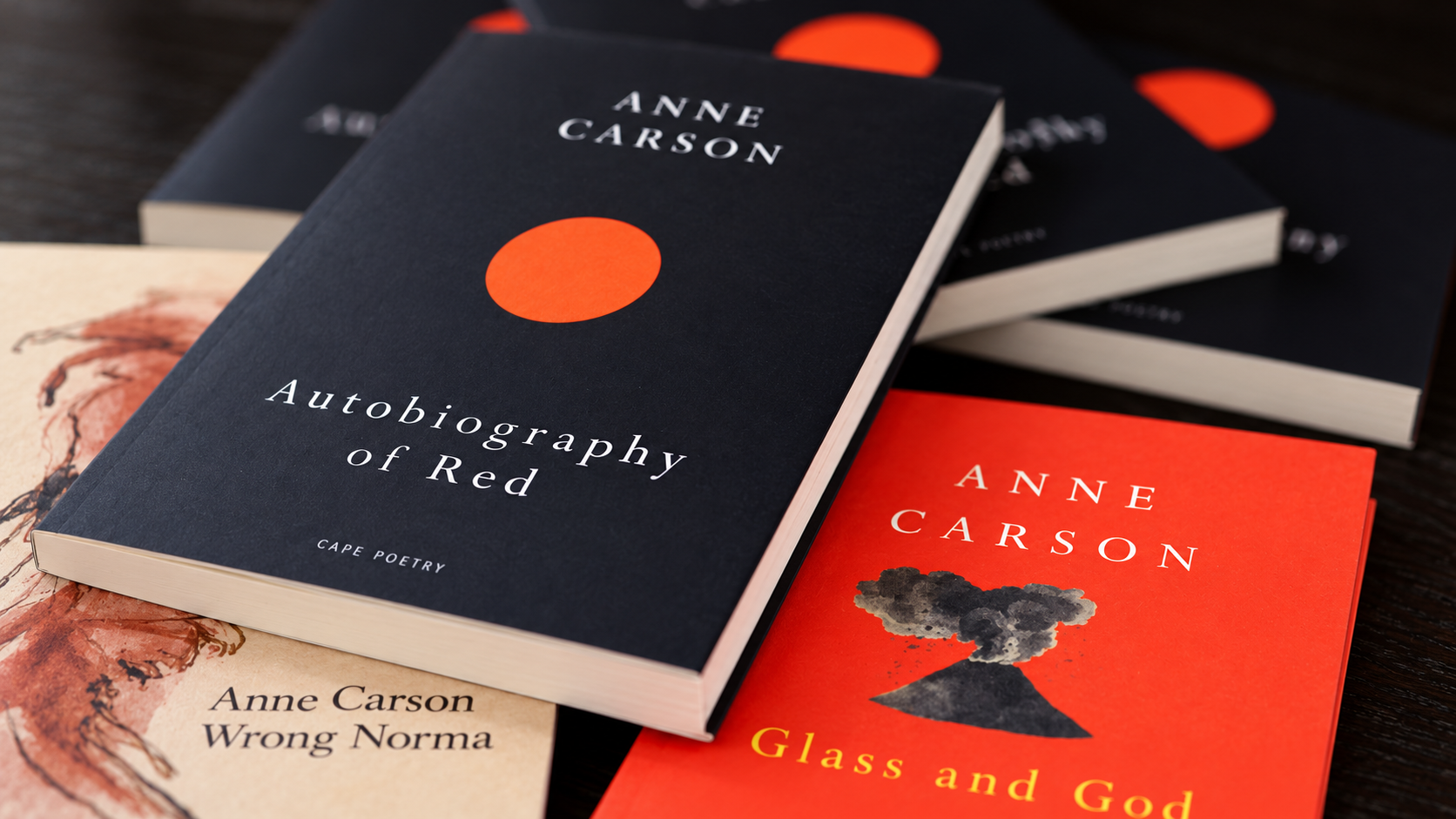
For readers who want to understand the Academy’s choice through one book, I would begin with Autobiography of Red. Published in 1998 and described as a novel in verse, it takes inspiration from fragments by the ancient Greek poet Stesichorus.
In the older story, Geryon is a red, winged monster whom Heracles kills during one of his labours. Carson changes the angle of view. Geryon becomes a young person with a childhood, a camera, a difficult family history and a painful attachment to Heracles.
That change is larger than moving a myth into a modern setting. A figure known chiefly as someone else’s adversary is given a way to describe his own life. Carson uses the freedom of verse, the jumps, images, and spaces it permits, inside a coming-of-age story concerned with vulnerability, desire, and the effort to become oneself.
The book also shows why “playful” should not be mistaken for lighthearted. Carson can be funny and startling, but Geryon’s story includes abuse and emotional hurt. The ancient material gives her a way to approach those experiences from an unfamiliar direction.
Translation is part of the writing
Translation sometimes appears in a writer’s biography as a separate accomplishment, set apart from the supposedly original books. That division is difficult to maintain with Carson. The Swedish Academy explicitly treats her translations from classical Greek as creative works in their own right.
What remains of Sappho
In If Not, Winter, published in 2002, Carson translates the surviving fragments of Sappho’s poetry. These are texts shaped partly by loss: many poems did not reach us complete.
That makes translation more than a matter of finding an English equivalent for each Greek word. The reader has to confront the broken condition in which the work survives. Carson’s attention to those gaps fits a wider interest in what language can suggest when it cannot supply a complete account.
A reader does not need to know ancient Greek to understand the force of that question. We often try to make sense of people and events from pieces left behind.
When a Greek tragedy becomes a visual work
Antigonick, Carson’s 2012 version of Sophocles’ Antigone, brings another dimension into view. Bianca Stone’s illustrations and Robert Currie’s design make the book’s visual presentation part of the experience of reading it. Carson has also worked across theatre and other art forms.
This is why it would be too narrow to describe her simply as someone who modernizes ancient stories. She is interested in what changes when a story moves between languages, voices, images, and performance.
Nox: Making a book out of grief
If Autobiography of Red shows Carson changing the perspective of a story, Nox shows her changing the shape of a book.
Published in 2010, it was made in memory of her brother Michael. It comes as an accordion-fold work housed in a box, bringing together pictures, letters, and other fragments. Carson also works with a poem by the Roman writer Catullus mourning his own brother.
A conventional account might try to put a life in order. Nox gives the reader remnants to move through. Its physical shape asks us to spend time with what Carson has kept, without promising that those pieces can answer every question about the person who is gone.
That could sound like an elaborate design idea until the reason for it becomes clear. Grief rarely gives us a complete story in the right order. Letters, photographs, remembered words, and unanswered questions are often what remain. In Nox, the book’s structure makes room for that experience.
Her experiments continued long after her best-known books
It would be easy to build an account of Carson around Autobiography of Red and stop in the 1990s. Her later work shows a writer still testing what a piece of literature can do.
“The Glass Essay,” included in Glass, Irony, and God in 1995, moves through the aftermath of a broken relationship, a visit to the narrator’s mother, and a reading of Emily Brontë. It is a long poem with the pull of a story and the searching quality of an essay.
The Beauty of the Husband, published in 2001, tells of a troubled marriage through 29 sections Carson calls tangos, bringing the poet John Keats into the account. Float, from 2016, consists of 22 small booklets that readers can approach in different orders.
Then came Wrong Norma in 2024, a varied collection of pieces accompanied by images Carson created. It went on to win a National Book Critics Circle Award for poetry. These works are quite different from one another, but they share a refusal to assume that every subject needs the same kind of page.
The feeling beneath the changing forms
A list of Carson’s methods- translation, verse novels, visual books, performance- can make her sound forbiddingly academic. Some works do demand patience, especially when they bring several unfamiliar voices or references onto the same page. It is reasonable for a reader to find one book inviting and another difficult.
What connects them is often quite direct. Geryon wants to be loved without losing himself. Nox is shaped by a sister’s loss. The Beauty of the Husband examines what remains when attraction and trust part ways.
Carson’s writing rarely resolves those feelings for us. It can hold more than one perspective at once, or leave a gap where an explanation might normally appear. That uncertainty is part of the reading. It allows an ancient poem and a present-day experience to sit together without pretending they are identical.
Why this Nobel matters beyond one writer
Carson is the 19th woman to receive the Nobel Prize in Literature and the second Canadian woman, after Alice Munro. Those are meaningful points of context, though they cannot explain the choice on their own.
The more distinctive literary point lies in the breadth of work the Academy is recognizing. Carson is a poet, but poetry does not describe everything she makes. Translation is central to her achievement. Some of her works ask readers to pay attention to a book as a designed object; others have lives in performance.
That recognition does not mean Carson invented writing that crosses genres. She is part of a much longer history of authors stretching and combining forms. The Academy’s case is more specific: across a substantial career, she has used her knowledge of classical literature to make works with a voice and structure of their own.
There is also a fair question about access. Some readers will arrive at Carson through a compelling story like Autobiography of Red. Others may find the references, interruptions, or unusual formats hard to enter. An honest analysis should leave room for both experiences. A Nobel Prize can direct attention to a writer; it cannot tell every reader how they will respond.
Nor does the announcement reveal the Academy’s private deliberations. Nobel literature nominations remain confidential for 50 years. Public predictions about other writers do not establish who was considered alongside Carson, and the citation should not be stretched into an unstated political or cultural manifesto.
What comes next for Anne Carson and her readers?
The formal award ceremony is scheduled for December 10 in Stockholm. The 2026 literature prize carries 12 million Swedish kronor, and literature laureates are expected to deliver a Nobel Lecture during their visit.
For now, the announcement creates a more immediate opportunity: readers who know Carson’s name but have never opened one of her books have several ways in. Autobiography of Red offers a story. Nox shows what she can do with memory and the physical page. If Not, Winter opens the question of how to read what history has left incomplete.
I would resist turning the Nobel into a claim that difficult books are automatically better books. Carson’s achievement asks for a closer reading than that. Again and again, she starts with something inherited or unfinished and finds a form that lets it speak in another way. The prize brings attention to that work. The books let readers decide what it means to them.