When I first saw the news of the G7 oil reserve release, 100 million barrels sounded like enough to change the fuel market almost overnight. But a number that large needs context. The G7 plans to release the emergency stocks over four months, with a substantial amount of diesel expected during the first 20 days. Officials have not yet revealed the complete breakdown of which countries will contribute, how much will be diesel and how much will be crude oil.
The timing matters because the world is not dealing only with expensive crude. It is also facing a shortage of finished fuels. Disrupted shipments from the Middle East, damage to Russian refineries, and restrictions on fuel exports have tightened diesel supplies. That pressure can spread far beyond filling stations because diesel powers trucks, farms, construction equipment, and many of the supply chains that move everyday goods.
So, will this release bring fuel prices down? My answer is that it could ease the immediate pressure, particularly in wholesale diesel markets, but cheaper fuel at the pump is neither automatic nor guaranteed. The final effect will depend on how quickly the stocks reach buyers, whether refinery and shipping disruptions improve, and how taxes, exchange rates, and domestic pricing policies shape retail prices in each country.
What Did the G7 Agree to Do?
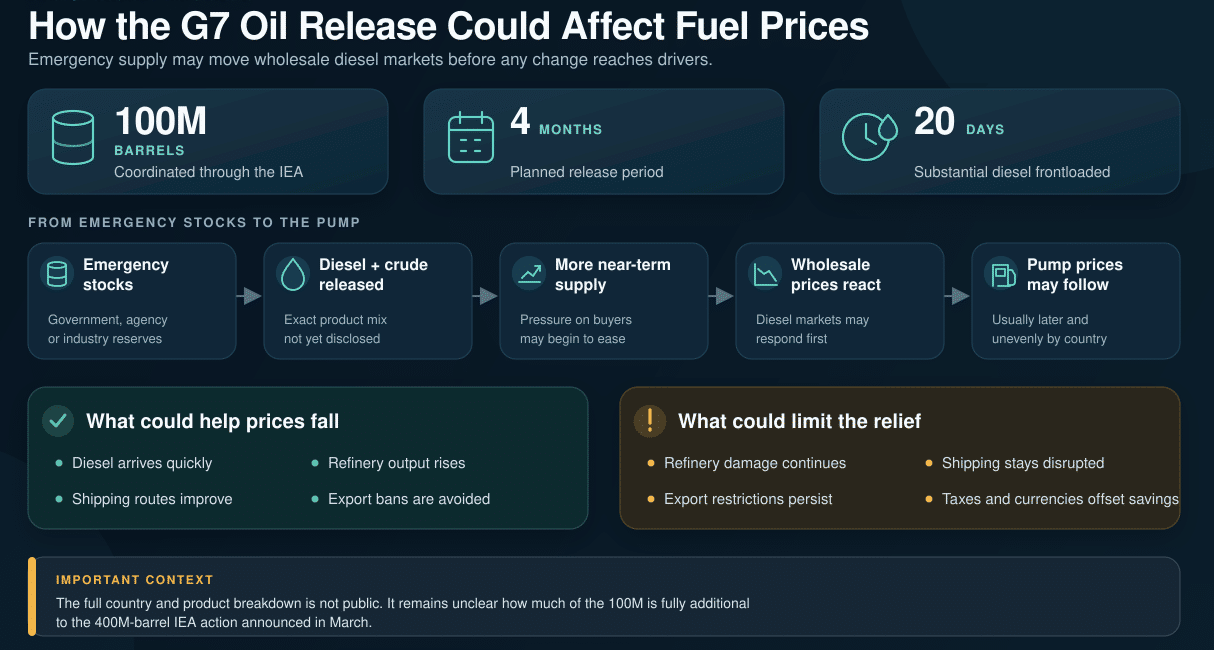
On October 2, 2026, G7 leaders announced a coordinated release of 100 million barrels from emergency oil stocks through the International Energy Agency, or IEA.
The release is due to begin immediately and continue over four months. A substantial amount of diesel will be frontloaded into the first 20 days by G7 members and partner countries.
Officials have not yet provided a country-by-country breakdown. They have also not said exactly how much of the 100 million barrels will be diesel, crude oil or other petroleum products.
The announcement included several measures that received less attention than the headline number. G7 countries agreed to coordinate refinery maintenance so that too many facilities do not shut down simultaneously. They will also try to increase refinery operating rates where possible and encourage other major refining countries to produce more finished fuels, particularly diesel.
The group also pledged not to impose energy export restrictions on other G7 members. This followed intense debate over whether the United States might restrict diesel exports to protect its domestic market. Such a restriction could have lowered US prices temporarily while worsening shortages elsewhere, especially in Europe.
The G7 instead chose a coordinated release and left open the possibility of releasing more diesel if market pressure continues.
Why Is Diesel the Main Concern?
Crude oil normally dominates energy headlines, but diesel is the more urgent part of this crisis. The IEA says crude exports from the Middle East have recovered significantly from earlier disruptions. Flows of finished petroleum products, however, remain severely constrained.
This distinction is important. Having crude oil available does not automatically produce more diesel. The crude must reach a suitable refinery, be processed, and then move through storage and distribution networks before it becomes usable fuel.
The conflict involving Iran and disruption around the Strait of Hormuz have affected normal energy shipments from the Persian Gulf. Some regional refining capacity and export routes have also been damaged or interrupted.
At the same time, Ukrainian attacks have reduced operations at a number of Russian refineries. Russia has restricted diesel exports to protect its domestic market, removing supplies that would otherwise have gone to international buyers.
Reuters also reported that China suspended most fuel exports for October to protect its own inventories. When several major suppliers reduce exports at the same time, buyers in Europe, Asia and other regions are forced to compete for fewer available cargoes.
Diesel shortages also spread quickly through an economy. Diesel powers trucks, farm machinery, construction equipment and parts of the shipping industry. Related distillate fuels are used for heating in some countries.
When diesel becomes expensive, the cost is not limited to motorists. It can increase the price of farming, food distribution, manufacturing, and almost every supply chain that depends on heavy transport.
How Do Emergency Oil Reserves Work?
IEA member countries are generally required to maintain emergency oil stocks equal to at least 90 days of their net imports.
Those reserves are not always kept in one government-owned facility. Depending on the country, they may be held by governments, dedicated stockholding agencies or private companies operating under national rules.
The stocks may contain crude oil, diesel, gasoline and other petroleum products. This gives governments some flexibility when responding to different kinds of disruption.
During a serious supply crisis, IEA members can agree to release part of those stocks collectively. The additional supply helps replace missing barrels, reassures buyers, and gives producers and distributors time to adjust.
Emergency reserves are designed to soften short-term supply shocks. They are not a permanent price-control system.
That is how I think this release should be understood: as a bridge through a dangerous period, rather than a complete solution to the energy crisis.
How Large Is the 100-Million-Barrel Release?
The headline figure is significant, but it needs context. If 100 million barrels were distributed evenly over approximately four months, the average would be about 830,000 barrels a day. The actual schedule will not be even because diesel is being released more heavily at the beginning.
An additional 830,000 barrels a day can influence a tight market. Prices are often determined by the availability of the final barrels needed to meet demand, so even a relatively modest change in supply can affect trading and purchasing decisions.
The type and location of the fuel matter just as much as the total amount.
A barrel of finished diesel stored near a major port or distribution network can enter the market relatively quickly. A barrel of crude stored far from available refinery capacity may take much longer to help consumers. This is why the eventual diesel-versus-crude breakdown will be so important.
Is This Separate From the March Release?
This remains the most important unanswered question. In March 2026, IEA members announced a larger emergency action involving 400 million barrels. By October 2, approximately 325 million barrels, more than 80% of that original commitment, had been released.
The October G7 statement says the new plan takes account of commitments that have already been fulfilled. It does not clearly establish whether the entire 100 million barrels are additional to the March action or whether part of the amount represents the completion of earlier promises.
For that reason, it would be misleading to add the two headline figures together and describe the total as 500 million barrels.
The IEA still needs to confirm how much each country will provide, which products will be released, and how the October plan relates to the remaining March commitments.
The uncertainty does not make the announcement meaningless. It does, however, make the headline number less straightforward than it first appears.
How Could the Release Lower Prices?
The release can affect prices through both physical supply and market expectations.
- Diesel and crude oil become available to buyers who might otherwise struggle to secure enough fuel.
- Coordinated action can reduce fears that the shortage is about to become worse. Traders may become less willing to pay extreme prices when they know governments are prepared to release emergency stocks.
An initial market reaction was visible as details of the discussions emerged. Reuters reported that US diesel futures fell about 3.25%, while benchmark European diesel futures dropped approximately 5.75%. AP reported that US oil prices declined about 2% following the announcement.
These movements show that the plan influenced market expectations. They do not tell us how much consumers will save.
Futures prices can change within minutes. Physical fuel still has to leave storage, reach buyers, move through distribution systems, and replace supplies purchased earlier at higher prices. That process can take days or weeks.
Will Drivers Pay Less at the Pump?
I think some consumers may eventually pay less, but the size and timing of the reduction will vary considerably.
Wholesale diesel markets are likely to feel the effects first because diesel is being prioritized. Retail diesel prices may follow if the released fuel reaches the right markets quickly and wholesale costs remain lower.
Petrol or gasoline could also become cheaper if the release reduces crude prices or allows refineries to increase production. The effect will be less direct because the immediate shortage is concentrated in diesel and other refined products.
Retail prices include much more than the international price of oil. They also reflect refining costs, transportation, storage, taxes, retailer margins, and local competition.
For fuel-importing countries, exchange rates can be equally important. A fall in the dollar price of oil may provide little relief if the local currency weakens at the same time.
Government policy matters too. Some countries regulate or subsidize fuel prices, while others allow international market movements to pass through more quickly.
Fuel stations may also be selling inventories purchased before the G7 announcement. Even if replacement supplies become cheaper, retailers may need time to work through their more expensive stocks.
A fall in diesel futures, therefore, should not be confused with an identical and immediate reduction at the pump.
What Could Prevent Prices From Staying Down?
The release does not repair the problems behind the shortage.
It cannot rebuild damaged refineries, restore every disrupted shipping route, or guarantee safe passage through the Strait of Hormuz. It cannot force Russia or China to resume fuel exports. It also cannot prevent another escalation in the Middle East.
If those disruptions continue, the released fuel may replace only part of the missing supply. Prices could fall initially and rise again as emergency volumes are absorbed.
The condition of refineries will be particularly important. Releasing additional crude has limited value when the market lacks enough functioning capacity to turn it into diesel and other products.
Emergency stocks are also finite. Countries that release them will eventually need to rebuild their reserves. That future purchasing could add demand to the market, although governments will normally try to replenish stocks when conditions are more stable and prices are lower.
Using reserves during a major supply disruption is not necessarily a mistake. That is why they exist. But governments must preserve enough protection in case the crisis becomes longer or more severe.
G7 Oil Reserve Release: What Should We Watch Next?
The IEA’s implementation details will tell us more than the original headline. The first figure to watch is the amount of finished diesel included in the release. The second is the timetable for delivering it. The third is how much of the 100 million barrels represents genuinely additional supply beyond the March commitments.
The G7 has requested an IEA progress report within 20 days. It may also consider further diesel releases if the market remains under pressure.
Refinery output, Russian and Chinese export policies, and shipping conditions around the Strait of Hormuz will be equally important. Improvement in those areas would reinforce the release. Further disruption could quickly overwhelm its benefits.
Finally, wholesale movements must be compared with actual retail prices. Lower futures are an encouraging early signal, but the real test is whether farmers, transport companies, businesses and motorists begin paying less.
The Release Can Buy Time
The G7 oil reserve release should help calm an anxious market, particularly if substantial diesel volumes arrive quickly. It could lower wholesale prices and eventually provide some relief to consumers.
A dramatic or permanent fall is far less certain. My reading is that fuel prices are more likely to soften than collapse. Diesel markets may respond first, while changes at fuel stations will arrive later and vary widely between countries.
Emergency reserves can replace missing supplies for a limited period. Lasting relief will require functioning refineries, reliable export flows and safer shipping routes.
The release can buy that time. What happens during it will determine whether fuel prices genuinely fall or merely pause before climbing again.