
A professional SEO audit should leave you clearer about what your website needs and where to start. Yet a report packed with technical warnings and colourful charts can still leave the most useful questions unanswered: Which problems actually matter? What should you fix first? And is the proposed work worth the time and cost?
Before paying for an audit, it helps to know what a thorough review should cover, how its findings should guide decisions, and where reasonable expectations end. Promises of guaranteed rankings or instant traffic growth deserve scrutiny. The real value lies in clear evidence, sensible priorities, and recommendations your team can put to work.
What Is a Professional SEO Audit?
A professional SEO audit is a close look at your website’s technical health and performance. It finds the hidden problems that affect how search engines see your site, then shows you how to fix them.
Think of it like a doctor’s checkup for your website. You get clear, useful findings instead of vague promises about guaranteed results.
A strong audit goes beyond surface-level notes. Here’s what it typically reviews:
- Technical SEO: How fast pages load, how search engines crawl your site, and whether your schema markup is set up correctly.
- On-page and keyword analysis: How well each page targets keywords and serves what users need, plus where gaps exist.
- Content evaluation: Which low-performing pages need work or should be removed.
- Performance metrics: How speed and user experience affect your rankings.
- Backlink analysis: The quality and relevance of outside links pointing to your domain.
- Site structure and internal linking: Whether your pages are organized so search engines can crawl everything easily.
All of this gives your digital marketing strategy a solid base of real data. You won’t get empty promises about overnight success or permanent results without ongoing work.
Key Components of a Professional SEO Audit
A good SEO audit pulls back the curtain on your website. It shows you what search engines see and what your competitors might be missing.
You’ll find the technical problems holding you back, the content gaps costing you traffic, and the off-page factors that help or hurt your rankings. Let’s look at each piece.
Technical SEO Analysis
Technical SEO analysis checks the “plumbing” of your website. It looks for issues that stop search engines from seeing your content, such as slow pages, poor mobile layouts, crawl problems, and indexing errors.
Search engines struggle with broken links, duplicate content, and messy site structure. Your site’s technical health directly affects how well search engines can reach and rank your pages.
Performance metrics show how speed and user experience affect your search rankings. A slow site frustrates visitors. It also tells search engines your site may be low quality.
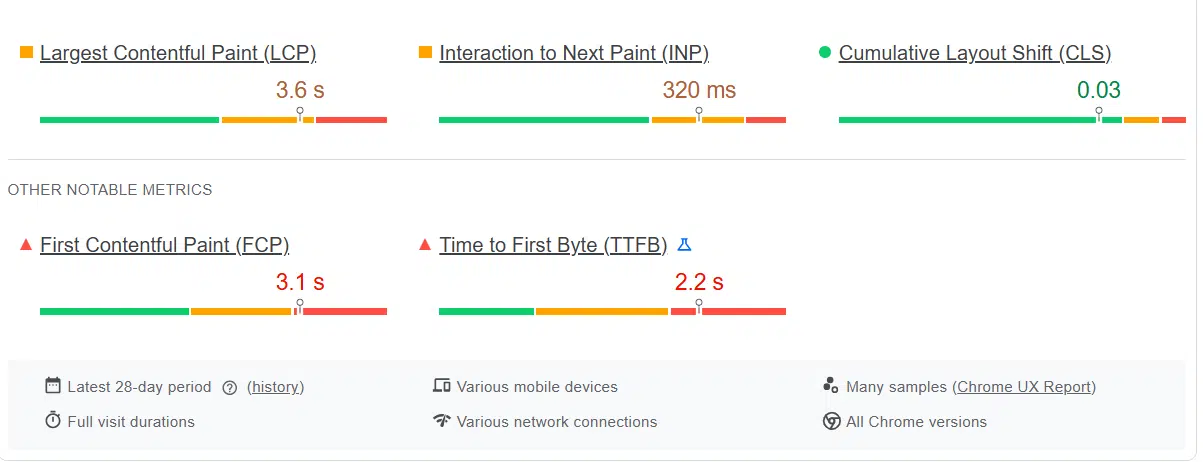
Here’s a tip I always share: don’t settle for an audit that just says “site speed.” According to Google’s Core Web Vitals guidance (web.dev) and Search Console reporting, a page passes when it hits these “good” numbers for at least 75% of real visits:
| Core Web Vital | What It Measures | “Good” Threshold |
|---|---|---|
| Largest Contentful Paint (LCP) | How fast the main content loads | 2.5 seconds or less |
| Interaction to Next Paint (INP) | How quickly the page responds when you click or tap | 200 milliseconds or less |
| Cumulative Layout Shift (CLS) | How much the page jumps around while loading | 0.1 or less |
In Search Console, a group of URLs only counts as “Good” if it meets all three. INP also replaced an older metric called FID in March 2024. So if your auditor still reports only FID, they may be using an outdated playbook.
A full crawl can show how big your technical problems really are. For example, a scan of 1,200 pages might flag:
- 248 pages with duplicate meta descriptions
- 34 pages blocked by robots.txt
- 12 pages with 5xx server errors
- 86 pages with redirect chains longer than two hops
These numbers show how small faults add up across a site. Fixing blocked pages and redirect chains cuts wasted crawling right away. Search engines can then spend their time on your best content instead of getting stuck.
Structured data is another big piece. Schema markup is code that helps search engines understand what your content means. Done right, it can lead to rich snippets, like star ratings or prices in search results. Your audit should check this markup on product pages, articles, and local business info.
The technical review should also catch broken redirects, missing meta tags, and XML sitemap errors. These seem small. But over time, they grow into major visibility problems. Fixing them gives every other SEO effort a strong foundation.
Content Quality and Search Intent Evaluation
A professional SEO audit looks at your content to find pages that need work. It checks how well each page targets its keywords and serves your readers.
Low-quality pages can drag down your whole site. So auditors spot these weak pages and suggest improving or removing them. They also check whether your content truly answers what people search for, not just whether it uses the right words.
Search intent is the “why” behind a search. Your website optimization falls short when content doesn’t match what searchers want. A good content evaluation asks:
- Does this page solve a real problem?
- Does it give genuine value?
- Does it match how people actually phrase their searches?
- Can readers find answers quickly through your site structure?
Auditors also study performance metrics to see how user experience affects rankings. Then they suggest specific changes. This kind of keyword analysis goes beyond word counts. It focuses on relevance and context, turning guesswork into data-driven decisions.
Backlink Profile and Off-Page SEO Review
Your backlink profile tells a story about how much people trust your site. A backlink is simply a link from another website to yours. A thorough backlink analysis checks the quality and relevance of these links, which directly affects your search engine ranking.
The audit looks at where your links come from, whether they relate to your industry, and whether they follow search engine rules. Spammy links can hurt you, so spotting them matters a lot. The review also shows chances to build ties with respected sites in your field.
Off-page review goes beyond counting links. It also covers:
- Your overall online footprint
- Brand mentions across the web
- How your site stacks up against competitors
- Whether your link strategy fits your business goals and audience
A few strong links from trusted sources carry far more weight than dozens of weak links from unrelated sites. This review shows exactly where you stand in your industry.
Local SEO and Geographic Signals
Local SEO matters more than most business owners realize. A professional SEO audit checks how well your website performs in location-based searches. Can search engines tell where you are, which areas you serve, and why you’re relevant there?
One quick check: listen to the words your auditor uses. Google now calls its local listing tool Google Business Profile, not “Google My Business.” Also, 2026 audit checklists from agencies such as SEO Atlantic and Loona list NAP consistency and review checks alongside it. NAP stands for your business name, address, and phone number.
A solid local audit should review:
- Your Google Business Profile setup
- NAP consistency across online directories
- Your reviews and service-area coverage
- Local business schema markup
- Pages focused on specific cities, regions, or service areas
- Links from local websites, which build geographic authority
All these signals work together to tell search engines which regions or neighborhoods you serve. The audit should also confirm that your location data appears the same way across your whole site.
Your report should highlight which local fixes will bring the most traffic from nearby customers. And every recommendation should be a clear step you can actually take.
Website Structure and Internal Linking
Your website structure is like the foundation of a house. If it’s poorly built, everything else falls apart. A professional SEO audit checks how your site is organized and whether search engines can crawl it without getting lost.
Poor site structure creates roadblocks. Search engines struggle to find and index your content. Visitors bounce away faster than you can say “404 error.”
The audit checks whether:
- Your pages connect to each other in a logical way
- Your navigation makes sense
- Important pages sit just a few clicks from your homepage
- Any “orphan” pages exist with no internal links pointing to them
Internal linking is the glue that holds your site together. Good internal links guide visitors from page to page. They also pass authority around your site and show search engines which pages matter most.
The audit checks whether you link to high-value pages often enough and whether your anchor text (the clickable words) fits your target keywords. It shows which pages need more links and which already get enough. The result? A confusing maze becomes a clear path that both search engines and visitors can follow.
What a Professional SEO Audit Should Not Promise
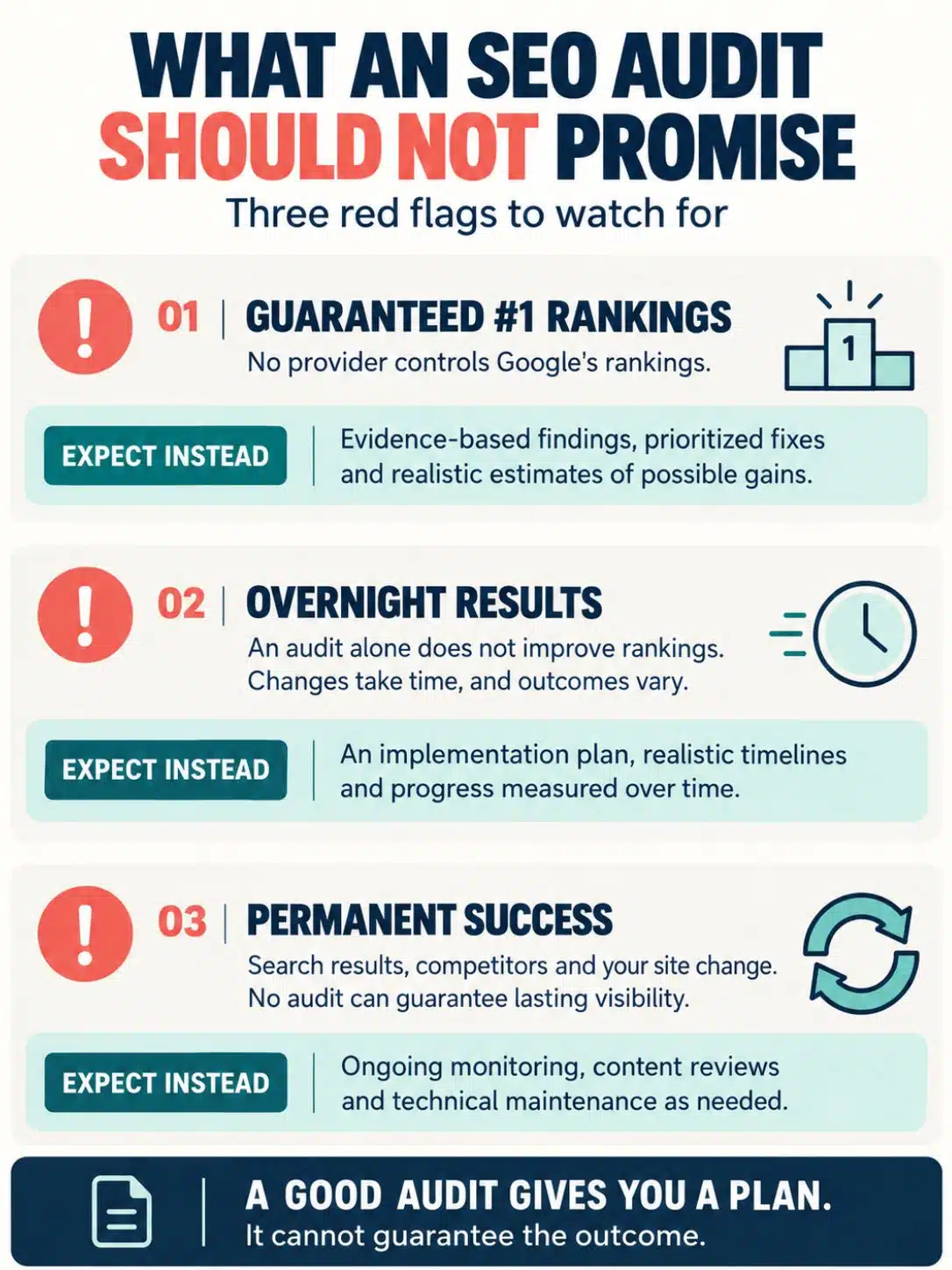
Many SEO companies make wild claims that just don’t hold up in the real world. Knowing the red flags helps you tell honest pros from people who oversell. Here are the three big promises to watch out for.
Guaranteed #1 Rankings
Anyone who promises you a number one ranking is selling snake oil. And you don’t have to take my word for it.
According to Google Search Central’s guidance on hiring an SEO, as covered by Search Engine Journal in 2026, Google puts it plainly:
Google says an SEO can give you an estimate of possible gains, but not a guarantee. Its updated guidance also encourages businesses to report fraudulent SEO providers to the US Federal Trade Commission (FTC). So if you’ve been misled, you have a real place to turn.
Rankings depend on hundreds of factors that Google controls, not your SEO provider. Your competitors are working to improve too, so the landscape shifts all the time.
Honest SEO experts focus on what they can control:
- Technical SEO fixes
- Content quality improvements
- Backlink analysis
- Site structure and on-page improvements
- Tracking performance metrics over time
What they won’t do is claim you’ll hit the top spot by next month. If an auditor promises number one rankings, walk away. Real pros know rankings take ongoing work and honest talk about what’s possible in your market.
Overnight Results
SEO doesn’t work like magic. Your website won’t jump to the top of search results after a single audit. Most websites need months, not days, to see real gains in their search engine ranking.
The data backs this up. According to Ahrefs’ study of roughly 2 million newly published pages (updated 2025), only 1.74% reached Google’s top 10 within a year. Most of those took about 61 to 182 days to get there.
Ahrefs also found that the average top 10 page is more than two years old. Pages in the #1 spot average almost three years. So if someone promises big ranking jumps in a few weeks, you have good reason to doubt them.
An audit’s findings need to be put into action, tested, and refined. You apply the fixes, watch your performance metrics, and adjust based on what the data shows. Expecting instant results only leads to disappointment.
Here’s a realistic example. Say an audit’s top fixes include:
- Compressing images
- Fixing 15 render-blocking scripts
- Removing 40 low-value thin pages
Over a 10-week rollout, median mobile First Contentful Paint might improve from 4.6 seconds to 2.1 seconds. Organic sessions may grow by 8% in the same period. (First Contentful Paint is a helpful speed number, but it isn’t one of Google’s Core Web Vitals. LCP is the one Google actually grades.)
Speed and user experience gains like these can show up within weeks. Traffic gains stay gradual and need steady content work. Real improvements unfold over weeks and months, not days.
Search engines reward sites that keep getting better. Your audit might show that your site structure needs reworking, that some pages need better content, or that you need stronger outside links. None of that happens instantly.
Website optimization is a marathon, not a sprint. Anyone promising quick rankings isn’t being honest about how search engines work.
Permanent SEO Success Without Ongoing Efforts
SEO success isn’t a one-time win. Your website needs steady attention to keep and grow its rankings.
Think of SEO like caring for a car. You can’t tune it up once and expect it to run perfectly forever. Search algorithms change, competitors adjust their plans, and user habits shift.
An audit gives you the roadmap. But the trip takes steady effort. Your digital marketing strategy should include regular work like:
- Checking your performance metrics
- Refreshing older content
- Building quality backlinks
- Adapting to algorithm updates
Rankings fade without this kind of consistent effort. A professional audit should never promise permanent success. Instead, it should lay out the ongoing work needed to keep your visibility and grow your traffic over time.
The audit is your starting line, not your finish line.
Final Thoughts
When reviewing an SEO audit, ask whether you could use it to decide what to do next. Each important finding should explain the problem, show the evidence, and recommend a practical response. You should also understand which fixes deserve immediate attention, which can wait, and how you will assess progress.
Be wary of anyone who sounds more certain about future rankings than they are specific about your website’s problems. A professional SEO audit should give you a credible plan, explain its limitations, and help you spend your resources wisely. That is a much stronger foundation than a promise nobody can reliably keep.
FAQs about What A Professional SEO Audit Should Include
1. What should a professional SEO audit include?
A good SEO audit checks your site’s tech health like page speed, broken links, and mobile use. It also reviews your keywords, content quality, and the sites linking back to you. Most professional audits from tools like Semrush examine 100 to 200 ranking factors to catch everything that could help or hurt you.
2. Can an SEO audit promise first-page rankings on Google?
No, and you should walk away fast if someone promises that, because Google’s algorithm uses over 200 ranking factors and changes constantly.
3. What should an SEO audit report give me when it’s done?
You should get a clear list of problems ranked by urgency, with simple steps for each fix. The best reports group issues into critical, high priority, and nice to have, so you know exactly where to start.
4. Why do some SEO audits promise fast traffic gains?
Some sellers use big promises to hook you because hope sells. Real SEO takes 4 to 6 months to show results according to 2025 Ahrefs data, so anyone promising fast gains is overselling.