Watching Spider-Man: Brand New Day recently made me want to revisit the stories I grew up with. After No Way Home, Tom Holland’s Peter Parker is broke, lonely, and trying to survive in New York while the people closest to him no longer remember him. Tony Stark is gone, along with the reassurance Peter once found in his mentor’s support.
I grew up loving superhero characters and Marvel, Disney, and Pixar stories. I love reading books and watching movies and series, and Spider-Man remains part of that affection. Why Spider-man still matter to me? Well, having seen all the films, I still enjoy their action, humour, and imagination.
Peter’s loneliness gave me another reason to think about his life beyond the suit. He can be needed by an entire city and still have nobody who remembers being his friend. Looking back through the films, I keep finding characters whose courage exists alongside impatience, grief, stubbornness, and a need for other people.
Spoilers follow for the Spider-Man films discussed, including No Way Home, Across the Spider-Verse, and Brand New Day.
Peter Parker’s Ordinary Life Gives the Story Its Weight
Peter can save a stranger on the way to an appointment and still arrive too late for someone who was counting on him. I can understand his decision to help. I can also understand the frustration of the person left waiting.
His secret identity often prevents an honest explanation. Other people see a broken promise and have to decide what it says about him. They have needs of their own, and being close to a superhero does not make those needs disappear.
That tension reaches back to Peter’s debut in Stan Lee and Steve Ditko’s Amazing Fantasy #15 in 1962. He lets a criminal escape, then discovers that the same man killed Uncle Ben. He learns responsibility through a failure he cannot undo.
The films keep testing how he applies that lesson. Knowing he should help people does not settle every decision about work, love, or friendship. Sometimes he chooses badly; sometimes even a necessary choice hurts someone.
I like that the story gives those consequences space. Peter has to live with people’s disappointment, repair what he can, and decide how to show up again.
Three Peter Parkers, Different Ways of Carrying Responsibility
Tobey Maguire, Andrew Garfield, and Tom Holland play separate versions of Peter Parker. Their films have different histories and relationships, which No Way Home eventually brings into contact.
Each version gives familiar pressures a different emotional shape.
Tobey Maguire: Knowing the Cost and Choosing Again
In Spider-Man 2, Peter struggles to manage college, work, and his relationships while protecting New York. For a time, he gives up being Spider-Man.
The appeal is easy to understand. He wants control over his day and a chance to keep his promises. His return to the suit matters because he now knows how much the commitment can demand. He chooses it again with fewer illusions.
Spider-Man 3 tests him differently. Public admiration feeds his confidence, while the symbiote intensifies his anger and arrogance. Peter starts treating other people carelessly.
I appreciate that the trilogy allows him to become difficult to like at times. Learning responsibility has not made him permanently wise. He still has to recognise when his behaviour is hurting people.
Andrew Garfield: Grief and a Second Chance
Andrew Garfield’s Peter combines sharp humour with restlessness. His relationship with Gwen Stacy gives the films much of their warmth, making her death in The Amazing Spider-Man 2 a devastating failure he must live with.
When he catches MJ in No Way Home, that earlier story gives the rescue its meaning. His reaction afterward brings Gwen into the scene without her being there.
Saving MJ cannot repair Gwen’s death. It does spare another Peter a tragedy he understands.
That is a convincing way to continue his story. Grief remains part of his life, and he can still change what happens to someone else. The rescue gives his experience a purpose without pretending the earlier loss has been resolved.
Tom Holland: Learning to Accept Help
Holland’s Peter begins Homecoming eager to prove himself. Tony Stark’s attention matters to him, and the Avengers represent a world he wants to enter.
Trapped beneath rubble, he is frightened and overwhelmed before finding the strength to lift himself out. That vulnerability keeps his ambition connected to the young person carrying it.
In No Way Home, Aunt May’s death brings him close to killing the Green Goblin. Maguire’s Peter intervenes.
Holland’s Peter already has the strength to act. What he needs at that moment is someone who understands his anger and stops him from making it irreversible. The older Peters’ histories become useful to someone still struggling through his own.
The Spider-Verse Gives the Mask More Possibilities
The multiverse allows parallel realities to contain different histories. The Spider-Verse brings that idea into Spider-Man’s world, connecting heroes with lives and identities of their own.
Some are alternate Peter Parkers. Others, including Miles Morales, Gwen Stacy, and Miguel O’Hara, are distinct people.
Gwen becomes the Spider-Hero in her world, with her own relationships and losses. Hobie Brown’s independence and Pavitr Prabhakar’s cultural setting offer further ways of inhabiting the identity. Spider-Ham and Spider-Man Noir bring humour and different storytelling traditions into the mix.
As an illustration fan, I notice how much the visual styles tell us. Gwen’s painted world and Hobie’s rough collage aesthetic create different moods before their histories have been fully explained. The films let those styles meet without smoothing away their differences.
That makes the shared mask more interesting to me. It can connect these characters while allowing each of them to bring a different family, culture, temperament, and sense of belonging to the story.
Miles Morales Makes the Name His Own
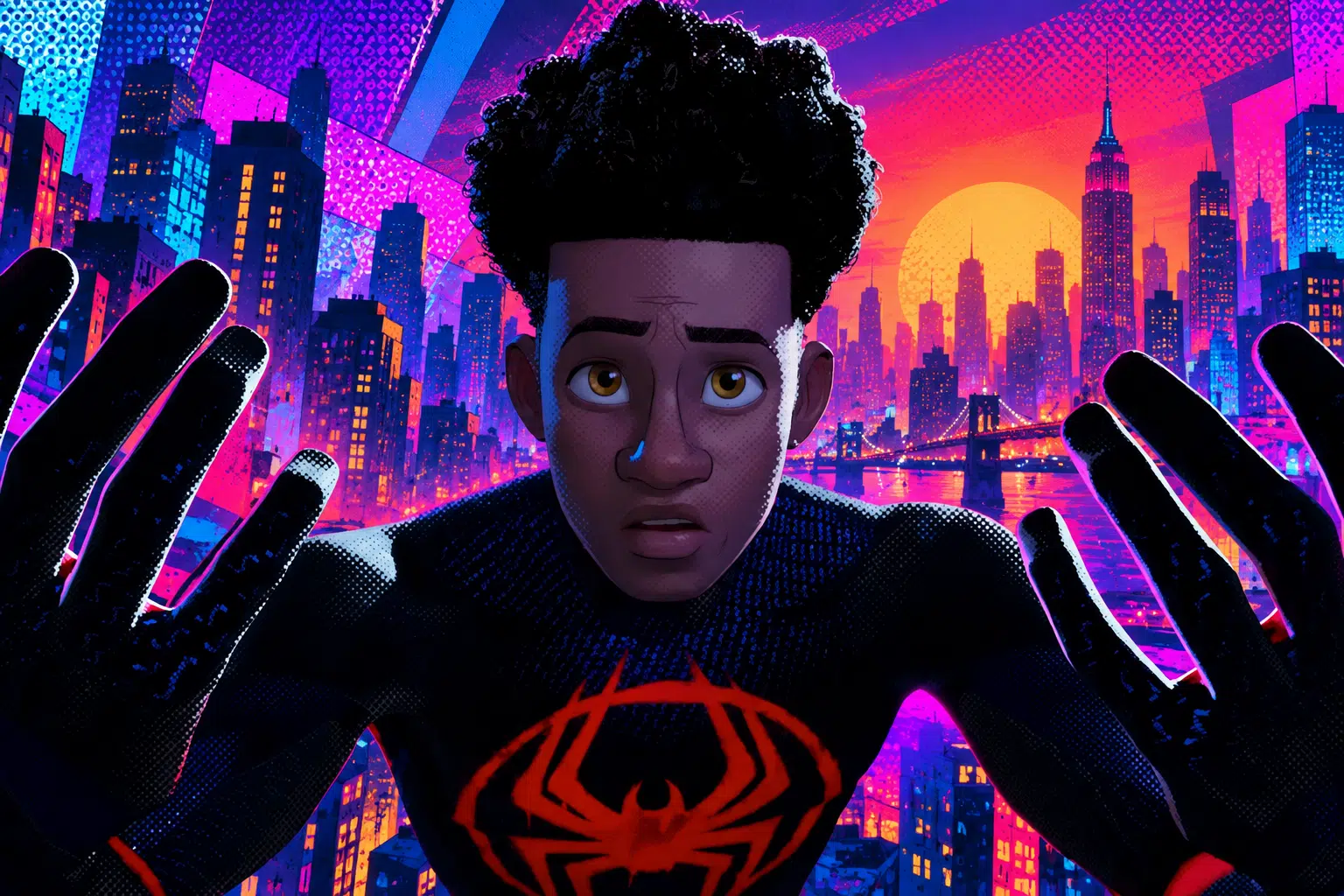
In Into the Spider-Verse, Miles is learning to use his abilities under a name that already means something to other people. The experienced Spider-People around him offer support, but their presence also makes his uncertainty harder to escape.
His leap of faith gives that struggle a physical expression. He acts before he can feel completely prepared, beginning to trust his own judgment.
Miles first appeared in Ultimate Fallout #4 in 2011. In the original Ultimate comics universe, he became Spider-Man after that world’s Peter Parker died. The animated films develop his journey in a separate continuity.
His connection to Peter’s legacy matters, but his parents, friendships, neighbourhood and creativity give his decisions their own stakes. Following him means watching someone work out how to carry an inherited identity without surrendering everything that makes his life his own.
Peter and Miles have both experienced grief. In Across the Spider-Verse, however, Miles faces a particular demand: other heroes tell him that a loss he wants to prevent must happen.
Who Gets to Decide What Spider-Man Must Lose?
Miguel O’Hara, Spider-Man 2099 and leader of the Spider Society, believes certain recurring experiences, called canon events, are necessary to preserve the multiverse. That explanation becomes personal when Miles is told that his father is supposed to die.
Miles wants to protect someone he loves. Miguel believes interference could endanger entire realities. His experience of catastrophe helps explain why he wants certainty.
I find that disagreement compelling because neither character is choosing without consequences. Miles’s refusal carries a possible cost, and Miguel’s position requires him to accept someone else’s suffering.
What makes me uneasy is the demand that Miles agree to his father’s death in advance. A history of loss has become something other heroes insist he must inherit.
Canon events are presented through Miguel’s account, which Miles contests. The film leaves the argument unresolved. His explanation should not automatically become a rule for every Spider-Man story.
That uncertainty belongs in the discussion. We can understand Miguel’s fear while questioning the authority he claims over Miles’s life.
Surviving tragedy may help someone understand another person’s pain. Whether it gives them the right to prescribe that pain is a much harder question.
Spider-Totems Take the Question of Destiny Further
Looking into the comics adds another layer to these connections.
Later stories introduce Ezekiel Simms, who challenges Peter’s scientific understanding of his abilities by suggesting a mystical connection. Spider-Totems are beings associated with mystical spider power, linked across realities through the Web of Life and Destiny.
Morlun and the Inheritors hunt these beings and feed on their life force. The Spider-Verse comic crossover, which began in 2014, brings Spider-Heroes together against those hunters.
This mythology belongs to those comic stories. The animated films develop their own explanations, including the disputed canon-event theory.
I find Spider-Totems fascinating because they make Peter’s apparently accidental beginning part of a discussion about a larger pattern. I still want room within that pattern for the decision that gives his origin its meaning: whether to help when he has the ability to do so.
A cosmic explanation can expand his world. His response to the person in front of him keeps the story personal.
Peter’s isolation in Brand New Day makes being Spider-Man consume more of his life. The city needs his help, but that usefulness cannot replace the relationships he has lost.
His encounter with Jean Grey gives the film a specific way to explore connection. Peter allows the telepath into his mind and shares the love he received from Aunt May.
May’s death helped shape his grief in No Way Home. Here, the care she gave him becomes something he can offer someone else. Her influence continues through an act of trust.
I find that a meaningful development for Peter. He has spent so much of his life carrying the consequences of loss. This interaction also lets him carry forward something good that a relationship gave him.
It connects with what the older Peters do for him in No Way Home. Their experience helps reach him when he is overwhelmed; his memory of May’s care now helps him reach another lonely person.
That is the kind of resilience I want these films to explore. Relationships help Peter understand himself and affect how he treats others. Letting someone know him can be a difficult choice in its own right.
He still needs the possibility of receiving that care too. Being able to help someone does not remove his need for friendship, affection, or a future he can look forward to.
A Hero Needs a Life to Return To
I enjoy watching Peter and Miles become more capable. Their mistakes and difficult choices give that growth meaning, and their relationships give them reasons to keep trying.
I want to see what they can build as well as what they can survive: lasting friendships, a chance at love, and reasons to look forward to an ordinary day.
Across all those worlds and versions, I still care about the person who has to take the mask off. I want Peter and Miles to keep choosing to help people. I also want them to have someone to go home to.