The history of AI milestones is defined less by flashy headlines and more by foundational breakthroughs in architecture, hardware, and training. While board game victories capture public attention, quiet technical shifts—like neural networks and transformers—fundamentally remapped what machines can learn and build.
This guide breaks down the ten pivotal history of AI milestones that redirected computer science, solved longstanding computational bottlenecks, and brought artificial intelligence into daily global use. Arranged chronologically, these breakthroughs trace how simple rule-based logic evolved into today’s multimodal intelligence.
How to Read the History of AI Milestones
These events represent different kinds of progress. Dartmouth gave the field a name. Backpropagation improved how neural networks learned. Deep Blue and AlphaGo demonstrated specialized abilities, while ChatGPT made generative AI accessible through a familiar conversational interface. They should not be read as ten equal steps toward a human-like machine.
What Neat AI Timelines Often Leave Out
AI has repeatedly moved through cycles of confidence and disappointment. Funding and enthusiasm declined during the 1970s, then contracted again near the end of the 1980s as expensive expert systems failed to meet commercial expectations. These periods became known as AI winters.
Research continued throughout those downturns. Computer vision, neural networks, robotics, statistical learning, and other fields kept developing, sometimes without using the unfashionable AI label.
Any history of AI milestones that ignores these setbacks creates a false impression of steady progress. A striking demonstration can fail as a product when it meets high operating costs, poor data, unfamiliar inputs, maintenance problems, or users who behave differently from laboratory participants.
1. Alan Turing Introduces the Imitation Game in 1950
Alan Turing’s paper “Computing Machinery and Intelligence” began with the question, “Can machines think?” He replaced that difficult philosophical problem with an experiment called the imitation game, later closely associated with the Turing Test.
Turing also considered learning machines, language, memory, and objections to machine intelligence. The paper did not establish AI as an academic discipline, but it offered a practical way to discuss whether a computer could display behavior that people would judge as intelligent.
2. The Dartmouth Project Gives AI Its Name in 1956
The phrase “artificial intelligence” appeared in the 1955 proposal for the Dartmouth Summer Research Project on Artificial Intelligence. The proposal was written by John McCarthy, Marvin Minsky, Nathaniel Rochester, and Claude Shannon. The workshop took place the following summer.
Dartmouth did not produce a unified theory of intelligence. Its lasting contribution was organizational. Research into reasoning, learning, language, and problem-solving could now develop under one recognizable name.
3. The Perceptron Demonstrates Machine Learning in 1958
Frank Rosenblatt described the perceptron in a 1957 technical report. In July 1958, the U.S. Office of Naval Research demonstrated the idea on an IBM 704. After repeated trials, the system learned to distinguish cards marked on different sides.
The perceptron adjusted internal weights after receiving feedback, making it an important ancestor of modern neural networks. However, Rosenblatt’s early design used a single layer and could not represent many nonlinear relationships.
The episode also established a pattern that AI has never entirely escaped: impressive research followed by publicity that promises much more than the system can deliver.
4. DENDRAL Establishes the Expert-System Approach in 1965
DENDRAL began at Stanford in 1965 through work led by researchers including Edward Feigenbaum and Joshua Lederberg. It used detailed chemical knowledge to help infer molecular structures from mass-spectrometry data.
It is widely recognized as the first expert system, although claims about historical “firsts” can depend on how the category is defined. More importantly, DENDRAL showed that useful AI did not have to imitate general human intelligence. It could concentrate on one demanding field and encode the knowledge of specialists.
That approach later spread into medicine, engineering, and business. Its weakness was maintenance: large collections of rules were slow and expensive to build, update, and reconcile.
5. Backpropagation Strengthens Neural-Network Training in 1986
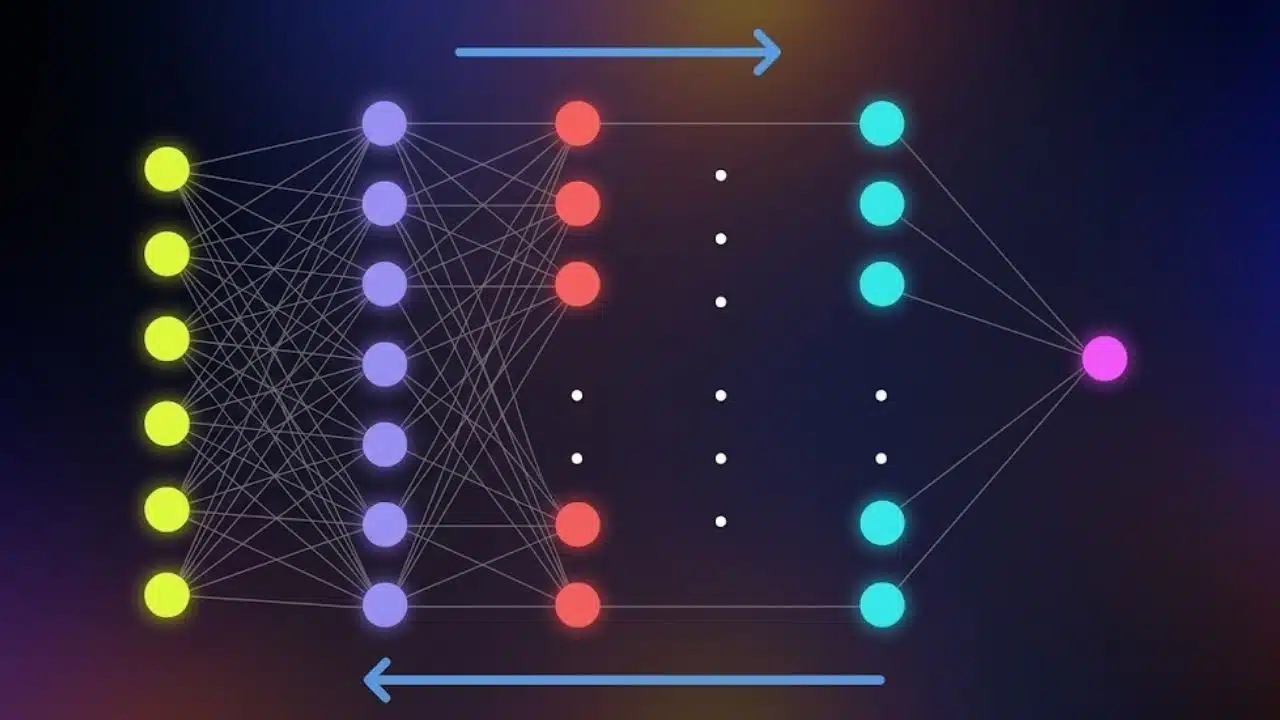
David Rumelhart, Geoffrey Hinton, and Ronald Williams published an influential account of backpropagation in 1986. The procedure trained a neural network by adjusting connection weights to reduce the difference between its prediction and the desired output.
Backpropagation had earlier mathematical and computational roots, so crediting its entire invention to one paper would be misleading. The 1986 publication mattered because it demonstrated a practical way to train networks containing hidden layers. Its full value only became apparent when researchers gained larger datasets, better algorithms, and far more computing power.
6. Deep Blue Defeats Garry Kasparov in 1997
IBM’s Deep Blue defeated reigning world chess champion Garry Kasparov in a six-game rematch in May 1997. It won 3.5–2.5, becoming the first computer system to defeat a reigning champion in a full match under standard tournament controls.
Deep Blue could evaluate up to 200 million chess positions per second. Its strength came from specialized hardware, search methods, chess databases, evaluation functions, and preparation involving human experts.
Calling it a general thinking machine would overstate the result. Deep Blue was exceptional at chess, but it could not carry that ability into an unrelated task.
7. AlexNet Redirects Computer Vision in 2012
AlexNet made deep learning difficult for the computing industry to dismiss. Created by Alex Krizhevsky, Ilya Sutskever, and Geoffrey Hinton, the convolutional neural network was trained on approximately 1.2 million images across 1,000 classes.
A version entered the 2012 ImageNet competition and achieved a top-five test error rate of 15.3%. The second-best entry recorded 26.2%. That unusually large gap redirected serious attention toward deep neural networks.
Graphics processors were central to the result because they made training such a large model practical. The history of AI milestones sometimes presents AlexNet as an isolated invention. Its real achievement was combining established neural-network ideas with enough labeled data, computing power, and careful engineering to produce a decisive result.
8. AlphaGo Defeats Lee Sedol in 2016
Go presented a different challenge from chess. Its enormous search space made evaluating every possible continuation impractical. AlphaGo combined policy networks, value networks, reinforcement learning, self-play, and Monte Carlo tree search. An earlier version defeated European champion Fan Hui 5–0. In March 2016, a stronger version beat Lee Sedol, one of the world’s leading Go players, by four games to one.
The system did more than search quickly. Learning helped it identify which positions and moves deserved attention. Some of its unconventional choices also encouraged professional players to reconsider strategies shaped by centuries of human play.
9. The Transformer Reshapes Language AI in 2017
The 2017 paper “Attention Is All You Need” introduced the Transformer architecture. Instead of processing a sequence mainly through recurrent steps, the original Transformer relied on attention mechanisms and could perform more of its training calculations in parallel.
The first experiments focused on machine translation. The wider consequences came later, as transformers became the foundation for many large language models and spread into computer vision, audio, biology, and other fields.
This milestone lacked the spectacle of a world-champion match, but its technical influence has been broader. Much of the generative AI industry rests on adaptations of this architecture.
10. ChatGPT Makes Generative AI Widely Accessible in 2022

OpenAI released ChatGPT as a research preview on November 30, 2022. The initial system was based on the GPT-3.5 model series and trained to follow conversational instructions using methods that included reinforcement learning from human feedback.
ChatGPT was not the first chatbot, generative model, or large language model. Its importance came from packaging those developments in an interface that people could use without programming knowledge. Drafting, summarizing, explaining, brainstorming, and coding assistance suddenly became accessible through ordinary dialogue.
The original release also documented serious weaknesses. ChatGPT could produce plausible but false answers, change its response after small alterations to a prompt, and display biased or unsafe behavior. Its accessibility increased both the practical value and the consequences of those limitations. That combination gives ChatGPT a clear place in the history of AI milestones.
Final Thoughts
The history of AI milestones is less about machines steadily becoming human and more about researchers finding different ways to automate parts of perception, prediction, language, search, and decision-making.
The best way to evaluate the next claimed breakthrough is to look beyond the demonstration. Ask what task it solves, whether the method transfers to other problems, what data and computing resources it requires, and how reliably it performs outside controlled tests. Those questions reveal more than headlines about a machine appearing intelligent.
Frequently Asked Questions
Did artificial intelligence begin in 1956?
Not exactly. Logic, statistics, computing, and early neural models existed before the Dartmouth workshop. The 1956 event matters because it gave the emerging research field a shared name and identity.
Is machine learning the same as artificial intelligence?
No. Machine learning is one approach within the broader field of AI. Other approaches include symbolic reasoning, search, planning, expert systems, robotics, and knowledge representation.
Why were chess and Go important to AI research?
Games offer clear rules, measurable outcomes, and difficult decision problems. They make useful research environments, although success in a game does not automatically translate into general intelligence.
Did the AI winters stop AI research?
No. Funding and public enthusiasm declined, but researchers continued working in areas such as neural networks, vision, robotics, and statistical learning. Some later breakthroughs grew from work pursued during those quieter periods.
What could become the next major AI milestone?
A convincing milestone would need more than an impressive demo. It could involve dependable reasoning, lower computing requirements, safer autonomous systems, or useful AI that transfers knowledge reliably across very different tasks.