An app marketplace can put your SaaS in front of the right buyers, simplify installation, and remove friction from purchasing. But that only works when the product genuinely belongs in the ecosystem.
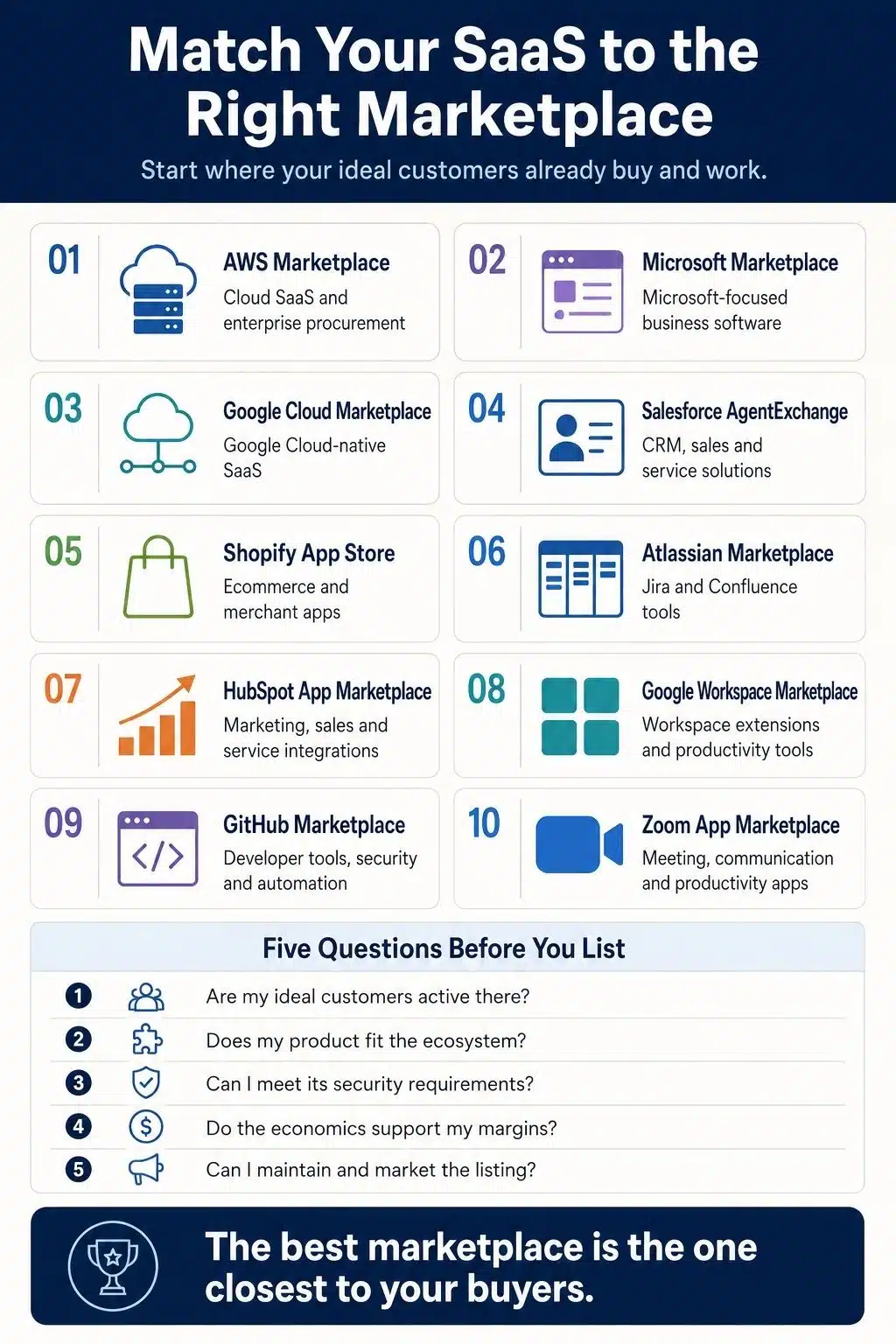
The ten best app marketplaces to distribute your SaaS are AWS Marketplace, Microsoft Marketplace, Google Cloud Marketplace, Salesforce AgentExchange, the Shopify App Store, Atlassian Marketplace, HubSpot Marketplace, Google Workspace Marketplace, GitHub Marketplace, and the Zoom App Marketplace.
I have not ordered them from universally best to worst because they serve different customers. AWS may be the strongest choice for an enterprise security platform, while Shopify would make far more sense for an inventory or returns app. What matters is the match between the marketplace, the product, and the buyer.
Each options are based on customer reach, purchasing support, integration requirements, publisher costs, approval difficulty, and its ability to create meaningful distribution rather than another page for a SaaS company to maintain.
1. AWS Marketplace
Best for enterprise cloud, security, data, infrastructure, and developer SaaS
AWS Marketplace is where I would look first if the product already sells to cloud, security, procurement, or IT teams. Its biggest advantage is not search visibility. It is the ability to fit a SaaS purchase into an organisation’s existing AWS relationship.
Customers can purchase software through their AWS accounts, receive the cost on their AWS bills, and negotiate private offers with custom pricing, payment schedules, and licensing terms. For companies with established procurement rules, that can remove weeks of administrative work.
SaaS vendors can offer subscriptions, contracts, usage-based pricing, or contracts with additional usage charges. Public SaaS offers generally carry a 3% marketplace fee. Fees for eligible private offers can fall to 1.5%, depending on the contract value and type of transaction.
AWS also removed an important barrier in 2025. A SaaS product no longer needs to run entirely on AWS to be listed. Products hosted fully on AWS can receive a special designation, but externally hosted products are also eligible.
Publishing still involves substantial preparation. Vendors must integrate subscription or entitlement management, test purchasing flows, provide support documentation, and meet AWS security and operational requirements.
A listing should not be mistaken for automatic lead generation. AWS Marketplace is often most useful when a customer already wants the product but needs a practical route to purchase it.
2. Microsoft Marketplace
Best for B2B SaaS connected with Azure, Microsoft 365, Dynamics, or Copilot
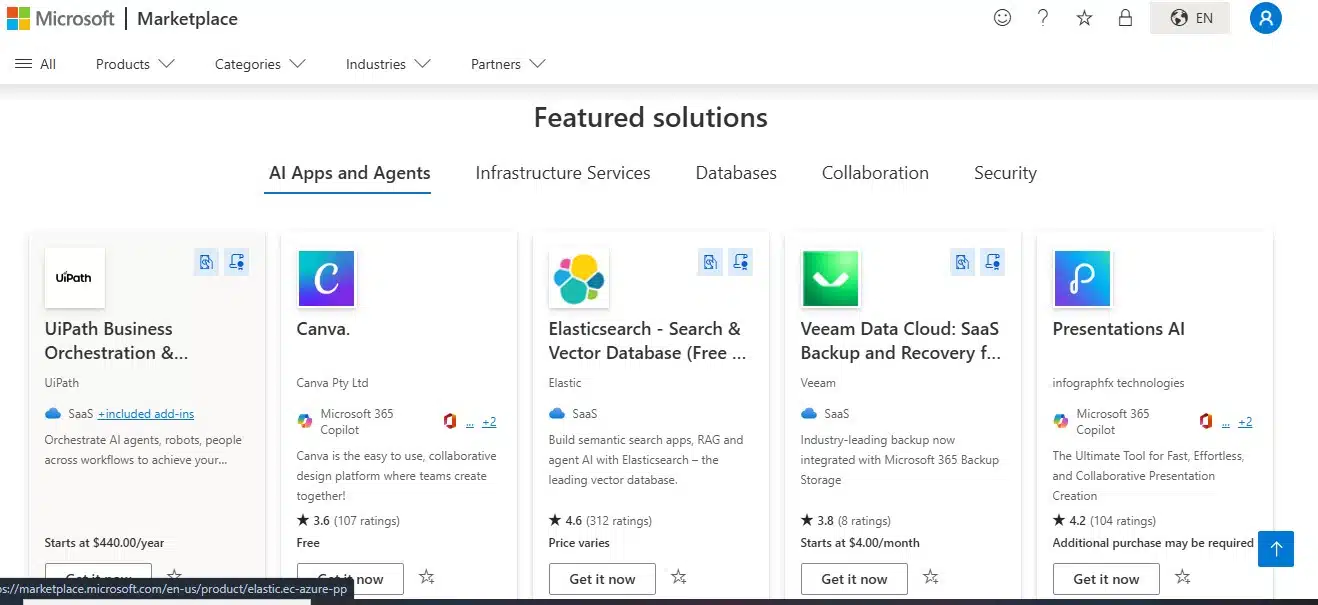
Microsoft combined AppSource and Azure Marketplace into a single Microsoft Marketplace in September 2025. Older articles may still present them as two separate channels, but that distinction is now outdated.
For SaaS companies serving Microsoft-heavy organisations, the unified marketplace offers a mix of product discovery, enterprise procurement, billing, reseller participation, and potential co-selling opportunities.
Microsoft does not charge a fee simply to publish an offer. It currently retains a standard 3% service fee when a customer purchases a transactable offer through the marketplace.
Publishers can use flat-rate subscriptions, per-user pricing, metered billing, or a combination of fixed and usage-based charges. Private offers make it possible to negotiate terms for larger customers rather than forcing every buyer into the same public plan.
The technical setup deserves proper planning. A transactable SaaS offer needs Microsoft Entra configuration, an operational landing page, a secure webhook, and integration with Microsoft’s SaaS fulfilment APIs. Those systems communicate purchases, renewals, plan changes, suspensions, and cancellations.
The work is easier to justify when the product already supports Microsoft-based teams. A weak or mostly cosmetic integration will not gain much simply from appearing beside more established applications.
3. Google Cloud Marketplace
Best for data, AI, analytics, security, and infrastructure SaaS built on Google Cloud
Google Cloud Marketplace can be a valuable route into organisations already buying and managing technology through Google Cloud. It supports integrated billing, private offers, subscriptions, and usage-based pricing.
The standard revenue share is 3%. Eligible large private offers, renewals, migrations, and channel-shift transactions may qualify for lower rates between 1.5% and 2%.
However, Google Cloud Marketplace is more selective about product architecture than AWS. A SaaS product generally needs to be production-ready, enterprise-ready, hosted primarily on Google Cloud, and capable of generating meaningful Google Cloud consumption.
That makes it a natural choice for products already using Google Cloud infrastructure, not a marketplace that every SaaS company should try to enter. I would not restructure an unrelated product simply to qualify for a listing.
The onboarding process can include joining the Google Cloud Partner Network, completing vendor validation, passing product and pricing reviews, and integrating account creation, billing notifications, entitlements, and usage reporting.
For the right product, the result is a credible enterprise purchasing channel. For the wrong product, it can become an expensive architectural distraction.
4. Salesforce AgentExchange
Best for CRM, sales, customer service, Slack, and Agentforce applications
Salesforce AppExchange is now called AgentExchange. In April 2026, Salesforce brought traditional Salesforce applications, Slack solutions, integrations, experts, and Agentforce components into one marketplace.
This also means Slack Marketplace should no longer be treated as a separate distribution option.
AgentExchange makes the most sense when the product improves work already happening inside Salesforce or Slack. That could include data enrichment, sales automation, reporting, document management, customer support, commerce, marketing operations, or industry-specific CRM functions. Agentforce actions, agents, and connected tools create another route for suitable AI products.
Salesforce expects more than a basic integration. Commercial apps usually require partner onboarding, an executed Partner Application Distribution Agreement, and a security review.
The standard ISVforce revenue-share model is 15%, although Salesforce may use other commercial structures, including annual fees based on projected distribution. The final agreement determines the actual terms.
AgentExchange can provide valuable enterprise credibility, but it is not a lightweight directory. Platform-specific development, security preparation, licensing, and ongoing partner administration all need to be included in the business case.
5. Shopify App Store
Best for ecommerce, retail, fulfilment, and merchant-focused SaaS
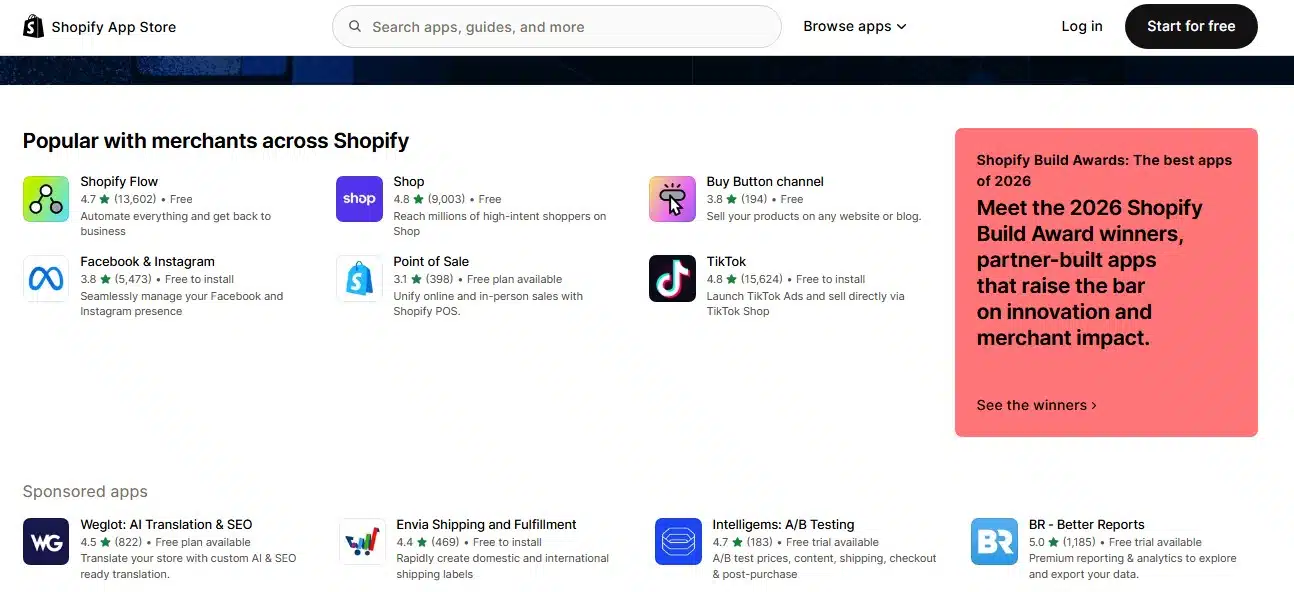
The Shopify App Store offers one of the clearest product-led distribution opportunities on this list. Merchants actively search it for help with marketing, inventory, fulfilment, subscriptions, returns, customer support, analytics, merchandising, and international selling.
Apps can be discovered through marketplace search, categories, recommendations, the Shopify admin, and Sidekick. A useful product therefore has several opportunities to appear at the moment a merchant needs it.
Shopify currently allows developers to keep 100% of their first $1 million in gross app revenue earned from January 1, 2025. Developers keep 85% above that threshold. Billing is also subject to a 2.9% processing fee, while App Store registration carries a one-time $19 charge per Partner account.
New public apps must use Shopify’s GraphQL Admin API, pass the app review process, and use a Shopify-provided billing solution when charging merchants.
The attractive economics should not distract from the competition. A vague app with a long feature list can easily disappear among established alternatives. A product that removes one expensive or repetitive merchant problem has a better chance of earning installations and reviews.
Support quality matters too. Ecommerce problems can affect live orders, customer communication, payments, or inventory. Merchants will not tolerate unreliable syncing simply because an app has a polished listing.
6. Atlassian Marketplace
Best for project management, DevOps, IT service management, and knowledge tools
Atlassian Marketplace has developed into a serious software economy, with more than 6,000 apps and integrations and billions of dollars in lifetime marketplace sales.
The strongest opportunities are usually tied to Jira, Jira Service Management, Confluence, and related workflows. Reporting, test management, time tracking, documentation, planning, automation, compliance, and administration are all established categories.
For a new cloud app, Forge is generally the sensible framework. Atlassian is moving away from Connect, while Data Center products and associated app sales are gradually approaching end of life. Starting with an older framework would create avoidable migration work.
Eligible Forge partners can currently keep 100% of their first $1 million in lifetime Forge revenue. After that, the standard marketplace share applies. Atlassian has been adjusting its revenue-share schedule as it pushes the ecosystem toward Forge, so publishers should confirm the current rate before building financial projections.
Security and privacy requirements continue after publication. Apps may need to meet rules covering authentication, encryption, data storage, tenant separation, vulnerability remediation, and incident reporting.
This marketplace can support a substantial SaaS business, but only when the app is treated as a maintained product rather than a side integration.
7. HubSpot Marketplace
Best for marketing, CRM, sales, service, and operations integrations
HubSpot Marketplace is one of the more accessible options financially. HubSpot does not currently charge a listing fee, certification fee, fee for marketplace-generated installations, or revenue share.
The SaaS company keeps control of its pricing, billing, subscription plans, and customer relationship. That is good for margins, although it means the publisher must operate the commercial system independently.
A public app must use OAuth and have at least three active, unique installations before it can be listed. The submission also needs accurate pricing, data-sharing information, setup documentation, support resources, terms, and a privacy policy. HubSpot manually reviews the app and listing.
Certification comes later. An app generally needs to have been listed for at least six months, maintain at least 60 active installations, and generate the required API traffic before it can apply. Certification adds a visible trust badge and may improve access to curated marketplace exposure.
HubSpot is particularly relevant for products that move, enrich, analyse, or act on customer data. It can work well for lead management, reporting, marketing automation, data synchronisation, sales support, and customer-service workflows.
The limitation is straightforward: HubSpot provides discovery, trust, and installation, but it does not process SaaS payments or replace the vendor’s sales operation.
8. Google Workspace Marketplace
Best for productivity, communication, scheduling, and workflow SaaS
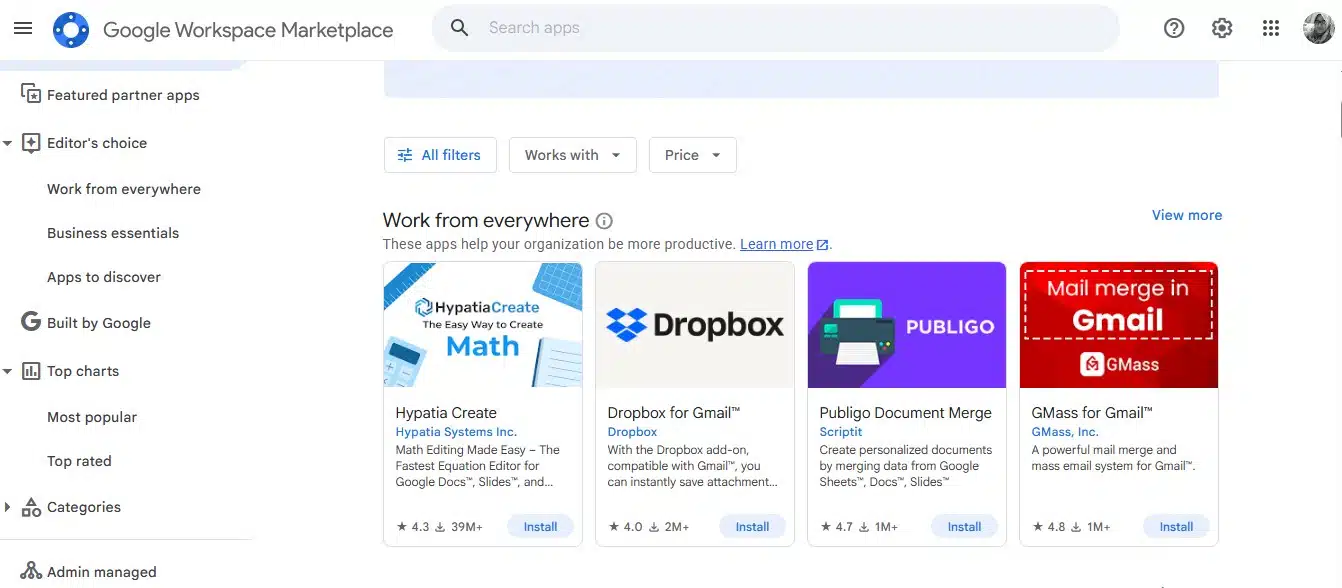
Google Workspace Marketplace can put a SaaS product directly inside the tools people use to write, schedule, communicate, organise information, and collaborate.
Apps may extend Gmail, Drive, Calendar, Docs, Sheets, Slides, Forms, Meet, Chat, Classroom, and Gemini. They can be installed by individual users or deployed more widely by an administrator.
To qualify, a public app must extend at least one Google Workspace product and pass marketplace review. Apps requesting sensitive or restricted OAuth scopes must complete a separate OAuth verification process. Some may also need an independent security assessment.
Google does not process payments for third-party Workspace apps. The developer must collect payments, communicate pricing accurately, and provide support. As a result, the marketplace is better viewed as an adoption channel than a complete SaaS commerce system.
Permissions can have a direct effect on conversion. An app that requests broad access to email, files, calendars, or organisational data may concern both users and administrators. Asking only for the permissions the product genuinely needs is good security practice and good marketing.
Free plans or trials can also help because users often expect to experience an add-on before leaving Google Workspace to pay for a full subscription.
9. GitHub Marketplace
Best for developer tools, code security, testing, CI/CD, and DevOps SaaS
GitHub Marketplace is a natural distribution channel for products that improve software development. Code analysis, dependency management, automated testing, deployment, monitoring, security scanning, and repository automation all fit the environment.
GitHub supports both free and paid plans. For marketplace transactions, it currently retains 5% of the revenue and charges customers through the payment method already connected to their GitHub accounts.
A paid listing requires some traction. A GitHub App must have at least 100 installations, while an OAuth app needs at least 200 users. The publisher must also be verified and support monthly and annual billing.
The application needs to process events for purchases, trials, upgrades, downgrades, and cancellations. It must also provide useful GitHub functionality beyond using the platform as a login method.
Those requirements make GitHub Marketplace more useful as a scaling channel than a day-one launch platform. A new developer tool may first need to grow through a free plan, open-source edition, direct integration, or external billing.
Once the product has earned adoption, native marketplace purchasing can make it easier for development teams to approve and manage the subscription.
10. Zoom App Marketplace
Best for meetings, events, contact centres, team chat, and collaboration SaaS
Zoom App Marketplace is narrower than the larger cloud marketplaces, but that focus can be an advantage. Users visit it with clear communication and collaboration needs.
Suitable products include meeting assistants, scheduling tools, transcription services, virtual-event features, note-taking applications, sales enablement, contact-centre tools, analytics, and team collaboration software.
Public and unlisted apps must go through Zoom’s review process. Reviewers assess functionality, usability, privacy, data handling, permission scopes, compliance, and application security. Zoom also monitors published apps and can require further security reviews.
Native monetisation is optional. Zoom currently retains 15% of gross retail sales, and every monetised app must include a free plan. Paid subscriptions must start at no less than $0.99.
The largest limitation is geographic. Zoom’s native marketplace monetisation is currently available only to US-based developers selling to US-based customers. Companies serving other markets can still use the marketplace for integration discovery but cannot depend on Zoom’s built-in billing globally.
I would choose Zoom only when the product naturally improves a communication workflow. A large audience will not rescue an integration that users have no reason to open during or around a meeting.
A Marketplace Listing Is Not a Distribution Strategy
Getting approved is a milestone, not the finished job. Search position, reviews, documentation, onboarding, product quality, support, and external promotion still determine whether people install and keep the app.
Before committing to a marketplace, I would ask:
- Are current or target customers already using this platform?
- Does the integration perform meaningful work inside the ecosystem?
- Will buyers discover the product there, or mainly use it to complete procurement?
- What will development, security, support, and revenue sharing cost?
- Is the goal more installations, qualified leads, faster enterprise deals, or easier billing?
One deep integration is usually more useful than five shallow listings. A good marketplace app becomes part of the customer’s workflow. A weak one becomes another product page that needs updating.
Choose the Marketplace Your Customers Already Trust
There is no universal winner among the best app marketplaces to distribute your SaaS. AWS, Microsoft, and Google Cloud are powerful enterprise purchasing channels. AgentExchange, Shopify, Atlassian, HubSpot, Google Workspace, GitHub, and Zoom work best when the product meaningfully extends their ecosystems.
I would say, start where the product’s customers already work and buy software. If an integration makes the SaaS easier to discover, purchase, install, and use, the marketplace can become a dependable growth channel. If the only attraction is the platform’s size, the investment is unlikely to pay off.
Frequently Asked Questions on the Best App Marketplaces to Distribute Your SaaS
1. Which app marketplace is best for a new SaaS startup?
It depends on what the product does. HubSpot is financially accessible because it does not charge listing or revenue-sharing fees. Shopify can support product-led growth for merchant tools. AWS, Microsoft, and Google Cloud usually make more sense for mature B2B products with enterprise buyers.
2. Can I distribute the same SaaS through several marketplaces?
Yes, as long as it qualifies for each one. A company might use AWS Marketplace for enterprise purchasing and HubSpot Marketplace for integration discovery. The difficult part is maintaining separate provisioning, billing, support, security, and update processes.
3. Do all SaaS marketplaces process customer payments?
No. AWS, Microsoft, Google Cloud, Shopify, Atlassian, GitHub, and eligible Zoom transactions support native marketplace billing. HubSpot and Google Workspace mainly help customers discover and install products, leaving payment collection to the vendor.
4. Does publishing in a marketplace guarantee new customers?
No. A listing creates access to a distribution or procurement channel, but it does not create demand on its own. Category competition, reviews, product quality, pricing, documentation, and external marketing still affect results.
5. How much do SaaS app marketplaces charge?
Fees vary considerably. HubSpot currently charges no listing fee or revenue share, while GitHub retains 5%. Major cloud marketplaces commonly retain around 1.5% to 3% on eligible SaaS transactions. Salesforce, Shopify, Atlassian, and Zoom use their own revenue-sharing or processing models.