A child can recite numbers to 20 and still struggle to give you exactly five blocks. Another child may not care much about number words but can build an elaborate bridge, spot a repeating pattern, or immediately tell which plate has more crackers.
That is why building early math skills for preschoolers should not begin with a race toward bigger numbers. Young children need opportunities to understand quantities, shapes, patterns, measurement, position, and simple problems in situations that make sense to them.
Much of that can happen without buying anything. Socks need matching. Snacks need sharing. Blocks can be compared. Cups can be filled and emptied. Stairs can be counted. Toys can be sorted.
For children ages 2–5, the most useful approach is usually to add a little mathematical thinking to play and routines that are already part of the day.
Early Math Is Much Bigger Than Counting
Counting is important, but it is only one part of early mathematics.
Before kindergarten, children may be developing an understanding of:
- quantities and number words
- more, less, and the same
- adding to and taking away small groups
- shapes and how they fit together
- position and direction
- repeating patterns
- size, length, weight, and capacity
- sorting and classification
These ideas overlap constantly in play.
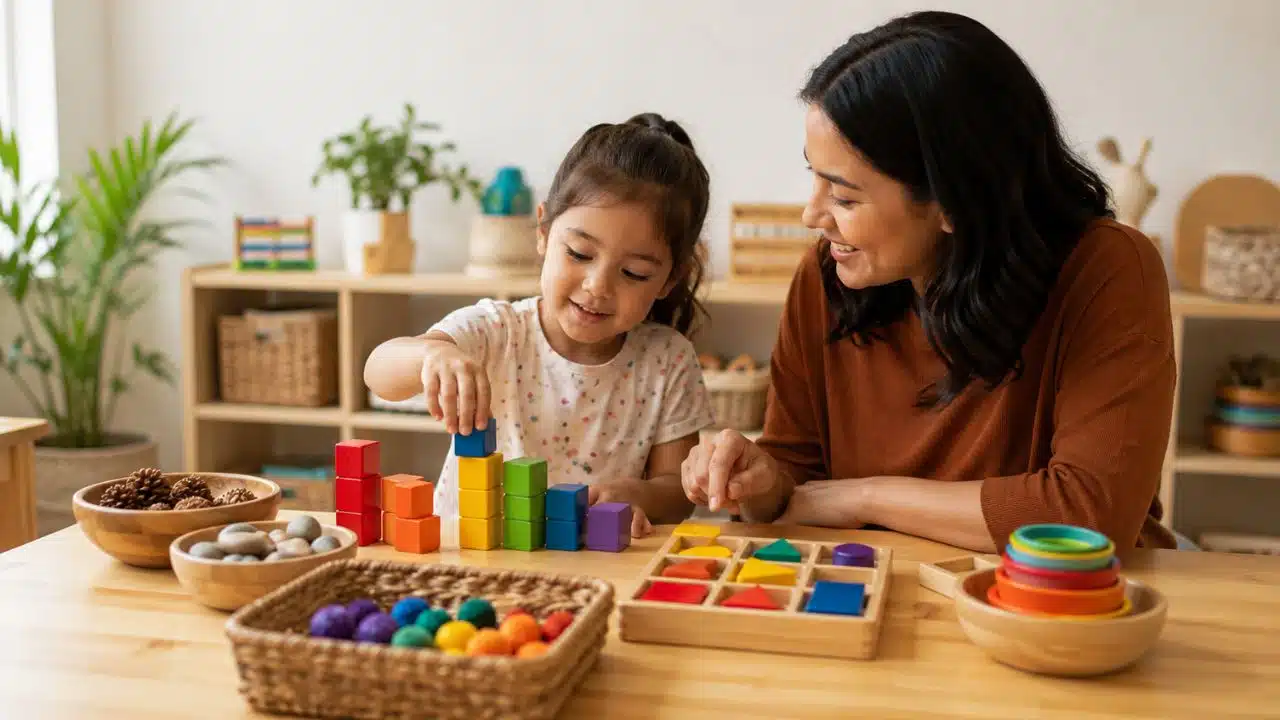
A child building a block tower is comparing size and height while thinking about shape and position. A child distributing fruit among family members is dealing with quantity and fairness. Putting toy animals into groups involves classification. Completing a puzzle requires shape and spatial reasoning.
This broader view is useful because adults sometimes overestimate what numeral recognition or memorized counting tells them. Knowing the spoken sequence “one, two, three, four, five” is not the same as understanding what five means.
Build Meaning Behind the Number Words
Counting becomes more useful when each number word is connected to a real object.
Suppose there are four strawberries on a plate. A child can touch or move each one while counting:
“One, two, three, four.”
Then reinforce the total naturally: “Four strawberries.”
The final number matters because children are gradually learning that the last number counted represents the size of the whole group.
Start with small amounts that are easy to handle. Two toy cars, three crayons, four spoons, or five blocks often provide more useful practice than repeatedly asking a child to count as high as possible.
Once that feels comfortable, vary the task:
“Can you bring me three spoons?”
“Put two animals in the truck.”
“There are four crackers here. What happens if we take one away?”
The objects make the mathematics visible.
If a child can chant to 30 but cannot reliably produce a group of five, there is little reason to push the counting sequence higher. Work on meaningful quantities first.
Early Math Skills for Preschoolers Grow Through Comparison
Numbers become more useful when children can compare them.
Place two small groups of blocks on the floor and ask which group has more. If the difference is obvious, the child may answer immediately. With closer quantities, they might count each group or match the objects one-to-one.
Instead of treating one method as the required method, ask how they figured it out.
Comparison also belongs outside counting activities:
“Which stick is longer?”
“Are these towers the same height?”
“Which basket has fewer toys?”
“Do these containers hold the same amount?”
Words such as more, fewer, longer, shorter, heavier, lighter, same, and different give children a way to describe relationships they can already see.
There is one practical limit here: too many adult questions can make play feel like an oral exam. Sometimes simply saying, “Your tower is taller than mine,” does more good than asking yet another question.
Help Children Recognize Small Quantities Without Counting Every Time
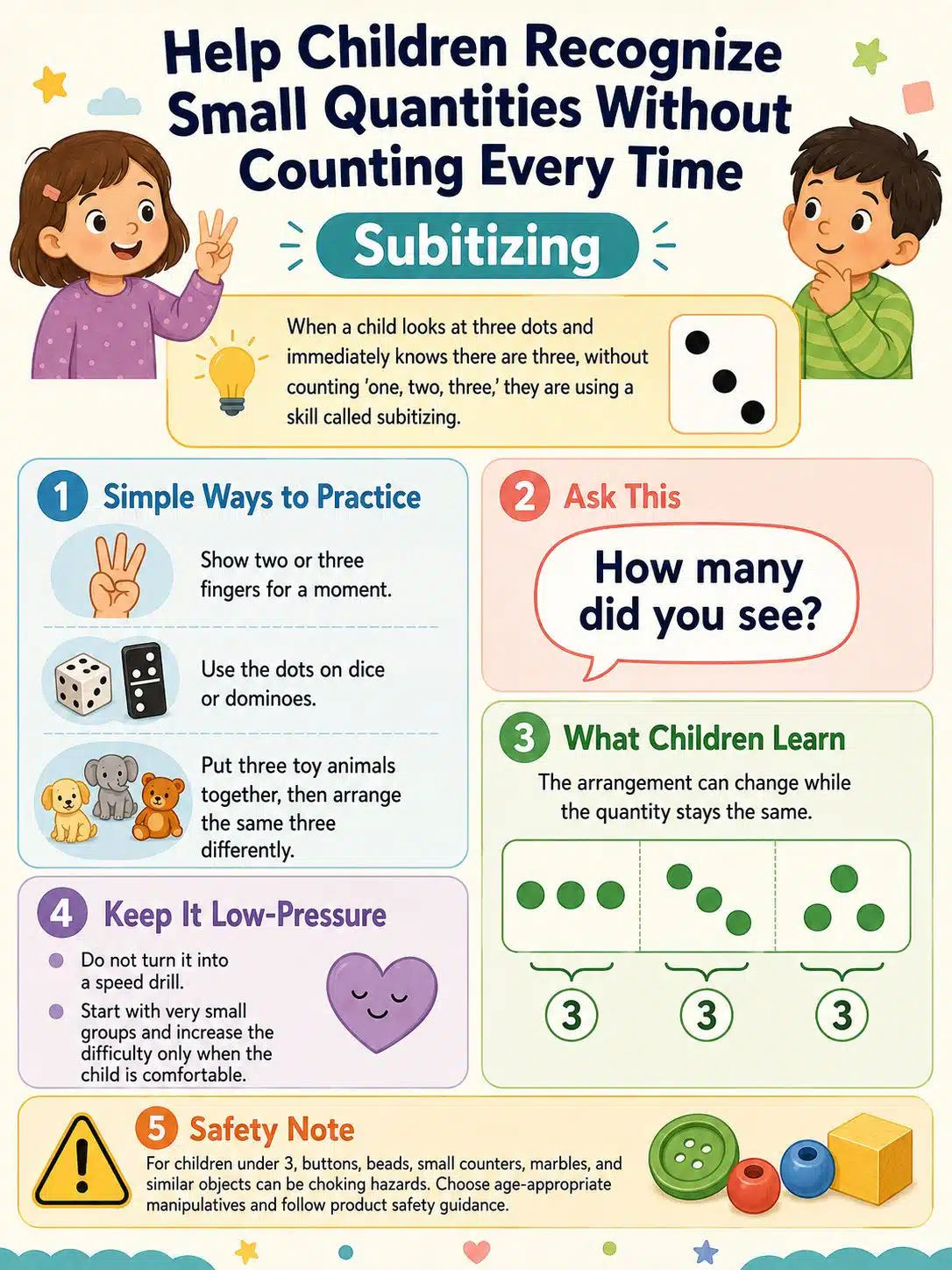
When a child looks at three dots and immediately knows there are three, without counting “one, two, three,” they are using a skill called subitizing.
This can be practiced casually with familiar materials.
Show two or three fingers for a moment. Use the dots on dice or dominoes. Put three toy animals together, then arrange the same three animals differently.
Ask, “How many did you see?”
The arrangement can change while the quantity stays the same. That is a useful idea for children to discover.
There is no need to turn this into a speed drill. Start with very small groups and increase the difficulty only when the child is comfortable.
For children under 3, materials require extra care. Buttons, beads, small counters, marbles, and similar objects can be choking hazards. Choose manipulatives that are appropriate for the child’s age and follow the product’s safety guidance.
Blocks Are One of the Most Useful Math Materials You Already Have
Blocks are easy to underestimate because children use them for play rather than something labeled “math.”
They are working with plenty of mathematics.
A bridge may need a longer piece. A tower needs a stable base. A roof has to fit across a gap. Two structures can be compared by height. Pieces must sometimes be rotated before they fit.
Adults can add mathematical language without designing the whole structure for the child:
“That piece is underneath the long block.”
“These two are the same shape but different sizes.”
“What might fit in this space?”
“Could you make another tower about the same height?”
Shape learning is especially useful when children can handle objects rather than only identify drawings.
If a child calls a rectangle a square, there is no need for a miniature lecture. Put the shapes together and compare them. Both may have four sides, but their sides are arranged differently.
Young children learn a great deal by turning, stacking, combining, and separating shapes.
Make Patterns With Things Children Actually Enjoy
Patterns can begin with movement.
Clap, stomp, clap, stomp.
Jump, jump, clap. Jump, jump, clap.
Or use objects:
Red block, blue block, red block, blue block.
Big car, small car, big car, small car.
Once the pattern is obvious, stop and let the child continue it.
Later, ask them to make one for you.
Creating a pattern is harder than copying one because the child has to invent a rule and then stick to it. Children sometimes make their own patterns during ordinary play, so look before introducing a separate “pattern activity.”
Measurement Makes More Sense When There Is a Reason to Measure
A preschooler does not need to begin with centimeters or inches.
Start with questions that solve an actual problem:
“Will this box fit under the shelf?”
“Which ribbon is longer?”
“Is your tower taller than the teddy?”
“Which container might hold more water?”
Children can also measure with informal units. A book may be four blocks long. A rug might be seven footsteps across.
Expect imperfect measurements. Children leave spaces between blocks, overlap objects, or take footsteps of different sizes. Rather than correcting the result immediately, use the mismatch:
“Would we get a different answer if the blocks touched?”
That question introduces an important measurement idea without requiring formal terminology.
Be more cautious with water play
Pouring between cups and containers is excellent for exploring full, empty, more, and less, but water activities require active adult supervision.
For toddlers and other weak swimmers, an adult should stay close enough to intervene immediately. Phone use, chores, or briefly leaving the room are not compatible with supervising a young child around water.
Use shallow, manageable amounts for play, and empty containers when the activity is finished.
Sorting Becomes More Interesting When the Child Chooses the Rule
Instead of saying, “Put all the red blocks here,” try giving a child a mixed collection of safe objects and asking:
“How could we put these into groups?”
You may get the obvious answer: color.
Or the child may separate animals from vehicles, large objects from small ones, or things that roll from things that do not.
Ask what their rule is.
Then reuse the same objects with a different rule. A pile previously sorted by color might now be sorted by size or shape.
This is a stronger activity than repeatedly practicing one predetermined category because the child has to notice which characteristics matter and reorganize the same information.
Sorting is one of the less flashy early math skills for preschoolers, but it develops the habit of looking for attributes, similarities, differences, and relationships.
Introduce Addition and Subtraction Before the Symbols
A child does not need 3 + 1 = 4 on paper to understand the idea behind it.
Use objects.
“Three animals are on the bus. One more gets on. How many are riding now?”
Or:
“There are four apple slices. You ate one. How many are left?”
Let the child move the pieces, use fingers, count everything again, or draw the situation.
Counting the whole group from the beginning may look inefficient to an adult, but efficiency is not the first priority. The child needs to understand what happened to the quantity.
Formal symbols become much more meaningful later when they represent ideas the child already recognizes.
Put Math Into Routines Instead of Adding Another Lesson
Parents do not need another item on an already crowded daily schedule.
Use moments that are already there.
While getting dressed: find the matching sock or compare which shoe is bigger.
At snack time: count a small group, share pieces, or notice who has more.
While tidying: sort cars into one box and animals into another—or let the child invent the categories.
On stairs: count a few steps or talk about first, next, and last.
During cooking: count spoonfuls, compare containers, notice sequence, or divide something into portions.
On a walk: look for circles, rectangles, repeating fence patterns, long and short sticks, or groups of objects.
While building: compare heights, find matching pieces, or solve the problem of what can fit underneath something.
Not every moment needs a math question. If a child is absorbed in pretending a cardboard box is a spaceship, there is no educational advantage in interrupting the story because an adult suddenly remembers to practice counting.
Use opportunities that fit the play.
Watch What the Child Understands, Not Just What They Can Recite
Age-based developmental guides are useful, but they should not become a checklist for comparing children.
A four-year-old who can say the numbers to 20 may still need practice counting small groups accurately. Another child may not count as far but may be very comfortable comparing quantities or manipulating shapes.
Teach from the part that is developing.
For a child still working on one-to-one counting, keep collections small enough to manage.
For a child who easily recognizes groups of three and four, try:
“Can you make four in two groups?”
For a child who creates simple AB patterns, introduce a pattern with a longer repeating unit, such as red-red-blue.
Small increases in difficulty are more useful than suddenly jumping several levels because of the child’s age.
This also matters for families reading global developmental advice. Preschool programs, kindergarten entry ages, languages, and curriculum expectations differ by country. Head Start and other U.S. frameworks can provide useful examples of developmental progressions, but they should not be treated as universal deadlines.
Worksheets Are Fine in Small Doses. They Should Not Become the Centerpiece
Some preschoolers genuinely enjoy tracing numerals, matching pictures, completing paper patterns, or playing printed number games. There is no reason to ban those activities.
The problem comes when worksheets replace the experiences that give mathematics meaning.
Drawing a line to the “bigger” object is not the same experience as trying to fit a large container on a small shelf. Circling the group with more objects is useful practice, but sharing actual pieces between two people gives the idea a purpose.
For most young children, blocks, puzzles, movement, sorting, cooking, building, and conversation should do more of the heavy lifting.
A preschooler does not need to look busy on paper for mathematical learning to be happening.
Wrong Answers Are Useful If Adults Do Not Rush Past Them
A child counts six blocks and announces, “Seven.”
A quick “No, it’s six” fixes the answer but tells you very little about the mistake.
Try, “Let’s check.”
Maybe the child skipped an object. Maybe one was counted twice. Maybe the counting sequence itself became confused.
Other questions can reveal more:
“How did you know?”
“Can you show me?”
“What would happen if we added one?”
“Is there another way to check?”
Not every mistake needs this treatment. Repeatedly interrogating a three-year-old over every incorrect answer is unlikely to improve anyone’s afternoon.
Use the moments when the child is engaged enough to think about the problem. At other times, model the correct idea and move on.
Why Early Math Matters Without Turning It Into Preschool Test Prep
Early mathematics deserves attention, but the research does not justify pushing formal schoolwork further and further into the preschool years.
A widely cited analysis of six longitudinal datasets found that mathematics skills measured at school entry were particularly strong predictors of later academic achievement. A separate longitudinal study found that children’s kindergarten number competence predicted mathematics achievement and growth through the early elementary grades.
The word predict matters.
These studies show an association between early mathematical competence and later outcomes. They do not show that making a three-year-old complete more worksheets, memorize larger numbers, or start formal arithmetic early will produce better school results.
A more useful response to the research is to give children frequent, meaningful opportunities to think mathematically.
Let them count things that matter. Compare quantities. Build structures. Sort. Measure. Notice patterns. Work out how many are left. Explain how they know.
That is serious early mathematics without turning preschool into test preparation.
Final Thoughts
If you want to strengthen early math skills for preschoolers, begin with the next ordinary opportunity rather than planning a large home curriculum.
At breakfast, count something small. During cleanup, sort. Later, build a tower and compare its height with something nearby. Tomorrow, try a repeating movement pattern or divide a snack fairly.
Then pay attention to what the child understands.
When an activity is easy, make it slightly harder. When a child is confused, return to smaller quantities or more concrete objects. When they lose interest, stop.
The strongest foundation is not a preschooler who can perform the most advanced-looking task. It is a child who is beginning to see that numbers, shapes, patterns, quantities, and measurements help make sense of ordinary problems.
Keep that thinking active, playful, and connected to real life. The mathematics will have plenty of room to grow.