On This Day September 1 brings together a fascinating mix of historical events, remarkable achievements, famous birthdays, and notable deaths from around the world. From major political and cultural milestones to the birth of influential figures who shaped their fields, September 1 has witnessed many moments worth remembering.
In this article, we’ll explore the most important September 1 history, including significant global events, famous people born on September 1, notable figures who died on this date, and other interesting moments from the past. Whether you enjoy history, celebrity birthdays, or discovering fascinating facts about the calendar, these events offer a quick journey through the stories that made September 1 memorable.
The Bangalee Sphere
The Indian subcontinent, specifically the Bengali-speaking regions of modern-day Bangladesh and West Bengal, has witnessed profound political shifts, cultural awakenings, and historical milestones on this day.
Historical Events
-
1947: Mahatma Gandhi’s Fast in Calcutta
Following the Partition of India, the region of Bengal was ablaze with communal violence. On September 1, 1947, Mahatma Gandhi began a crucial hunger strike in Calcutta (now Kolkata) to restore peace and promote unity among Hindus and Muslims. His presence and willingness to sacrifice his own life acted as a moral anchor, successfully quelling the riots when military and police forces could not. This event remains a testament to the power of non-violent resistance and its impact on the socio-political fabric of the subcontinent.
-
1978: Foundation of the Bangladesh Nationalist Party (BNP)
On this day, the political landscape of Bangladesh was permanently altered when President Ziaur Rahman founded the Bangladesh Nationalist Party (BNP). Originally established to unite diverse political factions under a nationalist umbrella, the BNP introduced a 19-point program aimed at building a self-reliant Bangladesh. The party has since been a central pillar of Bangladeshi politics, deeply influencing the nation’s democratic journey, economic policies, and governance structures over the decades.
-
1956: Nationalization of Life Insurance in India
The Life Insurance Corporation of India (LIC) was officially established on September 1, 1956, marking the nationalization of the entire life insurance sector in the country. By consolidating 245 Indian and foreign insurers, the government aimed to channel domestic savings into nation-building activities. LIC played a monumental role in shaping India’s post-independence economy, providing financial security to millions and funding massive infrastructure projects.
Famous Births
| Name | Year | Profession & Key Contribution |
| A. C. Bhaktivedanta Swami Prabhupada | 1896 | Born in Calcutta, he became a profound spiritual teacher and founded the International Society for Krishna Consciousness (ISKCON). His efforts globalized Gaudiya Vaishnavism, translating ancient Vedic texts into English and establishing spiritual centers worldwide. |
| Habibur Rahman | 1923 | A distinguished Bangladeshi jurist and writer who served as the Chief Advisor of the 1996 Caretaker Government. His contributions to the Bengali language movement and literature earned him the Bangla Academy Literary Award. |
Famous Deaths
| Name | Year | Legacy & Awards |
| Guru Amar Das | 1574 | The third of the Ten Gurus of Sikhism, he is immortalized for institutionalizing the Langar (community kitchen) system. This practice mandated that people of all castes, genders, and statuses sit and eat together, directly challenging the deeply ingrained caste system of the era. |
International Observances & Holidays
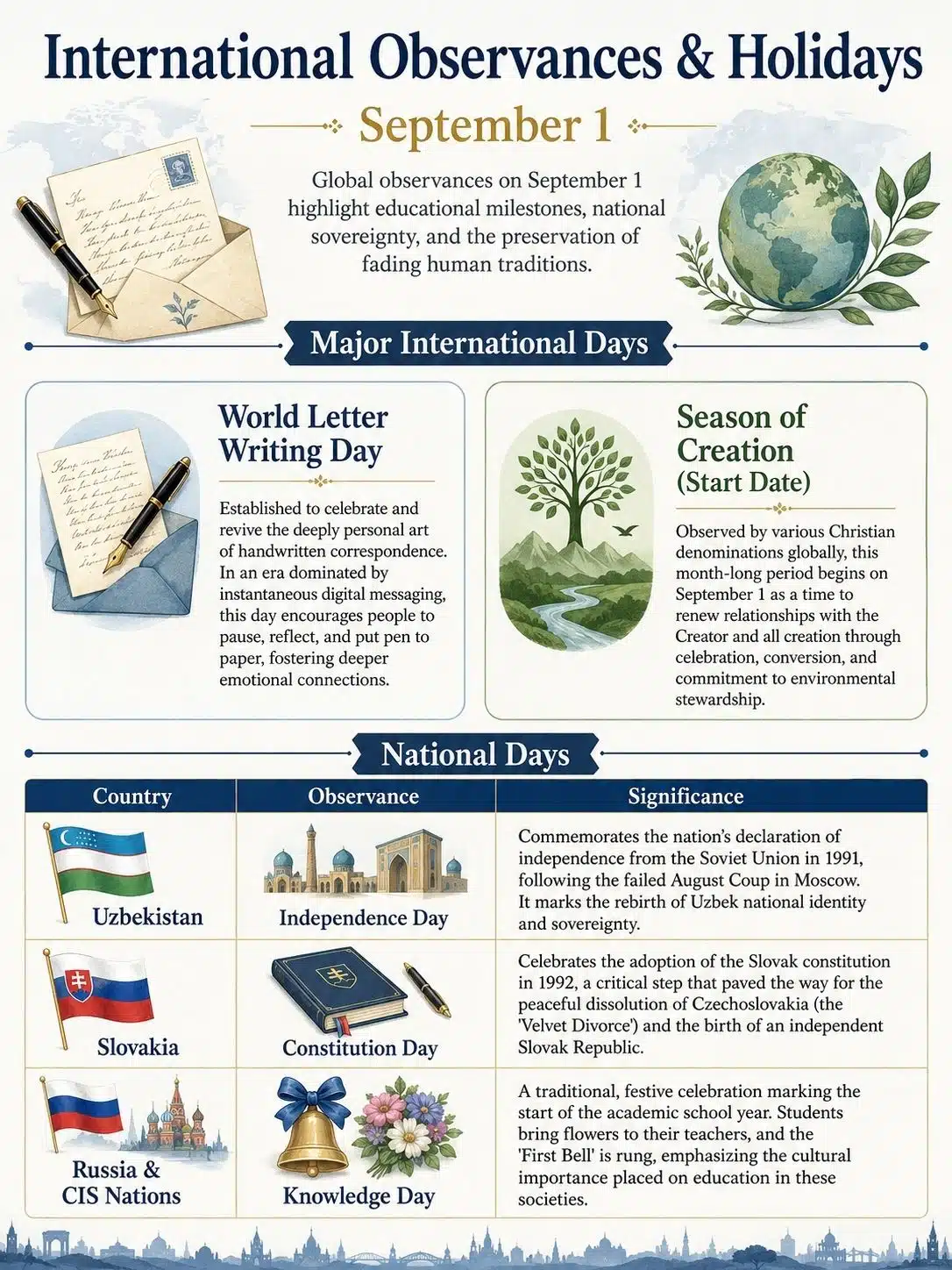
Global observances on September 1 highlight educational milestones, national sovereignty, and the preservation of fading human traditions.
Major International Days
-
World Letter Writing Day: Established to celebrate and revive the deeply personal art of handwritten correspondence. In an era dominated by instantaneous digital messaging, this day encourages people to pause, reflect, and engage in the deliberate, thoughtful process of putting pen to paper, fostering deeper emotional connections.
-
Season of Creation (Start Date): Observed by various Christian denominations globally, this month-long period begins on September 1 as a time to renew relationships with the Creator and all creation through celebration, conversion, and commitment to environmental stewardship.
National Days
| Country | Observance | Significance |
| Uzbekistan | Independence Day | Commemorates the nation’s declaration of independence from the Soviet Union in 1991, following the failed August Coup in Moscow. It marks the rebirth of Uzbek national identity and sovereignty. |
| Slovakia | Constitution Day | Celebrates the adoption of the Slovak constitution in 1992, a critical step that paved the way for the peaceful dissolution of Czechoslovakia (the “Velvet Divorce”) and the birth of an independent Slovak Republic. |
| Russia & CIS Nations | Knowledge Day | A traditional, festive celebration marking the start of the academic school year. Students bring flowers to their teachers, and the “First Bell” is rung, emphasizing the cultural importance placed on education in these societies. |
Global History
September 1 has been a day of tremendous geopolitical shifts, devastating tragedies, and monumental achievements across the globe.
United States
-
1864: The Capture of Atlanta
During the brutal American Civil War, Union General William T. Sherman’s army successfully captured Atlanta, Georgia. This decisive tactical victory crippled Confederate logistics, manufacturing, and transportation networks. More importantly, the fall of Atlanta provided a massive morale boost to the North, practically guaranteeing the reelection of President Abraham Lincoln and the eventual abolition of slavery.
-
1985: Discovery of the Titanic Wreckage
A joint American-French expedition led by Dr. Robert Ballard and Jean-Louis Michel finally located the wreckage of the RMS Titanic roughly 400 miles off the coast of Newfoundland. The discovery solved a 73-year-old maritime mystery, revolutionized deep-sea exploration technology, and reignited global fascination with the doomed ocean liner.
Russia
-
1983: The Tragedy of Korean Air Lines Flight 007
In one of the most tense moments of the Cold War, a Soviet Su-15 interceptor shot down Korean Air Lines Flight 007 after the civilian Boeing 747 strayed into restricted Soviet airspace near Sakhalin Island. All 269 passengers and crew perished. The incident drastically escalated US-Soviet tensions, led to the immediate deployment of Pershing II missiles in Europe, and prompted the United States to make GPS technology available for civilian use to prevent future navigational disasters.
China
-
1449: The Tumu Crisis
In a shocking military disaster for the Ming Dynasty, the Oirat Mongols decisively defeated a massive Chinese army and captured Emperor Yingzong. The crisis sent political shockwaves through Beijing, forcing the Ming court to completely restructure its military and defensive strategies, ultimately leading to the extensive reinforcement and expansion of the Great Wall of China.
United Kingdom
-
1644: Battle of Tippermuir
During the chaotic Scottish Civil War, James Graham, 1st Marquess of Montrose, secured a pivotal victory for the Royalist cause against the Covenanters. Utilizing highly mobile infantry and Highland charge tactics, Montrose overwhelmed a numerically superior force, temporarily securing Scotland for King Charles I and reshaping the military landscape of the British Isles.
Europe
-
1939: Outbreak of World War II
At 4:45 AM, Nazi Germany launched Fall Weiss (Case White)—a massive, unprovoked blitzkrieg invasion of Poland. Employing overwhelming air superiority, mechanized armor, and rapid infantry maneuvers, the German military decimated Polish defenses. This aggressive expansion shattered the fragile peace of Europe, forcing Great Britain and France to declare war on Germany two days later, officially igniting the deadliest conflict in human history.
-
1715: Death of the Sun King
King Louis XIV of France died of gangrene just days before his 77th birthday, ending the longest recorded reign of any sovereign in history (72 years, 110 days),. His absolute monarchy centralized the French state, built the magnificent Palace of Versailles, and established France as the dominant European power. However, his relentless wars left the nation heavily in debt, planting the early seeds of the French Revolution.
Australia
-
Wattle Day Celebration
Australians traditionally celebrate Wattle Day on September 1, marking the official start of the Southern Hemisphere’s spring. The vibrant golden wattle (Acacia pycnantha) is Australia’s national floral emblem, symbolizing the nation’s resilience, unity, and vibrant natural heritage.
Canada
-
1905: Alberta and Saskatchewan Join the Confederation
The vast western territories of Alberta and Saskatchewan were officially established as provinces and entered into the Canadian Confederation. This monumental administrative shift spurred massive agricultural settlement, the construction of transcontinental railways, and the rapid economic development of the Canadian Prairies.
Rest of World
-
1923: The Great Kantō Earthquake (Japan)
A catastrophic 7.9 magnitude earthquake struck the Kantō plain, completely devastating Tokyo, Yokohama, and surrounding prefectures. The initial tremors triggered massive firestorms that swept through the wooden cities, exacerbated by a passing typhoon. Over 100,000 people lost their lives. In the aftermath, Japan fundamentally reshaped its modern seismic architecture, emergency response protocols, and urban planning.
-
1969: Muammar Gaddafi Seizes Power (Libya)
A group of young military officers led by 27-year-old Colonel Muammar Gaddafi executed a bloodless coup d’état against King Idris I. This marked the end of the Libyan monarchy and the beginning of the Libyan Arab Republic. Gaddafi’s 42-year autocratic rule drastically altered North African geopolitics, fueled international terrorism controversies, and ended violently during the 2011 Arab Spring.
Notable Births & Deaths (Global)
September 1 has introduced visionary artists, fierce athletes, and groundbreaking leaders to the world, while also marking the departure of legendary figures.
Famous Births
| Name | Year | Nationality | Legacy & Impact |
| Edgar Rice Burroughs | 1875 | American | A prolific author best known for creating Tarzan of the Apes and the John Carter of Mars series,. His imaginative pulp fiction heavily influenced 20th-century science fiction and popular culture. |
| Rocky Marciano | 1923 | American | A ferocious professional boxer who holds the unparalleled distinction of retiring as the only undefeated heavyweight champion in boxing history, finishing with a 49-0 record,. |
| Gloria Estefan | 1957 | Cuban-American | A multi-Grammy Award-winning singer and songwriter who popularized Latin pop globally with the Miami Sound Machine, breaking cultural barriers in the mainstream music industry. |
| Zendaya | 1996 | American | An acclaimed actress, singer, and fashion icon who became the youngest recipient of two Primetime Emmy Awards for Outstanding Lead Actress in a Drama Series for her raw, generation-defining work in Euphoria. |
| Lily Tomlin | 1939 | American | A multi-award-winning comedian and actress whose incredible versatility and sharp wit have made her a legendary figure in American theater, television, and film. |
Famous Deaths
| Name | Year | Nationality | Cause & Legacy |
| Louis XIV | 1715 | French | Known as the “Sun King,” he died of gangrene after ruling France for over 72 years. He enforced absolute monarchy and centralized power, leaving a complex legacy of cultural brilliance and economic ruin. |
| Jacques Cartier | 1557 | French | A master navigator and explorer who was the first European to map the Gulf of Saint Lawrence,. His expeditions laid the foundational claims for French colonization in what is now Canada. |
| Siegfried Sassoon | 1967 | English | A decorated soldier and celebrated war poet whose poignant, visceral writings exposed the brutal realities of trench warfare in World War I, fiercely challenging blind nationalist fervor. |
| Jimmy Buffett | 2023 | American | A beloved singer-songwriter whose unique “tropical rock” sound and narrative songwriting birthed the “Margaritaville” empire. He embodied an escapist, coastal lifestyle that resonated with millions of devoted fans known as “Parrotheads”. |
| Eero Saarinen | 1961 | Finnish-American | A visionary architect and industrial designer who revolutionized modernism. He is remembered for breathtaking, futuristic structures like the Gateway Arch in St. Louis and the TWA Flight Center,. |
“Did You Know?” Trivia
-
The First Female Telephone Operator: On September 1, 1878, Emma Nutt became the world’s very first female telephone operator. Alexander Graham Bell specifically hired her because the teenage boys previously employed as operators were notoriously unruly, impatient, and rude to callers. Her soothing voice and professionalism set the standard for the industry.
-
The Day the Earth Sparked: The 1859 Carrington Event, which began on September 1, remains the most intense geomagnetic solar storm in recorded human history. It caused spectacular auroras visible as far south as the Caribbean and induced such massive electrical currents that telegraph pylons across Europe and North America spontaneously threw sparks, shocking operators and starting fires.
-
The End of the Passenger Pigeon: In 1914, the very last known passenger pigeon, named Martha, died in captivity at the Cincinnati Zoo. This marked the complete and tragic extinction of a bird species that once blackened North American skies in migratory flocks numbering in the billions, serving as a stark, historical warning about the consequences of unchecked human overhunting and habitat destruction.
Quote of the Day
“I depart, but the State shall always remain.”
— King Louis XIV of France, spoken on his deathbed on September 1, 1715.
Final Thoughts
The first day of September is a vivid tapestry of human triumph, tragedy, and transformation. From the devastating onset of World War II in Europe to the spiritual and political awakenings in the Bangalee sphere, September 1 serves as a powerful reminder of how individual actions and natural forces can irrevocably alter the trajectory of human history.
Whether we are reflecting on the architectural genius of Eero Saarinen, the unapologetic prowess of Rocky Marciano, or the sobering extinction of the passenger pigeon, this day offers endless lessons on resilience, innovation, and the delicate balance of our global ecosystem. Understanding the depth of these events ensures that the echoes of the past continue to educate and inspire the generations of tomorrow.