
AI is changing SaaS pricing and packaging by shifting the bill away from simple software access and toward usage, automated work, and measurable results. The most practical response has been hybrid pricing: a subscription or platform fee that includes some AI capacity, followed by charges for additional credits, actions, or outcomes.
I do not think the traditional SaaS subscription is about to disappear. The more important change is that a seat no longer captures everything the software does. An AI assistant can help one employee produce more work, while an autonomous agent can complete tasks without behaving like a conventional user at all.
Most of the market’s AI SaaS Pricing changes fall into five patterns:
- Basic AI features are being included in existing plans.
- Advanced AI is being sold as a per-user upgrade.
- High-volume features are being measured through usage or credits.
- Agents are being priced by actions or completed outcomes.
- Subscriptions and variable charges are being combined into hybrid packages.
These models are still evolving, but the reason behind them is already clear. SaaS companies need to cover the real cost of delivering AI without making customer bills impossible to predict.
Why Per-Seat Pricing No Longer Tells the Whole Story
Per-seat pricing has always been easy to understand. A company pays according to the number of people using the software. As the team grows, the subscription grows with it. That relationship becomes less reliable when AI enters the workflow.
One employee using an AI assistant may complete work that previously required more time or additional staff. An AI agent may answer customer questions, update records, prepare reports, and trigger workflows without needing its own traditional seat.
If the software creates more value while the customer needs fewer human users, the vendor risks earning less from a more capable product.
Seats still make sense for:
- Identity and access
- Permissions
- Collaboration
- Personal AI assistants
- Reporting and accountability
- Security administration
What is weakening is the idea that seat count alone reflects value. For many products, the likely direction is a seat or platform fee for human access combined with a variable charge for expensive or autonomous work.
AI Brings Variable Costs Back Into SaaS
Traditional SaaS products can be expensive to develop, but serving one additional customer often adds relatively little cost. AI products behave differently because almost every interaction consumes resources.
The direct cost of an AI feature may depend on:
- The model selected
- Input and output volume
- Context length
- Reasoning depth
- Data retrieval
- Third-party tool calls
- Image, voice, or video processing
- Agent retries
- Storage and infrastructure
- Human review or escalation
Two customers on the same plan can therefore create very different costs. One may use an AI summary tool occasionally. Another may run thousands of complex workflows every day.
This is why truly unlimited AI is difficult to sustain. Vendors can absorb light and predictable usage inside a subscription, but heavy use may require allowances, fair-use limits, credits, or overage charges.
Cheaper models do not automatically solve the problem. When the cost of an individual model call falls, customers often use the feature more. Capable agents may also use longer context, call several tools, and repeat steps until they finish a task. The unit cost can decline while total consumption rises.
The Main AI SaaS Pricing Models
There is no single model that fits every AI product. The right choice depends on what the software does, how customers measure its value, and how much usage varies.
Bundled AI and Paid Upgrades
The simplest approach is to include everyday AI features in the existing subscription. Writing assistance, search, meeting summaries, transcription, and short recommendations often fit this model because they encourage frequent use and make the core product more valuable.
Zoom illustrates the broader pattern. Core AI functions are included in eligible paid Workplace plans, while more capable agentic features are treated separately.
Bundling can make adoption easier because customers do not need a second purchasing decision. It can also prevent an established SaaS company from looking outdated when competitors include similar capabilities.
More expensive AI functions may be reserved for a higher tier or sold as an add-on. Microsoft 365 Copilot shows how a per-user AI license can sit alongside metered agent services.
This works when the AI behaves like a personal assistant. It is less convincing when only a few employees need it or when autonomous agents perform most of the work.
Usage-Based Pricing
Usage-based pricing charges customers according to what they consume. The billable unit may be tokens, API calls, documents, images, minutes, records, or automated tasks.
This approach allows customers to start small and protects vendors from unusually heavy users. It is especially suitable for developer tools and infrastructure products, where customers already understand technical consumption.
The drawback is uncertainty. A department leader usually wants to know what a product will cost before approving it. Raw token pricing may be precise for the vendor but meaningless to the person buying a customer-service or marketing platform.
Pure usage pricing can also discourage adoption. Employees may avoid experimenting if every request feels like an added expense.
Credit-Based Pricing
Credits hide some of that technical complexity. Instead of presenting separate charges for every model, tool, and output type, the vendor converts different activities into a shared billing unit.
GitHub, HubSpot, Notion, and Salesforce have all used credits or allowances to manage AI consumption. Their exact rates and policies may change, but the structure is useful because one balance can cover several AI features.
Credits are only transparent when customers can answer basic questions:
- How much does a credit cost?
- How many credits does each activity consume?
- Do advanced models use more?
- Are failed attempts billable?
- Do unused credits expire?
- Can credits be pooled across a team?
- What happens when the balance reaches zero?
- Can the vendor change consumption rates?
A credit system should simplify pricing. If customers need a spreadsheet just to decode it, the abstraction has failed.
Action-Based Pricing
AI agents often complete work through a sequence of steps. A vendor may charge whenever an agent performs a defined action, such as finding a record, updating a case, sending a message, or triggering a workflow.
Salesforce’s Agentforce pricing shows how action-based credits can operate across different teams and agent use cases.
Actions are easier for business buyers to understand than tokens because they resemble actual work. However, one customer request may trigger several billable actions. Checking an order status, for example, could involve authenticating the customer, retrieving an order, checking delivery data, and producing a response.
The vendor must explain that sequence clearly. Otherwise, the customer may think they are paying for one task while the system measures four separate actions.
Outcome-Based Pricing
Outcome-based pricing charges when the AI produces a defined result. That could be a resolved support case, qualified lead, recovered payment, completed booking, or successfully processed document.
Fin’s AI customer-service product is a useful example because its pricing is connected to defined outcomes rather than every message in a conversation.
The attraction is obvious. The vendor gets paid when the customer receives value.
I would still be careful about presenting outcome pricing as the future of every AI product. It works best when the result is:
- Measurable
- Repeatable
- Quickly verifiable
- Directly attributable to the software
- Valuable enough to support the delivery cost
A resolved support case can be recorded. Claims involving increased revenue, improved creativity, or prevented churn are harder to prove because many other factors may contribute.
That distinction matters. An activity is something the system does. An output is something it produces. An outcome is a result the customer values. They are not interchangeable.
Hybrid Pricing
Hybrid pricing combines a predictable commitment with a variable component. Common versions include:
- Platform fee plus usage
- Per-seat plan plus credits
- Subscription with an included allowance
- Annual commitment with overages
- Base package plus outcome charges
When I look at the market, this appears to be the most practical model for established SaaS companies adding AI. The subscription gives the vendor a revenue floor and gives the customer dependable access. Variable charges allow revenue to grow when the customer uses more expensive capabilities or receives more value.
The difficulty lies in choosing the right billing unit. A hybrid plan can still produce confusion if customers do not know what is included, how overages work, or why one task consumes more than another.
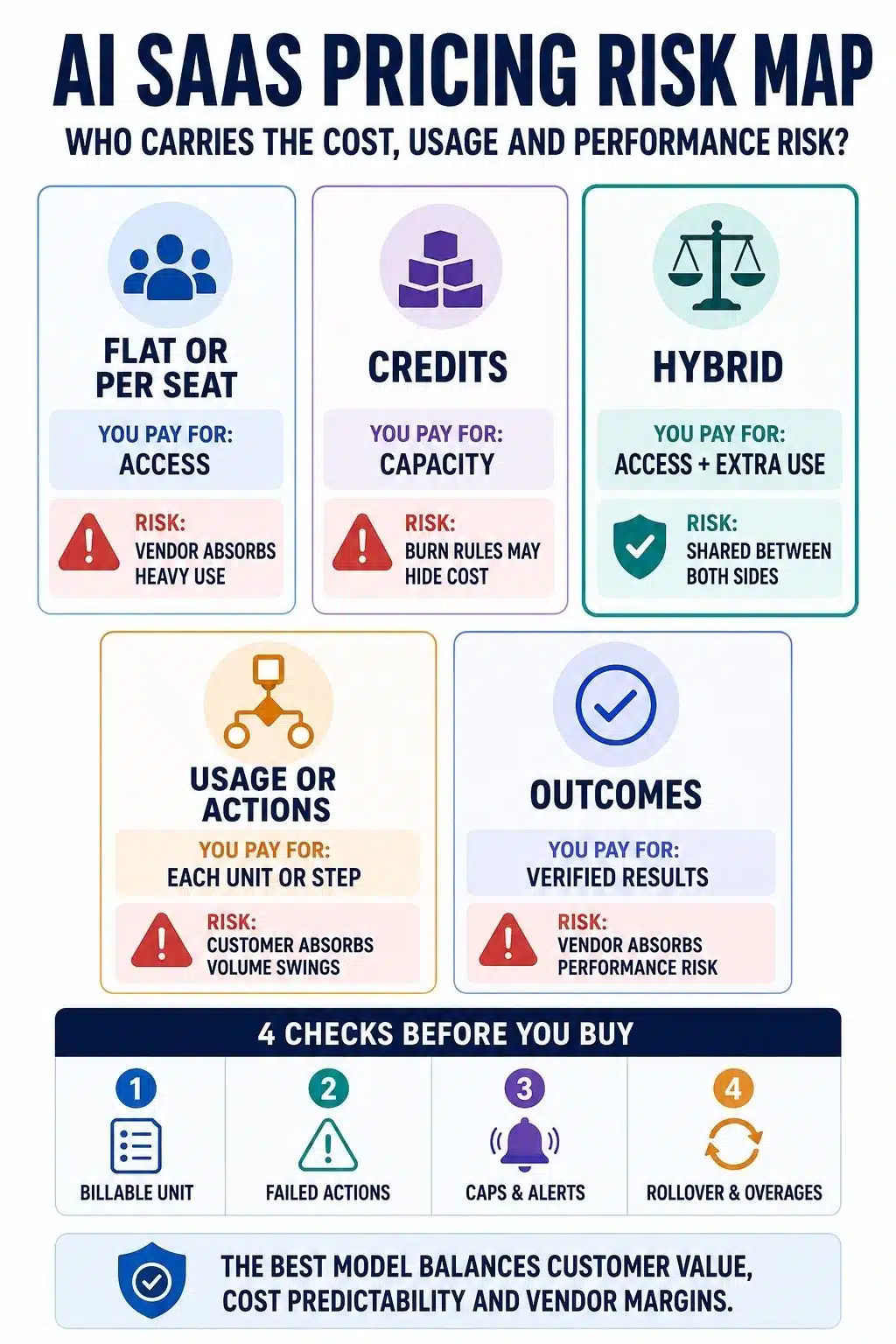
AI Pricing Is Really About Who Carries the Risk
Every pricing model decides who absorbs uncertainty. With a flat subscription, the vendor carries most of the usage risk. Heavy customers can consume far more resources without paying more.
With pure usage pricing, the customer carries more of the volume risk. The vendor protects its margins, but the customer may face an unpredictable bill.
With outcome pricing, the vendor takes on execution and attribution risk. It may spend money performing work that does not qualify as a billable success.
Hybrid pricing divides that risk. The base fee creates predictability, while the variable portion accounts for unusually high consumption or additional value.
This is a more useful way to evaluate AI SaaS pricing than asking which model is currently fashionable. The best structure is the one that assigns risk to the party most able to understand and control it.
Packaging Is Moving From Features to Capacity and Control
Pricing determines what the customer pays. Packaging determines what they receive. Traditional SaaS packages were separated mainly through features, users, storage, integrations, and support. AI adds new packaging variables:
- Included AI capacity
- Access to advanced models
- Processing priority
- Context and file limits
- Number of agents or workflows
- Level of agent autonomy
- External data connectors
- Custom agents
- Credit pooling
- Spending controls
- Usage analytics
- Audit logs
- Data residency
- Retention settings
- Service guarantees
This creates a recognizable tier structure.
An entry-level plan may offer a limited AI trial. A professional plan may include everyday assistant features. A business plan may add larger allowances, integrations, agents, and team controls. Enterprise packages usually place more emphasis on governance, security, negotiated capacity, and predictable service levels.
The highest tier is no longer simply the plan with the longest feature list. It may be the plan that allows AI to do more while giving the organization tighter control over what it can access, spend, and change.
Basic AI Is Becoming Part of the Core Product
SaaS companies face a difficult choice when deciding whether AI should cost extra.
Charging separately can create a new revenue stream, but it can also slow adoption. Customers may not want to pay for an AI add-on before they understand whether it improves their work.
Bundling removes that barrier, but it can leave the vendor paying substantial computing costs without earning additional revenue.
The sensible middle ground is to include low-cost, frequently used assistance while charging for advanced models, autonomous agents, custom workflows, or high-volume processing.
That also prevents companies from trying to monetize every small feature simply because it has an AI label. As similar capabilities become common, customers will stop paying a premium for the label alone. The product will need to prove that it completes valuable work, uses relevant business context, or produces a better result than the alternatives.
The Practical Direction for AI SaaS Pricing
AI will not eliminate the SaaS subscription. It will expose the weakness of charging only for access when the product can now perform meaningful work.
Seats will remain useful. Credits and usage charges will become more common. Outcome pricing will work well where success is clear and attributable. For many companies, a hybrid structure will provide the best balance between predictable revenue, manageable customer bills, and sustainable delivery costs.
The right AI SaaS pricing model is not the one generating the most attention. It is the one customers can understand, vendors can support, and both sides can still defend when the renewal conversation arrives.
Frequently Asked Questions on AI SaaS pricing
1. Will AI replace per-seat SaaS pricing?
No. Per-seat pricing still works for personal assistants, collaboration, permissions, and user-specific access. It is more likely to be combined with usage or agent charges than eliminated.
2. What is the difference between usage-based and outcome-based pricing?
Usage-based pricing charges for consumption, such as tokens, minutes, documents, or actions. Outcome-based pricing charges when the software produces a defined result, such as resolving a support request.
3. Why do AI SaaS products use credits?
Credits provide one billing unit for several AI features with different underlying costs. They simplify packaging, but customers still need clear consumption rates, expiration rules, and spending controls.
4. How can businesses prevent unexpected AI bills?
Choose plans with included allowances, real-time usage dashboards, alerts, hard caps, and clear overage policies. Running a controlled pilot can also reveal normal and peak consumption before a larger rollout.
5. Should SaaS companies include AI or charge separately?
Basic, low-cost AI often belongs in the core product because it encourages adoption. Advanced models, autonomous agents, custom workflows, and heavy processing are stronger candidates for paid tiers or metered pricing.