I used to think writing copy meant I had to put on a metaphorical cheap suit and start shouting about how “revolutionary” and “groundbreaking” the product was. I thought the louder I typed, the more people would buy. I was wrong. In fact, that approach did the exact opposite.
Today’s readers, and modern search engines, are smarter than ever. We all have a built-in radar for marketing fluff, and the second we feel pushed, we bounce. Google’s latest updates heavily prioritize “people-first” content, which means algorithms actively reward genuine, helpful writing over keyword-stuffed sales pitches.
If you want to drive conversions today, you have to stop selling and start helping. Here is exactly how I write copy that converts without making anyone roll their eyes.
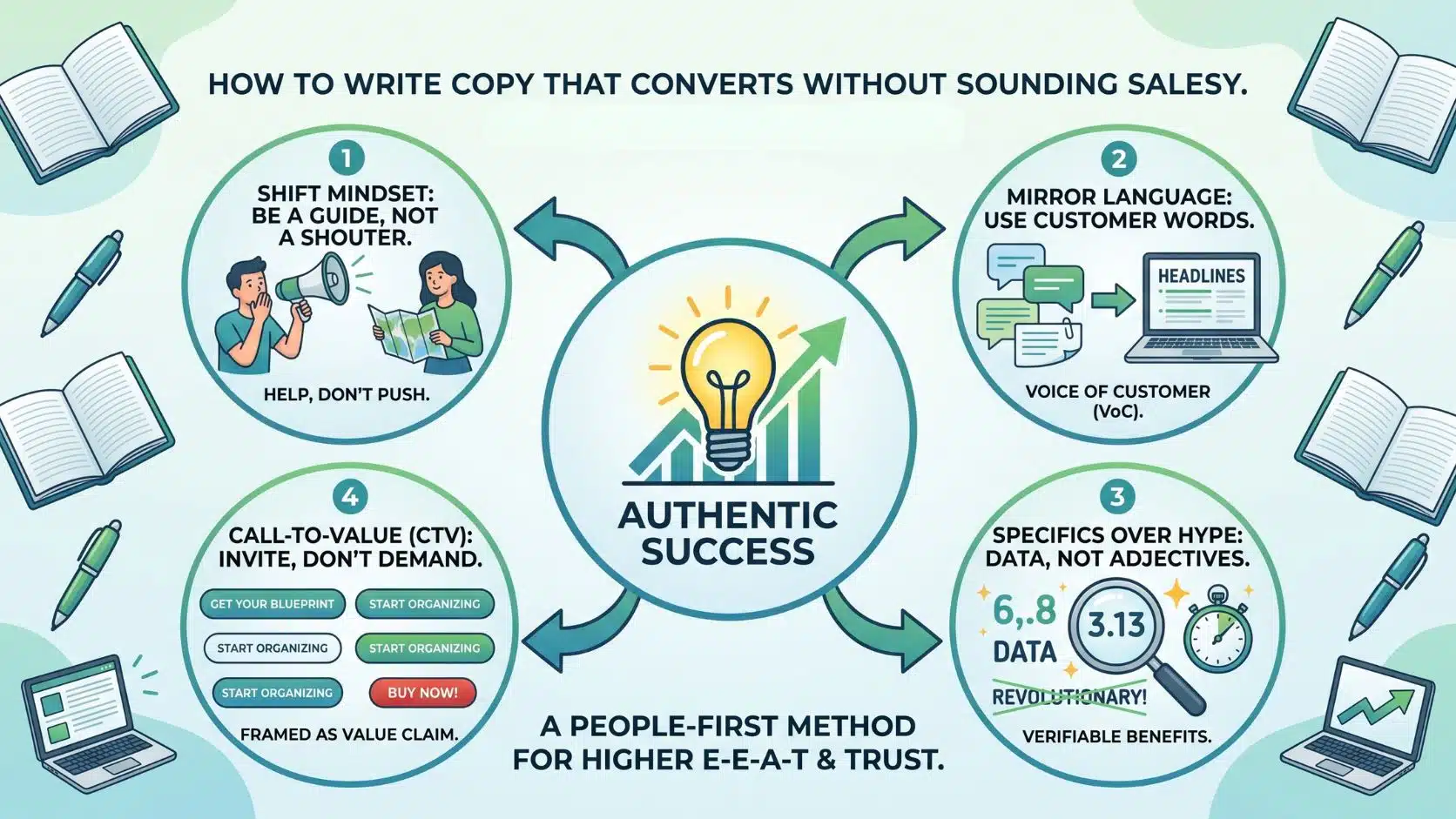
Shift from Salesperson to Trusted Guide
To write a copy that converts without sounding pushy, you must stop selling features and start solving problems. Shift your tone from a vendor demanding a transaction to a trusted guide offering a solution.
Whenever I write a headline or a landing page, I do the “Dinner Table” test. I read the draft out loud and ask myself: Would I actually say this to a friend sitting across from me at the dinner table?
Nobody in the real world says, “We empower synergy to optimize your daily workflow.” They say, “This saves you about three hours a week on reporting.” If your copy sounds like a corporate brochure, it builds walls. When you write conversationally, using “you” and “I,” you build trust.
Steal Your Customers’ Exact Words
The most authentic, highest-converting copy isn’t written from scratch; it is assembled from the exact phrasing your customers already use to describe their struggles and desires.
The fastest way to sound salesy is to guess what your audience wants and invent clever ways to say it. I don’t do that anymore. Instead, I rely entirely on Voice of Customer (VoC) data.
Before I type a single word, I spend time reading Reddit threads, YouTube comments, and customer support emails. If a customer says, “I’m drowning in spreadsheets,” I don’t write, “Optimize your data management.” I write, “Stop drowning in spreadsheets.” Using their exact words proves you understand their lived experience, which makes your pitch feel like empathy rather than a sales tactic.
Trade Hype for Undeniable Specifics
Vague, exaggerated claims trigger skepticism, while specific, verifiable details build instant credibility and trust.
When you write that your software is the “best on the market,” the reader instantly thinks, “Who? But when you write, “Cuts your Friday reporting time from 3 hours to 20 minutes,” the claim is concrete and believable.
Whenever I review my drafts, I aggressively delete empty adjectives like ultimate, fastest, or innovative. I replace those words with exact data points and tangible benefits. Specificity is the ultimate antidote to sounding salesy because you aren’t asking the reader to take your word for it, you are just showing them the facts.
Swap the “Call-to-Action” for a “Call-to-Value”
Replace aggressive, demand-based buttons with “Call-to-Value” (CTV) prompts that highlight exactly what the user gains by clicking.
Buttons that scream “BUY NOW BEFORE IT’S TOO LATE!” rely on artificial pressure. That might work for a flash sale, but it cheapens your brand and feels manipulative.
Instead of demanding an action, I invite the user to claim the value they came for.
- Instead of “Sign Up,” I use “Get Your Free Blueprint.”
- Instead of “Submit,” I use “Start Organizing Your Work.”
- Instead of “Buy Now,” I use “Upgrade My Setup.”
This subtle shift aligns the conversion with the reader’s goals. It makes the next step feel like a natural progression of your relationship, rather than a hard close.
Final Thoughts
People don’t hate buying things. They just hate feeling tricked or manipulated into buying things.
When you prioritize clarity over cleverness and empathy over ego, your copy stops reading like a pitch. By focusing entirely on making the reader’s life easier, the conversion happens naturally. You don’t need artificial urgency when your solution genuinely helps. Just speak like a human, present the facts, and let the value do the heavy lifting.
Frequently Asked Questions on Write Copy That Converts
1. What is the difference between salesy copy and persuasive copy?
Salesy copy focuses entirely on the product and uses artificial pressure (like fake countdown timers) to force a transaction. Persuasive copy focuses on the reader’s problem, offering a clear, logical, and emotionally resonant solution without the pressure.
2. How do I find the right words if I don’t have customer reviews yet?
If you lack direct customer data, study your competitors’ negative reviews. Look at what frustrates people about the current market offerings on sites like Amazon or Trustpilot, and write your copy to address those exact gaps.
3. Does conversational copywriting work for B2B audiences?
Absolutely. B2B software is still purchased by human beings. While the subject matter might be highly technical, stripping out corporate jargon and addressing real-world frustrations works just as well in B2B as it does in consumer markets.
4. How long should my sales copy be?
Your copy should be exactly as long as it takes to answer the reader’s core questions and overcome their objections, and not a single word longer. Eliminate the filler. Respect the reader’s time by leading with the most important information first.
5. Will writing naturally hurt my SEO rankings?
No, writing naturally actively improves your SEO. Search algorithms have evolved to prioritize people-first content. When you directly answer questions, provide genuine value, and avoid keyword-stuffing, you are giving search engines exactly what they want to rank.